Paper commentary
Benchmarking Large Language Models for News Summarization
Human raters find instruction-tuned LLM news summaries as good as human-written ones
- Problem Low-quality reference summaries in CNN/DM and XSUM have made LLM summarization benchmarks unreliable. Heuristic references were not written for summarization, so they underestimate human performance and weaken few-shot and finetuned results.
- Method The authors hire freelance writers to write better reference summaries, then have annotators rate ten LLMs against them.
- Results Human raters judged LLM summaries on par with the freelance writers' summaries, with preference split 50.4% to 49.6%.
Why reference summaries get in the way
The CNN/DM and XSUM references are large in number but were not written for summarization. On CNN/DM, the reference is the bullet point highlights that come with each article. On XSUM, the reference is the bolded sentence(s) that appear in the first paragraph. Because the references are built from heuristics, they are not representative of human performance.
The problem reaches past judgement, because low-quality references also weaken automatic metrics. The same poor references also degrade systems that take supervision through finetuning or few-shot prompting. For XSUM, conditioning Instruct Davinci on five reference summaries drops its faithfulness score from 0.97 to 0.77. So the authors ask freelance writers from Upwork to re-annotate 100 articles from the test sets of CNN/DM and XSUM.
The authors treat this as a reason to replace the references, not to trust them.
Ten LLMs under one prompt setup
The design holds the news task fixed and varies the pretraining recipe and model size, so the human ratings can show which change matters. The ten models include OpenAI's GPT-3 in base and instruction-tuned forms, plus OPT, GLM, Cohere XL and Anthropic-LM. Because of limited computational resources and model access, the authors ran only three base and three instruction-tuned GPT-3 models zero-shot.
All ten models were run in the five-shot setting, which lets the comparison cover both prompting regimes. The authors also inferred the training details of the instruction-tuned GPT-3 models from the API naming scheme, since those details may differ from the publication.
In the zero-shot setting, the model receives a news article and a natural language instruction, with no training examples. For CNN/DM, the prompt template asks the model to summarize the article in three sentences. For XSUM, the prompt asks for one sentence, so the output matches the style of the reference summaries. Every LLM was sampled at temperature 0.3, following prior work by Wu et al.
(2021). Five-shot prompts prepend training input-output pairs with the same instruction style to the test input.
For the few-shot settings, the authors sampled five demonstration examples from the training set. Those articles had to be between 50 and 150 tokens long under the GPT-2 tokenizer, because of the limited context window. Uniform sampling sometimes gave unreadable XSUM articles after preprocessing, so the authors picked those articles by hand.
The existing reference summaries of the CNN/DM and XSUM validation sets were rated as a baseline alongside the models. Fine-tuned Pegasus and BRIO were added as state-of-the-art references, decoded with a beam size of 5.
How annotators scored each summary
Annotators were recruited from Amazon Mechanical Turk and paid $15.00/hr, using conservative time estimates recommended by Whiting et al. (2019). Each model summary was judged by three annotators, and the reported score is the average of their ratings for that summary. The annotators rated the summaries on faithfulness, coherence and relevance, following the guidelines of Fabbri et al.
(2020). Faithfulness was collected as a binary rating because its nature is binary, while coherence and relevance used a 1 to 5 Likert scale. The authors dropped fluency, unlike Fabbri et al. (2020), because they found LLM outputs to be mostly fluent.
The human ratings also judged the reference summaries, which is the comparison that motivates the rest of the study. Across faithfulness, coherence and relevance, most automatic summarization systems scored better than the reference summaries.
Each rating in Table 2 is an average over three annotators, so the numbers are not single judgments. Annotators scored Instruct Davinci at 4.15 for coherence on CNN/DM, compared to 3.93 for Pegasus. On XSUM, Instruct Davinci reached 0.97 faithfulness, compared to 0.57 for Pegasus.
Instruction tuning versus scale
Instruct Davinci gives the clearest test, because it is compared directly against the finetuned Pegasus. On CNN/DM, Instruct Davinci scores 4.15 for coherence, against 3.93 for Pegasus. On XSUM, its faithfulness is 0.97, while Pegasus reaches 0.57. The authors tie this gap to recent work that reports the same pattern with Instruct GPT-3 Davinci.
Table 2 gives the scale comparison, with three zero-shot GPT-3 sizes next to the instruct models. So a 350M instruction-tuned model beats the 175B base model on coherence and relevance. The authors read this as instruction tuning mattering more than scale in the zero-shot setting.
Five-shot prompting lifts the base models, which is the in-context learning effect the authors describe. Several base models match instruct models on CNN/DM faithfulness and XSUM coherence. For the other aspects, the instruction-tuned models still come out ahead.
Reference quality changes the picture as well, because five reference summaries get added to the prompt. After that, Instruct Davinci's XSUM faithfulness falls from 0.97 to 0.77. The authors read this as low-quality references dragging down models that take supervision.
Do automatic metrics track human ratings on news summarization
The authors computed Rouge-L, METEOR, BertScore, BLEURT and BARTScore against the references and measured Kendall's tau with human ratings. On CNN/DM, Rouge-L reaches a Kendall's tau of 0.72 with relevance, while its tau with faithfulness is 0.54. The authors call this a moderate correlation, and they say it is comparable to the level Fabbri et al.
(2020) reported. Because of that match, they conclude that automatic metrics still give useful signals for relevance on CNN/DM.
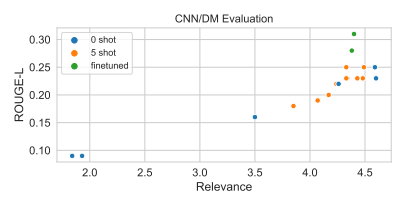
Figure 3 : System-level Rouge-L vs. annotator rated relevance scores.
Original paper · CC BY 4.0The correlation is stronger when Rouge-L is compared only within each model group rather than across groups. Rouge-L still prefers finetuned LMs to LLMs, which the authors treat as a mistake. Among LLMs alone, a Rouge-L difference larger than 0.05 usually matched an improvement in human evaluation.
On XSUM, the metrics correlate weakly with faithfulness and relevance. Rouge-L's Kendall's tau with faithfulness is -0.27, which points the wrong way. The authors blame the reference summaries, which are terrible on exactly these aspects, so reference-based metrics have little to extract. Across both datasets, reference-based metrics agree better with humans on aspects where the references also score well.
The authors point to the role of quality references, as previously observed in machine translation (Freitag et al., 2020).
Freelance writers as higher-quality references
The authors recruited six freelance writers from Upwork to write summaries that could serve as better references. Writers were chosen after a qualification round in which each summarized five articles, judged on faithfulness, coherence, and relevance. Each writer was paid $4 per article, since a pilot put one article at 12 to 15 minutes. The study used 50 articles from each of the CNN/DM and XSUM evaluation sets, and each article went to three writers.
For XSUM, the writers received the full articles, not the version where the first bolded sentence is removed. Writers aimed for around 50 words and wrote as if updating newsletter readers on news.
The writer workload was uneven, with the most prolific writer summarizing 100 articles and the least 35. To match the writers' length, the authors prompted Instruct Davinci with a 25 words limit, since it consistently exceeded word limits. That prompt was designed to keep length from confounding the human comparison, following Liu et al. (2022a).
Mechanical Turkers scored a random subset of 100 summaries with the same annotation scheme. Writers scored 0.93 for faithfulness, against 0.98 for zero-shot Instruct Davinci and 0.64 for existing references. Coherence and relevance followed the same pattern, with writers at 4.39 and 4.26 and existing references at 3.59 and 3.45. The gap between writers and Instruct Davinci is small in this check, so the authors moved on to direct comparisons.
On XSUM, Rouge-L correlates weakly with faithfulness when computed with XSUM references. When computed with freelance writer summaries, the Rouge-L correlation with faithfulness becomes much more positive. The authors read this as showing that the usefulness of reference-based evaluation depends on reference quality.
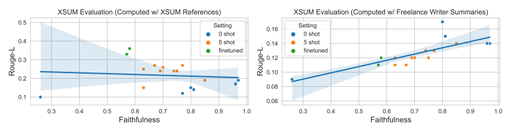
Figure 6 : System-level Rouge-L vs. annotating rating of faithfulness. The left plot is computed with XSUM references, where the correlation is weak, and the right plot is computed with the freelance writer summaries, where the correlation is much improved.
Original paper · CC BY 4.0 · Tianyi Zhang, Faisal Ladhak, Esin Durmus, Percy Liang, Kathleen McKeown, Tatsunori B. Hashimoto · Benchmarking Large Language Models for News Summarization · Original paper figure · Extracted the figure area from page 10 of the original PDF.Writing styles differ between writers and Instruct Davinci
Writers and Instruct Davinci build their summaries in different ways, and the authors measure this with coverage and density. Coverage is the percentage of summary words that also appear in the article, and density is the average length of copied spans. Instruct Davinci reaches a coverage of 0.92 and a density of 12.1. The freelance writers reach a coverage of 0.81 and a density of 2.07.
Instruct Davinci copies far more from the article, while the writers paraphrase far more.
To see where this gap comes from, the authors annotate cut and paste operations in ten randomly sampled summary pairs. They build on the operations from Jing and McKeown (2000) and add a sentence copy operation for sentences copied directly from the article. The freelance writers use lexical paraphrasing and generalization or specification much more often than Instruct Davinci.
Because these operations often introduce novel words, they explain the writers' lower coverage of 0.81 versus 0.92. Both groups combine sentences, so sentence combination is a shared strategy. The writers never copy an entire sentence from the article, but Instruct Davinci does so more frequently.
Although the writers were not told to write abstractively, all six of them produce abstractive summaries. Annotator 1 is a writer who writes abstractively with a density of 2.5 and a coverage of 0.86. Even so, annotator 1 prefers Instruct Davinci 57% of the time, although Instruct Davinci is much more extractive. This shows a gap between how the annotators write summaries and how they judge them.
Paired preferences between writers and Instruct Davinci
Blinded annotators compared the same 100 summary pairs each, choosing the better summary or calling the pair equal. Two aspects were judged: overall preference, which weighs faithfulness, coherence and relevance together, and informativeness. Coherence and relevance were dropped, because annotators couldn't tell them apart from overall preference in a pilot study.
Five annotators were recruited through Upwork, and one writer from the earlier round stayed on.
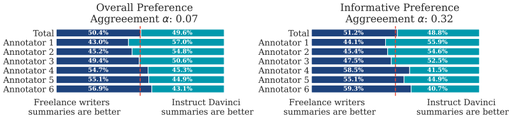
Figure 5 : Human evaluation results comparing summaries written by freelance writers and summaries generated by Instruct GPT-3 Davinci. On aggregate, annotators equally prefer the freelance writers and Instruct Davinci. However, there is high variability in individual annotators’ preferences. Notably, annotator 1 writes abstractive summaries but prefers the more extractive Instruct Davinci summaries.
Original paper · CC BY 4.0Overall preference split almost evenly, 50.4% to 49.6%, between the freelance writer and Instruct Davinci summaries. Individual annotators varied more, with their splits ranging from 43.0% to 57.0%. Agreement on overall preference was low, with Krippendorff's alpha at 0.07. Informativeness wasn't driven by style, since the more abstractive summaries were judged more informative only 51.1% of the time.
Agreement on informativeness was moderate, with Krippendorff's alpha at 0.32.
Annotator 1 wrote abstractive summaries, with density 2.5 and coverage 0.86. Yet that annotator preferred Instruct Davinci 57% of the time, even though its summaries were far more extractive. The authors read the near-even split as quality getting close to writer level, with the verdict depending on each annotator's style preference. They call this an intriguing gap between how annotators write summaries and how they judge them.
Where the results stop: scope, sample sizes and prompt changes
The authors ran only three base and three instruction-tuned GPT-3 models zero-shot, because computational resources and model access were limited. The 350M base GPT-3 produced empty outputs, so the authors left it out of the human evaluation. The annotators did not rate fluency, because the authors found LLM outputs to be mostly fluent.
The writing study used 50 articles per dataset, and each article went to three writers. Six Upwork writers produced these summaries, so the reference set rests on a small writer pool. A Mechanical Turk check on 100 summaries served as the quality control for the writer summaries. The informativeness and preference comparisons used six annotators, so each judgment comes from a small group.
Agreement stayed low, with Krippendorff's alpha at 0.07 for overall preference and 0.32 for informativeness.
The authors changed the Instruct Davinci prompt to a 25-word limit to match the writers' roughly 50-word summaries. That prompt differs from the main benchmark prompt, so the writer comparison doesn't run under the Section 3 setup. The main benchmark asked for three sentences on CNN/DM and one sentence on XSUM, at temperature 0.3. The authors note that the training details of the instruction-tuned GPT-3 models may differ from the published ones.
They inferred those training details from the API naming scheme, so they can't confirm them directly.
Open questions for instruction tuning
The authors offer three hypotheses for why instruction tuning works, and the paper tests none of them. The first hypothesis is that training data quality matters, since the finetuning data they examined was low quality. They cannot rule out that finetuned LMs would perform much better when trained on higher quality data.
The second hypothesis credits the learning algorithm, specifically learning from human feedback (LHF). Supervised finetuning trains systems on written summaries, whereas LHF trains systems from binary labels of human preferences. The authors also note that annotators write and rate summaries differently, a discrepancy LHF might exploit. Validating this idea would require more analysis.
Many earlier studies have confirmed the effectiveness of multi-task learning, and the authors want to see how summarization benefits from other tasks. These hypotheses sit alongside the finding that instruction tuning, not scale, drives zero-shot summarization. Even a 350M instruction-tuned GPT-3 can perform on par with the 175B GPT-3.
Human scoring gets harder as LLMs approach human-level performance, so evaluations need more samples and less noisy measurement. The authors suggest grounding summarization in downstream applications where user values are defined. This would give annotators less freedom to decide which quality aspects matter most to them. They didn't test whether higher quality finetuning data would close the gap, so that question stays open.
Paper info
- Authors
- Tianyi Zhang, Faisal Ladhak, Esin Durmus, Percy Liang, Kathleen McKeown, Tatsunori B. Hashimoto
- Venue
- arXiv · Preprint
- First published
- 2023-1-31
- Added
- 2026-11-5
- Updated
- 2023-1-31
- Version
- v1
- arXiv
- 2301.13848
- Category
- cs.CL · cs.AI · cs.LG
- Original paper terms
- CC BY 4.0
- What we show
- Paper info, commentary and permitted figures from the original paper
AI commentary is a separate explanation from the original paper and may contain errors. The original paper and figures follow each source's terms of use and any rights noted separately.
Abstract
Large language models (LLMs) have shown promise for automatic summarization but the reasons behind their successes are poorly understood. By conducting a human evaluation on ten LLMs across different pretraining methods, prompts, and model scales, we make two important observations. First, we find instruction tuning, and not model size, is the key to the LLM's zero-shot summarization capability. Second, existing studies have been limited by low-quality references, leading to underestimates of human performance and lower few-shot and finetuning performance. To better evaluate LLMs, we perform human evaluation over high-quality summaries we collect from freelance writers. Despite major stylistic differences such as the amount of paraphrasing, we find that LMM summaries are judged to be on par with human written summaries.
Quote from the paper
Tianyi Zhang, Faisal Ladhak, Esin Durmus, Percy Liang, Kathleen McKeown, Tatsunori B. Hashimoto (2023). Benchmarking Large Language Models for News Summarization. arXiv:2301.13848v1. https://arxiv.org/abs/2301.13848v1
BibTeX
@misc{zhang2023benchmarking,
  title = {{Benchmarking Large Language Models for News Summarization}},
  author = {Tianyi Zhang and Faisal Ladhak and Esin Durmus and Percy Liang and Kathleen McKeown and Tatsunori B. Hashimoto},
  year = {2023},
  eprint = {2301.13848},
  archivePrefix = {arXiv},
  url = {https://arxiv.org/abs/2301.13848v1}
}