Paper commentary
GHAgentCI: A Dataset of Coding-Agent Invocations in CI Workflow Histories
GHAgentCI dataset tracks coding agents across CI workflow histories
- Problem Filenames rarely reveal agent-driven CI workflows, so agent invocations hide among ordinary workflow files. Action names alone miss shell calls and other routes.
- Method cai-miner reads what each workflow does, not what it is called. It checks each revision against a frozen catalogue of agent evidence and records the matches.
- Results Manual validation confirmed 96.1% of dedicated-action matches and 98.8% of GitHub Agentic Workflow matches. Weak evidence alone was confirmed at 42.7%.
Why filenames can't find agent workflows
Agent-driven CI workflows rarely announce themselves, because their files seldom carry a distinctive name under .github/workflows/. Unlike agent configuration files, these workflows have to be identified by what their contents say. A file name alone gives the detector too little to go on, so cai-miner reads the file contents instead.
Evidence can surface in four different places, and each place looks different. A dedicated action such as anthropics/claude-code-action invokes the agent directly from a workflow step. A shell step may run an agent's command-line interface, for example claude -p or codex exec. Copilot's reserved file copilot-setup-steps.yml sets up the execution environment, but it doesn't call the agent.
GitHub Agentic Workflows compile Markdown specifications into .lock.yml files, and their compiler headers name the agent engine.
Credentials such as ANTHROPIC_API_KEY can appear in a workflow with no agent invocation at all. Such weak signals are ambiguous, because ordinary LLM-backed applications use the same keys and inference endpoints. Detecting only dedicated actions would therefore miss the other mechanisms entirely.
These workflows can process outside contributions under CI-defined permissions and conditions, which raises the stakes. Interactive agent use has drawn more research attention than this CI path. Existing datasets cover agent-authored changes, configuration files and general workflow histories, but they don't tie agent evidence to triggers and declared constraints.
How cai-miner detects agent evidence
cai-miner reads what a workflow does, not what it is called, because agentic workflows rarely carry distinctive filenames. The authors identified four integration mechanisms from vendor documentation and existing workflows. Dedicated actions such as anthropics/claude-code-action invoke agents through workflow steps. Shell steps may run agent command-line interfaces such as claude -p or codex exec.
Copilot's reserved copilot-setup-steps.yml configures the execution environment without invoking the agent. gh-aw compiles Markdown specifications into .lock.yml workflows whose headers declare the agent engine. Detecting only dedicated actions would miss the other three routes.
The detection patterns sit in a declarative TOML catalogue that the authors froze before mining. The catalogue covers nine agents from vendor documentation: Claude, Codex, Copilot, Gemini, Cursor, Aider, Devin, PR-Agent and CodeRabbit. Actions tied to known vendors add Goose, OpenCode and OpenHands, giving 12 named agents. The authors also included 1,122 action repositories from GitHub Marketplace's ai-assisted category.
These remaining actions form a generic_ai group, which stays in the dataset but leaves the reported adoption counts. cai-miner walks the default branch's first-parent history and records each workflow revision with its git metadata.
Uses patterns produce 69,104 records, so dedicated actions dominate the step-level matches in Table I. Weak evidence alone never classifies a revision as agentic, because an API key can also appear in ordinary LLM-backed applications. A workflow-level API key yields one file-level record instead of one per step. Multiple matches within one step merge into a single record that keeps the strongest evidence kind.
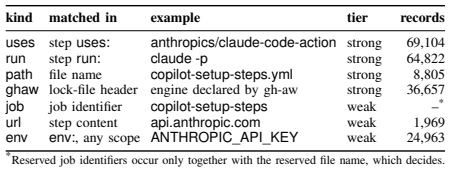
Figures from the paper TABLE I: Evidence kinds, example patterns, evidence tiers, and the number of agent-evidence records associated with each kind. Only strong evidence classifies a workflow revision as agentic.
Original paper · CC BY 4.0For gh-aw, the tool parses compiler headers and Markdown frontmatter across compiler versions. When a revision cannot be parsed, cai-miner falls back to text matching and flags the record. Reserved Copilot setup files stay configuration evidence, so they don't count as direct invocations.
Selecting and mining repositories
The authors selected repositories independently of agent usage, so adoption can be measured against a neutral base. That filter excluded 143,943 inactive repositories and left 196,938 candidates. Unlike GHAgentFiles, cai-miner doesn't require a repository to be a year old, because that rule would drop newer projects that might adopt coding agents.
Instead, the authors flagged 172,607 repositories that meet the one-year rule, so they can compare against GHAgentFiles.
Between 3 October 2026 and 5 October 2026, the authors cloned each repository as a partial clone that excludes blobs larger than 64 KB. Because truncated workflow histories would result otherwise, cai-miner fetches blobs above that limit separately. It records blob request and read counts, which let the authors check extraction completeness.
Each repository gets a 15-minute mining budget, and repositories exceeding it are retried with a one-hour budget. These repositories stay in the dataset with their status, as do four deliberately excluded gh-aw development repositories.
The authors examined matches predating LLM-based coding agents, since some Markdown frontmatter keys matched the gh-aw detector spuriously. Following GHAgentFiles, they used ChatGPT's release on 30 November 2022 as a conservative cutoff. This cutoff excluded 3 evidence records from 3 histories. The earliest retained agentic workflows, from PR-Agent and CodeRabbit, date to pull request reviews in 2023.
What the released GHAgentCI tables hold
The release holds four CSV tables, each gzip-compressed, alongside one archive of workflow revisions. The archive stores each distinct revision under its SHA-256 content hash.
The steps table holds one row per agent-evidence record per revision. Each steps row records evidence at the step level, meaning job and step, or at the file level. File-level rows come from a reserved filename, a workflow-level credential or a gh-aw header. The ghaw_manifests table has one row per revision of a gh-aw artifact, covering engine, compiler, model, tools and network policy.
The repositories table lists agentic and non-agentic repositories, so it provides an adoption denominator. Each repository row reports commit count, workflow and agentic file counts, agents used, and first and last agentic dates. The revisions table keeps the git metadata of GHAgentFiles, which lets the two datasets be linked. Table IV shows 6,345 repositories and 15,928 histories across all snapshots.
Those histories contain 159,878 workflow revisions and 205,832 agent records.
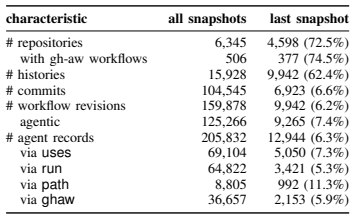
Figures from the paper TABLE IV: Characteristics of the dataset. The % indicates the proportion of elements in the last snapshot w.r.t. all snapshots.
Original paper · CC BY 4.0The repositories table also records blob accounting and status for each mined repository. Together, these tables tie evidence to triggers, permissions and actor conditions, supporting longitudinal CI studies.
How far the labels hold up
The validation sample drew 576 records, with 384 named-agent records split across the uses, run, path, gh-aw and parse-failed strata. Each named-agent stratum received at least 30 records, while weak-only and generic_ai strata received 96 each. Within each stratum, systematic sampling with a random start picked at most two records per repository.
Two authors checked each workflow at its commit, blind to the detector's label. Only yes labels counted as confirmed, so maybe labels count as incorrect in the strict rate.
Dedicated actions were confirmed at 96.1%. gh-aw was confirmed at 98.8%, the highest rate in the table. Shell commands reached 81.9%. Some shell matches named an agent or installed it without running it. Parse-failed records came out at 46.7%. Weak-only evidence came out at 42.7%, and generic AI actions reached 51.0%, so the authors kept these groups apart from confirmed invocations.
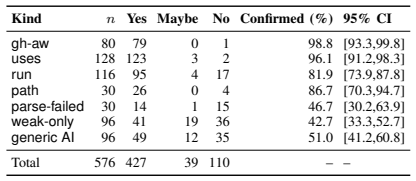
Figures from the paper TABLE II: Manual validation by evidence kind. Strict rates treat maybeas incorrect. Intervals are 95% Wilson confidence intervals.
Original paper · CC BY 4.0The two authors agreed on 97.7% of records, with κ = 0.96. They resolved disagreements through discussion. To test for misses, the authors re-mined 772 randomly selected repositories containing workflows. They inspected 200 unflagged workflows picked with broad keywords such as llm and agent. Eleven of them, or 5.5% with a 95% Wilson CI of 3.1 to 9.6%, contained an agent invocation.
That rate comes from the keyword-selected sample, so it doesn't measure overall recall.
Shift toward CLI and gh-aw
The authors group newly detected agentic workflows by quarter, using named agents with strong evidence only. Each quarter's bar splits its new workflows across dedicated actions, CLI calls in a shell step, reserved file names and gh-aw. Workflow counts appear above the bars, starting at 521 in 2025 Q2 and ending at 2,782 in 2026 Q3. Quarters that ended after cloning started are left out of the figure, so the series stops at 2026 Q3.
Dedicated vendor actions covered 73.9% of new workflows in 2025 Q2, against 42.1% in 2026 Q3. Over the same period, gh-aw climbed from 0.4% to 26.6%. CLI invocations rose from 7.3% to 27.6% across those quarters. Reserved Copilot setup files dropped from 18.4% to 3.7%, so the dedicated-action share shrank as other routes grew. The authors read this as a sign that action references alone miss a growing share of agentic workflows.
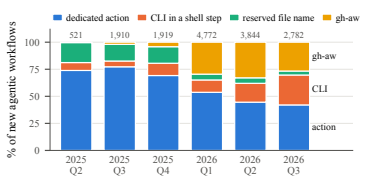
Fig. 1 : Integration mechanisms detected in newly agentic workflows by quarter; numbers above the bars indicate workflow counts. Quarters that ended after cloning started are omitted.
Original paper · CC BY 4.0 · Daniel Ogenrwot, Jorge Gonzalo Delgado Cervantes, Woojoong Kim, John Businge · GHAgentCI: A Dataset of Coding-Agent Invocations in CI Workflow Histories · Original paper figure · Extracted the figure area from page 4 of the original PDF.At the latest snapshot, the leading mechanism depends on the agent. Dedicated actions account for 77% of Claude workflows. CLI calls lead for Codex, covering 51% of its workflows. gh-aw accounts for 48% of Copilot workflows. The authors take this to mean that one detection route would miss much of the landscape.
Triggers and declared safeguards
The authors examine 9,265 agentic workflows at the latest commit, asking which safeguards each one declares. Inferred tasks are mostly review at 38.4% and triage at 34.4%, while implementation sits at 5.7%. These task labels are exploratory, so they don't count as ground truth.
Among issue- or comment-triggered workflows, 85% restrict the actors who can trigger them. Only 19% explicitly declare token permissions, which leaves most of these workflows without a declared scope. Of the workflows with dedicated actions, 24% pin the action to a SHA, a figure the authors place in Fig. 2.
Of 327 workflows using pull_request_target, only 55% restrict triggering actors. That gap matters because pull_request_target runs fork-triggered workflows with access to repository secrets.
Among 1,120 gh-aw sources, 50.8% declare custom network policies. Only 2.7% declare explicit sandboxing, so most gh-aw sources rely on defaults the authors don't inspect further.
How long repositories keep detected agentic workflows
The authors count a repository as agentic for as long as any detected agentic workflow remains, even when other workflows replace it. They estimate retention with Kaplan–Meier curves, plotted against elapsed months from each repository's first agent invocation. Within one month, 10% of repositories lose their detected agentic workflows. By three months that share reaches 20%, and within a year it reaches 44%.
The authors also find that 174 repositories removed their workflows on the day they adopted an agent. Copilot retains its workflows longest, while the Codex curve ends after approximately 8 months. Only 21 repositories were observed for a full year, so the later Codex estimates rest on few repositories. Figure 3 groups repositories by the first agent they adopted: Copilot with 1,577, Codex with 355, Claude with 4,084 and other with 630.
The curves carry 95% confidence bands and stop once fewer than 50 repositories remain under observation.
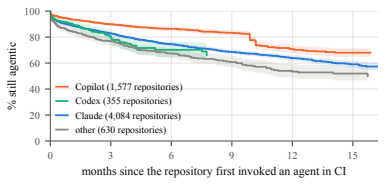
Fig. 3 : Repository retention of detected agentic workflows by first adopted agent (Kaplan–Meier; 95% confidence bands). Simultaneous adopters count in multiple groups; curves stop when fewer than 50 repositories remain under observation.
Original paper · CC BY 4.0Removals also cluster, because 33 Pulumi repositories removed Copilot setup workflows together. Another 32 R-package repositories, such as r-dbi, r-lib and tidyverse, stopped on 13 September 2026. Moving agents into external reusable workflows may look like abandonment in this data. The detected evidence reflects workflow declarations rather than observed executions, so these curves track declared invocations.
What the sample and detector can't establish
The sample starts from SEART-selected repositories, so small and inactive projects drop out of the analysis. Those projects might adopt coding agents differently, and the study can't check how. Rewritten git histories can shift the commit dates that the analysis relies on. Traversing only the default branch's first-parent history misses workflows that live on other branches.
The detection catalogue depends on vendor documentation, which may be incomplete or change over time. Such changes could bias the historical trends the paper reports. cai-miner may miss invocations hidden behind unrecognised wrappers, composite actions or external reusable workflows. Validation found false positives and some missed cases, but it can't establish overall recall.
The keyword-selected check found 11 of 200 unflagged workflows containing an invocation, a rate of 5.5%, which isn't overall recall.
Detected evidence reflects workflow declarations, not observed executions. Moving an agent into an external reusable workflow can look like abandonment in the retention curves. Organisation-wide changes also create dependencies between repository histories.
That work would bring currently unrecognised integrations into the dataset.
Paper info
- Authors
- Daniel Ogenrwot, Jorge Gonzalo Delgado Cervantes, Woojoong Kim, John Businge
- Venue
- arXiv · Preprint
- First published
- 2026-11-11
- Added
- 2026-11-13
- Updated
- 2026-11-11
- Version
- v1
- arXiv
- 2611.15522
- Category
- cs.SE · cs.AI
- Original paper terms
- CC BY 4.0
- What we show
- Paper info, commentary and permitted figures from the original paper
AI commentary is a separate explanation from the original paper and may contain errors. The original paper and figures follow each source's terms of use and any rights noted separately.
Abstract
Coding agents are increasingly integrated into GitHub Actions to review pull requests, triage issues and modify code. Identifying these integrations is challenging because agentic workflows often resemble ordinary CI files, with evidence appearing in action references, shell commands and workflow conventions. We present GHAgentCI, a dataset of 15K+ workflow histories from 6K+ of 196K+ mined GitHub repositories, comprising 159K+ revisions and 205K+ agent-evidence records linked to workflow triggers and declared execution constraints. Our open-source extractor, cai-miner, detects agent-related evidence using an extensible catalogue. Manual validation of 576 stratified records confirmed 96.1% of dedicated-action matches and 98.8% of GitHub Agentic Workflow matches, with lower rates for other evidence kinds. Exploratory analyses reveal a shift toward command-line and GitHub Agentic Workflow integrations, differences in declared safeguards, and frequent removal of detected agentic workflows. GHAgentCI supports longitudinal studies of coding-agent integration into CI.
Quote from the paper
Daniel Ogenrwot, Jorge Gonzalo Delgado Cervantes, Woojoong Kim, John Businge (2026). GHAgentCI: A Dataset of Coding-Agent Invocations in CI Workflow Histories. arXiv:2611.15522v1. https://arxiv.org/abs/2611.15522v1
BibTeX
@misc{ogenrwot2026ghagentci,
  title = {{GHAgentCI: A Dataset of Coding-Agent Invocations in CI Workflow Histories}},
  author = {Daniel Ogenrwot and Jorge Gonzalo Delgado Cervantes and Woojoong Kim and John Businge},
  year = {2026},
  eprint = {2611.15522},
  archivePrefix = {arXiv},
  url = {https://arxiv.org/abs/2611.15522v1}
}