Paper commentary
Think or Remember: The Exchange Rate of Agentic Inference
Dropping earlier reasoning can cut agent cost or raise it, depending on cache rules
- Problem Token counts alone miss what an agent's context policy costs, because the server's prefix cache changes the price of resent reasoning. Keeping or dropping earlier reasoning was never compared under different serving setups.
- Method The authors price each run with a cost model that charges per processed token and per attended pair. They split a policy change into a mechanical part, from repeating the same tokens, and a behavioral part, from writing different ones.
- Results On recorded Qwen3-8B ScienceWorld runs, dropping earlier reasoning cost 1.74 times keeping it with generated-state reuse, and 0.34 times with no reuse.
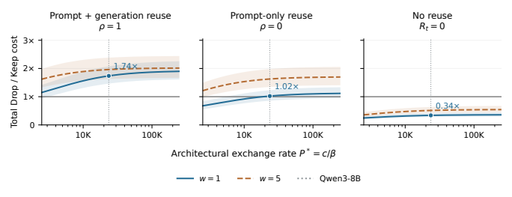
Figure 4 :Prices reverse rankings on unchanged work.Total Drop/Keep cost of the same 103 Qwen3-8B ScienceWorld pairs under three cache rules, with pointwise 95% family-bootstrap bands; the dotted line marks the 8B exchange rate.
Original paper · CC BY 4.0 · Juan Wisznia, Santiago Luis Groba Alonso, Matías Gómez Taddeo, Gonzalo Zabaleta, Joaquín Cullen, Luciano Del Corro · Think or Remember: The Exchange Rate of Agentic Inference · Original paper figure · Extracted the figure area from page 6 of the original PDF.Why token counts mislead
A long-running agent resends its whole transcript on every call, and each call pays for whatever part the prefix cache doesn't hold. Two parties set that bill, and the model isn't one of them: the client keeps, summarizes or edits history, while the server decides whether earlier reasoning returns. Whether earlier reasoning is kept or dropped is therefore a decision made by two transacting parties, not a property of the model.
Token counts can't settle the question, because a token's cost depends on where it sits in the context. Recent work reports savings in tokens, dollars or FLOPs, usually under one serving convention, which hides this dependence. The authors instead price a run as a function of the architecture and of both parties' choices.
A dropped token is paid for later, by producing it once more and by rebuilding whatever followed it in the cache. The run cost C=cN+βQ counts processed positions N, repeats included, and attended pairs Q, with c and β fixed by the architecture.
Two prices and an exchange rate
The cost model splits a run into a base price c per processed position and a price β per attended pair. A run costs C = cN + βQ, where N counts processed positions with repeats included and Q counts attended pairs. On Qwen3.6-27B, where 16 of 64 layers attend, that length is 124K tokens. A synthetic all-attention variant of the same model reaches it at 30K tokens.
Below P* a token sits in a thinking regime, and above it the token sits in a memory regime.
Serving then enters through the cache rule ρ and the decoding premium w. The cache rule ρ ∈ {0,1} sets whether generated states are reusable on later calls, or reprocessed as input when they return. The run cost becomes C_{ρ,w}(π;ξ) = cN_ρ + βQ_ρ + (w−1)cG, so the same history can cost differently under each serving setting. Figure 1 prices one call's history under each rule, and it shows the same reasoning block charged differently in its two panels.
Under contiguous prefix reuse, N_ρ and Q_ρ come from the processed positions and the causal attention pairs of each call. The decoding premium w is kept at 1 for the base comparison, and the paper sweeps it from 1 through 5.
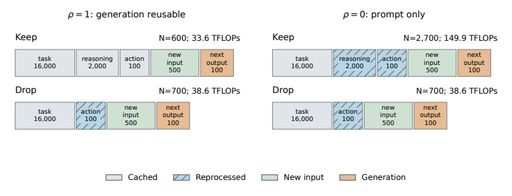
Figure 1 :Serving changes the price of the same history.A call adds 2,000 reasoning and 100 action tokens to a cached 16,000-token task; the next call adds 500 input and 100 generated tokens. Hatching marks rebuilding: Drop rebuilds the action under ρ= 1 , and Keep also rebuilds reasoning under ρ= 0 . Qwen3.6-27B prices, w= 1 , token-granular reuse; widths are schematic.
Original paper · CC BY 4.0A kept reasoning block of r tokens is charged βr at every later evaluation, while dropping it forces the answer to be rebuilt once. The two costs balance at a horizon L*, the number of later positions at which the accumulated carry equals the one-time rebuild. Under prompt-only reuse, keeping is never mechanically cheaper, because keeping also rereads the reasoning.
Splitting a policy change into mechanical and behavioral cost
A change of context policy is split in two, so the cost of repeating the same tokens is separated from the cost of writing different ones. Replaying the recorded run with the other policy's prompts computes it exactly.
The total difference is written as ΔC = ΔM + ΔB, with ΔM the mechanical term and ΔB the behavioral term. Positive terms increase cost, so −ΔB is a behavioral saving. Policy 1 costs less exactly when −ΔB exceeds ΔM.
A mechanical expense therefore requires a larger behavioral saving to repay. A mechanical saving, however, can absorb some increase in later work. The chosen continuation reference determines how the total is allocated between ΔM and ΔB. Reversing the reference preserves their sum, so the total doesn't depend on that choice.
The split matters because the same recordings are repriced when cache rules, architecture or the decoding premium change. The behavioral part is priced on the recorded continuation, so the authors didn't test a deployed keep-or-drop policy.
Do the experiments bear this out?
On recorded Qwen3-8B ScienceWorld runs with the agent's tokens unchanged, Drop cost 1.74 times Keep under generated-state reuse and 0.34 times under no reuse. Serving alone therefore flips which policy is cheaper, so a ranking based on token counts would miss the cache setting.
In live reruns from the same points, Drop lowered fully correct title-hidden HotpotQA answers by 9 to 23 percentage points across four models, at lower point-estimate cost. The cost intervals still include equal cost, so the cost advantage is not established. So the cost of a deletion can't be read apart from what the agent does after it.
Timing matters more than size in the sliding-window results.
In the chained ScienceWorld study, Carry under Keep costs 0.60 times Fresh, and it solves 17 of 96 new tasks compared to 30 of 96 for Fresh under Keep. Carrying history cuts cost but solves fewer new tasks in this setting.
Limitations of the cost ratios and outcome gaps
The cost figures are operation counts at declared coefficients, not measured time or money.
Work beyond the horizon L∗ of Equation 7 is reached only by repricing recorded work, so the agent never actually runs that far. The models were served at different precisions, so differences between models in Table 1 aren't architectural effects. The HotpotQA harness samples 200 questions from the distractor validation split, using seed 0.
The compaction study uses CLM's released zero-shot prompt on a hosted model, covering 20 chains in three cohorts. Each cell runs once at temperature 0.7, so the reversals in the ranking can't be separated from run-to-run variation. The original cohort's CLM costs less than Summary under Keep, and the intermediate cohort reverses both comparisons.
Provider retention rules come from documentation that changes between model versions.
Comparisons are therefore paired within one collection rather than pooled across collections. The archived launchers don't show the original first-panel Qwen3-8B startup script or exact checkpoint revision.
Paper info
- Authors
- Juan Wisznia, Santiago Luis Groba Alonso, Matías Gómez Taddeo, Gonzalo Zabaleta, Joaquín Cullen, Luciano Del Corro
- Venue
- arXiv · Preprint
- First published
- 2026-11-7
- Added
- 2026-11-10
- Updated
- 2026-11-7
- Version
- v1
- arXiv
- 2611.10982
- Category
- cs.CL · cs.AI
- Original paper terms
- CC BY 4.0
- What we show
- Paper info, commentary and permitted figures from the original paper
AI commentary is a separate explanation from the original paper and may contain errors. The original paper and figures follow each source's terms of use and any rights noted separately.
Abstract
Agents built on reasoning models resend their growing transcript at every call. Two transacting parties, not the model, decide what that costs: the client keeps or edits messages; the server decides whether earlier reasoning returns in the prompt and what its cache reuses. We define a cost model whose counts match an instrumented engine exactly; the architecture charges $c$ per token processed and $β$ per pair attended. Their ratio $P^*=c/β$ is an exchange rate between thinking and remembering: per token, processing dominates below this context length, a thinking regime, and attention above it, a memory regime. A policy change has a mechanical cost, incurred even if the agent writes the same tokens, and a behavioral one: it writes different tokens, changing cost and outcome. Serving alone can flip which policy is cheaper: on recorded Qwen3-8B ScienceWorld runs, dropping earlier reasoning costs 1.74 times keeping it when the server reuses generated states and 0.34 times when it reuses nothing. In live reruns, dropping it cuts correct HotpotQA answers by 9-23 percentage points on four models, at lower point-estimate cost. Comparing context policies means comparing systems: architecture and serving set the cost of the history kept and the work it induces.
Quote from the paper
Juan Wisznia, Santiago Luis Groba Alonso, Matías Gómez Taddeo, Gonzalo Zabaleta, Joaquín Cullen, Luciano Del Corro (2026). Think or Remember: The Exchange Rate of Agentic Inference. arXiv:2611.10982v1. https://arxiv.org/abs/2611.10982v1
BibTeX
@misc{wisznia2026think,
  title = {{Think or Remember: The Exchange Rate of Agentic Inference}},
  author = {Juan Wisznia and Santiago Luis Groba Alonso and Matías Gómez Taddeo and Gonzalo Zabaleta and Joaquín Cullen and Luciano Del Corro},
  year = {2026},
  eprint = {2611.10982},
  archivePrefix = {arXiv},
  url = {https://arxiv.org/abs/2611.10982v1}
}