Paper commentary
Evaluating Causal Reasoning in LLMs: A Case Study in the Challenges of Procedural Generation
Simple classifiers match LLMs on CLADDER, exposing its shortcut patterns
- Problem High LLM scores on CLADDER were taken as evidence of formal causal reasoning. The generator embeds superficial patterns in every query, so a high score may not show causal reasoning.
- Method The authors train a random forest on surface features of the query text. They also fine-tune open-weight LLMs with LoRA and remove parts of the queries to see what the models depend on.
- Results The random forest reached 87% cross-validated accuracy averaged over query types. Removing critical probabilities still left models 11 to 21 percentage points above random.
Why a high CLADDER score is hard to read
CLADDER is a procedural generator that builds yes/no causal questions from formal data structures and writes them in natural language. Its correct answers are produced automatically by construction, so it was meant to avoid the memorization risk of static benchmarks. Because of that design, many papers have treated high scores on CLADDER test sets as evidence that a model has learned formal causal inference.
The generator covers ten types of causal reasoning, spanning Pearl's three rungs of causation.
The authors question that inference, because a generator can leave regularities in every query that a model can exploit without modeling causation. If that happens, a high score shows that the model learned the generator, not that it can do causal inference. Their central hypothesis is therefore that exposure to CLADDER data and superficial patterns explain most of the strong results.
They argue that any claim of more complex causal reasoning must first rule out this hypothesis.
Keeping test items out of training data doesn't remove this problem. A model can still learn the intrinsic patterns of the generator even when no test item was ever seen. So the question moves from what the model saw to what the generator produces. A simpler model trained on the public data is one baseline the authors suggest for comparison.
Shortcuts built into the generator
The core idea is that if the generator writes predictable structure into every query, a model can exploit it and answer without any causal calculation. The authors look for such patterns in the query text, train simple classifiers on that text, and then cut information out of the queries to see what the models depend on. The authors describe these repeated elements as shortcuts that let a model answer correctly without any causal reasoning.
The clearest pattern appears in average treatment effect (ATE) queries, which often give two conditional probabilities and then ask whether an intervention increases the chance of an outcome. Once the polarity of the question is known, comparing the two probabilities is enough to answer the query. The graph structure and the variable names stop mattering once this comparison is apparent.
Some of these queries contain as many as seven probability values, but the pattern uses only the first two. The same pattern appears in effect of treatment on the treated (ETT) queries.
Figure 2 plots the first probability against the second for ATE and ETT queries, split by polarity and colored by the correct answer. Within each polarity, yes and no answers separate almost linearly, so a single comparison rule would score near perfectly on these types. The authors don't claim that such a rule involves any formal causal reasoning.
The authors also report subtler patterns that are harder to spot by inspection, and they see those as the main risk for any model trained on this data. They argue that a model trained on such data may learn these shortcuts and perform strongly on CLADDER while generalizing poorly.
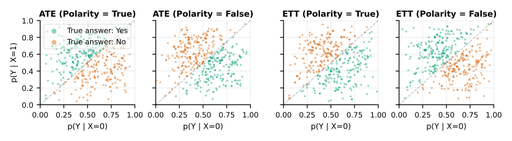
Figure 2 : Scatter plots of the two key conditional probabilities provided in average treatment effect (ATE) and effect of treatment on the treated (ETT) queries, colored by correct answer. Within each polarity condi- tion, yes and no answers are nearly linearly separable. A model that learns this simple comparison rule can achieve near-perfect accuracy on these query types without any formal causal reasoning.
Original paper · CC BY 4.0 · Justin Clarke, Isha Karn, Patrick Murray, KJ Hill, David Jensen · Evaluating Causal Reasoning in LLMs: A Case Study in the Challenges of Procedural Generation · Original paper figure · Extracted the figure area from page 5 of the original PDF.Simple models and fine-tuning reach high accuracy on CLADDER
The authors train a random forest classifier on two feature sets derived from the query text, and they compare it with fine-tuned open-weight LLMs. The surface features include the number of characters, the number of probability values, the first, second and last probabilities, and their products and comparisons. They also include boolean flags for strings such as 'increase', 'decrease', 'more likely' and 'correlation'.
The second feature set appends a fixed-length BERT embedding, because the embedding alone doesn't represent the probabilities in the query. Each classifier is evaluated with 10-fold cross-validation, and the reported accuracy is the mean over folds.
The random forest does well on these data, reaching 100% on collider bias queries and 94% on marginal queries. Averaged across all query types, its cross-validated accuracy is 87%, which the authors describe as roughly comparable to the accuracy of current language models. The authors compare against GPT-5.6 Sol and GPT-5.6 Sol Med. in the same table, so that the comparison uses the same generated test set.
Because the classifier sees only surface features, a high score here shows that such features carry the answer, not that the classifier reasons causally.
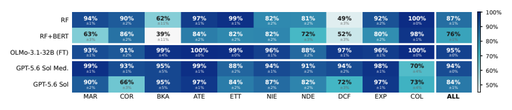
Figure 3 : Model accuracies by query type. The first two rows show accuracy by query type on our generated CLADDERtest set for a random forest classifier trained on superficial features derived from the query text or BERT embeddings. We report the mean accuracy over 10-fold cross-validation. The third row shows the performance of OLMo-3.1-32B after fine-tuning on CLADDER. We also show gpt-5.6-sol with and without reasoning for comparison.
Original paper · CC BY 4.0The authors then ask whether supervised fine-tuning on CLADDER queries improves performance, choosing four instruction-tuned models unlikely to have seen CLADDER. Zero-shot, OLMo-3.1-32B-Instruct scores 63.9±0.9%, while OLMo-3-7B-Instruct, Llama-3.1-8B-Instruct and Qwen2.5-3B-Instruct score 55.3±1.0, 55.7±1.0 and 52.1±1.0. Fine-tuning uses LoRA with rank 16 and scaling factor 32, applied to the attention and feed-forward projection layers.
With 2,000 labeled examples, every fine-tuned model exceeded 80% overall accuracy. With 16,000 examples, every model exceeded 94% overall accuracy. They read this scaling with training examples as consistent with learning superficial features, and they conclude that limited exposure is enough for models to learn generator-specific shortcuts.
Whether the models had seen the data
CLADDER data has been publicly available since its original release, and it has been copied, forked, and redistributed across many public repositories. Any one of these many copies is enough to contaminate a model's training data, whether or not the model saw the canonical release. That alone complicates reading any post-release evaluation, because high performance can't be attributed to better reasoning once exposure through some channel can't be ruled out.
Figure 4 plots each model's accuracy against the date of its public release. Accuracy rises over time, from slightly above random for early evaluations to over 90% for current reasoning models that regularly achieve it. Many of these later models were trained after the CLADDER generator and example datasets were released, so the authors argue they likely learned the published patterns.
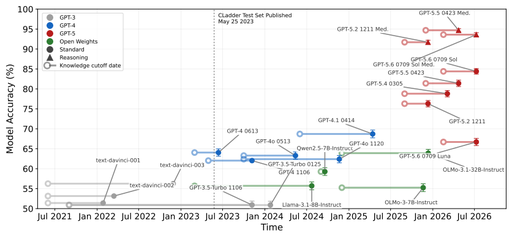
Figure 4 : Model accuracy compared to the date of the model’s release. Open circles represent the published ”knowledge cutoff” dates for each model. The results for the text-davinci models come from the original CLADDERpaper.
Original paper · CC BY 4.0So the rising trend can't be separated from contamination, and the authors treat it as confounded. Model size and complexity grew a lot over the same period, but the paper's evidence ties the trend to exposure rather than to reasoning.
Removing information the models need
Each CLADDER query opens with background conditions and a graph description, which together make the causal query identifiable. The authors remove the introductory sentence, the graph structure, or both, and measure how accuracy changes. Figure 5 shows the example alarm clock query used for these interventions. A model that reasons formally should do much worse once this information is gone, so the small drop argues against formal reasoning.
The authors then remove the first marginal or conditional probability value, then the second, then all the given values. A formal reasoner should fall to 50% in all three cases, because it can't beat random chance without the numbers. Instead, accuracy dropped but stayed 11 to 21 percentage points above random across all three versions of the intervention.
The authors read this as the models relying on shortcuts instead of on the probabilities.
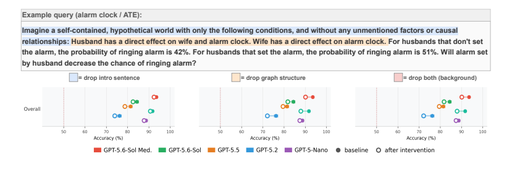
Figure 5 : Model accuracy under interventions that remove elements of the queries that are critical for formal causal reasoning. A full query-wise breakdown in Appendix A.6. The 95% Wilson confidence intervals are not visible in this plot due to large sample size.
Original paper · CC BY 4.0These larger drops are expected, since the removed information is critical to the answer. Per-query-type breakdowns for these interventions appear in Appendix A.6 and are not shown here. They didn't test whether a formal reasoner would perform differently under these conditions beyond the random-baseline comparison.
Single-token sensitivity
The authors measure how much removing one token changes gpt-5.2's answers on marginal queries. They establish a baseline by running each query 100 times, then rerun it 100 times for each token removed. Because only one token changes, the probe shows which tokens the model's answer depends on without altering the query's logic in a way a human would notice.
The models proved very brittle under these interventions, and they were highly sensitive to specific tokens.
Sensitivity varies sharply across queries that look alike to a human reader. Removing the token 'hard' from Q17820 flips the answer when the baseline accuracy is 100%, pushing accuracy to approximately 0%. Query Q7131 is nearly identical in structure, but its baseline accuracy is only 8.0%. For Q7131, removing many of its tokens raises accuracy to nearly 100%.
The authors note that removing tokens that look inconsequential to a human still has a large effect on the model.
The authors read this variation as evidence that the models exploit superficial patterns. Their reading rests on one model, gpt-5.2, and on a small set of marginal queries shown in Figure 7.
Transfer to CounterBench
CounterBench is a counterfactual benchmark that uses abstract variable names and was produced independently of CLADDER. If the models rely on patterns specific to CLADDER's data generation process, those patterns shouldn't generalize to it. The authors evaluated several frontier models on CounterBench, and Table 4 in Appendix A.9 lists each model's accuracy.
Every frontier model scored near chance, between 48.6% and 52.2%. The gap between CLADDER and CounterBench performance ranges from 29 to 44 percentage points across models. The random forest trained only on superficial features derived from query text reached 79.1% on CounterBench. That result stands above every frontier LLM the authors tested.
The authors read this as evidence that the frontier LLMs don't rely on the same transferable feature combinations that the random forests or fine-tuned models capture. That reading is the authors' interpretation, and it rests on one independent benchmark. The commercial models were run with a one-word prompt, so the comparison depends on that prompt format.
Where the evidence stops
The main evidence rests on one generated split of 9866 samples, which the authors built instead of using the original v1 release. They built it by running the original Jin et al. codebase over the final/common and final/det-common configurations. The difficulty check on that split used one model, gpt-5.5 with medium reasoning, run zero-shot.
Exposure to CLADDER data can't be verified for closed models, because their training corpora aren't documented. So the exposure explanation for newer models stays an inference rather than a measured fact. The trend in Figure 4 is confounded by exposure, since many of those models were trained after the dataset's release. The transfer test used one independent benchmark, CounterBench, with 1200 queries per model.
The token ablations ran on gpt-5.2 for marginal queries, with 100 runs per query and 100 runs per removed token. Backdoor adjustment had only 74 queries, so its per-type accuracies carry wide confidence intervals. The removal experiments report Wilson 95% intervals, which the figures don't show at this sample size. They didn't test the three remedies for generator shortcuts, so their effect on performance remains unknown.
A generator faithful enough to avoid embedded patterns seems unlikely, unless real-world systems produce the data.
Paper info
- Authors
- Justin Clarke, Isha Karn, Patrick Murray, KJ Hill, David Jensen
- Venue
- arXiv · Preprint
- First published
- 2026-10-28
- Added
- 2026-11-1
- Updated
- 2026-10-28
- Version
- v1
- arXiv
- 2610.38100
- Category
- cs.AI · cs.LG
- Original paper terms
- CC BY 4.0
- What we show
- Paper info, commentary and permitted figures from the original paper
AI commentary is a separate explanation from the original paper and may contain errors. The original paper and figures follow each source's terms of use and any rights noted separately.
Abstract
Large language models (LLMs) appear to represent and reason about a large range of phenomena. In particular, recent studies have examined whether LLMs can accurately reason about causation. One of the most commonly used benchmarks for evaluating formal causal reasoning in LLMs is CLadder, a framework for procedural generation of benchmark data sets that was released in 2023. Experiments with CLadder appear to indicate that LLMs can perform formal causal reasoning in a large percentage of generated examples. In this paper, we examine what can be reliably inferred when LLMs perform well on test sets produced by CLadder. We identify several examples of superficial and highly predictive patterns that the CLadder generator embeds in data sets it generates. We find that even simple models such as random forests perform well on CLadder-generated data sets after training on a sample of generated data. We also find that the performance of many commercial LLMs on CLadder test sets is extremely brittle and that removing large sections of the text that are critical for formal causal reasoning has almost no effect on performance. Given these results, the most likely hypothesis for the strong performance of state-of-the-art LLMs on CLadder is that they are exploiting superficial patterns learned from exposure to training data from the generator. Any inference that LLMs are exhibiting more complex causal reasoning must rule out this hypothesis.
Quote from the paper
Justin Clarke, Isha Karn, Patrick Murray, KJ Hill, David Jensen (2026). Evaluating Causal Reasoning in LLMs: A Case Study in the Challenges of Procedural Generation. arXiv:2610.38100v1. https://arxiv.org/abs/2610.38100v1
BibTeX
@misc{clarke2026evaluating,
  title = {{Evaluating Causal Reasoning in LLMs: A Case Study in the Challenges of Procedural Generation}},
  author = {Justin Clarke and Isha Karn and Patrick Murray and KJ Hill and David Jensen},
  year = {2026},
  eprint = {2610.38100},
  archivePrefix = {arXiv},
  url = {https://arxiv.org/abs/2610.38100v1}
}