Paper commentary
DataDecide: How to Predict Best Pretraining Data with Small Experiments
Small-scale ranking of pretraining data predicts the best large models
- Problem Pretraining a full-size model on every candidate corpus is too expensive, so teams need to pick data from small experiments. Until now, it was rarely checked whether those small-scale predictions hold at the large target size.
- Method DataDecide pretrains 25 data recipes at 14 model sizes, with three seeds at the 1B target. It then checks which small-scale signals pick the best 1B corpus.
- Results Ranking models at 150M parameters picks the better 1B corpus about 80% of the time. None of 8 scaling law methods beat this single-scale baseline.
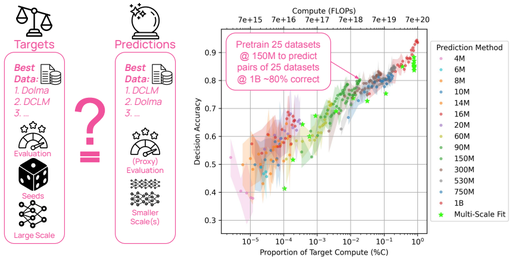
Figure 1 . Which pretraining data to use? Ideally, compare performance of large models with fixed configurations averaged over random seeds (left). In practice, cheaper, smaller-scale experiments are used (center). Here DATADECIDE measures accuracy of pairwise decisions between 25 pretraining corpora to find efficient prediction methods (right).
Original paper · CC BY 4.0 · Ian Magnusson, Nguyen Tai, Ben Bogin, David Heineman, Jena D. Hwang, Luca Soldaini, Akshita Bhagia, Jiacheng Liu, Dirk Groeneveld, Oyvind Tafjord, Noah A. Smith, Pang Wei Koh, Jesse Dodge · DataDecide: How to Predict Best Pretraining Data with Small Experiments · Original paper figure · Extracted the figure area from page 2 of the original PDF.Why data choices are hard to test
Choosing which pretraining corpus to use is one of the most impactful development decisions, and the cost of training LMs makes testing that choice expensive. Training a full-size model on every candidate would answer the question directly, but the cost rules that out. So common practice, as in Li et al. (2024), runs a single small scale of experiments and ranks the candidate data there.
The other main approach fits scaling laws over several small sizes and extrapolates the trend to the target size. Recent work extends these fits from language modeling loss to downstream performance instead of loss.
Neither route has been checked well, because the predictions were rarely compared against a large model that was actually trained on the chosen data. Judging how much prediction error is tolerable requires a suite of comparable models trained on many datasets. Open corpora exist, but their scaling behavior is hard to read from off-the-shelf models that differ in data, optimizer and modeling choices at once.
DATADECIDE provides that set, with 25 corpora, 14 model sizes from 4M to 1B parameters, and 1,050 models in total. The authors train three random seeds per configuration, so variation from initialization and data order can be separated from differences between corpora.
The authors measure each decision by whether the small-scale prediction picks the correct winner at the 1B target scale. Each 1B target is averaged over three seed runs, which makes the winner a stable reference.
How the DataDecide suite is built
The suite keeps the model configuration fixed at each size and changes only the pretraining data. The 25 data recipes start from corpora such as Dolma, DCLM, RefinedWeb, C4 and FineWeb. They then add interventions such as source mixing, deduplication and quality filtering. Table 1 lists each recipe with its source and the filter or mix that produced it.
Every recipe is trained at 14 model sizes, ranging from 4M to 1B parameters. The authors choose a token to parameter ratio of 100, which is 5 times the Chinchilla-optimal ratio. The ratio captures the typical overtraining favored for inference savings, so they don't test other ratios. Batch size and learning rate come from OLMo's model ladder, which applies heuristics from Porian et al.
(2024). Layers, hidden dimension, number of heads and MLP dimension were handpicked by OLMo developers for each scale to reach the target parameter count. Keeping these settings fixed at each scale stops hyperparameter differences from being confused with data differences.
Only the 1B target models get three full runs with different seeds, trained to completion. The full reruns let the target gold predictions absorb run-to-run variance from weight initialization and data order. Smaller sizes stop early at 25% of the target compute budget, except for the default seed. Across the suite, the pretraining experiments required approximately 820K H100 GPU hours.
Two prediction routes and the decision score
The single-scale route runs every recipe at one small size and assumes the winner there also wins at the 1B target. Ranking at 150M is the case the paper highlights, and it reaches about 80% of comparisons correct at 1B. The multi-scale route fits a scaling law for each recipe across several sizes, then picks the recipe with the highest extrapolated score at the target scale.
The authors' default multi-scale fit is a two-step chain taken from Bhagia et al. (2024), because the suite has only one token-to-parameter ratio.
The first step maps compute to loss with L(C) = A C^α + E, where C is compute, and it has three fitted parameters. That first step is fit only on final, fully trained checkpoints, because modeling the learning rate schedule for intermediate checkpoints would need more parameters. The second step, Acc(L), is fit on all observations, including intermediate checkpoints.
The authors add a helper point at loss 0.0 and accuracy 1.0 to the second-stage fit, which anchors the upper asymptote. They also drop the first 50% of intermediate checkpoints, which reduces noise from high-loss early points. Another variant fits compute directly to accuracy in one step, so there is no separate loss stage. In total, the authors test 8 multi-scale approaches, and none of them make substantially better decisions than the default.
Decision accuracy scores a method by how often its pairwise ordering matches the observed ordering at the target scale. It is nearly equivalent to Kendall's τ, but it ranges from 0 to 1. Compute is approximated as FLOPs = 6ND, from parameters N and tokens D, and %C is the experimental budget as a share of the target budget.
Scaling laws don't beat single-scale ranking
The core question is whether fitted scaling laws give better decisions per unit of compute than ranking recipes at one small scale. None of the 8 scaling law variants exceeded the compute to decision accuracy frontier set by ranking single scale experiments. At best, the variants reached that same frontier, so the extra fitting bought no additional decision accuracy here.
The 2-parameter and 3-parameter variants achieve among the top decision accuracies across the tested variants. Ranking single scales still sets a high baseline, which implies relatively little crossover between recipes occurs. Scaling laws can't predict when one recipe's trend overtakes another between the small runs and the target scale.
The authors expect future scaling laws to advance the Pareto frontier, since they aren't bound by crossovers.
Prediction error gives a second view of the same variants, measured as relative and absolute error for 1B targets. The 3-parameter variant with helpers and more than 50% checkpoints has the lowest relative error, at 5.6. The plain 3-parameter baseline has a relative error of 6.5, while its absolute error is 3.1. The single-step variants and the 5-parameter fit have far larger errors, such as 42.8 and 230.8.
Because the best variants are roughly comparable, the authors kept the simple 3-parameter setup as their baseline.
Which benchmarks become predictable with little compute
Predictability depends heavily on the benchmark, not only on the model scale. BoolQ reached beyond trivial decision accuracy only for intermediate checkpoints of the target runs. HellaSwag, SocialIQA and WinoGrande show distinct periods of insensitivity, then rise roughly log-linearly once they pass a compute threshold.
The paper's Figure 2 breaks this down task by task, which is why the aggregate curve hides so much spread. MMLU and ARC need much less compute to predict than HellaSwag, so their decisions settle early.
Across all 10 OLMES tasks, decision accuracy rises roughly log-linearly with experimental compute. Each point averages decision accuracy over three random-seed runs, and the shading shows the standard deviation. So small experiments can stop early without losing decision quality, at least in these runs.
Continuous proxies at small scale
Accuracy is a discrete metric, so it can jump across scale even when the underlying probabilities improve smoothly. CORRECT PROB averages the probability that the model assigns to the correct continuation across items. TOTAL PROB instead averages the summed probability of all correct and incorrect continuations. Both are computed with character length normalization unless the authors specify otherwise.
The authors compare them against ACCURACY, which counts the fraction of items where the correct continuation scores highest.
At small scales, CORRECT PROB or TOTAL PROB matched or beat the other metrics for most scales. CORRECT PROB and TOTAL PROB sometimes even decrease in decision accuracy at that point. Tasks fall into two trends: the proxies are nearly indistinguishable and improve with compute, or CORRECT PROB and TOTAL PROB stay flat with scale. TOTAL PROB may reflect a model's exposure to a task's domain, through higher likelihoods on incorrect but relevant answers.
The authors tie this to two properties of a benchmark: run-to-run noise and the spread of scores across recipes. A useful evaluation has to separate two recipes by more than the combined noise of their runs. At 150M, HellaSwag with CORRECT PROB has low run-to-run variance, while SocialIQA spreads recipes widely. Figure 5 also shows MMLU with low run-to-run noise and ARC Easy with a wide spread.
The same metric switch helps code tasks that are too hard for accuracy at small scales. Using CORRECT PROB, decision accuracy on MBPP and HumanEval goes from trivial to 80%, as Figure 6 shows. Math benchmarks don't see such a benefit, so the authors ask whether the target metric should change instead.
Code and math tasks
Under ACCURACY, the code tasks MBPP and HumanEval give trivial decision accuracy at small scale. Switching the proxy to CORRECT PROB at the 4M and 60M scales lifts decision accuracy to about 80%. The authors explain this with the noise floor: accuracy keeps small models below it, while the continuous metric lifts them above it. The switch keeps predicting large-scale accuracy metrics, so the target stays ACCURACY.
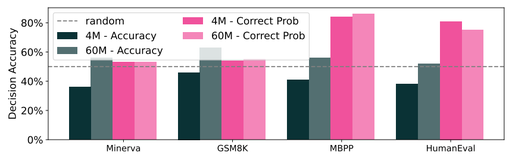
Figure 6 . Code tasks such as humaneval and MBPP go from trivial decision accuracy to largely predictable when using using continuous CORRECT PROB instead of discrete ACCURACY . Meanwhile common math tasks remain near trivial decision accuracy regardless of metric.
Original paper · CC BY 4.0The math benchmarks Minerva and GSM8K don't benefit from this change in the proxy metric. Under ACCURACY targets, they stay near trivial decision accuracy regardless of the metric. They reach decision accuracy above 80% only if the target metric itself is switched to CORRECT PROB.
Figure 4 shows that per-task proxy results for the other benchmarks sit alongside these code and math results. Prior scaling work mostly predicts loss from scale, and predicting downstream performance is generally harder.
Limitations of the DataDecide study
The study covers only one token-to-parameter ratio, 100, which is the 5x Chinchilla-optimal ratio. More configurations would always be better, but that choice trades off against exploring other data recipe dimensions and random seed reruns.
The evaluations use only multiple-choice tasks with a cloze formulation, which they found fit their range of scales. New evaluations can be assessed by others on DataDecide without any additional pretraining.
Scaling-law variants were run with only the default fully trained seed, because final checkpoints aren't available for all seeds. The scaling law approaches vary in fitted parameters, hard-coded min and max points, second-half intermediate checkpoints, or a single-step fit. The 2 and 3 parameter variants achieve among the top decision accuracy, and ranking single scale experiments sets a high baseline.
The Impact Statement reports about 820K H100 GPU hours for the pretraining experiments. The authors release their models, data, and evaluations so others don't need to repeat this expenditure.
Paper info
- Authors
- Ian Magnusson, Nguyen Tai, Ben Bogin, David Heineman, Jena D. Hwang, Luca Soldaini, Akshita Bhagia, Jiacheng Liu, Dirk Groeneveld, Oyvind Tafjord, Noah A. Smith, Pang Wei Koh, Jesse Dodge
- Venue
- arXiv · Preprint
- First published
- 2025-4-15
- Added
- 2026-10-31
- Updated
- 2025-7-13
- Version
- v2
- arXiv
- 2504.11393
- Category
- cs.LG · cs.CL
- Original paper terms
- CC BY 4.0
- What we show
- Paper info, commentary and permitted figures from the original paper
AI commentary is a separate explanation from the original paper and may contain errors. The original paper and figures follow each source's terms of use and any rights noted separately.
Abstract
Because large language models are expensive to pretrain on different datasets, using smaller-scale experiments to decide on data is crucial for reducing costs. Which benchmarks and methods of making decisions from observed performance at small scale most accurately predict the datasets that yield the best large models? To empower open exploration of this question, we release models, data, and evaluations in DataDecide -- the most extensive open suite of models over differences in data and scale. We conduct controlled pretraining experiments across 25 corpora with differing sources, deduplication, and filtering up to 100B tokens, model sizes up to 1B parameters, and 3 random seeds. We find that the ranking of models at a single, small size (e.g., 150M parameters) is a strong baseline for predicting best models at our larger target scale (1B) (~80% of com parisons correct). No scaling law methods among 8 baselines exceed the compute-decision frontier of single-scale predictions, but DataDecide can measure improvement in future scaling laws. We also identify that using continuous likelihood metrics as proxies in small experiments makes benchmarks including MMLU, ARC, HellaSwag, MBPP, and HumanEval >80% predictable at the target 1B scale with just 0.01% of the compute.
Quote from the paper
Ian Magnusson, Nguyen Tai, Ben Bogin, David Heineman, Jena D. Hwang, Luca Soldaini, Akshita Bhagia, Jiacheng Liu, Dirk Groeneveld, Oyvind Tafjord, Noah A. Smith, Pang Wei Koh, Jesse Dodge (2025). DataDecide: How to Predict Best Pretraining Data with Small Experiments. arXiv:2504.11393v2. https://arxiv.org/abs/2504.11393v2
BibTeX
@misc{magnusson2025datadecide,
  title = {{DataDecide: How to Predict Best Pretraining Data with Small Experiments}},
  author = {Ian Magnusson and Nguyen Tai and Ben Bogin and David Heineman and Jena D. Hwang and Luca Soldaini and Akshita Bhagia and Jiacheng Liu and Dirk Groeneveld and Oyvind Tafjord and Noah A. Smith and Pang Wei Koh and Jesse Dodge},
  year = {2025},
  eprint = {2504.11393},
  archivePrefix = {arXiv},
  url = {https://arxiv.org/abs/2504.11393v2}
}