Paper commentary
StyleFlow: Attribute-conditioned Exploration of StyleGAN-Generated Images using Conditional Continuous Normalizing Flows
- Problem Attribute-controlled editing of StyleGAN images is hard because conditional GANs must fix attributes at training time, and edits in the unconditional latent space can change identity.
- Method StyleFlow trains a conditional continuous normalizing flow that maps Gaussian noise and target attributes to StyleGAN W latent codes, then edits an image by reverse inference followed by forward inference with new attributes.
- Results Reached a cosine similarity of 0.967 for the face embedding after a pose edit on real images, against 0.899 for InterfaceGAN.
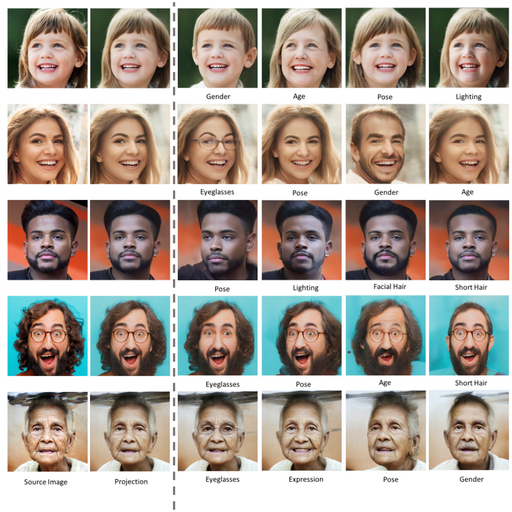
Fig. 9 . Real image non-sequential edits using our StyleFlow framework. Note that the method is able to handle extreme pose (first and second rows), asymmetrical expressions (fourth row) and age diversity (first and last rows) well compared to the concurrent methods.
Original paper · CC BY 4.0 · Rameen Abdal, Peihao Zhu, Niloy Mitra, Peter Wonka · StyleFlow: Attribute-conditioned Exploration of StyleGAN-Generated Images using Conditional Continuous Normalizing Flows · Original paper figure · Extracted the figure area from page 11 of the original PDF.Why attribute control of StyleGAN is hard
StyleGAN produces high-resolution faces with strong photorealism, yet the user has few ways to steer attributes such as camera pose, illumination or expression during generation. Conditional GANs give attribute control only when the attributes are chosen before training, and their outputs tend to be blurrier than uncontrolled StyleGAN results.
An attribute that was not specified during training can vary between generated images, so an edit can change the identity of the person as a side effect.
The authors keep the unconditional StyleGAN and treat attribute editing as a search for non-linear paths through its latent space. Two tasks are covered: attribute-conditioned sampling, which draws varied images that all meet the requested attributes, and attribute-controlled editing of a given image, possibly applied in sequence. Because the paths depend on the input image, the same edit can be adapted to the particular face.
Sampling latent codes from noise and attributes
Each training pair links a StyleGAN W latent code with the attributes that an attribute function assigns to the image rendered from it. The training data are built by sampling 10k vectors from the Gaussian Z space, mapping them to W, and truncating the W vectors with a factor of 0.7 to avoid low-quality outlier faces.
Sampling draws z from a zero-mean normal distribution with identity covariance and sets w = Φ(z, a), so that the classifier applied to the decoded image should return the target attributes. The conditional flow carries samples of the prior to a latent distribution conditioned on the target attributes.
Why continuous rather than discrete flows
A discrete normalizing flow composes invertible maps and obtains densities by change of variables, which needs a Jacobian determinant at each step. For a planar flow, the log density is the log density of the prior minus a sum over layers of log |1 + u_n^T ξ(z_{n-1})|, with ξ(z) = h'(w^T z + b) w.
The authors avoid discrete flows because it is hard to keep the mapping reversible, the expressiveness is limited by a fixed set of invertible functions, and the Jacobian determinant is costly. A continuous flow defines z(t1) by integrating dz/dt = φ(z(t), t; θ), and the log density changes by minus the integral of the trace of ∂φ/∂z(t). Invertibility holds by definition, and the trace replaces the determinant, which allows a wider choice of architectures.
The authors treat time as a virtual variable that only sets how the ODE is evaluated, rather than as a sequence of network layers.
The flow network and its training
The flow function is built from ConcatSquash blocks on top of FFJORD. In each block the gate learns a per-dimension scale for the input code, and the bias moves the code toward an edit direction. The time variable is broadcast to the spatial shape of the attributes and concatenated with them, and the combined input a+t is passed to the network.
The authors observed that two or three CNF blocks overfit, and they estimate the matrix trace with 10 evaluations of Hutchinson's trace estimator. The attribute transformation uses linear layers, with a sigmoid before the gate and a tanh on the output.
Training one flow per attribute produced entangled vector fields, so that one edit moved other attributes as well. The authors therefore concatenate all attributes into a single tensor, and they hypothesize that single-condition training overfits the data and leaves the flow unaware of the other attribute axes.
The objective maximizes the likelihood of w given the attributes a_t, and Algorithm 1 forms the loss as log N(z0; 0, I) minus the change in log density. \\(\\mathcal{L}=\\log\\mathcal{N}(z_0;0,I)-\\Delta\\log p\\) The main model was trained for 10 epochs with batch size 5 on an Nvidia Titan XP, with 1128449 parameters and a final log-likelihood of -4327872.
Three steps for editing a given image
Editing starts by projecting the input image into StyleGAN to find a latent w0 whose rendering approximates that image. The attributes a0 of the image are measured with the face classifier and the lighting predictor, and reverse inference then gives the base noise z0 that corresponds to w0 and a0. This first step is called Joint Reverse Encoding, because the latent and its attributes are inverted together.
Conditional Forward Editing keeps z0 fixed, replaces the attributes with the target values a_t, and runs the forward flow to obtain an edited latent w'.
Edit Specific Subset Selection writes w' only into chosen layers of the W+ space, because the authors expect lighting, for example, to live in later layers. The layer ranges used are Light 7-11, Expression 4-5, Yaw 0-3, Pitch 0-3, Age 4-7, Gender 0-7, Remove Glasses 0-2, Add Glasses 0-5, Baldness 0-5 and Facial hair 5-7 and 10. A faster mode skips reprojection after each edit, while a slower mode reprojects all 18 w vectors in one pass.
The fast mode can produce sudden jumps in the output, and re-encoding into the W+ space lets the flow see the changes, which the authors link to stable sequential edits.
Attribute-conditioned sampling and car editing
Sampling resamples z with the attributes held fixed, passes it through the trained flow, and decodes the resulting w with StyleGAN2. The text describes the samples as high-quality and diverse, with unedited attributes mostly unchanged, and these observations are qualitative.
The car experiments use StyleGAN2 trained on LSUN-Car, which contains 16,185 images at 512 × 384 resolution. The car attributes come from a fine-tuned ResNet-152 trained on Stanford Cars, and a car recognition model with 95% classification accuracy checks the edits. The checked accuracy is 80% for hatchback/SUV conversion and 100% for color, while rotation has no quantitative check in the text.
Identity preservation on real images
Identity is scored with a face-recognition model that compares embeddings before and after an edit by cosine similarity and Euclidean distance. The table covers expression, pose, light, light plus pose, and light plus pose plus expression edits, and its classifier differs from the attribute estimator used in training. A third score, edit consistency, checks whether an attribute is the same across different orders of edits, but the text gives its definition without reporting values.
For pose, StyleFlow reaches a cosine similarity of 0.967 against 0.899 for InterfaceGAN, 0.961 for GANSpace and 0.954 for StyleRig, and its Euclidean distance of 0.364 is lower than 0.468, 0.390 and 0.414 for those methods. For the light edit, StyleFlow scores 0.962 cosine similarity and 0.394 Euclidean distance, against 0.952 and 0.440 for InterfaceGAN, 0.902 and 0.458 for GANSpace and 0.955 and 0.414 for StyleRig.
On the projected image before any edit, StyleRig scores higher, at 0.988 cosine similarity against 0.980 for StyleFlow. After editing, the authors' method is better on all edit types except expression, where its cosine similarity of 0.964 is below StyleRig's 0.968 and GANSpace's 0.969. For light plus pose plus expression, StyleFlow reaches 0.941 cosine similarity against 0.925 for StyleRig.
Figure 9 shows real-image non-sequential edits, including extreme poses, asymmetric expressions and age diversity. Figure 14 places StyleFlow's real-image edits next to those of the competing methods.
Pairwise user study on real images
The study compares pairs of edited images from InterfaceGAN, GANSpace, StyleRig and StyleFlow. Raters answered which of two edited images better preserves the identity of the original person, and which is more realistic and of higher visual quality. Edits covered expression, pose, lighting, and sequential lighting plus pose and lighting plus pose plus expression, on 18 real images, with 25 participants.
The 1080 pairwise comparisons were arranged as 18 sets of 60 image pairs per task. StyleFlow is preferred over the other methods for visual quality and identity preservation in the aggregated results, which the text presents without per-method numbers.
How many CNF blocks to stack
The ablation compares 2, 3, 4 and 6 stacked CNF functions, reporting parameter count, inference time and final log-likelihood for each. The 2-stack model has 565249 parameters, 0.40 sec inference time and a final log-likelihood of -4323537, and the 3-stack model has 846849 parameters, 0.37 sec and -4325796. The authors label both as over-fitting, even though their log-likelihoods are higher than that of the selected model.
The selected 4-stack model has 1128449 parameters, 0.61 sec inference time and -4327872 log-likelihood. The 6-stack model has 1691649 parameters, 0.21 sec inference time and -4328470 log-likelihood, and it is labelled a faster alternative. The authors state that the 6-stack model reduces inference time at a slight cost in disentanglement quality.
Joint versus single-attribute training
Figure 12 compares a flow trained on single attributes with a jointly trained flow, for a pose-only, a gender-only and an illumination-only edit. In the single-attribute case, the same edits additionally changed identity, age and pose, respectively. With joint training, the other attributes are better preserved, including hairstyle, age and background.
This comparison is qualitative and rests on one example.
Effect of edit-specific subset selection
V1 is the framework without the edit-specific subset selection block, and V2 is the final framework that includes it. Figure 13 compares an input image, edits made without the block, and edits made with it. With the block, the background, skin tone and clothes stay closer to the source image.
The support for this block is a visual example, and no numeric measure of background preservation is reported.
Why the edit direction depends on the starting latent
Image2StyleGAN, InterfaceGAN and GANSpace compute one editing direction per attribute and add it, scaled, to every starting latent.
StyleFlow and StyleRig use non-linear edit paths, while InterfaceGAN and GANSpace use linear trajectories. The authors say that non-linearity alone does not explain the gains, and that a linear approximation of their path could also be set up for comparison. InterfaceGAN was retrained on the same data with binary labels, so the comparison uses continuous metrics, because a binary label cannot match edit magnitudes across faces.
Figure 19 compares edits on generated images under extreme attribute conditions and sequential edits, with Image2StyleGAN and InterfaceGAN.
Limitations
The method depends on attribute labels, which may be hard to obtain for new datasets and may need manual labelling. Strong results are reported for StyleGAN trained on high-quality data, mainly FFHQ, and the experiments use only the FFHQ faces and LSUN-Car. Other image types, such as buildings or indoor scenes, were not tested.
Projection of real images can move latent vectors out of the original distribution, which makes real-image editing harder. Real-image edits sometimes show artifacts compared with synthesized images. StyleRig was not designed for real images and supports only a subset of the edits, and its comparison results were prepared by its authors. The real-image comparisons use 18 images, and the sampling results are judged qualitatively.
Paper info
- Authors
- Rameen Abdal, Peihao Zhu, Niloy Mitra, Peter Wonka
- Venue
- arXiv · Preprint
- First published
- 2020-8-6
- Added
- 2026-11-6
- Updated
- 2020-9-20
- Version
- v2
- arXiv
- 2008.02401
- DOI
- 10.1145/3447648
- Category
- cs.CV · cs.GR
- Original paper terms
- CC BY 4.0
- What we show
- Paper info, commentary and permitted figures from the original paper
AI commentary is a separate explanation from the original paper and may contain errors. The original paper and figures follow each source's terms of use and any rights noted separately.
Abstract
High-quality, diverse, and photorealistic images can now be generated by unconditional GANs (e.g., StyleGAN). However, limited options exist to control the generation process using (semantic) attributes, while still preserving the quality of the output. Further, due to the entangled nature of the GAN latent space, performing edits along one attribute can easily result in unwanted changes along other attributes. In this paper, in the context of conditional exploration of entangled latent spaces, we investigate the two sub-problems of attribute-conditioned sampling and attribute-controlled editing. We present StyleFlow as a simple, effective, and robust solution to both the sub-problems by formulating conditional exploration as an instance of conditional continuous normalizing flows in the GAN latent space conditioned by attribute features. We evaluate our method using the face and the car latent space of StyleGAN, and demonstrate fine-grained disentangled edits along various attributes on both real photographs and StyleGAN generated images. For example, for faces, we vary camera pose, illumination variation, expression, facial hair, gender, and age. Finally, via extensive qualitative and quantitative comparisons, we demonstrate the superiority of StyleFlow to other concurrent works.
Quote from the paper
Rameen Abdal, Peihao Zhu, Niloy Mitra, Peter Wonka (2020). StyleFlow: Attribute-conditioned Exploration of StyleGAN-Generated Images using Conditional Continuous Normalizing Flows. arXiv:2008.02401v2. https://doi.org/10.1145/3447648
BibTeX
@article{abdal2020styleflow,
  title = {{StyleFlow: Attribute-conditioned Exploration of StyleGAN-Generated Images using Conditional Continuous Normalizing Flows}},
  author = {Rameen Abdal and Peihao Zhu and Niloy Mitra and Peter Wonka},
  year = {2020},
  eprint = {2008.02401},
  archivePrefix = {arXiv},
  doi = {10.1145/3447648},
  url = {https://arxiv.org/abs/2008.02401v2}
}