Paper commentary
Cooperative Multi-Agent Reinforcement Learning with Submodular Trajectory Rewards
GWPO greedily optimizes multi-agent policies under non-additive trajectory rewards
- Problem Optimal policies for cooperative agents with non-additive trajectory rewards depend on every agent's full history. Exact optimization is exponential in the horizon and the number of agents, so it is impractical.
- Method GWPO optimizes each agent's local policy in turn, after fixing its predecessors' policies. Each agent conditions only on its last m states, and the approximation error from this window is controlled by pre-window curvature.
- Results GWPO achieves a (1 − cm)/(2 − cm) approximation guarantee up to estimation error, in time polynomial in the number of agents and the horizon.
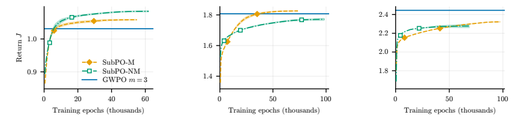
Figure 10 : Training ofSubPO-MandSubPO-NMat β = 0.4. Curves show the highest validation return reached by each epoch, averaged over five training runs with 95% confidence intervals. A curve ends when all five runs have stopped. Markers indicate the epoch budgets corresponding to TN , 5TN , and 20 TN that fall within each curve. The horizontal line shows the test return of GWPO withm= 3.
Original paper · CC BY 4.0 · Yasaman Zolfimoselo, Nikolas Geroliminis, Maryam Kamgarpour · Cooperative Multi-Agent Reinforcement Learning with Submodular Trajectory Rewards · Original paper figure · Extracted the figure area from page 28 of the original PDF.Where additive rewards stop working
Standard reinforcement learning sums stage rewards over time, and cooperative MARL often sums them across agents too. The authors drop both forms of additivity. Their reward is a monotone submodular function over the visits of all agents, where a visit is a time-state pair. Diminishing returns then appear across agents and over time. A second UAV monitoring the same road at the same time adds no new information.
Even a single agent can't get a constant-factor approximation in polynomial time under standard complexity assumptions. Its optimal policies may need history dependence, and storing an arbitrary history-dependent policy can take space exponential in the horizon. Known single-agent guarantees of (1 − c) need total curvature c below 1. For multiple agents under decoupled dynamics, Chen et al.
get a 1/2 approximation for time-additive rewards without a curvature assumption.
Total curvature is one minus the smallest ratio of a marginal gain to a singleton value. Four simultaneous visits at s1 to s4 monitor every road that s5 monitors. So the visit at s5 has zero marginal gain, although its singleton value is positive. That makes c equal one, even for time-additive rewards.
Pre-window curvature only looks at visits made before an m-step window, so it fits that goal.
Keep a recent window and bound what it loses
Pre-window curvature cm is the largest relative drop in a current visit's marginal gain caused by visits that come before that window. The definition takes a time t, a visit xt in Vt, a set B in V0:t-m-1 and a set Z, and it excludes cases where the marginal gain Δ(xt|Z) is zero. Formally, cm equals 1 minus the minimum of Δ(xt|B∪Z) divided by Δ(xt|Z), with Δ(xt|Z) greater than 0.
Because B only contains visits up to time t-m-1, the definition isolates exactly the visits that the window leaves out.
The authors show that cm satisfies 0 ≤ cm ≤ c and is nonincreasing in m. Pre-window curvature equals zero at m = H, so the full history removes the loss entirely. Pre-window curvature is zero whenever F is additive over time, even when overlap across agents makes c equal one. For the traffic reward with recovery rate β > 0, cm equals e^{-β(m+1)} for 0 ≤ m < H, so it stays below 1.
Without recovery, cm equals c = 1 for every m < H, so the window doesn't help there.
This curvature bounds the loss from the window, which the approximated objective then carries into its guarantee. Maximizing the windowed objective over joint policies achieves at least (1 − cm) times the optimal return J*. Joint maximization stays exponential in the number of agents N, so the authors turn to sequential optimization of local policies.
That sequential step gives the 1 − cm over 2 − cm guarantee up to estimation error.
How GWPO optimizes agents one at a time
GWPO starts from an augmented state per agent, which pairs the agent's current state with its last m states. That pair takes at most |S|^(m+1) values, while a full history takes |S|^(t+1) values at time t. Transitions stay decoupled across agents, and the history updates by appending the newest state and dropping the oldest one once the length exceeds m.
Each history maps to the set of visits it determines, so the reward function F can be evaluated on it.
The windowed objective Φm replaces each term of the time decomposition with a stage reward that sees only the window. Maximizing Φm is a finite-horizon MDP with a deterministic optimal policy in Πm, but the joint state space still grows exponentially in N. Lemma 1 gives (1 − cm)Φm(π) ≤ J(π) ≤ Φm(π), and Theorem 1 turns this into J(π') ≥ (1 − cm)J* for the maximizer π'.
At m = H, cH = 0 and the windowed objective equals J, so the theorem gives an optimal policy.
To avoid joint optimization, GWPO fixes the predecessors' policies and then optimizes the next agent's policy. The local stage reward is the expected marginal gain of agent i's visit, given its own window and the complete predecessor trajectories. Because predecessor trajectories are random, the expectation is estimated by averaging K sampled trajectories for each agent from the second onward.
The first agent needs no sampling, because its reward uses only its own window.
Each agent's local MDP is solved exactly, for example with Algorithm 2, and the resulting policy is fixed before the next agent is processed. During training the predecessor trajectories are sampled and F is evaluated exactly, while at execution each agent acts from its own augmented state. Theorem 2 chooses K ≥ (R²/(2ε²)) ln(2(N−1)(H+1)|S|^(m+1)/δ), with R the largest single-visit reward.
With probability at least 1 − δ, the returned policy satisfies J(π̄) ≥ ((1 − cm)/(2 − cm))(J* − 2(N−1)(H+1)ε).
The proof has to close two gaps: the optimal policy may depend on the full joint history, and the return isn't the sum of the local objectives. Pre-window curvature handles the second gap by lower bounding J(π̄) with 1 − cm times the sum of the attained local objectives. Summed over the agents, the computation time is O(NH|S|^(m+1)(K + |S||A|) + N²KH), which is polynomial in N and H for fixed m.
Traffic monitoring results
The experiments run GWPO on a traffic-monitoring instance with a 20 × 20 road grid and horizon H = 20. GWPO is compared with GPO, a time-additive sequential baseline, and with two SubPO variants trained by policy gradient. The SubPO-M variant uses Markov policies, while SubPO-NM encodes the history with a recurrent neural network. All policies are scored under the traffic-monitoring reward (4) on 10,000 common initial joint states.
The reward (4) sums the value of each road over its monitoring times, with importance recovering as 1 − e^{−βℓ}. Total curvature equals one in this setting, so the classical bound gives no guarantee, which is why the authors use pre-window curvature. Proposition 3 gives cm = e^{−β(m+1)} for 0 ≤ m < H, so longer memory lowers the curvature term.
At N = 20, longer memory raised returns over GPO for the non-additive rewards, and the gain grew as β got smaller. For the time-additive case with αℓ = 1, GWPO roughly matched GPO, which fits the point that the window matters only for non-additive rewards.
These memory gains came with higher computation time as the memory length grew. Memory length therefore trades return against cost. The experiments don't show a setting where both return and cost improve together.
With a computation budget equal to GWPO's time TN, GWPO and SubPO achieved comparable returns for N ≤ 6. GWPO achieved higher returns than both SubPO variants for N ≥ 10 under that budget. This comparison uses GWPO with m = 3 at β = 0.4. The ranking depends on the budget and the number of agents, and SubPO's advantage appears only with 20TN compute.
Results over five SubPO seeds with their confidence intervals appear in Appendix F.4.
Limits of the guarantee and the tests
The guarantee rests on assumptions that the authors state up front, and they bound what the evidence can show. GWPO assumes known transition dynamics and initial distributions for every agent. It also assumes that F(B) can be evaluated exactly for every set B during policy optimization. Total curvature can't replace the pre-window curvature cm here, because simultaneous visits can push it to one.
Even for time-additive rewards, two UAVs visiting the same road at the same time can make c = 1.
The bound holds only up to the estimation error ε, and only with probability 1 − δ. For N ≥ 2, the bound carries the additive term 2(N−1)(H+1)ε, which the sample size K controls through its logarithmic dependence on N, H and 1/δ. The approximation factor (1 − cm)/(2 − cm) equals zero at cm = 1, so the guarantee gives nothing in that case.
The guarantee also compares GWPO with the optimal global history-dependent return J*, not with a fixed budget of computation.
The experiments use only the traffic-monitoring instance, with one reward family parameterized by β. The SubPO comparison is reported at m = 3 and β = 0.4, at the budgets TN, 5TN and 20TN. Memory gains cost computation time: GWPO with larger m takes more time, as Figure 2(b) shows. With a budget of 20TN, both SubPO variants reach up to 6% higher returns than GWPO for N of at most 15.
At N = 30, the same SubPO variants obtain lower returns than GWPO. Under the smaller budget TN, GWPO achieved higher returns than SubPO for N of at least 10. The results depend on the budget and the agent count, so a single comparison doesn't settle the ranking. The authors report results over five SubPO seeds in Appendix F.4, which the passages here don't reproduce.
Paper info
- Authors
- Yasaman Zolfimoselo, Nikolas Geroliminis, Maryam Kamgarpour
- Venue
- arXiv · Preprint
- First published
- 2026-11-3
- Added
- 2026-11-5
- Updated
- 2026-11-3
- Version
- v1
- arXiv
- 2611.04774
- Category
- cs.LG · cs.MA
- Original paper terms
- CC BY 4.0
- What we show
- Paper info, commentary and permitted figures from the original paper
AI commentary is a separate explanation from the original paper and may contain errors. The original paper and figures follow each source's terms of use and any rights noted separately.
Abstract
We study cooperative multi-agent reinforcement learning with decoupled dynamics and a monotone submodular reward function over joint trajectories. Due to the non-additive reward, an optimal policy may depend on the history of all agents. This dependence makes exact optimization exponential in the horizon and the number of agents. To overcome this challenge while retaining theoretical guarantees, we introduce pre-window curvature $c_m$, which quantifies how states visited more than $m$ steps earlier reduce current marginal gains. Using this curvature to control the error from restricting the policy of each agent to depend only on its last $m+1$ states, we propose a greedy algorithm that exploits the decoupled dynamics to optimize local policies sequentially. For fixed $m$, the algorithm achieves a $\frac{1-c_m}{2-c_m}$ approximation guarantee up to estimation error, and its computation time is polynomial in the number of agents and the horizon. We recover the known $1/2$-factor approximation for time-additive rewards and obtain an approximation factor no smaller than the known total-curvature bound for a single agent. We formulate multi-agent traffic monitoring as an example of this framework and evaluate our algorithm on it.
Figures from the paper
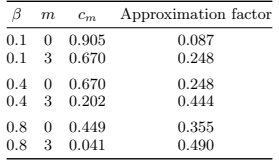
Table 1 : Pre-window curvature cm = e−β(m+1) and the approximation factor (1 −c m)/(2 −c m) of Theorem 2 for the traffic-monitoring reward at the listed recovery ratesβand memory lengthsm.
Original paper · CC BY 4.0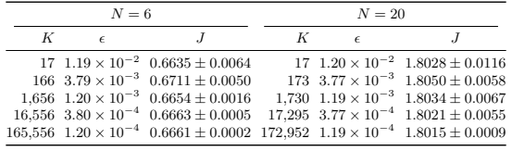
Table 2 : Sample counts K, associated ϵ, and returns J for GWPO with m = 3, β = 0.4, and uniform initial state distributions. We fix δ = 10−6. Each return is the mean over seeds {1, 2, 3} with its 95% confidence interval. The second row gives the counts used in the remaining experiments.
Original paper · CC BY 4.0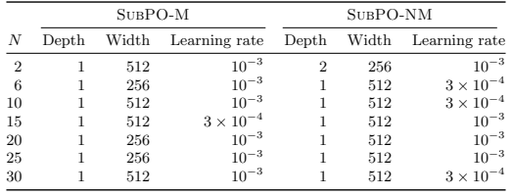
Table 3 : Selected neural network architectures and hyperparameters forSubPO. Depth denotes the number of ReLU layers; the recurrent policy additionally uses one GRU layer.
Original paper · CC BY 4.0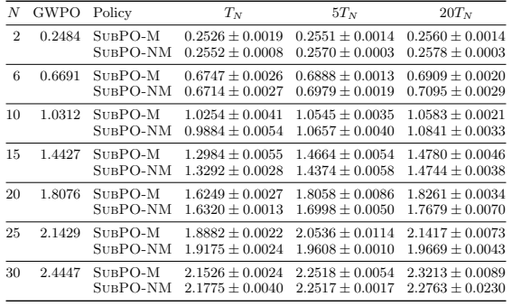
Table 4 : Returns of the selected policies at β = 0.4 with uniform initial state distributions. TheSubPObudgets use the isolated timing calibration and 10% allowance described above. EachSubPOentry is the mean over five training seeds ± the half-width of its 95% confidence interval. GWPO with m = 3 uses seed 1. Intervals describe training-seed variation on the fixed map and evaluation states.
Original paper · CC BY 4.0Quote from the paper
Yasaman Zolfimoselo, Nikolas Geroliminis, Maryam Kamgarpour (2026). Cooperative Multi-Agent Reinforcement Learning with Submodular Trajectory Rewards. arXiv:2611.04774v1. https://arxiv.org/abs/2611.04774v1
BibTeX
@misc{zolfimoselo2026cooperative,
  title = {{Cooperative Multi-Agent Reinforcement Learning with Submodular Trajectory Rewards}},
  author = {Yasaman Zolfimoselo and Nikolas Geroliminis and Maryam Kamgarpour},
  year = {2026},
  eprint = {2611.04774},
  archivePrefix = {arXiv},
  url = {https://arxiv.org/abs/2611.04774v1}
}