Paper commentary
Conditional Optimal Transport and Triangular Maps for Imitation Learning
- Problem Diffusion-style policies start sampling from a Gaussian that carries no information about the task, so accurate action chunks from few network evaluations are hard to obtain.
- Method Not stated in the paper.
- Results On Push-T, SIP reached a score of 0.965, and OTP reached 0.943 with a single network evaluation of a 0.23million-parameter network.
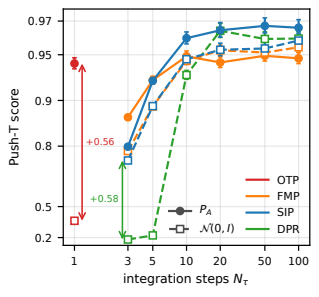
Figure 3 : Effect of the reference on Push-T: score against the number of integration stepsN τ with
Original paper · CC BY 4.0 · Mohammad Al-Jarrah, Yuhang Mei, Karen Leung, Bamdad Hosseini, Amirhossein Taghvaei · Conditional Optimal Transport and Triangular Maps for Imitation Learning · Original paper figure · Extracted the figure area from page 9 of the original PDF.Why the starting distribution matters
Diffusion Policy builds each action chunk by iteratively denoising a Gaussian sample, and every integration step costs one pass through a large network. Its simulation benchmarks use 100 steps, so the sampler is expensive for online control, and faster samplers and distilled students keep the same Gaussian starting point. A Gaussian holds no information about the task, so the learned map has to create all of the structure of the action distribution.
Some recent methods replace the Gaussian with a reference built from a separately trained model, from domain knowledge, from previously executed actions, or from the paired historical data of each training target. Such references tie the sampler to the observation or to past behaviour, so the question becomes whether a reference can be informative while staying independent of both.
Conditioning as a triangular transport problem
The observation history is the window of m = Ho do values and the action chunk is the block of n = Hp da values that follows it. Training pairs are treated as samples of the joint distribution of observation history and action chunk, and the goal is a map T whose output, for each fixed history s, pushes a reference distribution forward to the conditional distribution of the chunk.
At deployment, a reference sample is drawn afresh, independently of the history, and the policy returns T applied to the history and that sample.
A map G is triangular when it leaves the observation history unchanged and applies T only to the second block, so that G(s, z) equals (s, T(s, z)). Proposition 1 states that if G pushes the product of the observation marginal and the reference onto the joint distribution, then for almost every history the second block pushes the reference to the conditional distribution.
The proof compares integrals of bounded test functions of the history and of the action, which match once the push-forward condition holds.
The recipe that follows has three parts: take the joint distribution of the training data as the target, take the product of the observation marginal and the reference as the source, and train a generative model whose map has the triangular form. The push-forward condition fixes only the conditional law, not the particular map T, so the three policies differ in how T is chosen and learned.
Choosing the reference and deriving three policies
The reference is the empirical distribution of the demonstrated action chunks, so the policy draws a chunk from the demonstrations and transports it given the current history. This reference is supported on the actions the demonstrator applied, which stay in the reachable workspace and change smoothly in time, whereas a Gaussian has neither property.
The authors expect that, since this reference is a mixture of the conditional distributions over the histories, the transport to each conditional distribution needs a smaller displacement than from a Gaussian, which would reduce the number of integration steps needed.
OTP learns the conditional optimal transport map by solving a max-min problem over a potential function f and a map T, with the joint distribution and the independent coupling of the history with the reference as the two expectations. \\[ \\max_f \\min_T J(f,T) = \\mathbb{E}[f(S,A)] + \\mathbb{E}\\big[\\tfrac{1}{2}\\|T(S,\\bar A)-\\bar A\\|^2 - f(S,T(S,\\bar A))\\big] \\] In the implementation, f and T are residual networks trained adversarially, and at deployment a single evaluation of T gives the chunk, with f discarded.
Each iteration makes 25 gradient steps on T before one gradient step on f, and T is parameterized as the reference plus a displacement whose output layer starts at zero.
FMP transports the reference along the time-one flow of an ODE, so that the map is the endpoint of the solution of \\( d\\xi_\\tau/d\\tau = b_\\theta(s,\\xi_\\tau,\\tau) \\) started from the reference chunk, with the history held fixed along the flow. The vector field is fitted by a least-squares regression of the time derivative of the interpolant, and the Heun scheme used at deployment evaluates the network 200 times.
Setting the noise parameter to zero recovers the ODE of FMP, and the stochastic Heun scheme of SIP uses 200 network evaluations in the comparison table.
The baseline policies all take the Gaussian reference, namely KRP, which learns the map from the data to the reference and inverts it at deployment, DP with 100 steps of an ancestral sampler, DPR, and CP in its one-step and three-step forms. Table 1 summarizes the references, transports and network evaluations of the policies compared in the study.
Deployment with a fresh reference draw
Drawing a fresh reference at each instant keeps the reference distribution the same during training and deployment, and it is independent of the observation history. For OTP and FMP the map is deterministic, so the randomness of the policy comes from the demonstrations, while SIP adds the noise of its sampler.
Since the observation histories in the data are generally distinct, the empirical conditional distribution at each history is a Dirac measure, so the stochasticity of a learned policy depends on how the map generalizes across neighbouring histories.
Push-T task performance and cost
On Push-T, a circular end effector with a 2-dimensional action pushes a T-shaped block whose observation has 20 dimensions, and the demonstration set holds 206 human demonstrations with 25,650 time instants. Each policy was trained with three seeds and evaluated on 500 held-out initial conditions, giving 1,500 episodes per policy, and the score is the mean episode score with reward given by the covered fraction of the target region.
The advantage of SIP over FMP has a 95% interval of 0.001 to 0.036 that excludes zero only marginally, so the margin is small and the two policies also differ in settings and networks.
What the reference contributes at few steps
The effect of the reference is isolated by varying the number of integration steps and by swapping the reference between the demonstrated chunks and N(0, I_n), with the score plotted on Push-T.
Replacing the demonstrated-chunk reference by N(0, I_n) in OTP lowers its score from 0.943 to 0.380.
Each point in the figure averages 1,500 episodes over three training seeds and 500 held-out initial conditions.
Square results and the two modifications
Because OTP's samples come from one batched network evaluation, the averaging adds no online time, and the time per episode of OTP is about one tenth of those of SIP and DP.
Limitations
At a fixed observation history, OTP produces a distribution supported on at most M demonstrated action chunks.
The reported scores come from deliberately small networks, so larger networks or architectures tailored to each policy may change the ranking.
Paper info
- Authors
- Mohammad Al-Jarrah, Yuhang Mei, Karen Leung, Bamdad Hosseini, Amirhossein Taghvaei
- Venue
- arXiv · Preprint
- First published
- 2026-11-15
- Added
- 2026-11-17
- Updated
- 2026-11-15
- Version
- v1
- arXiv
- 2611.19815
- Category
- cs.LG
- Original paper terms
- CC BY 4.0
- What we show
- Paper info, commentary and permitted figures from the original paper
AI commentary is a separate explanation from the original paper and may contain errors. The original paper and figures follow each source's terms of use and any rights noted separately.
Abstract
We introduce a unified formulation of imitation learning from demonstrations as a conditional sampling problem solved by triangular transport: a policy is the second block of a triangular map that transports a reference distribution to the conditional distribution of the action chunk given the observation history. Unlike in Diffusion Policy, where it is a fixed Gaussian, the reference becomes a design variable; we take it to be the empirical distribution of the demonstrated action chunks and introduce three instances of the formulation: an optimal transport policy (OTP), a flow matching policy (FMP), and a stochastic interpolant policy (SIP). On the Push-T and robomimic Square tasks, the three policies are competitive in task performance with Diffusion Policy and Consistency Policy while using considerably smaller networks and shorter training, and the informative reference accounts for a substantial part of their performance when few network evaluations are used. The three instances offer different trade-offs rather than a single best method: OTP generates an action chunk with a single evaluation of the smallest network (0.23 million parameters on Push-T) and is suitable for settings in which inference time and model size matter, whereas SIP attains the highest scores among the proposed policies at a higher cost.
Quote from the paper
Mohammad Al-Jarrah, Yuhang Mei, Karen Leung, Bamdad Hosseini, Amirhossein Taghvaei (2026). Conditional Optimal Transport and Triangular Maps for Imitation Learning. arXiv:2611.19815v1. https://arxiv.org/abs/2611.19815v1
BibTeX
@misc{aljarrah2026conditional,
  title = {{Conditional Optimal Transport and Triangular Maps for Imitation Learning}},
  author = {Mohammad Al-Jarrah and Yuhang Mei and Karen Leung and Bamdad Hosseini and Amirhossein Taghvaei},
  year = {2026},
  eprint = {2611.19815},
  archivePrefix = {arXiv},
  url = {https://arxiv.org/abs/2611.19815v1}
}