Paper commentary
Routeability Before Routing: Routeability Audit Protocol (RAP) and RouteabilityBench for Audited LLM Model Selection
Routing gains need a routeability check before they count as evidence
- Problem LLM routers often fail to beat the single best model when many models tie or the best model is already near the oracle. Routing gains are hard to read in that setting.
- Method RAP is a retrospective audit that runs once the benchmark-portfolio score matrix exists. It checks headroom, tied-best saturation, predictability, regret, and calibration before router gains are read as evidence.
- Results Across four benchmarks and 66 LLMs, generic routing enhancements do not consistently beat the single best model. Forced routing gap closure is +0.081 on Omni-MATH but negative on GPQA, MMLU-Pro, and IFEval.
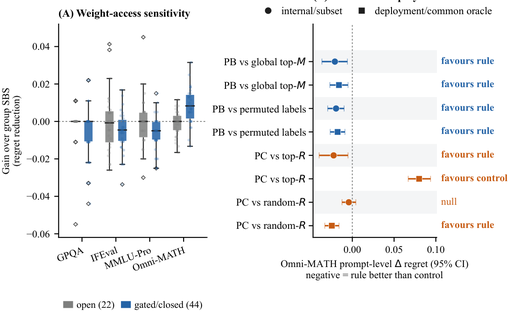
Figure 2 : Portfolio evidence under declared estimands.(A)Corrected 22/44 weight-access sensitivity; boxplots and overlaid points summarize all 30 repeated split-level gains per group and are descriptive because splits overlap. The registered 40-test split-level Wilcoxon–Holm value is0.004103 (0.005356 when four near-zero differences are treated as zeros; Table A.19).(B)Prompt-space comparisons survive both the internal and full-test controls, whereas the LLM-side comparison reverses under the common full-portfolio oracle. Circles indicate internal/subset comparisons; squares indicate full-test/common-oracle deployment comparisons.
Original paper · CC BY 4.0 · Yihang Lu, Denica Kjorvezir, Ana Gjorgjevikj, Carola Doerr, Tome Eftimov · Routeability Before Routing: Routeability Audit Protocol (RAP) and RouteabilityBench for Audited LLM Model Selection · Original paper figure · Converted the paper's own image file from its arXiv HTML version to PNG.Why a benchmark can leave routing little to learn
Per-prompt routing bets that different models win on different prompts, so a router can pick a better model for each prompt. That bet fails when the single best model already sits close to the oracle upper bound. It also struggles when many models tie for the top score on the same prompt. The authors call a benchmark-portfolio pair with enough learnable variation routeable, and they ask that question before comparing any router.
Routing headroom is the gap between the virtual best solver (VBS) and the single best solver (SBS), so it caps the average gain a perfect selector could add. So headroom alone can't separate a benchmark where routing helps from one where it doesn't, and the tied-best set has to be read alongside it. MMLU-Pro and IFEval have smaller ceilings, at 0.091 and 0.045, and heavier ties, at 76% and 88%.
Low headroom and heavy ties both narrow what a router can learn. A large ceiling doesn't promise that a learned router will reach it.
The audit and its formulas
The authors check the benchmark-portfolio pair before trusting any router, and they score routers by regret rather than by how often they hit a single winner. The audit runs five diagnostics: headroom (D1), tied-best saturation (D2), embedding-to-performance predictability (D3), realized utility through regret and gap closure (D4), and calibration in selective routing (D5).
The structural diagnostics say what a benchmark could offer, not what a learned router will achieve.
Let \(Y \in \mathbb{R}^{N \times K}\) hold the scores of \(K = 66\) LLMs on \(N\) prompts. The single best solver is picked on training rows, \(k_{\mathrm{SBS}} = \arg\max_k |\mathrm{train}|^{-1}\sum_{i \in \mathrm{train}} Y_{i,k}\). Its test score is \(S_{\mathrm{SBS}} = N_{\mathrm{test}}^{-1}\sum_{i \in \mathrm{test}} Y_{i,k_{\mathrm{SBS}}}\), while the virtual best solver averages the per-prompt maximum over test rows: \(S_{\mathrm{VBS}} = N_{\mathrm{test}}^{-1}\sum_{i \in \mathrm{test}} \max_k Y_{i,k}\).
Routing headroom is \(\Delta_{\mathrm{route}} = S_{\mathrm{VBS}} - S_{\mathrm{SBS}}\). Forced routing regret for prompt \(i\) is \(\max_k Y_{i,k} - Y_{i,\pi(i)}\), the best score in the row minus the score of the model the policy picks. Within a split, gap closure is \(1 - \bar r^{\mathrm{forced}}/\Delta_{\mathrm{route}}\) when headroom is positive, and the reported 30-split figures average these splitwise ratios.
Ties make strict winner labels unstable. If the strict winner is drawn uniformly from the tied-best set \(T_i\), a policy that picks any top-scoring model has zero tie-aware regret yet expected strict-label accuracy \(1/|T_i|\). This is why the authors keep strict accuracy as a side diagnostic and center tie-aware regret and gap closure.
Forced routing against the single best model
The baseline router predicts the whole 66-dimensional performance vector from a prompt's embedding, using Ridge regression. Each view gets its own λ, chosen by 5-fold cross-validation on training rows, and the view predictions are fused with non-negative weights learned on validation rows. Forced routing then picks the predicted best model for each prompt and breaks ties at random.
The router is deliberately simple, so it serves as a leakage-controlled reference point rather than a strong router.
Over 30 seeds, forced gap closure is negative on GPQA (−0.135±0.126), MMLU-Pro (−0.147±0.191) and IFEval (−0.324±0.477). On Omni-MATH it is positive, at +0.081±0.089. These ± values describe split-induced spread, not uncertainty across independent datasets, because the splits reuse the same benchmarks. So a predictor that estimates performance vectors reasonably well still doesn't automatically yield routing that beats the single best model.
Selective routing, which may abstain, lowers regret relative to forced routing on GPQA, IFEval and MMLU-Pro, while Omni-MATH moves the other way. The four prompt-level bootstrap intervals exclude zero in the prespecified direction, but they are not multiplicity-adjusted. The sign-flip tests survive Holm correction at adjusted p values of 0.0436, 0.0222, 0.0222 and 0.0040.
Against the single best solver, forced routing on Omni-MATH gives −0.0136, with a 95% interval of [−0.0251,−0.0020]. Its family-level Holm value is 0.0912, so the authors downgrade the claim that routing dominates the single best solver. Table 5 lists each corrected decision with its interval and Holm value.
Representation and regressor choices
The authors test whether richer embeddings, train-only dimensionality reduction or a stronger regressor can rescue routing. Across the view configurations, no representation gives a consistent routing gain after Holm correction.
PCA is fit on training rows only and then applied to the validation, calibration and test rows, which blocks test-set leakage. The first screen flagged one MMLU-Pro cell, but prompt-level re-analysis reduced it to −0.0017 with a 95% interval of [−0.0051,+0.0018]. That interval includes zero, so the authors withdraw the PCA-64 finding.
Swapping Ridge for ExtraTrees lowers IFEval forced-routing regret relative to Ridge, by −0.0164 in the prompt-level difference, with a 95% interval of [−0.0266,−0.0063]. RandomForest points the same way in some realizations, but its interval reaches zero, so the authors call it computationally unstable. IFEval is therefore a predictor-sensitive boundary case, and this comparison still doesn't show that either predictor beats the single best model.
Portfolio changes and the estimand
Omni-MATH's median routed-regret difference is +.002 at K=13 and turns to −.006 at K=33, compared to −.0164 for the full 66 models. The other three datasets stay unfavorable at the five completed uniform sizes. At small K the sub-portfolio's own SBS is easier to beat, so the authors anchor on the fixed full-66 reference.
The binary split compares 22 open-weight models with 44 gated-or-closed models. On Omni-MATH, margin abstention in the gated-or-closed portfolio has a split-level Wilcoxon-Holm value of 0.004103, with a mean regret difference of −0.008458 relative to its group SBS. That value comes from 30 overlapping splits, and the released evidence has no independent prompt-level confirmation, so the authors treat portfolio composition as a sensitivity axis.
The authors cluster models by their per-prompt performance profiles and use centroid medoids as representatives. At K=8 on Omni-MATH, these medoids beat top-R on their own subset oracle by −0.0224, with a 95% interval of [−0.0397,−0.0051]. Under a common full-portfolio oracle, the same medoids show higher regret, at +0.0800 with a 95% interval of [+0.0669,+0.0937].
So the favorable comparison depends on which oracle defines the regret.
The authors build train-only prompt clusters from the compact three-view encoder representation and apply a per-cluster top-M rule. On Omni-MATH at K=16 and M=8, this rule gives −0.0160 relative to a global top-M baseline, with a 95% interval of [−0.0269,−0.0051]. Against permuted cluster labels it gives −0.0176, with a 95% interval of [−0.0265,−0.0088].
When scores are binarized at 1.0, the global top-M contrast is null, at +0.0010, so the gain depends on score granularity as well as on the clusters.
Together the portfolio analyses show that headroom is necessary but not sufficient for learnable LLM routing.
Limits of the audit
The Omni-MATH comparison cells share one score matrix, so they aren't independent replications. The 30 splits reuse prompts and are correlated, so seed-level stability isn't independent replication.
Under that proxy, Omni-MATH reaches a hypervolume-vs-SBS of 0.004255, with a bootstrap interval of [0.00146,0.00717]. No headline row survives the Nadeau-Bengio family sensitivity.
Applied post hoc to 12 public RouterEval tasks, Ridge is favorable to the task-specific SBS on 9 of 12. The authors present this as a check that the audit runs over a wider size range, not as external validation. The artifact verifies shipped evidence, and it doesn't refit routers or ship embeddings.
Paper info
- Authors
- Yihang Lu, Denica Kjorvezir, Ana Gjorgjevikj, Carola Doerr, Tome Eftimov
- Venue
- arXiv · Preprint
- First published
- 2026-11-25
- Added
- 2026-11-27
- Updated
- 2026-11-25
- Version
- v1
- arXiv
- 2611.34825
- Category
- cs.LG
- Original paper terms
- CC BY 4.0
- What we show
- Paper info, commentary and permitted figures from the original paper
AI commentary is a separate explanation from the original paper and may contain errors. The original paper and figures follow each source's terms of use and any rights noted separately.
Abstract
LLM routing aims to choose, for each prompt, which model in a portfolio is most likely to answer correctly. This only makes sense when the benchmark contains enough prompt-specific variation for different models to be best on different inputs. On coarse-scored LLM benchmarks, however, many models often tie for the best score, and the single best model may already leave little room for improvement. We therefore propose a routeability-first audit, instantiated as RAP and RouteabilityBench, a runnable claim-verification package. The audit is retrospective: it runs once the benchmark-portfolio score matrix exists and before router comparisons are interpreted as general evidence, rather than certifying a portfolio that has not yet been evaluated. Across four benchmarks and 66 LLMs, generic routing enhancements such as larger embedding sets, dimensionality reduction, selective abstention, clustering, and stronger regressors do not consistently outperform the single best model. The clearest positive evidence is concentrated in portfolio-dependent Omni-MATH settings, while GPQA, MMLU-Pro, and IFEval show different ways in which routing can remain hard or predictor-sensitive. Our practical recommendation is that routing gains should be reported together with routeability diagnostics, tied-best analysis, portfolio construction details, and family-corrected statistical tests.
Quote from the paper
Yihang Lu, Denica Kjorvezir, Ana Gjorgjevikj, Carola Doerr, Tome Eftimov (2026). Routeability Before Routing: Routeability Audit Protocol (RAP) and RouteabilityBench for Audited LLM Model Selection. arXiv:2611.34825v1. https://arxiv.org/abs/2611.34825v1
BibTeX
@misc{lu2026routeability,
  title = {{Routeability Before Routing: Routeability Audit Protocol (RAP) and RouteabilityBench for Audited LLM Model Selection}},
  author = {Yihang Lu and Denica Kjorvezir and Ana Gjorgjevikj and Carola Doerr and Tome Eftimov},
  year = {2026},
  eprint = {2611.34825},
  archivePrefix = {arXiv},
  url = {https://arxiv.org/abs/2611.34825v1}
}