Paper commentary
Continual-ARC: Measuring Skill Acquisition over a Working Lifetime
Continual-ARC tests whether agents keep skills across returning and new tasks
- Problem Existing continual-learning benchmarks test one applied domain, serve each instance once, and assume one kind of learner. So memory-based and weight-based systems are rarely compared on the same scale.
- Method Continual-ARC builds a lifelong stream from ARC-AGI tasks that return with fresh instances after dormant gaps. Each instance is scored by the share of a feedback budget the learner uses.
- Results Harness-based methods gain nothing on unseen tasks, while weight-based learning, DAgger, saves 0.29 on held-out tasks versus 0.57 on seen tasks.
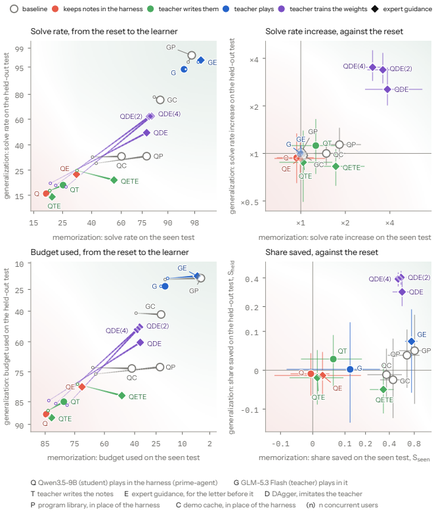
Figure 3 : At one user, with DAgger also at two and four. Left: lines join each reset (hollow dot) to its learner, on complementary log-log axes. Up and right are better; bars show simultaneous 95% intervals (Appendix A), hidden where narrower than their point.
Original paper · CC BY 4.0 · Daniel Lenton · Continual-ARC: Measuring Skill Acquisition over a Working Lifetime · Original paper figure · Extracted the figure area from page 6 of the original PDF.Why current benchmarks miss memorization and generalization
Agent systems that run for days or weeks need a skill learned on one job to survive until a similar job returns. ARC measures acquisition once, inside a single episode, so it says nothing about either question. The paper separates two questions: memorization, whether a skill is still there at the next similar scenario, and generalization, whether the experience helps with jobs never met.
The existing continual benchmarks have three gaps, and each one blocks a clean answer to at least one of those questions. Each is built around one applied domain, such as coding or office work, where the models already know a great deal from pretraining. In that setting, gains may come partly from drawing out that existing knowledge rather than from new learning.
Most also assume a single family of learner, such as gradient updates for fine-tuning suites like MLLM-CTBench, or prompting and memory for agent benchmarks like AgentCL and PATH-Bench. Only some benchmarks permit both kinds of learner, such as those of Wu et al. (2024) and Zheng et al. (2025).
On the ARC-AGI-1 track, the Re-ARC generators produce a fresh, verified instance of any training task on demand. The score is the share of the feedback budget used, and an instance that fails uses all of it.
A stream of ARC tasks that come back with new inputs
The stream makes a task return with a new input each time, so a cached answer never fits the returning instance. A task stays active for a spell of instances and then rests for a dormant gap before it may return. Each round names one task drawn from the active set, and a task stays active for a spell before it rests. Each of the 25 tasks serves eight instances, and the stream runs for 200 rounds.
The stream draws 25 of the 400 training tasks for ARC-AGI-1 and serves 200 instances of them. Each instance has a charge budget of 16, with a wrong submission costing 1 and a demonstration request costing 1. Demonstration requests are capped at eight per instance, and a ninth request is refused at no cost. An unsolved instance costs the full budget of 16, so asking for demonstrations never avoids that charge.
Usage is measured by the mean budget used, U, and the solve rate, P, over each set of instances. A solved instance that spent 4 of the 16 has used 25% of its budget. The task id is shown on every instance under a per-run alias, because the input grid doesn't identify the task.
The seen test gives four fresh instances of each stream task, which measures memorization. The held-out test gives 100 evaluation tasks the stream never showed, which measures generalization.
Harnesses against the demo cache on returning tasks
The demo-cache floor is the bar that a harness has to clear on returning tasks. The demo-cache floors saved 0.37 on the seen test, with a share saved of 0.37 [0.26, 0.51]. The GC floor saved 0.44 [0.34, 0.57] on the same test, against the stateless floor. On new tasks the demo caches saved nothing measurable, at −0.01 and −0.02, because there was no earlier task to replay.
The Qwen harness saved nothing measurable against its own reset, with S_seen of −0.01. The GLM harness saved a bit more, with S_seen of 0.25 [0.17, 0.33] over three runs. Even so, GLM spent 13.6% of its budget per solved instance, against 17.5% for its reset. The harness showed only six entries per instance, and those were chosen before the task was known.
So the stored rule for each task reached GLM on only 40 of 154 returns.
Expert guidance changed this picture, because it told the harness to write Python programs and verify each one against the demonstrations. The guidance also told the harness to save each program for its task and reuse it. With that guidance the GLM harness saved 0.74 on the seen test, with a share saved of 0.74 [0.64, 0.84]. The authors read this as the harness being capable, with the earlier failure lying in a lack of judgment and in harness prompts.
A program library, which keeps one verified program per task, saved 0.65 [0.46, 0.86] on the seen test, well above the demo caches.
That program library saved nothing measurable on the held-out test, at 0.03 [−0.02, 0.09]. A program checked against one task's demonstrations has no reason to solve a different task. The Re-ARC generators derive all 400 training rules from 160 primitive functions, so seen and held-out tasks share building blocks. Even with those shared blocks, none of the harness methods generalized measurably.
Whether weight training generalizes to unseen tasks
The Re-ARC generators derive all 400 ARC-AGI-1 training rules from one library of 160 primitive functions, so seen and held-out tasks share building blocks. A harness that stores these shared blocks during the stream could in principle help on held-out tasks. Most harness-based methods still learn less than the demo-cache floor, and no harness-based method gains on unseen tasks.
Training the student weights on the teacher's moves, using DAgger (QDE), did generalize measurably. DAgger's held-out share saved was 0.29 [0.23, 0.35], about half its seen-test share saved of 0.57 [0.48, 0.67]. The untrained Qwen solved only 18 of the 100 held-out tasks in prime-agent, against 31 in the stateless loop. So part of what DAgger learned was simply how to drive the harness, and the harness reset sat below the stateless floor.
Expert guidance lifted the untrained Qwen's held-out solves from 13 to 26 up to 22 to 33 per play. DAgger solved 47 to 52 held-out tasks, beyond both the harness and the stateless loop. The authors take this to mean DAgger also learned something fundamental about ARC itself, beyond driving the harness and distilling the guidance.
DAgger's held-out share saved was 0.40 at two users and 0.39 at four users. The authors read this as diminishing returns for generalization beyond two users.
Limits and open questions
The results rest on one stream seed, 0, and that stream draws 25 of the 400 training tasks. Failing an instance costs the whole budget of 16, so a learner that will fail anyway doesn't gain by asking. That charge is the scoring rule itself, not a finding about how harnesses behave.
Qwen3.5-9B often wrote no readable action, giving up on 48 to 68% of the stream's instances in every harness method. A share saved on that model therefore includes what the learner picked up about writing a readable action.
On GPT-6 Luna, no harness as shipped saved a measurable share at any reasoning effort. The program library saved 0.62 [0.37, 0.93] at high effort, against 0.49 [0.31, 0.73] at low effort. They didn't test openclaw with a store that the consolidation actually writes to, so that case stays open.
Paper info
- Authors
- Daniel Lenton
- Venue
- arXiv · Preprint
- First published
- 2026-11-10
- Added
- 2026-11-12
- Updated
- 2026-11-10
- Version
- v1
- arXiv
- 2611.14505
- Category
- cs.LG
- Original paper terms
- CC BY 4.0
- What we show
- Paper info, commentary and permitted figures from the original paper
AI commentary is a separate explanation from the original paper and may contain errors. The original paper and figures follow each source's terms of use and any rights noted separately.
Abstract
Agent harnesses have emerged as a promising mechanism for continual learning, alongside test-time parametric learning. However, the current benchmarks have several limitations: they generally focus on a single applied domain, serve each instance only once, and assume a single family of learner, so memory-based and weight-based systems are rarely compared on the same scale. We propose Continual-ARC, a lifelong stream built from the three ARC-AGI editions, whose tasks need no domain knowledge. The same tasks return after dormant gaps with fresh instances, while new tasks keep arriving. On each instance, the learner may pay for demonstrations, submit answers, or act inside the harness, with retries permitted on incorrect submissions, which are paid for. Each instance is scored based on the share of this feedback budget consumed. Since a learner may keep anything between instances, memory-based and weight-based systems are scored on the same scale. After the stream, the learner is frozen and tested on fresh instances of the tasks it met, which measures memorization, and on unseen tasks, which measures generalization. We run an agent harness with frozen weights, with and without persistence, on Qwen3.5-9B and GLM-5.3 Flash, comparing them with two prompting floors, a program-induction method and Qwen3.5-9B's weights trained to imitate GLM-5.3 Flash. Persistence in the harness generally does not improve memorization unless provided with explicit expert guidance. Most harness-based methods still learn less than a floor that simply caches each task's demonstrations, across all models we tested. No harness-based method gains on unseen tasks, whereas weight-based learning shows substantial gains. This opens the door to future weight-based continual learning that could teach models to drive harnesses in new domains.
Figures from the paper
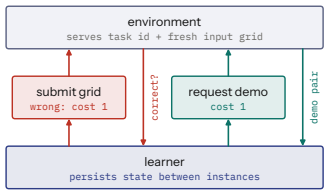
Figure 1 : Each incorrect attempt or demon- stration costs one. Unsolved instances cost the full budget of sixteen.
Original paper · CC BY 4.0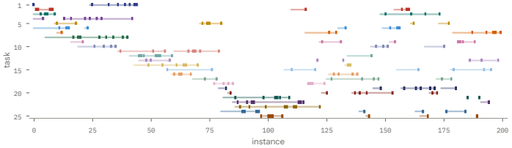
Figure 2 : The ARC-AGI-1 stream: its 25 tasks, one row each in the order they first appear, and each instance a mark. A thin line in the task’s color marks a spell in which the task is active.
Original paper · CC BY 4.0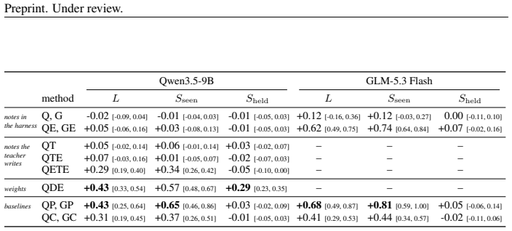
Table 1 : Qwen3.5-9B and GLM-5.3 Flash driving prime-agent: the share learned on the stream,L, and the share saved on each test,S, against the method’s reset (Section 2.4; higher is better), with 95% intervals in small type. Bold marks each model’s best where its interval lies above zero.
Original paper · CC BY 4.0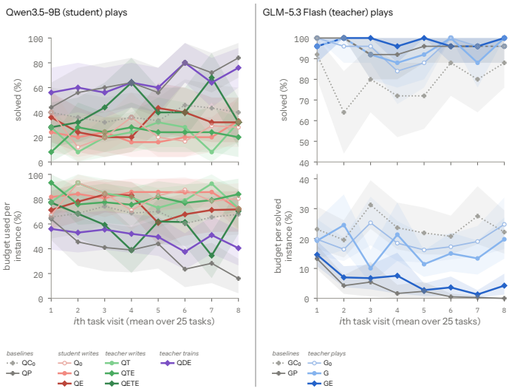
Figure 4 : At one user. Bands show 95% intervals over task resamples. GLM’s budget is averaged only over instances it solves.
Original paper · CC BY 4.0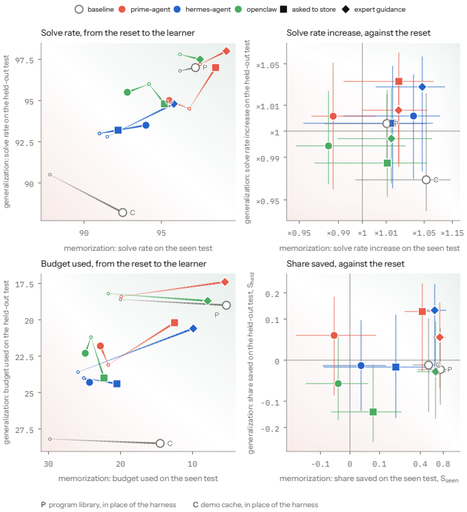
Figure 5 : GPT-6 Luna at high effort, as in Figure 3. Appendix I gives every effort.
Original paper · CC BY 4.0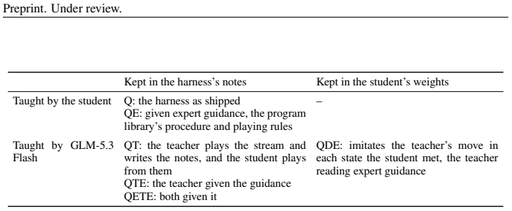
Table 2 : The comparison on Qwen3.5-9B. Every method plays the same stream in the same harness, prime-agent, beside its wiped twin and the baselines, and the methods on each line share their teacher. The weights taught by the student alone are not shown (Appendix H).
Original paper · CC BY 4.0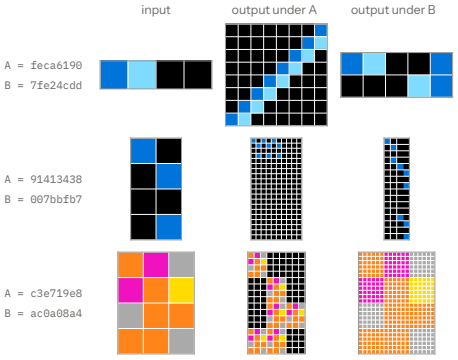
Figure 6 : An input grid does not determine its task. Each row shows one input generated for training task A, with the output of task A’s rule and the output of task B’s rule on the same grid. Both are valid ARC tasks, and only the demonstrations or the id say which rule applies. Top: A (feca6190) draws diagonal lines from each colored cell on a larger black square, and B (7fe24cdd) lays out the input and its three rotations as four quadrants. Middle: A (91413438) tiles copies of the input, one per colored cell, and B (007bbfb7) places the input’s pattern in every tile whose cell is colored. Bottom: A (c3e719e8) places the whole input in every tile whose cell has the most frequent color. B (ac0a08a4) enlarges every cell into a block. The pairs are selected automatically: an input generated for A on which B’s verifier runs and returns a different valid grid.
Original paper · CC BY 4.0
Table 3 : The ARC-AGI-1 track’s configuration. Each track is its configuration, in the individual regime, at seed 0. The stream length is per user, and the held-out tasks, those of the held-out test, are the same for every user.n c,b,mandaare the stream’s parameters (Appendix B), in instances, withσ= 1throughout. The number of usersn u ∈ {1,2,4}is a setting of the run, not of the configuration. At four users, the stream has 200 rounds over 100 distinct tasks, with eight instances per task and four graded instances per round. Every configuration has an attempt cap of 8 and a demonstration cap of 8, one pair per request, withc d = 1.
Original paper · CC BY 4.0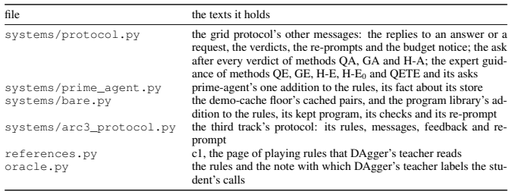
Table 4 : Where the benchmark’s code keeps every other text a learner is shown: the first four files underbaselines/src/continual_arc_baselines/and the rest under training/src/continual_arc_training/, at tagv0.3.0for GPT-6 Luna’s methods andv0.5.0for the rest, which alone has DAgger’s teacher and the third track.
Original paper · CC BY 4.0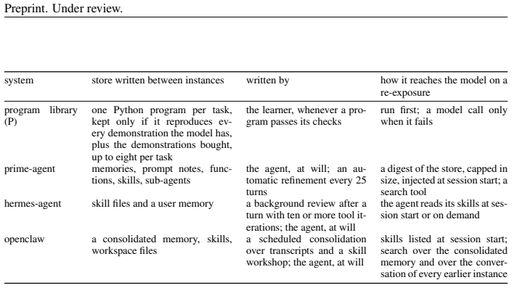
Table 5 : What each method is built to persist between instances and how it reaches the model when a task returns, read from the designs. The subsections below give what the stores held and delivered on the cells.
Original paper · CC BY 4.0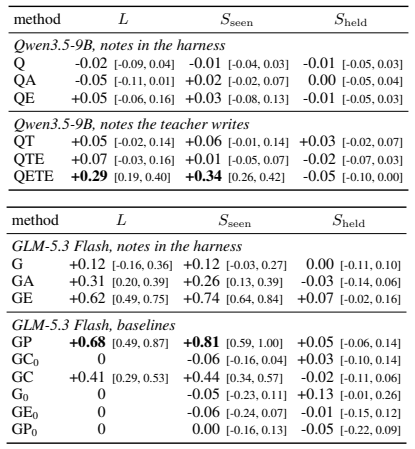
Table 6 : Every method on Qwen3.5-9B that keeps notes in the harness at one user, QA among them (top), and every method on GLM-5.3 Flash at one user, GA and the methods that keep nothing among them (bottom), read as in Table 1. Bold marks each column’s best among the values whose 95% interval lies above zero.
Original paper · CC BY 4.0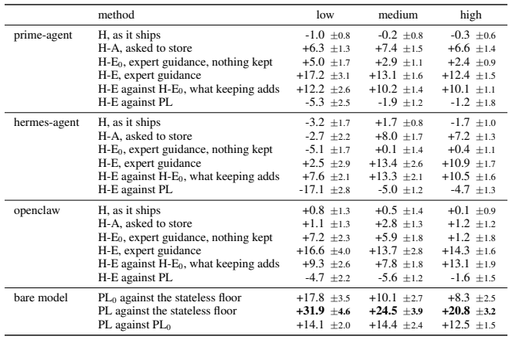
Table 7 : ARC-AGI-1: budget saved by each method against its reference, in percent of the cap (higher is better), on the stream slots both methods have reached, pooled with the side experiment’s two orders, with a bootstrap standard error over tasks in small type. A harness method is read against the same harness’s stateless method H0, except for the last two lines of each harness, which read H-E against H-E0 and against method PL; the bare model’s methods are read as named. Bold marks each column’s best among the savings whose 95% interval, 1.96 standard errors either side, lies above zero.
Original paper · CC BY 4.0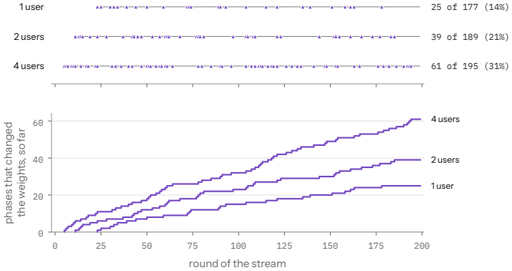
Figure 7 : How often DAgger’s phases changed Qwen3.5-9B’s adapter at one, two and four users. Above, a triangle marks each round after which the phase kept a later checkpoint than the adapter it started from, on a rule over the rounds that had a phase, which begin once the base model has played 24 games; on the right, how many of the phases did. Below, how many had by each round.
Original paper · CC BY 4.0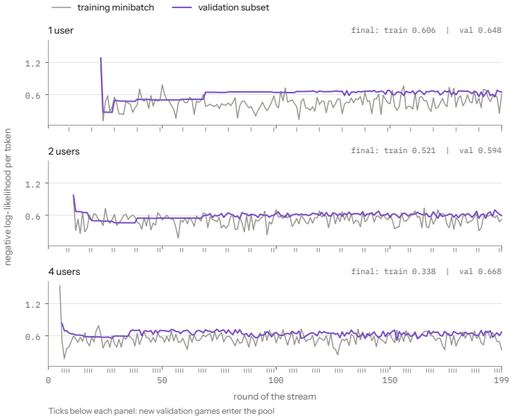
Figure 8 : QDE’s training and validation token loss at the start of each phase, with common axes and no smoothing. Ticks mark new games entering the validation pool; its sampled subset can also change between ticks. Values above each panel are from the final phase, which kept its incoming adapter in all three runs.
Original paper · CC BY 4.0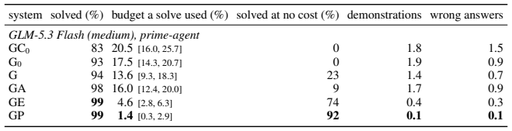
Table 9 : GLM-5.3 Flash in prime-agent, rounds 100 to 199 of the stream at one user: the share of instances solved, the budget a solve used in percent of the budget with its 95% interval over task resamples, the share of solves that used none of it, and the demonstrations and wrong answers behind a solve. Perfect memory on any of these systems spends nothing here. Bold marks each column’s best.
Original paper · CC BY 4.0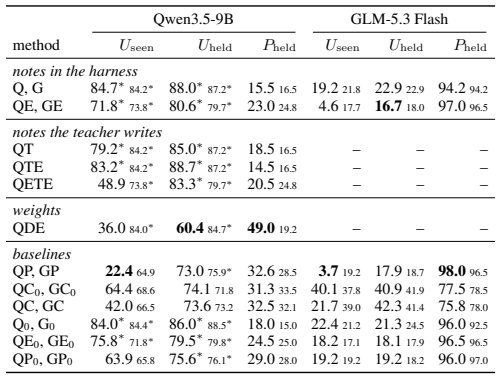
Table 10 : Every method at one user in absolute terms, on Qwen3.5-9B (left) and on GLM-5.3 Flash (right):Uis the budget used on a test in percent, lower is better, andP held the share of the held-out test solved in percent, each the mean of four plays, the learner’s own in normal type and the reset’s beside it in small type, each marked with an asterisk where it is above the bare model’s, the stateless floor’s, as Appendix J flags. Table 1 gives each method’s share saved, which is one minus the ratio of the two budgets. Bold marks each column’s best.
Original paper · CC BY 4.0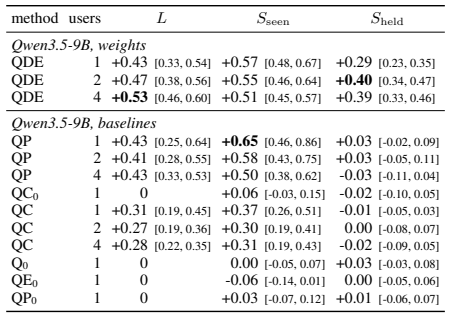
Table 11 : DAgger on Qwen3.5-9B, and its baselines, at each number of users they served, read as in
Original paper · CC BY 4.0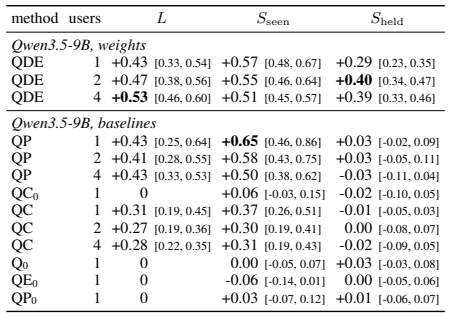
Table 1 : the share learned on the stream and the share saved on each frozen test, against the method’s wiped twin at the same number of users, and on the held-out test against the reset’s plays at one user as well. At two and four users DAgger plays each test four times, and its baselines once. Bold marks each column’s best among the values whose 95% interval lies above zero.
Original paper · CC BY 4.0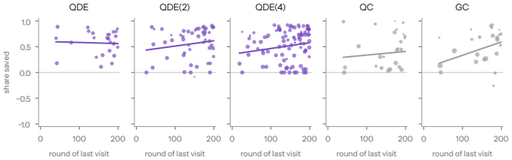
Figure 9 : Each task’s share saved on the seen test against the round of its last visit in the stream, for DAgger at one, two and four users and for the two demo-cache floors. A dot’s area is the reset’s spend on the task, and each line is the fit weighted by it.
Original paper · CC BY 4.0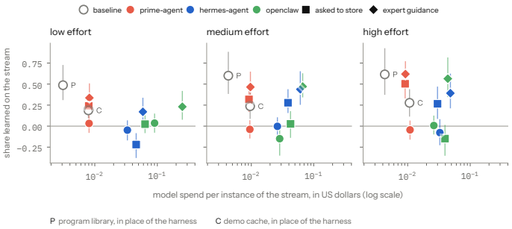
Figure 10 : The share learned on the stream (Equation 3, higher is better) of every GPT-6 Luna system that keeps something, with its 95% interval, against what its model calls cost per instance of the stream (log scale), a panel per effort: each harness in its color, as it ships (circle), asked to store (square) and given the expert guidance (diamond), beside the program library (P) and the demo-cache floor (C). Each system is read against itself reset before every instance. The program library learns as much as any system for the least spend.
Original paper · CC BY 4.0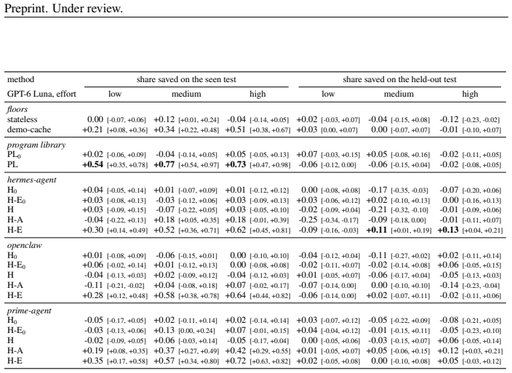
Table 12 : GPT-6 Luna’s frozen tests: the share of the reset’s spend on each test that a system no longer pays, against itself reset (Equation 4, higher is better), with its 95% interval over task resamples in small type. A harness is read against its method H 0, and H-E against H-E0; the demo- cache floor against the stateless floor, and the program library against PL 0. A floor or a wiped method reads half its plays against the other half, so these methods show the noise of playing a test. Bold marks each column’s best among the values whose 95% interval lies above zero.
Original paper · CC BY 4.0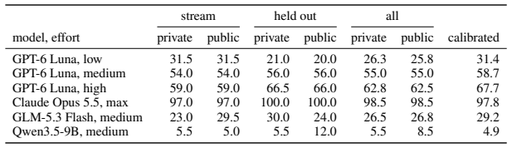
Table 13 : First-sight solve rates, in percent, on the private set and on the ARC-AGI-1 track’s pub- lic tasks, measured the same way: three demonstrations, one answer and an exact match. Private columns are the 25 streamed rules, the 25 held-out rules and the 50 kept; public columns are the track’s 25 stream tasks, its 25 held-out ARC-AGI-1 evaluation tasks and all 50. Calibrated is all 92 candidates that passed the filters and screens. Each rate is a mean over rules or tasks, of eight instances per rule or stream task for GPT-6 Luna, GLM-5.3 Flash and Qwen3.5-9B and four for Claude Opus 5.5. The selection matched the first four rows; the last two were calibrated after it.
Original paper · CC BY 4.0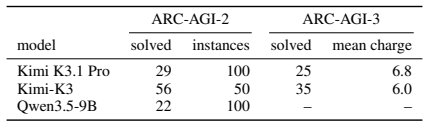
Table 14 : First-sight solve rates on the second and third tracks, in percent, with the number of instances, requested at medium reasoning effort through OpenRouter, a level Kimi does not offer. ARC-AGI-2: four fresh instances of each of the track’s 25 stream tasks (two of each for Kimi-K3), three demonstrations and one answer, an exact match, a reply capped at 32,000 tokens, which no reply of the Kimi models reached, and at 65,536 for Qwen3.5-9B. ARC-AGI-3: the track’s 40 held- out levels, the bare model wiped before each, a reply capped at 64,000 tokens, and the mean charge out of 8. A dash marks a track a model is too slow to play.
Original paper · CC BY 4.0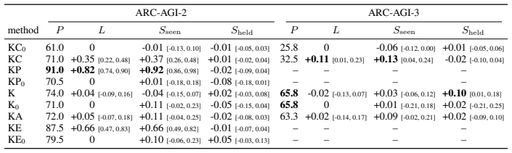
Table 15 : Initial results on the second and third tracks: Kimi K3.1 Pro, requested at medium rea- soning effort, at one user, the two floors through OpenRouter and every other method pinned to Moonshot AI’s own endpoint.Pis the share of the stream’s instances solved, in percent.L,S seen andS held are read as in Table 1, the demo-cache floor against the stateless floor, KA against K 0 and every other method against itself wiped, from four plays of each test by each floor and two by every other method, a method that keeps nothing reading half its plays against the other half. A dash marks a method that does not play ARC-AGI-3 beyond the pilot of Table 16. Small type is the 95% interval over task resamples. Bold marks each column’s best, forLandSamong the values whose 95% interval lies above zero.
Original paper · CC BY 4.0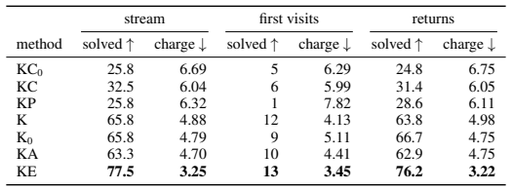
Table 16 : The pilot of the program library (KP) and the expert guidance (KE) on ARC-AGI-3, beside Table 15’s methods on the same 120 instances of its stream, a first visit and seven returns of each of the 15 games, in the same order. Kimi K3.1 Pro is requested at medium reasoning effort, at one user, the two floors through OpenRouter and every other method pinned to Moonshot AI’s own endpoint. Each method played the stream once. Solved is the share of instances solved, in percent, and the number solved of the 15 first visits; charge is the mean charge out of 8. Bold marks each column’s best.
Original paper · CC BY 4.0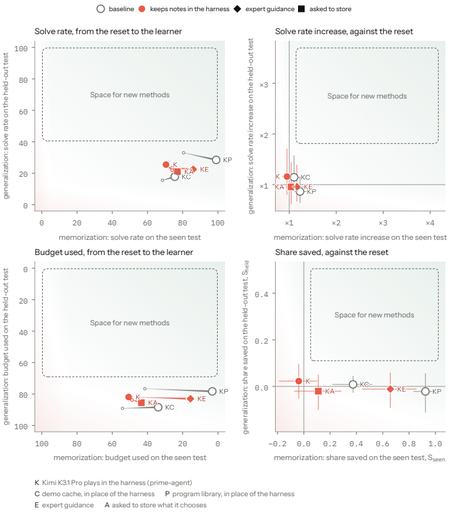
Figure 11 : Figure 3’s four panels for ARC-AGI-2, with broad axis ranges: every learner Kimi K3.1 Pro has played on this track so far, requested at medium reasoning effort, at one user, each against its reset. The dashed boxes mark the space no learner here reaches yet, which we leave open for new methods and submissions: on the left panels everything above the points drawn, where a learner better on the held-out test than any here would stand, and on the right an open region above and to the right of no gain.
Original paper · CC BY 4.0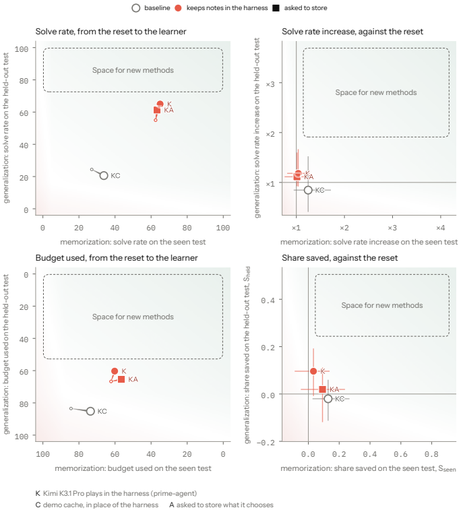
Figure 12 : Figure 3’s four panels for ARC-AGI-3, as Figure 11 draws them for ARC-AGI-2, with the space left open boxed the same way. The program library and the expert guidance are procedures for grids, so they do not play this track, beyond the pilot of a version of each for games in Appendix K, which played no test.
Original paper · CC BY 4.0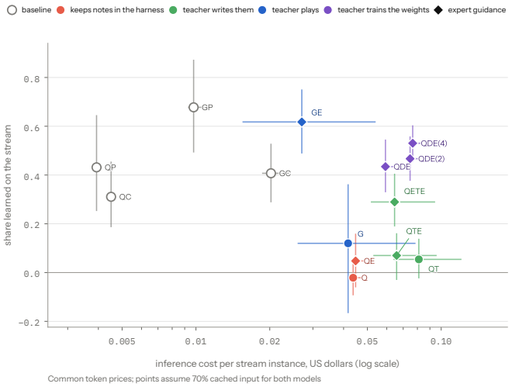
Figure 13 : Inference cost and share learned on the stream, with labels as in Figure 3. Vertical bars are pointwise 95% task-bootstrap intervals; horizontal bars span 0 to 100% cached input, with points at 70%. QDE(2) and QDE(4) serve two and four users; every other learner serves one.
Original paper · CC BY 4.0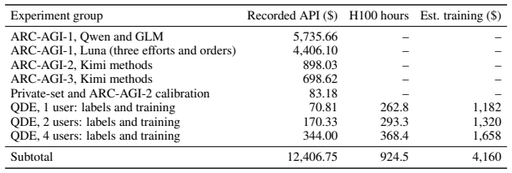
Table 18 : Recorded API charges and estimated H100 training costs, in US dollars. QDE’s rows give its teacher-label charges and training over all completed phases of its one-, two- and four-user runs.
Original paper · CC BY 4.0Quote from the paper
Daniel Lenton (2026). Continual-ARC: Measuring Skill Acquisition over a Working Lifetime. arXiv:2611.14505v1. https://arxiv.org/abs/2611.14505v1
BibTeX
@misc{lenton2026continual,
  title = {{Continual-ARC: Measuring Skill Acquisition over a Working Lifetime}},
  author = {Daniel Lenton},
  year = {2026},
  eprint = {2611.14505},
  archivePrefix = {arXiv},
  url = {https://arxiv.org/abs/2611.14505v1}
}