Paper commentary
CoilStellaration: A Dataset and Benchmark for Engineering-Aware Stellarator Coilset Generation
Benchmark dataset shows learned models struggle to generate stellarator coils
- Problem Finding stellarator coils that reproduce a target magnetic field is a nonlinear inverse problem with no closed-form solution. Traditional optimization is computationally expensive, so fast iteration on design requirements is hard.
- Method CoilStellaration releases 177,000 optimized coilsets with sampled engineering requirements. The benchmark asks models to predict coils in a single forward pass, with no optimization at inference.
- Results The best baseline, EnsembleResMLP, reaches a mean feasibility score of 0.13 and 4.4% strict feasibility on the fixed-shape track.
Why coil design stays slow
Stellarator coils must reproduce a target magnetic field while respecting spacing and curvature limits set by the machine. The filamentary approximation models each coil as a current-carrying curve, which keeps attention on those limits and sets winding-pack thickness aside. Computing the field from a known coilset is straightforward, but finding a coil geometry that produces a given field has no closed-form solution.
Optimization is therefore the main tool, and traditional optimization is computationally expensive.
A field does not fix its coilset, because many geometries produce the same confining field. Those geometries differ in length, curvature and spacing, so a model has to learn a mapping from a boundary and requirements to a family of acceptable coils. Requirements also shift during conceptual design, which makes fast iteration valuable.
How the coilsets are built
Each dataset sample pairs one target plasma boundary with one sampled requirement set, and a coilset is built in two stages. Each sample holds a REGCOIL coilset and, for 66.5% of samples, the refined DESC coilset. In total the dataset has 266,549 samples, 177,341 DESC coilsets and 14,496 unique plasma boundaries. NFP takes values 2 to 5 and NC takes values 4 to 8, with NFP=3 deliberately oversampled.
Equilibria are filtered so that only QI-optimized boundaries with a solved VMEC++ equilibrium and QI diagnostics remain.
Each boundary gets a requirement set drawn from predefined ranges rather than a fixed design. The ranges cover NC in [4,8], normalized minimum coil-to-plasma distance in [0.5,1.0], and normalized minimum coil-to-coil distance in [0.3,0.7]. The normalized maximum curvature is sampled in [1.5,5.0], with a denoting the minor radius of the target boundary.
Figure 1 shows a target boundary, a generated coilset and the three constraints the sampler sets.
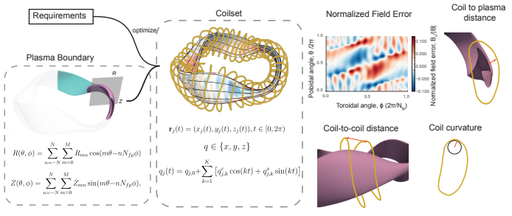
Figure 1 : Left: The target plasma boundary, parameterized as a truncated Fourier surface in θ and ϕ. Center: The generated coilset. Each filamentary coil is modeled as a closed 3D curve using a Fourier series int, a parameter that runs along the curve. Solid black lines on the stellarator surface trace the equilibrium magnetic field lines, which are tangent to the boundary. Right: Key evaluation metrics. The heatmap displays the normalized magnetic field error across one plasma field period. The diagrams below illustrate the three physical engineering constraints used in this work: minimum coil-to-plasma distance, coil-to-coil spacing, and maximum coil curvature.
Original paper · CC BY 4.0 · Jan-Hendrik Ewers, Santiago A. Cadena, Nicolò Foppiani, Andrea Merlo · CoilStellaration: A Dataset and Benchmark for Engineering-Aware Stellarator Coilset Generation · Original paper figure · Extracted the figure area from page 3 of the original PDF.REGCOIL solves for a regularized surface current on a winding surface at a fixed distance from the plasma, and Nc coils are extracted from it as the warm start. The regularization strength is uniformly sampled between limiting the maximum surface current density and limiting the maximum magnetic field error. DESC then refines the coils with an augmented Lagrangian method, minimizing a weighted least-squares mix of normalized coil length and normal-field residuals.
Each coil uses Fourier modes up to k=7 and a current, giving 46 degrees of freedom per coil. Each coilset is normalized to a major radius of 1 m and its currents are rescaled to an average on-axis field of 1 T. The REGCOIL step costs about 0.1 CPUh and the filamentary stage about 1.3 CPUh.
Matching the boundary doesn't show that the source equilibrium's pressure, current or stability is reproduced. The gold standard metric is the average normalized field error, and values below 1% usually count as good enough. REGCOIL coilsets almost never reach that value, so the authors restrict further analysis to DESC coilsets only.
Which coilsets are kept
The filter starts from the average normalized field error, which the stellarator community treats as its gold standard metric. A field error below 1% usually counts as good enough to reproduce the target field. REGCOIL coilsets almost never reach that level, so the authors restrict all later analysis to DESC coilsets.
Figure 3 plots measured values against the requirements for the three geometric constraints. Two populations appear: points that sit near the measured-equals-target line, and points where measured values fall near zero or spike high. The second population holds coilsets whose optimization missed the requirements completely, so the authors remove them.
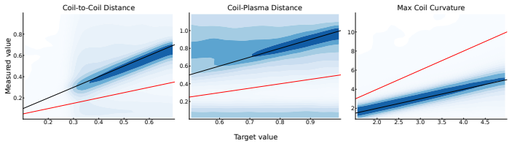
Figure 3 : Measured vs. target values for the three geometric constraints. Colour scale is logarithmic. Black line: requirement equals measured. Red line: selection cut threshold.
Original paper · CC BY 4.0The authors define relative error as measured value minus target value, divided by the target value. They keep coilsets with relative error above -0.5 for coil-to-coil distance and above -0.5 for coil-to-plasma distance. For curvature, the relative error must stay below 1.0. This cut removes 21.8% of the DESC coilsets, and a further 7.6% drop out because the metric calculation failed.
The surviving coilsets span a wide range of geometric metrics and field errors, as Figure 4 shows. The third coilset, at the highest field error, displays almost no flux surfaces.
How a predicted coilset is scored
A predicted coilset is graded on four requirements, two of them lower bounds and two upper bounds. The model must output the coilset in a single forward pass, and no optimization is allowed at inference. The grader re-evaluates the achieved metrics with the same DESC filamentary pipeline used during dataset generation. This setup keeps amortized prediction separate from classical optimization, so a model can't lean on an inner solver.
For each metric, the grader computes a normalized violation that is zero whenever the constraint holds. A saturating exponential turns each violation into a soft-feasibility score, s_i = exp(-v_i/alpha_i), which lies in [0, 1]. The tolerance alpha_i is frozen before any baseline run, so the tolerances can't be tuned to the results. When the denominator floor is inactive, a violation of alpha_i times 100% of the threshold drops the score to about 0.37.
The four scores are combined with an unweighted geometric mean, S = (product of s_i)^(1/4). Any single near-zero score pulls S toward zero, which matches the rule that a coilset failing one requirement is not feasible. The authors avoid the arithmetic mean because an arithmetic mean of 0.8 can hide a coilset that is feasible on three requirements and collapsed on one.
Across a test set, the mean of S is the headline ranking column. The median serves as a typical-instance diagnostic, alongside the soft-feasibility rate Pr[S >= 0.9]. The split is disjoint by plasma boundary, using a ConStellaration-based hash with a 95%/5% division. This produces 253,000 training rows and 13,000 evaluation rows.
The fixed-shape track fixes NFP=3 and NC=5, the most common configuration in the dataset. Requirement tiers come from tertiles of the mean normalized field error that the reference coilset achieved. An instance is tight at or below the first tertile, medium up to the second, and loose otherwise. The field-error requirement bounds the maximum sampled normalized field error, and the tiers don't order all four requirements together.
What the fixed-shape baselines score under the strict standard
The four baselines are MLP, ResMLP, EnsembleMLP and EnsembleResMLP, all sharing a bidirectional spectral-scaling interface between Fourier-parameterized boundaries, coilsets and flat vectors. MLP uses a feed-forward net with GELU activations that outputs both spatial coil arrays and scalar currents. ResMLP uses pre-norm residual blocks with split heads, where a zero-initialized currents head is conditioned on the predicted geometry.
Each single-model or ensemble run repeats with three seeds, evaluated on 2,771 fixed-shape instances.
Feasibility stays low for all four baselines, and no model comes close to saturating the benchmark. The best mean score is 0.13, and the best strict-feasibility rate is 4.4%, both from EnsembleResMLP in Table 1. Figure 5 shows strict feasibility and mean score by tier for both the fixed-shape and variable-shape tracks.
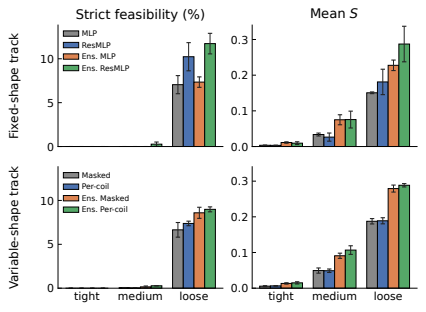
Figure 5 : Strict feasibility (%) and mean score S by require- ment tier (tight / medium / loose), for the fixed-shape track (top) and the variable-shape track (bottom). Each track shows its own four architectures. Bars are the mean over three train- ing seeds with ±1σ error bars. Across both tracks and all architectures, strict feasibility is 0% on the tight tier and near- zero on the medium tier: nearly all strictly feasible coilsets fall in the loose tier. Strict feasibility uses the benchmark tolerancev i ≤1×10 −3.
Original paper · CC BY 4.0Ensembling raises the mean score for both backbones, so averaging five networks helps the MLP and the ResMLP alike. The residual backbone adds feasibility, since ResMLP and EnsembleResMLP both beat their plain-MLP counterparts on strict feasibility. EnsembleResMLP leads on mean score, soft rate and strict rate, while EnsembleMLP keeps the best median score.
The gap in mean score between MLP and ResMLP is small compared with the spread across the three training runs.
Field error drives most of the geometric-mean collapse, because a single near-zero soft score pulls the whole score down. Median normalized field-error violations sit between 2.1 and 2.9 across all architectures. Every architecture still shows a positive median coil-to-coil spacing violation, so spacing is the other open weakness. The authors name field-error reproduction as the highest-leverage research direction for this benchmark.
One model across topologies
The variable-shape track asks one model to cover field periods NFP in {2, 3, 4, 5} and coil counts NC in {4, ..., 8}. The model gets one-hot encodings of NFP and NC appended to its input. Its slot input carries the one-hot index and the normalized position (slot + 1/2)/NC.
Ensembling lifts the mean score of PerCoilMLP from 0.082 to 0.137 on the 8,058 variable-shape instances. EnsemblePerCoilMLP is the strongest variable-shape model on every aggregate metric, with a strict-feasibility rate of 3.1%. Strict feasibility is 0% on the tight and medium tiers, so every feasible coilset lands in the loose tier.
On the fixed-shape subset at NFP=3 and NC=5, EnsemblePerCoilMLP reaches a mean score of 0.18. The authors read this as sharing capacity across the full topology distribution not hurting, and possibly helping, even though NFP=3 is oversampled. The reference coilset's mean normalized field error correlates most strongly with both strict feasibility and the score S.
Instances with larger reference mean field errors generally reach higher feasibility and mean scores.
Do learned coilsets help refinement?
The authors run the same DESC refinement used to build the dataset from two starts. The learned start is the per-coil ensemble's single-pass prediction, and the REGCOIL start is the coilset the pipeline normally uses. The comparison covers 1,289 instances from the tight stratum of the variable-shape split, each scored at a fixed iteration budget.
After 200 iterations the learned start is strictly feasible more often than REGCOIL after the dataset's full 500-iteration budget, 22% compared to 18%. Figure 7 tracks both starts across iteration budgets with 95% intervals.
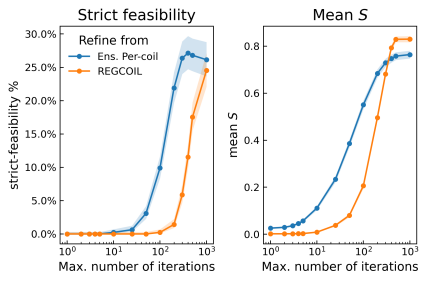
Figure 7 : Strict-feasibility rate (left) and mean scoreS (right) against the iteration budget, for the REGCOIL and learned (per-coil ensemble) starts. Each instance uses its dataset metrics as targets; the instances comprise up to 100 per (NFP, NC) pair. Markers show the tested budgets. Shaded bands are instance-level 95% confidence intervals (Wilson for feasibility, Student- t for S); they do not account for shared boundaries.
Original paper · CC BY 4.0At 500 iterations REGCOIL leads on mean score, 0.83 compared to 0.76, but is strictly feasible less often, 18% compared to 27%. The learned start levels off near 26% from 300 iterations on, while REGCOIL keeps improving. At 1000 iterations the rates are 26% and 25% with p=0.4, so the gap is not significant. The instance-level tests do not account for shared plasma boundaries.
The authors attribute the split to opposite weaknesses: REGCOIL coils are well separated but sit too close to the plasma. The authors suggest the learned start suits limited budgets, such as an outer configuration loop or a large parameter scan.
Limitations of the coilset results
The results rest on filamentary coils, so finite winding-pack dimensions are not modeled. Only a limited set of engineering constraints enters the dataset and the benchmark. Evaluation runs on target boundaries, not on the free-boundary equilibria the coils would actually produce. The authors don't test whether the resulting equilibria match the source plasma at the level of the full free-boundary solution.
Every optimization fits a vacuum coil field to the prescribed target boundary. Matching the boundary doesn't establish that the source equilibrium's pressure, current, or stability properties are reproduced. The warm-start evidence covers only the tight stratum of the variable-shape evaluation split. It also covers only the per-coil ensemble as the learned start, with 1,289 instances.
The learned start's strict-feasibility rate levels off at about 26% from 300 iterations on. At 1000 iterations, the learned start reaches 26% strict feasibility against 25% for the REGCOIL start. That gap is not significant, with p=0.4, so the two starts are indistinguishable on feasibility at that budget. The REGCOIL start keeps improving, so the comparison depends on the iteration budget.
The confidence intervals in the warm-start figure are computed per instance. They don't account for shared plasma boundaries, so the reported uncertainty is likely too narrow. Coil-to-coil spacing remains the requirement where the learned start still trails at 500 iterations.
Paper info
- Authors
- Jan-Hendrik Ewers, Santiago A. Cadena, Nicolò Foppiani, Andrea Merlo
- Venue
- arXiv · Preprint
- First published
- 2026-11-9
- Added
- 2026-11-11
- Updated
- 2026-11-9
- Version
- v1
- arXiv
- 2611.12689
- Category
- cs.LG · physics.plasm-ph
- Original paper terms
- CC BY 4.0
- What we show
- Paper info, commentary and permitted figures from the original paper
AI commentary is a separate explanation from the original paper and may contain errors. The original paper and figures follow each source's terms of use and any rights noted separately.
Abstract
Stellarators are fusion devices that use externally generated, three-dimensional magnetic fields to confine hot plasma and offer a promising route to commercial fusion. Their electromagnetic coils pose a challenging design problem: they must reproduce the target magnetic field while satisfying engineering constraints and remaining practical and cost-effective to manufacture. Finding suitable geometries is a highly nonlinear inverse problem that generally has neither a closed-form nor a unique solution. This problem lies at the heart of stellarator design. We introduce CoilStellaration, a dataset and benchmark for learning the mapping between coil geometries from target plasma magnetic fields and engineering requirements. The dataset contains 177,000 optimized filamentary coilsets targeting plasma equilibria from ConStellaration, with sampled engineering requirements and achieved geometric and magnetic-field metrics. It spans multiple coil counts and field-period numbers, supporting studies of both specialized and shared models across configurations. The benchmark asks models to predict coils conditioned on a target equilibrium and requirements on coil-coil and coil-plasma spacing, curvature, and magnetic-field error. We show that magnetic-field accuracy remains the main challenge, with learned models rarely satisfying all requirements simultaneously. However, using learned predictions to initialize conventional coil optimization can accelerate early progress. We release baseline models and evaluation code to support reproducible research on both direct coil generation and learned optimization initializations. By lowering the barrier for machine learning and optimization researchers to engage with stellarator coil design, we aim to accelerate progress toward practical, cost-effective stellarator power plants.
Quote from the paper
Jan-Hendrik Ewers, Santiago A. Cadena, Nicolò Foppiani, Andrea Merlo (2026). CoilStellaration: A Dataset and Benchmark for Engineering-Aware Stellarator Coilset Generation. arXiv:2611.12689v1. https://arxiv.org/abs/2611.12689v1
BibTeX
@misc{ewers2026coilstellaration,
  title = {{CoilStellaration: A Dataset and Benchmark for Engineering-Aware Stellarator Coilset Generation}},
  author = {Jan-Hendrik Ewers and Santiago A. Cadena and Nicolò Foppiani and Andrea Merlo},
  year = {2026},
  eprint = {2611.12689},
  archivePrefix = {arXiv},
  url = {https://arxiv.org/abs/2611.12689v1}
}