Paper commentary
Martine: Benchmarking Multi-View 3D Surface Reconstruction Across Viewpoint Coverage, Resolution, and Lighting
Martine benchmark tests multi-view surface reconstruction across viewpoints, resolution and lighting
- Problem Existing benchmarks restrict viewpoint coverage, resolution or illumination, which can favour certain methods. Many also lack accurate 3D ground truth or quantified image-to-geometry alignment.
- Method Martine captures 28 objects from 84 views over a spherical cap under single-light and multi-light regimes. It calibrates cameras in one joint Structure-from-Motion run, so the object never enters calibration.
- Results The best observed Chamfer distance is 0.058 mm over the visible surface. Neuralangelo reaches 77.9% F-score at 0.5 mm, compared to 70.6% for COLMAP at quarter resolution.
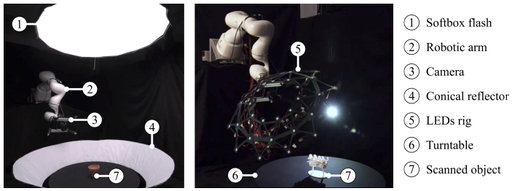
Figure 3 : Acquisition setup. (a) Single-light acquisition regime, using an ambient illumination setup designed to be rotation-invariant around the turntable axis. (b) Multi-light acquisition regime, using a rig of 30 LEDs rigidly mounted around the camera. At each viewpoint, the LEDs are activated sequentially while the camera pose remains fixed.
Original paper · CC BY 4.0 · Robin Bruneau, Baptiste Brument, Frederic Giraud, Bastian Sigrist, Sascha Jecklin, Philipp Fürnstahl, Bjoern Menze, Lilian Calvet · Martine: Benchmarking Multi-View 3D Surface Reconstruction Across Viewpoint Coverage, Resolution, and Lighting · Original paper figure · Extracted the figure area from page 5 of the original PDF.Why current benchmarks leave errors unexplained
Multi-view reconstruction is now accurate enough that small differences matter. Benchmarks for it, however, often restrict viewpoints, resolution or illumination, which can favour the methods that suit the chosen setting. DTU provides 49 to 64 views over roughly 0 to 110 degrees of azimuth, so its viewpoint coverage is narrow. DiLiGenT-MV is the usual photometric-stereo benchmark, but it has five objects, each seen from 20 views at 612×512.
Photometric-stereo datasets have the illumination they need, but each covers the other dimensions only partially. OpenSubstance registers its scans to a COLMAP reconstruction, which can fail for transparent objects, thin structures or hard materials. The resulting alignment errors are seldom quantified, so a weak score could come from the reconstruction or from the reference.
Single-light methods in photometric-stereo datasets often receive an RGB input built from the multi-light stack, typically by a median or an average over the lights. That input has no image-formation basis for single-light reconstruction, and it is usually meant to suppress specular highlights. So the reported result measures a hybrid setting of multi-light capture followed by single-light reconstruction, not a true single-light regime.
Resolution adds another ambiguity, because higher resolution hasn't consistently lowered reported error. LUCES-MV and Skoltech3D yield higher errors than DiLiGenT-MV, despite images up to 7296×5472 against 612×512. Resolution is confounded with differences in objects, reference scans and alignment, so the cause stays unclear.
Most benchmarks report one aggregate score per object, although each object mixes several geometric and optical properties. Failures due to visibility, curvature, fine structures or transparency therefore can't be separated. Prior work has shown that global Chamfer or F-score averages can poorly reflect gains or losses on high-curvature or low-visibility regions.
One object, two lighting regimes, dense viewpoints
The core design images each object from a dense spherical cap of 84 views twice, once under approximately rotation-invariant ambient light and once under a multi-light rig. That lets single-light methods run on true single-light captures instead of images averaged from the multi-light stack. The multi-light stack then supplies the per-view lighting variation that photometric-stereo methods need.
Viewpoints follow a Fibonacci-sphere distribution restricted to a cap of 80 cm radius around the object. Each view is captured at 9568×6376 with a Sony α7R V camera.
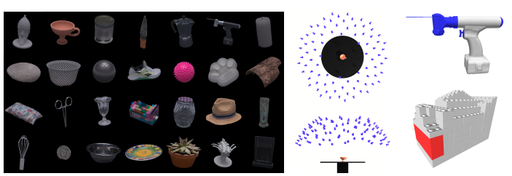
Figure 2 : Dataset overview. (a) All objects in the proposed dataset, showing high geometric and optical diversity, including low-texture regions, fine structures, transparent and specular materials, and high-frequency geometric details. (b) Dense viewpoint sampling with wide angular coverage, obtained by coupling a robotic arm with a turntable. (c) Two examples of ground-truth meshes with manually curated challenge-level 3D masks highlighting specular regions (top, in blue) and transparent regions (bottom, in red) for challenge-level evaluation.
Original paper · CC BY 4.0The aim is nearly view-invariant lighting, so the object's appearance changes little as the turntable rotates. The authors checked symmetry on a white 25 cm sphere, where intensity varies from 0.5% to 2.7% across viewpoints, with a mean of 1.4%.
Thirty Luxeon Rebel LEDs of 220 lm each sit on a rig rigidly mounted to the camera, so the camera-light geometry stays fixed across views. The LEDs fire one at a time in a darkroom, and a black image per view is captured for calibration. The count of 30 follows UniMS-PS, which reports no gain beyond 30 lights, and it balances the cost of more images per view.
Reference geometry comes from an Artec Spider scanner, specified at 0.05 mm point accuracy, for 21 of the 26 meshes. CT scans at a 0.117 mm voxel size cover the thin or concave objects, and PILLOW and COIN have no ground-truth scans. Those two objects are excluded, so all quantitative results cover 26 objects.
Calibration and alignment as measured error
MARTINE calibrates all camera poses in one joint Structure-from-Motion run, so the object never enters the calibration. Meshroom runs that SfM with DSP-SIFT features, and a Segment Anything mask limits feature extraction to the black turntable fabric. Leaving markers and checkerboards off the scene avoids inter-reflections, which would make contour extraction less robust.
Prior work found robot and turntable poses insufficiently accurate at this image resolution, so the authors didn't rely on them.
The authors compared four calibration setups on the same 6 480 checkerboard corners, taken from 20 high-angle views. The SfM-based approach reached a mean reprojection error of 0.542 px, compared to 0.666 px for the ArUco cylinder. COLMAP on the same textured cloth gave 0.809 px, while the ChArUco board gave the highest error at 1.086 px.
The measured residual also includes checkerboard-corner localisation error, on top of the calibration error.
The ground-truth scans are metric, but SfM poses carry an unknown scale, so the alignment estimates a 7-DoF similarity transform. The method treats alignment as a contour-based ICP problem that matches projected mesh silhouettes to object contours in the images. Canny edges, searched in a band around SAM object masks, supply the target contours, with parameters tuned per object.
For specular or transparent objects, the images taken after spraying raise the contrast near the silhouette.
Each object gets eight control views, chosen by k-means on the camera centres, that stay out of its registration. The mean leave-one-out residual across objects is 1.22 px, and all 26 objects stay below 2 px. The authors chose reprojection residuals over silhouette IoU, since IoU on downsampled masks can miss small contour misalignments.
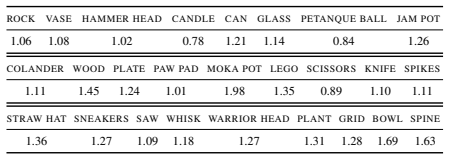
Table 2 : Leave-one-out registration residuals (mean reprojection error in pixels, over 8 control views per object.
Original paper · CC BY 4.0Global and per-object scores across paradigms
Global scores at quarter resolution show which paradigms lead, and the benchmark scores each method as an F-score over distance thresholds from 0 to 4 mm. Only Meshroom and RealityScan process full-resolution images, because the other methods fail there for lack of GPU memory. Precision and recall are the two parts of each F-score, and the F-score is their harmonic mean.
Neuralangelo reaches 77.9% F-score at 0.5 mm, and NeuS2 reaches 75.5%, while COLMAP reaches 70.6%. Because the pooled curves aggregate every point-to-surface distance, larger objects contribute proportionally more to these scores.
The neural implicit methods therefore lead the global comparison, with COLMAP trailing them on recall. COLMAP's precision is the highest beyond 0.6 mm, but its recall is lower. RNb-NeuS2 reaches 66.7%, which is below NeuS2 even though RNb-NeuS2 builds on it. SuperNormal ranks last at 60.8%, so the multi-light methods don't beat their single-light counterparts in global accuracy.
The authors read this as a sign that the photometric cues from multi-light images don't yet turn into higher global accuracy for these implementations.
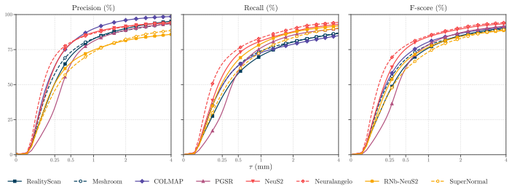
Figure 4 : Global precision, recall, and F-score curves pooled across all evaluated objects at quarter resolution (d4). Each curve aggregates all point-to-surface distances before computing the metric, so larger objects contribute proportionally more.
Original paper · CC BY 4.0On the VASE object, the authors varied the view count and the input resolution while measuring F-score at 1 mm. Across all 26 objects, COLMAP and PGSR reconstruct 14 and 13 objects with 10 views, while NeuS2 and RNb-NeuS2 reconstruct all of them. VASE is a single object, so it shows per-object behaviour rather than general conclusions.
Per property, transparent and low-visibility regions give the lowest F-scores for every method except Neuralangelo. On fine structures, NeuS2 reaches 92.1% and RNb-NeuS2 91.0%, against 59.6% for COLMAP and 52.3% for RealityScan. Neuralangelo scores lowest on low-visibility regions and fine structures, at 38.2%. The authors link this gap to patch-based MVS, since COLMAP relies on photo-consistency across views, which is weakest on specular or transparent surfaces.
These per-property gaps are often small, and they come from a single resolution, so the authors ask for caution.
The authors suggest neural surface methods tolerate view-dependent appearance better, because they optimise a global, regularised volumetric representation. Pixel-wise optimisation may also preserve thin structures and high-frequency detail, as prior work indicates. Confirming these trends needs tests at other resolutions and view counts, and the benchmark is set up for such tests.
Limitations of the benchmark and its first evaluation
The property taxonomy is conservative, so uncertain regions are left out of the evaluation. Regions where the label was uncertain are excluded, which keeps the labels reliable but leaves part of the surface outside the property analysis.
The benchmark stops at 28 objects because acquiring and validating the data takes about one day per object. Each object yields 2 604 images at 61 megapixels, and the workflow includes acquisition, scanning, alignment, and quality control.
Only Meshroom and RealityScan process full-resolution images, because the other methods run out of GPU memory at 9568×6376. The other methods run at half resolution or below, and Neuralangelo and SuperNormal run only at quarter resolution. The per-property analysis is conducted at a single resolution, and several of its gaps are small. Patch-based MVS and neural methods are therefore not compared across resolutions on that analysis.
The authors evaluated surface reconstruction only, so the evaluation does not cover novel-view synthesis. Confirming the trends across paradigms requires testing at different resolutions and view counts.
Paper info
- Authors
- Robin Bruneau, Baptiste Brument, Frederic Giraud, Bastian Sigrist, Sascha Jecklin, Philipp Fürnstahl, Bjoern Menze, Lilian Calvet
- Venue
- arXiv · Preprint
- First published
- 2026-11-8
- Added
- 2026-11-10
- Updated
- 2026-11-8
- Version
- v1
- arXiv
- 2611.11602
- Category
- cs.CV
- Original paper terms
- CC BY 4.0
- What we show
- Paper info, commentary and permitted figures from the original paper
AI commentary is a separate explanation from the original paper and may contain errors. The original paper and figures follow each source's terms of use and any rights noted separately.
Abstract
Controlled acquisition setups are widely used for high-accuracy multi-view 3D surface reconstruction, as they allow sensor configuration, image resolution, viewpoint distribution, and illumination to be specified. Yet benchmarking remains difficult, since reconstruction accuracy depends jointly on the reconstruction paradigm, object properties, and acquisition regime. Existing benchmarks often restrict viewpoint coverage, resolution, or illumination, which can bias comparisons towards methods suited to the chosen setting. Others lack accurate 3D ground truth or quantified image-to-geometry alignment, limiting their use for metric surface evaluation. We introduce Martine, a benchmark for controlled 3D object surface reconstruction. Martine comprises 28 objects, including transparent materials and fine structures, captured at 9568 x 6376 pixels from 84 views over a spherical cap under both single-light and multi-light regimes. It provides object-independent camera calibration, accurate 3D ground-truth scans, calibration and image-to-geometry accuracy quantified on test images, and 3D property masks for analysing errors by material properties, visibility, curvature and fine structures. Experiments across photogrammetry, classical multi-view stereo, neural implicit surfaces, Gaussian-splatting-based reconstruction, and multi-view photometric stereo show that Martine enables regime-aware evaluation with explicit control over reference-data accuracy. The benchmark resolves sub-millimetric reconstruction differences, with a best observed Chamfer distance of 0.058 mm over the evaluated visible surface.
Quote from the paper
Robin Bruneau, Baptiste Brument, Frederic Giraud, Bastian Sigrist, Sascha Jecklin, Philipp Fürnstahl, Bjoern Menze, Lilian Calvet (2026). Martine: Benchmarking Multi-View 3D Surface Reconstruction Across Viewpoint Coverage, Resolution, and Lighting. arXiv:2611.11602v1. https://arxiv.org/abs/2611.11602v1
BibTeX
@misc{bruneau2026martine,
  title = {{Martine: Benchmarking Multi-View 3D Surface Reconstruction Across Viewpoint Coverage, Resolution, and Lighting}},
  author = {Robin Bruneau and Baptiste Brument and Frederic Giraud and Bastian Sigrist and Sascha Jecklin and Philipp Fürnstahl and Bjoern Menze and Lilian Calvet},
  year = {2026},
  eprint = {2611.11602},
  archivePrefix = {arXiv},
  url = {https://arxiv.org/abs/2611.11602v1}
}