Paper commentary
Measuring Generative AI Content in Political Campaigns: Evidence of Rising Adoption and Non-Disclosure
Campaigns' AI-generated content is rising, and most of it goes undisclosed
- Problem Campaign use of generative AI is hard to track, since candidates rarely label it and finance reports miss free tools. Detection alone struggles with short social posts that lack metadata or watermarks.
- Method The authors score campaign text and images with outside detectors, then condense each campaign into two metrics. Magnitude measures how much AI content a campaign produces, and modality splits that by website, X and email.
- Results Detectable AI content rose significantly across modalities from 2023 to 2025, and campaigns that use it often do not disclose it. Only 7.6% of text samples were flagged as AI.
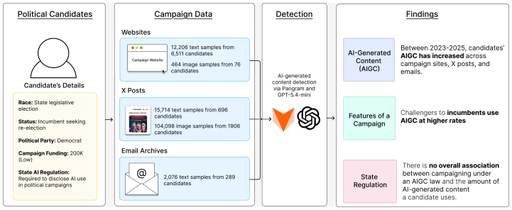
Fig. 1 . We collect data on political candidates across political races from 2023 to 2025 and their campaign data from three modalities (campaign websites, X posts, and emails). We apply AI detection methods to text and image content and introduce two metrics to estimate prevalence of AIGC across races and modalities. We use these estimates to characterize detectable AIGC use over time, which types of candidates use it, and potential effects of state regulations on its use.
Original paper · CC BY 4.0 · Anna-Maria Gueorguieva, Nic Weber · Measuring Generative AI Content in Political Campaigns: Evidence of Rising Adoption and Non-Disclosure · Original paper figure · Extracted the figure area from page 2 of the original PDF.Why campaign AI use stays hidden
Candidates can disclose AI use directly, through statements or captions attached to their content. Close to half of U.S. states now require labels on materially deceptive AI election content, and twenty-four of them did so by 2025. Most of these laws bite only 30 to 120 days before an election, which leaves a narrow window. Indirect disclosure instead relies on platform labels and campaign finance records of AI purchases.
Finance reports are coarse, because candidates may bundle AI software with other technical or logistical tools. Candidates who use free AI tools report no spending, so those records miss them entirely. Detection is the remaining route, but it struggles with short social posts that lack metadata and watermarking. AI detection is still an open technical problem, as multimodal models and humanization methods keep changing.
Most earlier work examined deepfakes and voter trust rather than the content candidates produce at scale. Studies of paid advertising on Meta and Google platforms produced only a small-n sample, because the searches could not be automated.
So the authors ask how much detectable AI content candidates produce across channels, and whether that amount changes over time. They also ask whether state laws go with less of it, because enforcement needs independent verification of AI content.
Magnitude and modality, built from detector scores
Magnitude and modality turn raw detector output into one campaign-level number and one number per channel. The authors treat outside detectors as instruments with error, so every score is read as an estimate. Pangram gives each text sample an AI assistance score from 0 to 1, and GPT-5.4-mini gives each image a binary AI label. Samples labeled "AI" or "Mixed" count as detected AI, which fixes the binary side for text.
Magnitude adds token-length weighted text AI-assistance scores to the binary image labels. Because Pangram's score is very rarely exactly zero, a campaign only reaches zero when all its images are non-AI.
Modality reruns the same magnitude calculation separately for campaign sites, X, and email. Each channel therefore gets its own magnitude, which lets the analysis compare one candidate across channels. For candidates with scores in all three modalities, a Friedman test checks whether magnitude differs within the same candidate. Email data covers fewer candidates, so a Mann-Whitney U test restricted to campaign sites and X keeps the sample larger.
For text, the authors choose Pangram because independent evaluations find it performs well across domains. Because campaign web pages contain more text, the authors sample a contiguous 60% of each page's body text, preserving sentence order. Samples shorter than 70 tokens are excluded, and mean lengths are 536 tokens for websites, 662 for emails and 125 for X posts.
For images, the authors adopt the approach of Chen et al., who used GPT-4o on X images from the 2024 presidential election. Chen et al. reported a 6.5% false positive rate and a 1.6% false negative rate on 2,000 labeled images. The authors validate GPT-5.4-mini on 340 images from Chen et al., 170 AI and 170 non-AI. GPT-5.4-mini agrees with the prior labels 78.3% of the time, with 16.5% false negatives and 5.2% false positives.
The authors read this conservative labeling as a choice that makes the image estimates measure detectable AI, not all AI use.
Assembling the candidate dataset
The dataset covers 12,977 candidates for federal, state and local offices from 2023 to 2025. The authors combine the MIT Election Lab, Ballotpedia, Wikipedia and the National Governors Association, keeping the top two by vote share in each general election. Coverage is complete for all races except state legislators and U.S. House races, where the authors manually checked that missing candidates aren't concentrated in any region or party.
Ballotpedia, Wikipedia and automated DuckDuckGo searches supply the campaign site and X account links. For 2023 races, candidates often no longer maintain a web presence, so the authors used the Internet Archive's Wayback Machine. Archived pages recovered 21.7% of the missing web presences, and the authors found 4,246 X URLs and 8,171 campaign site URLs.
Campaign emails come from the Archive of Political Emails, which yielded 2,076 emails.
The authors scraped homepage, About and Policy pages from each campaign site, and collected X posts with their text and images. X posts span five months before to one month after November 5th, or the exact date of a special election. Text samples under 70 tokens were removed, because 70 tokens is the minimum required by the AI-text detector.
Non-English text and sites ending in .gov or official township websites were also excluded. Incumbency status, race type and political party come from the MIT Election Lab and Ballotpedia, while funding comes from OpenSecrets. Fixed effects for RQ3 also use the exact election date and a district partisan lean score based on the 2024 presidential outcome.
State AI election laws were collected from the National Conference of State Legislatures database for 2019 to 2025. Because the authors care about campaign behavior rather than strict legal compliance, pending legislation passed in an election year still counts.
AI magnitude rose from a low base
The authors measured magnitude by year and race type, and they used a Mann-Whitney U test to compare consecutive years. Magnitude adds token-length weighted Pangram AI-assistance scores and binary AI image labels, then divides by the total number of content data points. A score of 0 means no AI-generated content, and a score of 1 means complete use of AI across all sampled content.
For State House, State Senate and US House races, magnitude rose significantly from 2024 to 2025, with p below 0.05 for each. The 2023 to 2024 change was not significant for those races. Mayoral races, by contrast, rose significantly from 2023 to 2024, though not from 2024 to 2025. So the increase shows up in some race types and years but not others, which makes the trend uneven.
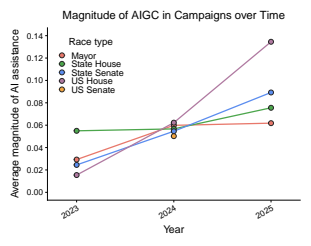
Fig. 2 . Average magnitude of AI-generated content in campaigns over time, by race type. U.S. Senate elections occurred only in 2024.
Original paper · CC BY 4.0The absolute level stays low, even though the trend is statistically clear. Fewer than 10% of content across modalities and types was identified as AI-generated. The authors detected 7.6% of text samples (N = 29,996) as AI. They detected 6.1% of image samples (N = 104,562) as AI. Detected AIGC therefore makes up a small share of campaign content, even as magnitude rises.
The authors also split the comparison by modality, which the next section examines in detail. Within candidates, X had the highest magnitude at 0.071, followed by email at 0.057 and campaign sites at 0.027. They didn't test whether the rise in magnitude differs by modality. The authors also acknowledge that detection covers only visible text and sampled content.
Which channels carry the AI content
Within 130 candidates who have magnitude scores on all three channels, magnitude differs significantly across channels. The Friedman test gives a chi-squared of 48.8 with df = 2 and p = 2.531e-11. X has the highest mean magnitude at 0.071, followed by email at 0.057 and campaign sites at 0.027. The passage also calls this group three candidates, which conflicts with the 130 stated just before it.
Bonferroni-corrected Mann-Whitney tests separate every pair of channels at p below 0.0001.
Email covers fewer candidates, so the authors widened the comparison to 1,535 candidates with both site and X scores. In that larger group, the Mann-Whitney test still finds a significant difference between the two channels. X averages higher than campaign sites, at 0.057 against 0.047. The authors suggest candidates may put more AI content on social platforms like X than on their sites.
Table 1 reports shares of detected content, with campaign site text at 7.5%, X text at 8.2% and email at 3.7%. The same table reports image shares of 10.5% for campaign sites and 6.1% for X. These shares measure something different from the magnitude scores, so they offer another cut of the same data.
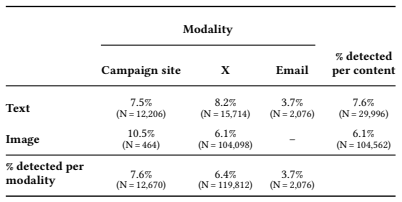
Table 1 . Share of content detected as AI-generated, by content type and modality.
Original paper · CC BY 4.0How rarely AI use is disclosed
Campaigns rarely label their AI content, so the authors checked three disclosure channels: campaign site text, X images, and finance records. For text, the authors replicated the regex patterns used by He and Bu and added their own terminology filter. Every captured site passage then went through a manual review to verify the candidate's disclosure intent.
Only one campaign website carried a statement that its content was created with artificial intelligence. That statement doesn't say which content it covers, and the authors found no further detail. Other disclosure statements concern website builders such as Campaign Partner and Tech for Campaigns, and it isn't clear those tools use AI. Two authors manually reviewed 505 randomly sampled X posts with an AI-detected image, looking for disclosure in the image or its caption.
None of the 505 posts showed disclosure, by the candidate or by the platform.
For indirect disclosure, the authors matched candidates against expense reports from the FEC and four state agencies. The agencies were Massachusetts, Washington, Colorado and California, and matching used name, race type and year. The matching found 129 candidates in federal and state races who had content and reported spending on AI tools.
Most reported tools serve campaign outreach or logistics, such as Prompt.io, Calltime AI and Otter AI. Grammarly and OpenAI could generate text, and one candidate paid for Anthropic. Only four candidates paid for tools that generate image or graphical content, such as Midjourney and Canva AI. Of those 129 candidates, 48% were not identified by the detection tools as using AI at all.
The authors point to detector limits, AI tools that produce no text or images, free AI services and unitemized spending as possible causes.
Taken together, the disclosure checks suggest that detected AI content is rarely labelled by the campaigns that produce it. Metadata could close part of this gap, since Colorado's House Bill 24-1147 requires deepfakes to carry the tool and creation time. Platforms such as Meta already archive AI-altered election ads in a public Ad Library, which the authors suggest could be shared.
Campaign features and AI magnitude
The authors fit a zero-inflated beta regression because magnitude scores contain exact zeros and many near-zeros. They modeled magnitude, a continuous score between 0 and 1, for 6,285 candidates after dropping those with missing predictors. The first model puts state and year in as random intercepts to absorb clustering. It estimates average marginal effects (AMEs) for incumbency, race type, party, funding, and state law compliance.
Challengers' campaigns carry higher AI magnitude than incumbents' campaigns, with a gap of 0.014 and a 95% CI of [−0.017, −0.010]. The text prints the lower bound as −0.018, so the value differs from Table 2. Federal races show an AME of 0.010, with a CI of [0.005, 0.015], relative to state legislative races. Republicans sit 0.003 above Democrats, with a CI of [0.000, 0.006].
Candidates under a disclosure law differ from those without one by 0.003, with a CI of [0.000, 0.007].
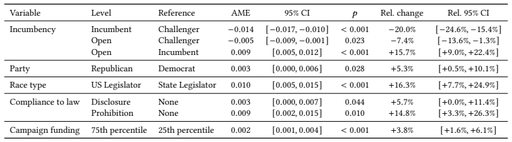
Table 2 . Average marginal effects on campaign AI magnitude.
Original paper · CC BY 4.0Funding has a small positive association, with an AME of 0.002 (95% CI [0.001, 0.004]) between the 25th and 75th percentiles. Those percentiles correspond to $19,580.73 and $237,906.87 in the model. The interaction model found no significant interaction effects, so the incumbency gap doesn't hinge on funding. The authors read this as a sign that incumbency works through mechanisms beyond funding.
They didn't test demographic traits, because the data sources lacked candidate characteristics.
On the 0 to 1 scale these effects are small, with incumbency at only a 0.014 difference on average. Features shape AI use only modestly, even where the associations reach significance.
State regulation and the TWFE comparison
States differ in many fixed ways, such as political culture and media markets, that could shape both regulation and AI use. A simple cross-state comparison would therefore be confounded, so the authors built a within-state comparison instead. The two-way fixed effects (TWFE) model absorbs state and election-year fixed effects, which isolates within-state, within-period variation.
A candidate counts as regulated when the election happened after the state's law took effect, dated to the day of the election.
The model also adjusts for incumbency, party, campaign funding, special elections, and the partisan lean of the district. Standard errors allow for correlation within states, because candidates in the same state aren't independent observations. Pooled across all office-level candidates, the estimate is essentially zero at -0.018 in transformed units.
The 95% confidence interval runs from -0.059 to 0.023, so the pooled result doesn't separate from zero.
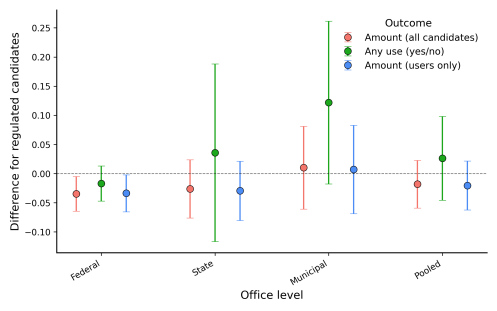
Fig. 3 .Impact of state regulations at the office-level.Each point is the estimated coefficient on the “regulated” indicator from a separate two-way fixed effects (TWFE) regression; The three colors portray differences in how the outcome is defined: Any use (yes/no), green = whether a candidate used any AIGC at all (binary); Amount (all candidates), red = magnitude of AIGC use across all candidates (zeros included); Amount (users only), blue = magnitude of use among only candidates who used some AIGC (zeros excluded).
Original paper · CC BY 4.0Restricting the federal sample to candidates who already used some AIGC gives -0.034, with a 95% CI of -0.065 to -0.002. State candidates show -0.026 with a CI of -0.076 to 0.024, and municipal candidates show +0.010 with a CI of -0.061 to 0.081. The municipal estimate rests on only 144 candidates, so it is the least stable of the three.
The authors call these results descriptive differences, not evidence that the laws changed candidate behavior. Because nearly all measurable candidates use some AIGC, the authors read the federal gap as one of magnitude, not of use. The authors see these estimates as a baseline for future elections under different regulation regimes. The regulation result is narrow, appearing for federal races only and absent from the pooled sample.
Limitations: what the measures and comparisons leave open
Detection leaves the largest gap, because detectors can miss AI involvement when people edit existing text or visual data. Pangram's output is treated as an estimate, since detectors produce false positives and their accuracy shifts with text length and domain. X posts average 125 tokens, so the authors read their X estimates with extra caution.
For images, GPT-5.4-mini agreed with Chen et al.'s labels 78.3% of the time on 340 images, with 16.5% false negatives. They didn't compare other detectors, so the results describe what these two tools report.
The authors collected data retrospectively on completed campaigns, which limits what live monitoring can reveal. Missing sites were recovered through the Wayback machine, which may bias coverage toward pages that were archived. The disclosure review covered only visible campaign text, so content rendered dynamically on websites went unchecked.
Human review of disclosure covered only 505 AI-detected X images, so other images stayed unexamined. Video was excluded, so deepfake audio and other video-specific cases remain unmeasured.
The municipal sample includes only 144 candidates, which limits how far the municipal estimate can carry. The regulation estimates are descriptive, and the authors don't treat them as evidence that the laws changed candidate behavior. Future work could apply the approach to videos or other modalities to measure AIGC magnitude in those settings.
The authors present these effects as a baseline for measuring future elections under different regulation regimes.
Policy options beyond detection
The authors argue that detection at scale depends on metadata, and platforms already hold part of that data.
The second proposal is expenditure reporting, which asks campaigns to list AI spending and what it was used for. For example, Washington's Public Disclosure Commission requires candidates and committees to disclose vendors, amounts paid, and target audience for expenditures using synthetic media [11]. These rules apply to political advertisements, so they don't necessarily cover AI used for online content, campaign operations, data analysis, or voter outreach.
Campaigns may contract designers and consultants that use AI, which creates a downstream chain of AI use the candidates may not know about. Itemized reports of AI spending, the authors argue, can increase transparency.
Paper info
- Authors
- Anna-Maria Gueorguieva, Nic Weber
- Venue
- arXiv · Preprint
- First published
- 2026-11-8
- Added
- 2026-11-10
- Updated
- 2026-11-8
- Version
- v1
- arXiv
- 2611.11658
- Category
- cs.AI
- Original paper terms
- CC BY 4.0
- What we show
- Paper info, commentary and permitted figures from the original paper
AI commentary is a separate explanation from the original paper and may contain errors. The original paper and figures follow each source's terms of use and any rights noted separately.
Abstract
The use of generative AI in political campaigns has drawn public concern and policy attention. Public concerns range from distrust of candidates to skepticism about the authenticity and accuracy of political advertising, including AI-generated images and video. Nearly half of U.S. states have enacted laws that prohibit, or require disclosure of, "materially deceptive" AI-generated content (AIGC) in elections to guard against these concerns. This study measures how candidates and their campaigns produce and circulate AIGC during an election cycle. We develop two measures that estimate not only wether campaigns use AIGC, but how much they produce (magnitude) and in what forms (modality). We apply these measures to a novel dataset of text and images from the campaign websites, X accounts, and emails of 12,977 candidates for U.S. political office from 2023 to 2025. We report three findings. First, detectable AIGC from campaigns increased significantly across modalities over the observation window, and campaigns that use AIGC frequently do not disclose it. Second, incumbents' campaigns produced significantly less AIGC than challengers' campaigns. Third, candidates in states with AIGC disclosure or prohibition laws do not produce measurably less AIGC than candidates in other states. Our method and findings have implications for transparency and trust in elections, and on state laws that regulate AI use in campaigns. Because current state laws largely target mainly "materially deceptive" content, we identify additional policy mechanisms that could increase electoral transparency and improve trust as AIGC becomes more prevalent.
Quote from the paper
Anna-Maria Gueorguieva, Nic Weber (2026). Measuring Generative AI Content in Political Campaigns: Evidence of Rising Adoption and Non-Disclosure. arXiv:2611.11658v1. https://arxiv.org/abs/2611.11658v1
BibTeX
@misc{gueorguieva2026measuring,
  title = {{Measuring Generative AI Content in Political Campaigns: Evidence of Rising Adoption and Non-Disclosure}},
  author = {Anna-Maria Gueorguieva and Nic Weber},
  year = {2026},
  eprint = {2611.11658},
  archivePrefix = {arXiv},
  url = {https://arxiv.org/abs/2611.11658v1}
}