Paper commentary
JFinBench: A Continuously Refreshable Japanese Financial Benchmark from the Latest Certification Exams
- Problem Existing financial benchmarks cover few country-specific systems and go stale once their questions leak into training data.
- Method A coding agent writes per-exam conversion code and a review page, and a human checks every converted example against its source page.
- Results Claude Fable 5 reached 95.8 overall without tools, while the best open-weight model, Kimi K3.1 Pro, reached 83.4.
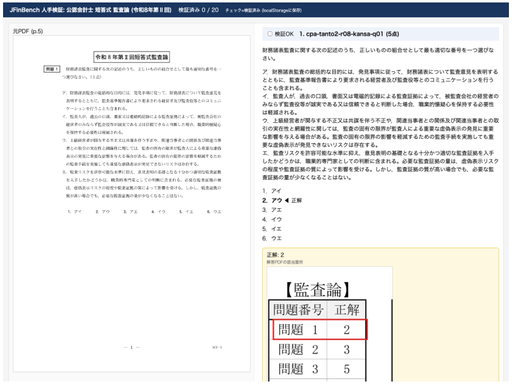
Figure 8 | Human verification interface (shown: CPA short-answer exam, auditing).Left:the source exam PDF page. Right:the final record with example ID (cpa-tanto2-r08-kansa-q01), question, options, and the answer key with the corresponding region of the answer-key PDF.
Original paper · CC BY 4.0 · Issa Sugiura, Taro Makino, Takashi Ishida · JFinBench: A Continuously Refreshable Japanese Financial Benchmark from the Latest Certification Exams · Original paper figure · Extracted the figure area from page 21 of the original PDF.Where existing financial benchmarks fall short
Financial answers depend on local tax rules, accounting standards and regulation, so a benchmark built mainly on English-language material and U.S.-centric settings says little about Japanese practice. Hirano (2024) assembled a Japanese benchmark from certification exams, but it spans four exams, uses only multiple-choice items, and leaves out tax calculations, essays and questions that rely on figures.
A second weakness is staleness. Tax rules and regulations change, so an older exam edition can ask about rules that no longer apply. Once a benchmark is published, its questions can enter training corpora, and then a score partly measures memorization rather than generalization. Refreshing a benchmark with new material helps, but turning fresh source documents into reliable structured examples is labor-intensive, which slows updates.
Turning exam PDFs into reviewed examples
Exam PDFs vary in layout from exam to exam and even between questions in the same exam, and standard text extraction loses tables, answer forms and figures. The pipeline therefore starts from rendered page images and runs in three steps, with each step handing its output to the next.
Shared scripts render each page at 300dpi and have Gemini 3.8 Flash transcribe it into markdown that keeps the page layout. Figures that cannot be written as text become explicit placeholders instead of disappearing. A character-multiset comparison against the text extracted with PyMuPDF then flags omitted or invented text for inspection.
All 321 examples went through this loop, about two hours per exam and roughly 12 hours in total. Nothing in the generic scripts or the agent workflow is specific to finance, so the same approach could serve other certification exams such as medical licensing or bar exams.
What the 321 examples contain
JFinBench draws on six certification exams held between May and August 2026, each represented by its most recent edition and, where offered at several levels, its highest level. The exams are the CPA short-answer exam, the Certified Public Tax Accountant exam, FP Level 1 written, the Financial counter services Level 1, Nissho Bookkeeping Level 1 and Zensho Bookkeeping Level 1, with section and example counts given in the table.
Of the 321 examples, 193 are multiple choice, 87 are short answer, 18 are structured forms and 23 are essays, and 12 include an image. The 321 examples come from 267 source problems, and the 128 examples that are not multiple choice require generated answers, from single values to full essays. The image examples, such as land-plot diagrams, are passed to the models as visual inputs.
Forms contain up to about 40 interdependent blanks and are graded blank by blank, while essays are graded by the fraction of answer-key points they cover.
How models are run and scored
The main evaluation gives each example to a model in a single API call without tools, so the score mainly reflects what the model stores in its parameters together with its own reasoning. Twelve models are tested: three proprietary models, Claude Fable 5, GPT-6 Astra and Gemini 3.8 Flash, and nine open-weight models. Gemini 3.8 Flash is accessed through Google's official API, and the other models go through OpenRouter, pinned to each developer's official provider, except DeepSeek V4.1 Flash 1017, which is served by DeepInfra.
Each model uses its developer's recommended sampling parameters where they are published, with a maximum output length of 131,072 tokens. Each model runs at the maximum and the minimum reasoning effort it supports, and a model without an effective effort control runs once with thinking enabled. Because outputs and judge decisions vary between runs, each combination is run three times and the mean is reported.
Scoring follows the question type. MCQ answers are extracted with a regex, with an LLM judge handling malformed outputs, short answers are checked by an equivalence judge, forms earn blank-level partial credit, and essays earn credit for the key points they cover. GPT-5.1 is the grader for all judges, and a re-grade with a second judge, Claude Opus 5.5, gives closely matching scores.
Scores without tools
At maximum reasoning effort, Claude Fable 5 reached 95.8 overall and GPT-6 Astra reached 93.6.
Gemini 3.8 Flash, the third proprietary model, reached 88.8, and GPT-6 Astra leads Kimi K3.1 Pro by 10.2 points.
They contrast it with agentic coding, where Kimi K3.1 Pro is reported at 65.7% on Terminal-Bench 4.0, above GPT-6 Astra's 58.2%, a figure cited from Moonshot AI (2026b) rather than measured in this study.
Cost and parameter count
Gemini 3.8 Flash has the lowest cost among the leading models and outscores every open-weight model even at low effort.
Score generally rises with parameter count, with a Pearson r of 0.82, but parameter count does not explain everything. Kimi K3.1 Pro, post-trained from Kimi K3, scores 3.5 points higher at the same 2.8T parameters, which the authors attribute to post-training.
Why models fail
Each failed example, meaning one with a score below 0.5, is taken from the first maximum-effort run of each model and assigned one of six primary causes: knowledge, misreading or reasoning, calculation, format or incomplete answer, token-limit truncation and grading artifact. The distribution of these causes for each model is shown in the failure figure.
To check the classifier, one author labeled 30 sampled failures, five per category, and the labels agreed on 26 of 30, with Cohen's kappa of 0.84; all four disagreements fell between the knowledge and misreading or reasoning categories.
Scores with tools
In the with-tools setting, each model works over multiple turns with a terminal and web access, inside an isolated container run by the Harbor framework. Each model runs with Terminus-2, mini-SWE-agent and the developer's official harness where one exists, and the best of these is reported. Answer keys are off-limits, every trajectory is audited with an LLM, and 8 of the 11,556 Terminus-2 attempts (0.07%) used answer material and scored 0.
Every model improves with tools, and the open-weight models gain between 9.5 and 29.9 points, the largest gain being GLM 5.3 Flash.
All four models most often consult e-Gov, the government's statute database. The open-weight models query search engines far more often, with DuckDuckGo used in 47% of the GLM 5.3 Flash tasks against at most 11% for the proprietary models.
Limitations
Every exam postdates every knowledge cutoff reported in the appendix, but this temporal separation does not rule out contamination. Most vendors report no cutoff, reported cutoffs are self-declared and defined differently, and training data may differ from the effective cutoff or be post-trained on later material. Refreshing the benchmark with future exam editions is the main mitigation.
The benchmark still tracks open-weight models, which trail by 12 percentage points without tools.
Paper info
- Authors
- Issa Sugiura, Taro Makino, Takashi Ishida
- Venue
- arXiv · Preprint
- First published
- 2026-11-13
- Added
- 2026-11-16
- Updated
- 2026-11-13
- Version
- v1
- arXiv
- 2611.18130
- Category
- cs.AI
- Original paper terms
- CC BY 4.0
- What we show
- Paper info, commentary and permitted figures from the original paper
AI commentary is a separate explanation from the original paper and may contain errors. The original paper and figures follow each source's terms of use and any rights noted separately.
Abstract
Large language models (LLMs) are increasingly applied to finance, creating a need for benchmarks that evaluate their capabilities across financial systems with different regulations and practices. However, existing financial benchmarks provide limited coverage of country-specific financial systems, and they are difficult to keep up to date as released questions leak into training data. We introduce JFinBench, a Japanese financial benchmark comprising 321 examples from the 2026 editions of six regularly administered certification exams covering accounting, tax, financial planning, and banking. To construct it, we develop a human-in-the-loop agentic pipeline in which a coding agent writes exam-specific conversion code and a review page, while a human verifies every example and feeds corrections back to the agent. This pipeline adapts to heterogeneous exam formats and reduces the effort of incorporating new exam editions, enabling periodic refreshes that mitigate data contamination. Evaluating 12 recent LLMs, we find that Claude Fable 5 and GPT-6 Astra exceed 93% overall, while even the best open-weight model, Kimi K3.1 Pro, trails Claude Fable 5 by 12 percentage points. When models can additionally use a terminal and web access, they retrieve the knowledge they lack and every model improves. The gap narrows but about 4 points remain, and the ranking of models stays largely the same, suggesting that knowledge held in the model itself remains valuable even with tools. We release the dataset, the evaluation code, and the construction pipeline.
Quote from the paper
Issa Sugiura, Taro Makino, Takashi Ishida (2026). JFinBench: A Continuously Refreshable Japanese Financial Benchmark from the Latest Certification Exams. arXiv:2611.18130v1. https://arxiv.org/abs/2611.18130v1
BibTeX
@misc{sugiura2026jfinbench,
  title = {{JFinBench: A Continuously Refreshable Japanese Financial Benchmark from the Latest Certification Exams}},
  author = {Issa Sugiura and Taro Makino and Takashi Ishida},
  year = {2026},
  eprint = {2611.18130},
  archivePrefix = {arXiv},
  url = {https://arxiv.org/abs/2611.18130v1}
}