Paper commentary
Fuse-All MoE Inference Kernel with Load Balancing on TPUs
- Problem Skewed routing concentrates expert work on a few devices, and the separate expert intermediates and receive buffers add HBM traffic to MoE inference on TPUs.
- Method Fuse-All MoE runs token collection, both expert projections, the gated activation and direct output writes in one expert launch, then adds load balancing that changes where work runs while each token-slot still writes to a fixed output row.
- Results Skewed EP16 prefill kernel runtime fell from 2.3x to 1.09x the balanced-workload kernel reference, and symmetric EP8TP2 cut decode kernel-operation latency by up to 21.3% relative to fused EP16 over 32 to 512 tokens.
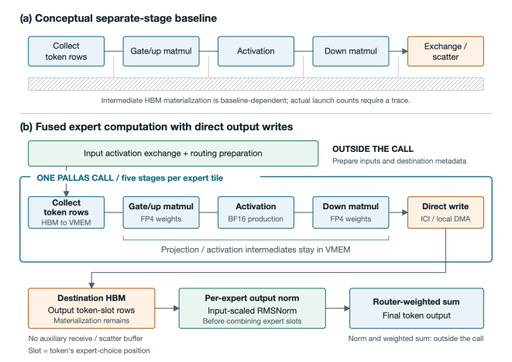
Figure 1 :Fusion boundary. Gate/up and activated intermediates stay in VMEM; expert results go directly to final token-slot buffers. Routing, input exchange, and postprocessing remain outside the expert launch. Boxes show logical stages, not measured kernel counts.
Original paper · CC BY 4.0 · Rupeng Liu, Bangsheng Tang, Zongwei Zhou, Chengji Yao, Yejin Lee · Fuse-All MoE Inference Kernel with Load Balancing on TPUs · Original paper figure · Extracted the figure area from page 2 of the original PDF.Fusing the expert launch around fixed destinations
Expert parallelism places experts on different devices, so the router's choices decide how much expert arithmetic each device carries, and a heavily loaded device can hold up the whole layer. Fuse-All MoE keeps token collection, both expert projections, the gated activation and the output writes inside one expert launch, and keeps the gate, up and activated intermediates in VMEM instead of writing them to HBM.
Routing, upstream input exchange and the router-weighted combination remain outside that launch, which Figure 1 marks with its boundary.
Keeping the output side fixed is what lets balancing work change placement safely. Each routed (token, slot) pair maps to a row computed from the token's local index and its slot, so the destination depends only on the contiguous token partition and not on which expert produced the result. The mapping is destination(t) = floor(t / c), local_token(t) = t mod c and output_row(t,s) = local_token(t) * k + s, with c = T / P owned tokens per rank.
Figure 3 works through a four-token example with two ranks and two slots, showing that an expert result can return to a different rank than the one that computed it.
Direct write means each local or remote DMA places an expert result in its final token-slot row, so no auxiliary receive buffer or receive-side scatter-add is needed. Transport only moves the rows; it does not sum them, so the combination across expert choices happens later in postprocessing.
What one tile does between collection and the write
Each tile starts by gathering its input rows with indexed DMAs from HBM straight into VMEM, which avoids building an expert-sorted activation tensor in HBM. The kernel unpacks W1, applies its scales, and computes the gate and up vectors together. The gated activation then writes its result directly into the VMEM input of the down projection.
The down projection multiplies by W2 to give a hidden-width result, which is staged for output DMA while later tiles compute.
The weights are stored as FP4 e2m1 values, packed eight to a uint32 word along K and read in place without a copy. Block scales are FP32 with shape [experts, K_blocks, 1, N], and each scale covers a group of K values. A separate global scale applies to the gate, up or down projection of each expert, so block scales and global scales are both applied to a projection.
For RMS-normalized expert blocks, each expert result is scaled and normalized before the weighted sum, using u[t,s] = (1 + norm_weight) * z[t,s] and v[t,s] = u[t,s] / sqrt(mean(u[t,s]^2) + 1e-8). The router-weighted combination then forms y[t] = sum over s of a[t,s] * v[t,s], which the paper distinguishes from applying RMSNorm to the weighted sum, since those two are not equivalent.
Postprocessing runs outside the launch, so the fused kernel itself returns one row per routed assignment.
Accumulation precision on the fused path
Block matmuls request FP32 results, but in the BF16-output FP4 path they are cast into a BF16 shared accumulator, so accumulation does not stay in FP32 across the whole computation. Block scaling, summation, global scaling, the activation and the stored intermediates therefore are not kept in FP32 throughout. The W4A8 variant quantizes each activation row by K-block absmax, and the W4A16 variant keeps BF16 activations.
Using BF16 instead of FP32 for the accumulator saves 16 KiB per row for an 8192-column accumulator, and the saving is smaller for narrower N tiles. An outer K tile can contain several conversion-and-accumulation steps, so the authors treat layer- and model-level accuracy validation as necessary, particularly for long K or several outer K tiles.
Balancing prefill with buckets, hot experts and chipmate moves
For uneven expert loads, the kernel picks the smallest precompiled row bucket that covers a tile's valid rows plus its leading alignment padding, so a sparse tile does not compute at full height. Each bucket is a separately compiled branch, so the implementation limits the bucket count times the row cost factor times tm, falling back to full height above 768; a 512-row allocation therefore cannot use two buckets.
Hot-expert interleaving alternates tiles of the busiest expert with tiles of other experts, so the longer hot-expert computation hides the weight loads of short-lived experts. A stable merge keeps each stream in order and places unmatched tiles in a tail. The skew test takes, across devices, the busiest expert's load divided by the mean expert load on that device, excluding invalid routes and applied before chipmate redistribution.
Chipmate redistribution moves at most one expert within each chip's pair of TensorCore devices per invocation, using replicated valid-row counts and the topology map, so no planning collective is needed. For large prefill batches the planner picks the move that lowers the pair's maximum row load. Figure 12 shows an example where moving a four-row expert changes the loads from 24/12 to 20/16.
The planner does not model transfer cost explicitly, and the example still transfers the full W1 and W2 weights and scales, which the paper gives as 24 MiB of packed W1/W2 excluding scales.
Preloaded copies and output ordering
Static placement permutes the router checkpoint columns and expert weights together, using observed loads, while keeping the number of expert slots per device fixed. Each expert is assigned once. The cross-chip design reserves one extra expert slot per chip. Calibration counts during weight loading pick hot experts to copy onto other chips, and each copy gets one non-home holder.
At runtime a copied expert runs either on its home chip or on its holder, and the decision uses the replicated counts, with the chosen expert's routed work moving as a unit and token-slot destinations left unchanged. For decode the planner accepts a move when the home load minus the expert cost is at least the holder load plus the expert cost, which keeps a transfer from reversing the imbalance.
Expert-major, global-token order can send bursts of output to one destination under contiguous token ownership, so sorting each expert's rows by (local_token * P + destination) * k + slot spreads the writes. Destination interleaving needs per-row DMA issue for noncontiguous destinations, which trades addressing work for less bursty traffic.
Symmetric EP8TP2 for decode
In EP8 x TP2, W1 is split across matching gate/up channels and W2 is split across the reduction dimension, so both cores process the same input rows with complementary weight halves and no weights move during an invocation. Each core computes its half, H_p = act(X W_gate,p) ⊙ (X W_up,p) and P_p = H_p W_down,p, and the two partial sums give Z = P_0 + P_1 for the expert result before normalization and router weighting.
Because both chipmates take part in every active expert, intra-chip imbalance is reduced compared with EP16 fixed ownership.
The symmetric schedule gives both cores the same tile with identical valid-row bounds and row-bucket choice, so their matmul work is matched and neither core waits on a longer partner tile.
Whether this variant wins depends on whether the reduced intra-chip imbalance and waiting outweigh the cost of the bridge and the reduction.
Hardware, model and what each measurement covers
The FP4 model has 256 experts, top-8 routing and widths d = f = 4096. EP16 places 16 experts on each device, and EP8TP2 places 32 experts on each chip, split across its two devices.
Each expert's packed W1 is 16 MiB and packed W2 is 8 MiB, excluding scales, and the arithmetic configuration must be stated as W4A8 or W4A16.
Measured gains by regime
On the measured skewed EP16 prefill workload, imbalance handling lowers kernel runtime from 2.3x to 1.09x the balanced-workload kernel reference.
This kernel-operation comparison is separate from the Megablox-based whole-stack serving result.
Whole-stack serving throughput improves by 12-34.5% over the Megablox-based EP16 baseline on the same 2x2x2 slice, across different request mixes and batch sizes. These gains include serving-stack changes, so they do not isolate the MoE kernel's own contribution.
The analytic table gives 25.8 useful projection GFLOPs and 4 weight-only FLOPs per byte at 32 global tokens, rising to 412.3 GFLOPs and 64 FLOPs per byte at 512 tokens. Those values are analytic projections under balanced routing with one weight read per expert, not measured performance.
Limitations
The listed ablations for the fusion boundary, weight reuse, staging depth, direct-write issue, row specialization, load management, preloaded copies and precision are planned validation and are not completed results.
Chipmate redistribution uses cost proxies, and its small-batch planner does not model transfer cost explicitly. The prefill extension of preloaded copies is not part of the current evaluation, and the cross-chip path is implemented for decode shapes only.
Paper info
- Authors
- Rupeng Liu, Bangsheng Tang, Zongwei Zhou, Chengji Yao, Yejin Lee
- Venue
- arXiv · Preprint
- First published
- 2026-11-13
- Added
- 2026-11-16
- Updated
- 2026-11-13
- Version
- v1
- arXiv
- 2611.17857
- Category
- cs.LG
- Original paper terms
- CC BY 4.0
- What we show
- Paper info, commentary and permitted figures from the original paper
AI commentary is a separate explanation from the original paper and may contain errors. The original paper and figures follow each source's terms of use and any rights noted separately.
Abstract
Mixture-of-Experts (MoE) architectures activate only a subset of experts for each token, allowing large language models (LLMs) to scale parameter capacity without a proportional increase in computation per token. However, intermediate data movement and uneven expert loads limit the efficiency of MoE inference on TPUs. To address these bottlenecks, we introduce Fuse-All MoE, a TPU kernel design that jointly optimizes expert computation, output communication, and load balancing. The kernel fuses token collection, expert projections, gated activation, and output writes, retaining expert computation intermediates on chip. Fixed token-slot destinations allow scheduling and expert placement to change while preserving routing semantics. In prefill-decode (PD) disaggregated serving, Fuse-All MoE balances EP16 prefill workloads through scheduling and expert redistribution, while symmetric EP8TP2 shares active expert computation between the two TensorCore devices within each chip during decode. Our experiments show that Fuse-All MoE reduces kernel runtime for a measured skewed EP16 prefill workload from 2.3x to 1.09x the same fixed reference time for a balanced workload. Across 32-512 decode tokens, symmetric EP8TP2 reduces kernel latency by up to 21.3% relative to fused EP16. With accompanying serving stack optimizations, the integrated system improves serving throughput by up to 34.5% over the Megablox EP16 baseline.
Quote from the paper
Rupeng Liu, Bangsheng Tang, Zongwei Zhou, Chengji Yao, Yejin Lee (2026). Fuse-All MoE Inference Kernel with Load Balancing on TPUs. arXiv:2611.17857v1. https://arxiv.org/abs/2611.17857v1
BibTeX
@misc{liu2026fuse,
  title = {{Fuse-All MoE Inference Kernel with Load Balancing on TPUs}},
  author = {Rupeng Liu and Bangsheng Tang and Zongwei Zhou and Chengji Yao and Yejin Lee},
  year = {2026},
  eprint = {2611.17857},
  archivePrefix = {arXiv},
  url = {https://arxiv.org/abs/2611.17857v1}
}