Paper commentary
Imitation Bootstrapped Multi-Agent Reinforcement Learning
- Problem Single-agent demonstration methods do not carry over directly to teams, because one operator cannot command several agents at once, and the learned actors must later act without the centralized critics that judged them.
- Method Each agent chooses between an R2BC imitation action and an RL action through a critic-scored arbiter, and a critic-gated penalty pulls each RL actor toward its imitation action only where the critics prefer it.
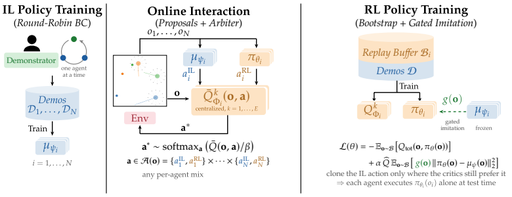
Figure 2 : IBMARL Pipeline. Left: R2BC trains the decentralized IL policy 𝜇𝜓 from single-agent demonstrations (Sec. 3.2). Middle: the agents’ IL and RL proposals form the 2 𝑁 joint candidates A (o), which the target critics score and the arbiter samples (Eqs. (5)–(6)). Right: the critics bootstrap through the same arbiter (Eq. (7)), and the actor loss adds the gated imitation term (Eqs. (8)–(9))
Original paper · CC BY 4.0 · Tony H. Zhang, Connor Mattson, Daniel S. Brown · Imitation Bootstrapped Multi-Agent Reinforcement Learning · Original paper figure · Extracted the figure area from page 4 of the original PDF.Why teams break single-agent demonstration methods
Cooperative multi-agent learning is hard for compounding reasons: the joint action space expands quickly as agents are added, credit for a team outcome is hard to assign to individuals, and rewards are often sparse. Even when the model is known, computing an optimal joint policy for a finite-horizon Dec-POMDP is NEXP-complete, so a learner that must also find the reward by random joint exploration faces a search that widens with every added agent.
Demonstrations help single-agent RL by steering exploration toward behavior that reaches the reward, either by seeding a replay buffer or by regularizing the learner toward expert actions.
Extending this to teams is first blocked by the data: most multi-agent imitation methods assume joint demonstrations, in which one expert commands every agent at once, which a single operator usually cannot do. R2BC avoids this by having the operator control one agent per round while the others run their current learned policies, but it inherits the limits of behavior cloning, namely covariate shift, a ceiling set by the demonstrator, and a heavy demonstration burden for the last gains.
The second obstacle is execution. IBRL consults its critic at every step to pick between the imitation action and the RL action, and in a team that critic scores joint actions, so it needs every agent's observation and action. Keeping the critic at deployment would require centralized execution or communication, and nothing in IBRL ensures that the RL actors can run alone, since they can lag behind the policy actually executed during training.
Per-agent proposals and the critic-scored arbiter
Each agent contributes two candidate actions for its current observation: an RL action from its actor and an IL action from its frozen R2BC policy, each perturbed by Gaussian exploration noise. Figure 2 shows how these proposals feed the arbiter, the bootstrap target and the gated actor loss.
Each agent keeps an ensemble of E centralized critics with target copies. For each candidate, the arbiter sums over agents the minimum over a sampled subset K of target critics, giving \(\bar Q(o,a)=\sum_{i=1}^{N}\min_{k\in K}\bar Q^{k}_{\Phi_i}(o,a)\). The joint action is then drawn from a Boltzmann distribution over the candidates with temperature β, while evaluation takes the argmax.
Allowing mixed candidates lets a team keep the IL action for an agent whose RL actor is still weak while another agent acts on its improved RL actor, so the team improves one agent at a time. The candidates differ in a single agent's action, so their scores compare joint actions that isolate each agent's contribution at a given state. The authors argue that this supplies a per-agent learning signal that joint demonstrations would not.
Critic targets and the gated imitation penalty
Each critic member regresses to \(y_i = r_i + \gamma(1-\mathbf{1}[\text{terminal}])\min_{k\in K}\bar Q^{k}_{\Phi_i}(o',a'^{*})\), so ensemble members differ only by initialization.
The actors follow the deterministic policy gradient through the centralized critics on the team objective \(Q_{tot}(o,\pi_\theta(o))=\sum_i Q^{1}_{\Phi_i}(o,\pi_\theta(o))\). That gradient only climbs the critics around the actors' own actions, so when the arbiter executes IL actions the actors receive no pull toward them and can fall behind the executed policy.
The penalty is added to the policy loss as \(\mathcal{L}(\theta)=-\mathbb{E}[Q_{tot}(o,\pi_\theta(o))]+\alpha\,\hat{Q}\,\mathbb{E}[g(o)\,\lVert\pi_\theta(o)-\mu_\psi(o)\rVert_2^2]\), where \(\hat{Q}\) is the detached minibatch mean of \(|Q_{tot}|\). The gate is \(g(o)=\sigma\big((\bar Q(o,\mu_\psi(o))-\bar Q(o,\pi_\theta(o)))/\beta_g\big)\), so it is large when the critics prefer the IL joint action over the actor's noise-free joint action.
Scaling by the mean of \(|Q_{tot}|\) makes α dimensionless, so one setting can transfer across tasks whose returns have different scales.
The penalty acts only where the actor differs from the IL policy and the critics prefer the IL action, which are the states where the arbiter would override the actor. The authors describe the gate as a soft, state-wise version of Nair et al.'s Q-filter that recovers the hard filter as β_g approaches 0.
All agents share one replay buffer pre-loaded with the demonstrations and sampled uniformly, so online transitions gradually dilute the demonstrations. Each agent's critic regresses to targets built from its own reward, updates begin once the buffer holds W transitions, and during warm-up the IL proposal can be executed unconditionally. Relative to IBRL, the new hyperparameters are the weight α and the gate temperature β_g.
Tasks, demonstrators and baselines
Experiments use four VMAS tasks: Navigation, Buzzwire, Balance and Transport. Navigation has three agents reaching assigned goals in a bounded 2-D workspace, and Buzzwire has two agents tied to a ball that must pass through a narrow corridor without touching the walls. Balance and Transport each have three agents: Balance lifts a spherical package on a rigid beam to a goal, and Transport pushes a package onto a goal.
Transport keeps its native reward, the per-step decrease in the package's distance to the goal.
Each task's IL policy comes from one R2BC session with one small MLP per agent, trained on demonstrations from a synthetic expert. The experts are a PPO policy on Navigation, a MAPPO policy on Balance, and scripted controllers on Buzzwire and Transport.
IBMARL uses E = 3 critics with |K| = 2, arbiter temperature β = 0.05 and imitation weight α = 0.4.
The baselines share IBMARL's architectures, DDPG-style updates, exploration noise and hyperparameters, with one critic per agent, so the way demonstrations are used is the only variable. MADDPG is the demonstration-free reference, and RLfD keeps demonstrations in a separate buffer whose share of each minibatch is annealed from 50% to 0%. RFT adds a behavior-cloning term on demonstration states with λ_BC = 0.1, with the weight λ(t) decaying from 1 to 0 on a schedule that differs by task.
Policies are evaluated without exploration noise, and every method, IBMARL included, is judged by its RL actors alone. For IBMARL the centralized arbitrated policy is also reported, but it needs the critics and the IL policy, so it is a training-time policy rather than a deployable one. Results average 5 seeds, and final returns average each seed's last 10 evaluations.
Navigation and Buzzwire against the baselines
MADDPG passes the IL policy in only 3 of 5 seeds. With the full budget, RLfD ends slightly higher at −19.6±0.5 against −20.9±0.8 for IBMARL, both within 0.04 of the expert in normalized return, while RFT ends at −35.0±4.9 and MADDPG at −43.9±6.7.
Buzzwire is harder because random joint exploration almost never earns reward; MADDPG never reaches the goal in any seed and ends at −194.6±2.5. IBMARL's actors pass the IL policy after 104k steps, 2.8× fewer than RLfD and RFT, which each take 296k steps.
Figure 3 plots the normalized curves for all four tasks, with the frozen IL policy and expert reference lines, and the ablation curves in its bottom row.
Balance and Transport where baselines do not learn
None of the baselines learns Balance within the budget: RLfD and MADDPG stay at the floor, and RFT rises only barely above it at 0.014±0.014.
Table 1 lists the steps to pass the IL policy and the final returns of every method on all four tasks. Across the four tasks IBMARL is the fastest to the IL level, and it is the only method that learns Balance and Transport.
Which additions carry the gains
Two ablations isolate the additions IBMARL makes to IBRL: no mixing restricts the arbiter to IBRL's all-IL or all-RL choice, and no penalty drops the gated imitation term. Table 2 reports the final returns of IBMARL and both ablations, with the centralized policy where it differs.
On Navigation the penalty makes no difference, and the no-penalty variant ends at −19.4±0.5, slightly above IBMARL. The authors explain that without the penalty the arbiter keeps choosing the IL action in the corridor, but the deterministic policy gradient does not pull the actors toward it.
On Balance the no-penalty variant ends at 0.333±0.015, with 0.347±0.012 for its centralized policy, against 0.423±0.017 for IBMARL. On Transport it ends at 17.3±1.0 (centralized 19.2±1.4), against 21.3±0.3 (centralized 22.7±0.6) for IBMARL. For the no-penalty variant on Transport, the centralized policy stays ahead of the actors throughout.
On Transport the no-mixing variant ends at 15.3±0.6, near the IL policy's own level of 15.7, against 21.3±0.3 for IBMARL.
Real human demonstrations on Buzzwire
A single demonstrator, one of the authors, gave demonstrations through R2BC's teleoperation interface, steering the controlled agent with an Xbox gamepad. Control passed round-robin between the two agents, and the R2BC policies were updated between rounds, so later demonstrations came alongside a better teammate. The budget was 24 episodes (4,800 transitions), of which 13 reached the goal.
IBMARL's actors pass the human-trained IL policy after 123k±26k environment steps in every seed, against 117k±8k with synthetic demonstrations.
RFT clones the demonstration actions on a fixed schedule and is about equally poor with either demonstrator.
Why the IL policy in the loop matters
The authors state that on Balance and Transport this policy decides whether the team learns at all within their budget. The actors can also end above the demonstrator, which the authors take as evidence that the demonstrator's ceiling is not inherited; on Buzzwire and Balance they do.
The demonstration effort is 12 to 500 episodes of single-agent teleoperation, far fewer than the hundreds of thousands to millions of steps RL requires.
Limitations
The IL policy is frozen once RL begins, so the demonstrator cannot keep teaching during RL in the current method. Evaluation uses 5 seeds, and final returns average the last 10 evaluations of each seed.
Paper info
- Authors
- Tony H. Zhang, Connor Mattson, Daniel S. Brown
- Venue
- arXiv · Preprint
- First published
- 2026-11-13
- Added
- 2026-11-16
- Updated
- 2026-11-13
- Version
- v1
- arXiv
- 2611.18543
- Category
- cs.AI · cs.MA
- Original paper terms
- CC BY 4.0
- What we show
- Paper info, commentary and permitted figures from the original paper
AI commentary is a separate explanation from the original paper and may contain errors. The original paper and figures follow each source's terms of use and any rights noted separately.
Abstract
Demonstrations are an effective way to accelerate single-agent reinforcement learning (RL), but extending this idea to multi-agent reinforcement learning (MARL) is non-trivial as it is difficult and often impossible for a single person to teleoperate multiple agents simultaneously. Round-Robin Behavior Cloning (R2BC) addresses this by letting a single demonstrator control one agent at a time while the others execute their current policies. However, the resulting imitation policies are limited by the quality of the demonstrations. We propose Imitation Bootstrapped Multi-Agent Reinforcement Learning (IBMARL), a framework that extends Imitation Bootstrapped Reinforcement Learning (IBRL) to cooperative teams and uses R2BC to train the imitation policies. At each time step, every agent receives one action proposal from its imitation policy and one from its RL policy, and an ensemble of centralized critics selects among the per-agent combinations of the two. A gated imitation penalty, a soft Q-filtered behavior cloning loss, regularizes each RL policy toward its imitation policy only where the critics value the imitation action more, so that after training each agent executes its RL policy alone, without the centralized critics. On four cooperative multi-agent RL benchmarks, IBMARL surpasses its imitation policies $2.6$-$4.2\times$ faster than demonstration-based baselines on two tasks, is the only method to surpass it on the other two, and exceeds the demonstrator itself on two of the four. With real human demonstrations IBMARL still surpasses imitation learning alone, and does so more than twice as fast as the best baseline.
Quote from the paper
Tony H. Zhang, Connor Mattson, Daniel S. Brown (2026). Imitation Bootstrapped Multi-Agent Reinforcement Learning. arXiv:2611.18543v1. https://arxiv.org/abs/2611.18543v1
BibTeX
@misc{zhang2026imitation,
  title = {{Imitation Bootstrapped Multi-Agent Reinforcement Learning}},
  author = {Tony H. Zhang and Connor Mattson and Daniel S. Brown},
  year = {2026},
  eprint = {2611.18543},
  archivePrefix = {arXiv},
  url = {https://arxiv.org/abs/2611.18543v1}
}