Paper commentary
Automated, auditable dating of the Babylonian Astronomical Diaries with language models and astronomical tools
Language models and sky tests help automate dating of Babylonian astronomical diaries
- Problem Published dates for broken Babylonian diary tablets rest on prose reasoning that is hard to audit or redo. Experts dated each tablet by hand, so the whole corpus was never checked the same way.
- Method The system pairs a rule-based parser with astronomical tests, then ranks candidate years by fixed rules. A language model only reads and checks the clauses, while code runs every sky test in all 701 candidate years.
- Results For 120 dated tablets with decisive clauses, the top tied group of years includes the published year in 96% of cases. The strict set holds the published year in 119 of 120 records.
Why diary dates are hard to audit
The Astronomical Diaries were kept mostly in Babylon for nearly six centuries, and their entries track the Moon and the planets, along with eclipses and the turning of the seasons. Many later uses, from Persian and Seleucid history to price series and the study of Earth's rotation, depend on knowing the date of each entry. Yet most tablets are now in the British Museum with lost findspots, and almost all are damaged, so the date formula is often gone.
Sachs and Hunger dated many broken tablets in ADART by comparing the surviving observations with computed phenomena and eclipse catalogs. They often combined several observations to narrow the candidate years, and difficult cases needed further specialist calculation. Their reasoning sits in prose comments for each tablet, so it takes specialist time and is hard to survey across the whole corpus.
Splitting the text into clauses and checks
The key idea is to let fixed code do the computing and the bookkeeping, and to let a language model only read and cite the text.
The parser is plain code with no model inside, so it returns the same clauses on every run. Across ADART I to III it yields 3,193 clauses, drawn from 316 of the 417 dated records.
Some wordings defeated the parser, so a coding agent, Claude Opus 5, proposed reading rules for them. Each accepted rule entered the code only after tests and human review, and the authors wrote the code for each rule.
GPT-6-Luna then reviews each parser clause, and it may keep, modify or drop the clause. Each change needs a second call that quotes the clause's own sentence as support.
Adding search results takes the total from 3,193 parser clauses to 4,010, drawn from 321 records. Where the tools can test them, reviewed clauses agree with the published year in 93.6% of cases, compared to 93.8% for the parser clauses. The added clauses are therefore about as reliable as the parser's, and the dates use the reviewed set. A larger model, GPT-5.6-Terra, was tried on ten records.
It cost about 20 times as much as GPT-6-Luna, and its added clauses agreed at 89% compared to 88% for GPT-6-Luna, so a small model was kept, since code tests what the model returns.
Testing clauses in 701 candidate years
Each clause is tested in all 701 candidate years, which run from 626 BCE to AD 75. The tools return agree, contradict or untestable for each clause and year, and agents reach them through the Model Context Protocol (MCP). Untestable means the event went unobserved, or a required field such as a distance's day is missing.
A clause narrows the years when few candidate years agree with it, and the authors measure this narrowing in bits. They define the score as \(u_j=\log_2(C_j/A_j)\), where C_j counts the years in which clause j is testable and A_j counts those in which it agrees.
Each clause also has a tier, which is separate from its bits. Only decisive clauses can decide which years remain, and they need unrestored text, no unobserved mark, a secure date or a whole-year test, and a type that acts as a clock. Supporting clauses only order the years, and a Moon position beside a star is one example.
Five clocks are used: Mars, Jupiter, Saturn, lunar eclipses seen from Babylon, and the solar year. The solar year works as a clock because Babylonian months follow the Moon, which shifts the Babylonian dates of solstices and equinoxes from year to year. Eclipse reports are common but mostly untestable, since the scribe marks them as unobserved or loses the day.
The opening of record X301322 shows how unequal the clauses are. Its two Moon rows agree with 656 and 635 years, while a Mars row agrees with 11 years, or 6.0 bits. Figure 2b shows each row's count of agreeing years next to its bits.
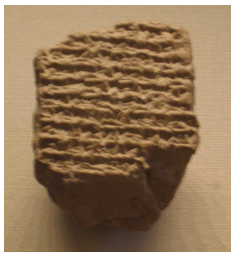
Fig. 2 .A diary tablet and the information in its clauses. (a) ADART I no.−322B (British Museum, BM 45962), a diary for 323/322 BCE that records the death of Alexander the Great. Photograph by Shaunnol, Wikimedia Commons, public domain. (b) The opening of X301322 from ADART III, one tablet line per row, colored orange for a decisive and blue for a supporting clause. Square brackets mark text that Sachs and Hunger restored. Each log-scaled bar shows the number n of years that agree with the row’s strongest clause, labeled withlog 2(701/n)bits (Eq. 1 gives the scoring). Gray rows hold unscored text, and their bars reach all 701 years (dashed line) at 0 bits.
Original paper · CC BY 4.0 · Lucas Carrit Delgado Pinheiro, Yuan-Sen Ting, Jon Clindaniel, Lu Li, Yingbin Liang, Ness Shroff · Automated, auditable dating of the Babylonian Astronomical Diaries with language models and astronomical tools · Original paper figure · Extracted the figure area from page 3 of the original PDF.The commonest clause type pairs the Moon or a planet with a Normal Star, a reference star near the Sun's path. Stations tested against a star carry a median of 8.5 bits, yet only 48% of their testable cases match the published year. That is why such a clause with high bits still stays supporting.
From clocks to one ranked answer
A single planet rarely fixes a year, so the decision step counts how many independent clocks agree with each year. It then sums the bits of the agreeing decisive clauses, and the same step keeps the supporting bits apart.
For each year y, the system computes K(y), the number of decisive clocks that agree, using \(K(y)=\sum_c \max_{j\in D_c} a_j(y)\). It computes the decisive bits as \(I_D(y)=\sum_{j\in D} u_j\,a_j(y)\), where a_j(y) is 1 when clause j agrees with year y and 0 otherwise. D holds the decisive clauses and D_c those of clock c. Clauses with identical verdicts share their bits, so a joint statement counts once, while each planet still counts for its own clock.
Contradictions do not remove a year here, because the strict set counts them as untestable and they enter only the ranking.
The safety set is the union of the strict set and the strict sets recomputed with each decisive source statement removed in turn, written \(S_{safe}=S\cup\bigcup_s S(-s)\). It holds the years that a single misread decisive statement could knock out of the strict set.
Years are ranked by t(y), then K, I_D, I_S and the fewest contradicting statements, and years with equal scores form tied groups. The system commits to one year only if an observed lunar eclipse agrees with it, or if two or more clocks agree and the safety set also holds just that year.
Record X301492 shows the effect: five decisive clauses from three planets narrow the candidates to 150 BCE, the published date. At that year all three clocks agree and the decisive bits total 16.3, while the five years with the next highest bits each agree with two clocks. Even so, the system does not commit, because dropping each decisive statement in turn brings six extra years in, so the safety set reaches seven years.
How often the published year survives
Before any candidate set was compared with a published date, the authors froze a benchmark of 179 dated records. It keeps records with at least three parser clauses, and 120 of them have a decisive clause while 59 are supporting-only. The inclusion rate counts the records whose published year falls inside a reported set. Supporting-only records receive a ranking score but never a commitment.
On the 120 records with decisive clauses, the first group of top-ranked tied years contains the published year in 115 cases, or 96%. For 86 of these records the first group is a single year, and that year is the published one for 84. The strict set holds the published year in 119 records, or 99%, with a median size of 15 years.
Only a few broad choices were fixed using the published years, such as decisive types, parser rules and tolerances. Per volume, the first group holds it in 94% for ADART I, 96% for ADART II and 97% for ADART III.
Across the 31 alternatives the rates change little, and conventions such as the cubit or the zodiac zero point move a rate by at most three points.
Ranked candidate years for undated ADART IV entries
Each undated entry reached the pipeline as its translated astronomical text alone. The input drops the printed date and comments sections, the catalog number and the page position. Placeholders stand in for year numbers and king names, and each entry gets an arbitrary label in place of its ADsD number. During the review, the model sees each parser clause with 500 characters of translation on each side.
Only the undated diaries on printed pages 95 to 575 entered the input. Splitting at the printed heading of each entry gave 867 entries. Of these, 860 have an English translation. Of these entries, 56 keep a decisive clause and so receive a ranked set of candidate years. Forty-seven of the 56 entries hold a single decisive clause.
The first groups of all 56 entries have a median of 100 years, so one clock leaves many candidates. Jupiter returns to a sign about every 12 years, which shows as repeated marks in Fig. S2. Table S7 lists the clocks, strict-set sizes and first groups of each entry.
Before reading the dated addenda, the authors fixed the rules and scores of the registered test. With so few texts, the 95% Wilson interval runs from 65 to 99%, which includes the benchmark rate of 96%.
Limitations of the addenda, commitment and benchmark evidence
The ADART IV addenda test covers only 12 texts, so its hit rate carries wide uncertainty. With so few texts, the 95% Wilson interval runs from 65 to 99%, and it includes the benchmark rate of 96%. The sample is far smaller than the benchmark, so the addenda can't settle whether the rates carry over.
The commitment rule is the second narrow point, because it fires for only a small part of the corpus. It commits to one year for 10 of the 417 dated records, and all 10 match the published year. Nine of those 10 rest on two or more clocks, and one rests on a lunar eclipse. For the rest of the corpus, the output is a ranked set rather than a single year, and the strict set can stay wide.
Outside the benchmark, the 238 dated records have strict sets with a median of 87 years, compared to 15 in the benchmark. The cost comparison with the larger model rests on ten records, so the figure of about $60 for the benchmark is an estimate. The authors didn't run the larger model on all 179 benchmark records, so the $60 figure is not a measured run.
Several settings were picked by looking at published years, so the benchmark rates may partly reflect that choice. The held-out test reduces this effect, but it reuses the same kinds of choice. The sensitivity audit changes one setting at a time, so it doesn't test every combination of settings.
Paper info
- Authors
- Lucas Carrit Delgado Pinheiro, Yuan-Sen Ting, Jon Clindaniel, Lu Li, Yingbin Liang, Ness Shroff
- Venue
- arXiv · Preprint
- First published
- 2026-10-25
- Added
- 2026-11-4
- Updated
- 2026-10-25
- Version
- v1
- arXiv
- 2610.34297
- Category
- astro-ph.IM · cs.AI · cs.CL · physics.hist-ph
- Original paper terms
- CC BY 4.0
- What we show
- Paper info, commentary and permitted figures from the original paper
AI commentary is a separate explanation from the original paper and may contain errors. The original paper and figures follow each source's terms of use and any rights noted separately.
Abstract
The Babylonian Astronomical Diaries record the sky over nearly six centuries. Many tablets are broken and have lost their date formula. Experts dated many of them one tablet at a time in the standard edition, Astronomical Diaries and Related Texts from Babylonia (ADART). They used the recorded sky and other evidence, such as year formulas and royal names. Our system automates the astronomical part for all tablets with the same rules. A rule-based parser turns the recorded observations into clauses, short statements with fixed fields. A language model checks them against the text and adds observations that the parser missed. Astronomical tools test the clauses in all 701 years from 626 BCE to AD 75. The system ranks the years by how well they agree with the clauses. The system withholds published dates until its results are final, and the output lists the passages and computed positions behind each candidate year. On 120 dated tablets, the years tied at the top of the ranking include the published year in 96% of cases. For 86 of them, this top group is a single year, the published year in 84. In 119 of the 120, the reported candidate set contains it. For 56 undated entries of ADART IV, the system gives ranked candidate years. For each tablet, the results show how far astronomy alone narrows the year. An interactive page at https://tingyuansen.github.io/Babylonian_Dating/ follows each tablet and links the code, protocol and results.
Quote from the paper
Lucas Carrit Delgado Pinheiro, Yuan-Sen Ting, Jon Clindaniel, Lu Li, Yingbin Liang, Ness Shroff (2026). Automated, auditable dating of the Babylonian Astronomical Diaries with language models and astronomical tools. arXiv:2610.34297v1. https://arxiv.org/abs/2610.34297v1
BibTeX
@misc{pinheiro2026automated,
  title = {{Automated, auditable dating of the Babylonian Astronomical Diaries with language models and astronomical tools}},
  author = {Lucas Carrit Delgado Pinheiro and Yuan-Sen Ting and Jon Clindaniel and Lu Li and Yingbin Liang and Ness Shroff},
  year = {2026},
  eprint = {2610.34297},
  archivePrefix = {arXiv},
  url = {https://arxiv.org/abs/2610.34297v1}
}