Paper commentary
Generative Latent Priors for Interpreting and Steering Protein Language Models
Generative latent priors let researchers interpret and steer protein language models
- Problem Sparse autoencoders impose strong structural assumptions on protein language model activations. Steered activations can also drift off the region the model was trained on, so the edited sequences look unnatural.
- Method GLP is a diffusion model trained directly on frozen ESM-2 activations, with no linearity or sparsity assumption. Instead of discarding affected candidates, it partly noises a steered activation and denoises it back onto the learnt manifold.
- Results Single GLP meta-neurons reach a mean test AUC of 0.932 at ESM-2-650M, compared to 0.872 for the SAE. Edited sequences lose naturalness after several decoding rounds.
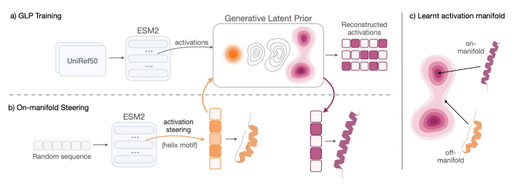
Figure 1 : Pipeline overview. (a) GLP trains by flow matching on ESM-2 activations from UniRef50 to learn their manifold. (b) Steering pushes an activation off that manifold toward a target property. (c) GLP correction re-noises and denoises the edit back onto the manifold.
Original paper · CC BY 4.0 · Daniel Hinjos, Lucía Urcelay · Generative Latent Priors for Interpreting and Steering Protein Language Models · Original paper figure · Extracted the figure area from page 2 of the original PDF.Why sparse dictionaries and steering both fall short
Interpreting protein language models usually starts with sparse autoencoders trained on ESM-2 activations and matched against Swiss-Prot annotations. Sparse dictionaries put strong structural assumptions into the latent space they are meant to describe. Later work extends this line to protein-level representations, GO enrichment, and a taxonomy of features.
That work inherits the same pathologies, including reconstruction residuals, feature splitting and absorption. Granularity follows the dictionary size rather than the data, and dictionaries can differ across random seeds.
Steering offers the other route to control, adding a fixed direction to hidden states while leaving the weights untouched. Such directions come from contrasts between two sets of inputs, or from a single clamped unit of a sparse dictionary. Both routes transfer to pLMs, and the authors test them on three biochemical properties and on structural motifs.
One earlier response, from [26], discards affected candidates under a statistical density prior. The authors instead correct the activation itself.
The Generative Latent Prior takes a different path by training a diffusion model directly on a frozen host's activations. It makes no linearity or sparsity assumption, so the learnt manifold can serve for inspection and control. Training blends each real activation with Gaussian noise by a random amount t, and the model learns to undo that blend.
The authors read the residual stream of ESM-2-8M and ESM-2-650M after layers 4 and 18, respectively.
A flow-matching prior over ESM-2 activations
The flow-matching GLP learns the distribution of frozen ESM-2 activations directly, with no linearity or sparsity assumption. It reads the residual stream after layer 4 of ESM-2-8M and after layer 18 of ESM-2-650M, the same layers InterPLM released SAEs for. Training mixes a real standardised activation h with Gaussian noise ε at a random level t, giving h_t = (1−t)h + tε.
The network u_θ sees only h_t and t, and it predicts the constant velocity ε−h under a squared-error loss. Integrating the negative velocity from t=1 down to t=0 removes noise, so pure noise becomes a new activation.
The network is a stack of SwiGLU MLP blocks with depth 3 to 24, and each block's gated activations form the meta-neurons. Each meta-neuron is read at a fixed noise level t=τ, so every block is probed under the same noise condition. The GLPs train on 100M activations for the 8M and 650M hosts and on 500M activations for the 8M host. These activations come from 5M random proteins, and all results use the 24-block model.
The concept set holds 110 discrete residue-level Swiss-Prot annotations and 10 continuous whole-sequence properties. Each meta-neuron is probed as a single unit, with a 1-D logistic probe for discrete concepts.
Generation quality is scored by the Fréchet Distance between generated and held-out real activations. Dividing each host's FD by its own real-versus-real floor gives a dimensionless ratio, because absolute FD scales with activation width. Plotted against C=6ND, the diffusion losses of all eight runs collapse onto one curve. That collapse means the total compute budget sets the loss, not how the budget splits between depth and data.
With enough sampler steps, the samples match the real distribution on the top two principal components.
Single meta-neurons as concept probes
The probing study uses 110 discrete residue-level Swiss-Prot annotations and 10 continuous whole-sequence properties. Four representations are compared: GLP meta-neurons, InterPLM's SAE features, ESM's own feedforward neurons and the raw residual stream. Each probe is trained on half the Swiss-Prot evaluation proteins, and inner 5-fold CV chooses the unit and the regularisation strength.
The concept set was frozen before any probing run, and residue-identity one-hots were dropped because they are trivially decodable.
For discrete concepts, the authors pick the unit with the best validation AUC on the train split and report its test AUC. At ESM-2-650M, GLP meta-neurons reach a mean test AUC of 0.932, compared to 0.872 for the SAE and for the raw residual stream. ESM's feedforward neurons reach 0.850 at 650M, and the GLP-over-SAE margin is +0.048 there against +0.058 at 8M.
These margins are small in absolute terms, but a meta-neuron beats the SAE on 104 of 110 concepts at 8M and on 105 at 650M.
Each winning meta-neuron is largely a linear read-out of the SAE dictionary, with median R2 of 0.76 at 8M and 0.73 at 650M. A joint probe over up to 20 top SAE features reaches the meta-neuron's AUC on 94 of 104 concepts at 8M and on 101 of 105 at 650M. The authors read this as concentration: the same information is spread over several dictionary atoms that one meta-neuron reads in a single unit.
On continuous properties, GLP reaches a mean test Spearman ρ of 0.669 at 8M, above the SAE at 0.602. At 650M the SAE nominally edges GLP, 0.569 to 0.555, with overlapping intervals. So the lead holds for discrete concepts at both scales, but not for continuous properties at 650M.
On-manifold correction for DiffMean property steering
Steering with a fixed linear direction can push an activation off the distribution ESM-2 was trained on. The direction v is scaled to the mean activation norm, then added to a residue activation h with strength α. The sum is rescaled back to the original norm, so α changes only the direction of the edit. The edited activation is written as h̃ = ‖h‖(h + αv̂)/‖h + αv̂‖.
The GLP correction then partly noises this edited activation and denoises it back onto the learnt manifold. The intended shift survives the correction, while the activation becomes a realistic one again.
GLP is trained with a velocity target, and a partly corrupted activation at level t0 is pulled back onto the manifold. Started from pure noise, the same integration produces a new activation. The authors steer hydrophobicity, charge and instability in an up direction from low-scoring proteins and a down direction from high-scoring ones. Each round steers 10% of residues sampled without replacement, over N=30 rounds.
A genuine direction moves the two arms in opposite ways, while an artifact of the intervention shifts both the same way.
Without correction, the naive arm barely separates the up and down directions except at the strongest perturbation. Steering pushes the activation off the manifold, more so at larger α. A single correction pass restores the typicality of an isolated steered activation, as measured by GLP's diffusion loss.
The restored typicality doesn't survive the decoding loop. The authors conclude that the prior secures control of the property but not of the sequence that encodes it. The naturalness limit comes from the masked-Gibbs decoding loop rather than from the prior.
Structural steering and decoding limits
Structural steering overwrites one SAE latent with a clamp value and rebuilds the activation with its residual included. The authors start from short random sequences, then clamp and resample the whole sequence. They run 100 independent rounds and keep the round that maximises the clamped latent. Four concepts are tested: Helix, Beta strand, Coiled coil and Zinc finger.
Each concept gets the SAE feature with the highest feature-concept F1 against Swiss-Prot labels. Success means a concept hit in the finished sequence, so every sequence is folded with ESMFold.
Only Helix improves consistently across the four structural concepts. The apparent Coiled coil gain is helix formation being scored as hits. The authors explain the helix result by local propensities within a short window.
The authors attribute the loss to how much of the protein gets rewritten, not to the prior. Typicality is recovered on an isolated steered activation but isn't kept after re-embedding the finished sequences. Beam search folds better per edit than masked-Gibbs, according to the appendix comparison.
Limitations of the lens and editing claims
The study's lens and editing claims are bounded by how the experiments were set up, starting with the training layout. GLPs were trained on one hook layer per host, so the results don't show how other layers behave. Steering was restricted to one layer and to the masked positions, which limits what the edits can reach. The probing is correlational and runs on a pool heavy in domains and motifs.
Meta-neurons were read only through 1-D probing against curated annotations.
Structural steering with a single SAE clamp succeeded consistently only for Helix. Feature selection was indirect, because the clamp target was chosen by detection F1 rather than by control success. The naturalness loss after decoding was not repaired by the correction, since the corrected arm was no more on-manifold than the naive one.
The authors point to several open directions that follow from these limits. A more granular and guided masked-Gibbs loop is another route to explore. A host whose output stays continuous, such as structural or latent diffusion, would avoid decoding altogether. An edit constrained inside the sampler, by clamping a meta-neuron or gradient-guiding the denoising trajectory, would keep the result on-manifold by construction.
Paper info
- Authors
- Daniel Hinjos, Lucía Urcelay
- Venue
- arXiv · Preprint
- First published
- 2026-11-6
- Added
- 2026-11-9
- Updated
- 2026-11-6
- Version
- v1
- arXiv
- 2611.09818
- Category
- cs.AI · cs.LG
- Original paper terms
- CC BY 4.0
- What we show
- Paper info, commentary and permitted figures from the original paper
AI commentary is a separate explanation from the original paper and may contain errors. The original paper and figures follow each source's terms of use and any rights noted separately.
Abstract
Dominant methods for interpreting large models impose strong structural assumptions. Generative Latent Priors (GLP) are a complementary approach: a diffusion model that learns the distribution of a frozen model's activations directly, imposing no assumptions. We port GLP to ESM-2 activations (UniRef50) and evaluate it at two host scales (ESM-2-8M and -650M), both as a lens for protein representations and as a prior for editing them. Generation quality scales smoothly with depth and compute. As a lens, single GLP "meta-neurons" are the strongest probes of discrete Swiss-Prot concepts at both hosts, beating InterPLM's released SAE features, and lead on continuous properties at 8M though not at 650M; falsification tests show this is mostly concentration, not new information. As an editing prior, the on-manifold correction makes DiffMean steering of three biochemical properties effective and restores on-manifoldness, but only in isolation: re-embedding the sequences actually produced after several rounds of decoding, the structural plausibility is compromised. This is mainly reproduced in additional SAE-based clamping structural steering experiments, where only Helix motif succeeds. The naturalness failure is traced to the rewriting coverage and the decoder rather than the prior, highlighting what the method must clear before it can serve for both discovery-by-editing and discovery-by-exploration. Trained GLPs are released on huggingface.co/collections/HPAI-BSC/glprot.
Figures from the paper

Table 1 : 1-D probing: mean test AUC or Spearmanρ[95% bootstrap CI]. Bold: highest per column; ∗:p<0.05vs. all baselines (two-sided paired Wilcoxon).
Original paper · CC BY 4.0
Figure 2 : Property steering naive vs GLP correction, both directions. Change vs.α=0
Original paper · CC BY 4.0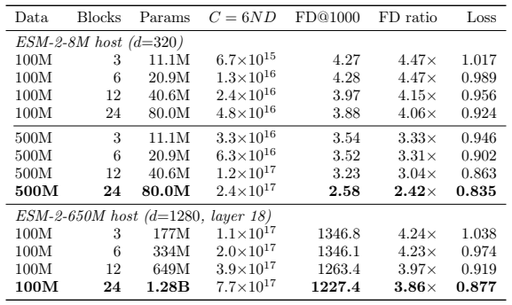
Table 2 : Depth×data-scale grid, generation quality only.N= parameters,C= 6N D, FD at 1000 sampler steps; ratio is FD / real-vs-real lower bound; loss is the mean of the last 500 training steps. The two hosts occupy different-dimensional activation spaces (d=320vs. 1280), so absolute FD and loss are not comparable across host blocks; only the FD ratio is. Bold: the model used for all probing and steering results.
Original paper · CC BY 4.0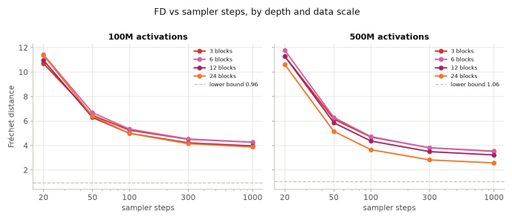
Figure 4 : Fréchet Distance vs. sampler steps, by GLP depth and data scale (sharedy-axis). FD falls with sampler steps everywhere. Depth lowers FD monotonically and the gain is larger at500M than at100M: more data lets extra depth pay off. The shallowest cells (3 vs.6blocks) are near-identical at both scales; separation appears at12–24blocks. Dashed lines: real-vs-real lower bound.
Original paper · CC BY 4.0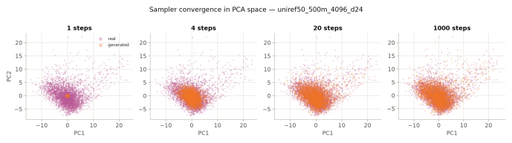
Figure 5 : Sampler convergence in PCA space (24-block, 500M): generated activations (or- ange) refine from a collapsed blob at 1 step to matching the real distribution (purple) at 1000 steps, on the real data’s top-2 principal components. Inset: training loss, converging below the trivial-predictor floor (≈2.0).
Original paper · CC BY 4.0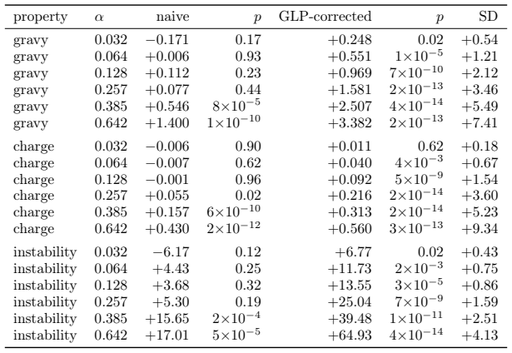
Table 3 : Steering-attributable divergence (up − down); α in units of ∥h∥, SD = divergence over the property’s UniRef50 spread. Unpaired Mann–Whitney, n=40 per direction.
Original paper · CC BY 4.0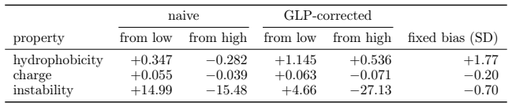
Table 4 : Concept change withnosteering applied (α=0), by arm and starting set, in each property’s own units. A fixed bias adds the same amount from both sets; mean reversion flips sign with the set and cancels in the corrected−naive difference, which is the last column.
Original paper · CC BY 4.0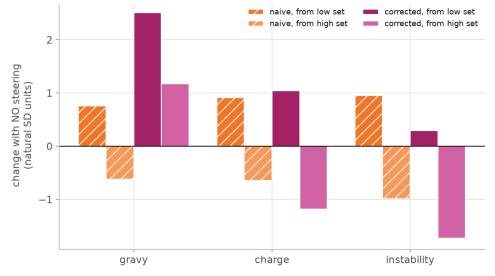
Figure 6 : Theα=0arms, in units of each property’s spread. Hatched: naive. A bias that reverses with the starting set is mean reversion; one that does not comes from the correction.
Original paper · CC BY 4.0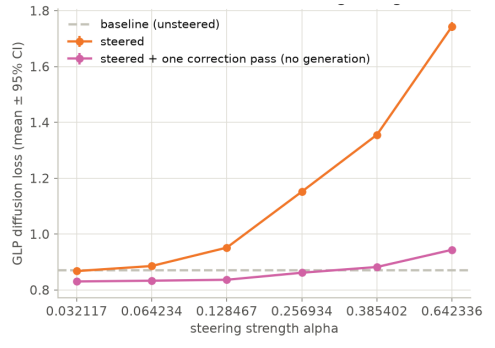
Figure 7 : GLP diffusion loss against steering strength, before and after a single correction pass applied directly to the steered activation (no generation), for hydrophobicity
Original paper · CC BY 4.0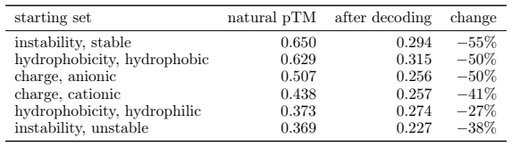
Table 5 : Foldability before and after the decoding loop, with no steering and no correction (α=0, naive arm), for all six held-out sets.
Original paper · CC BY 4.0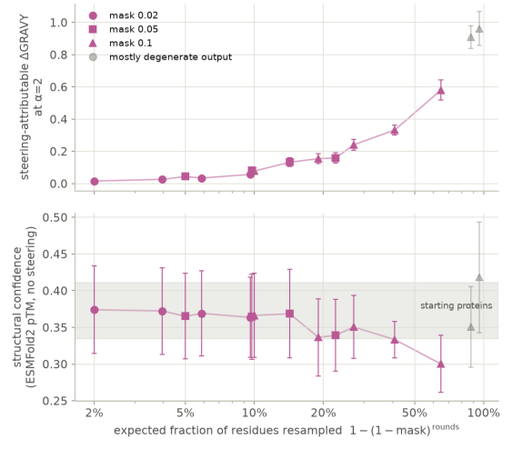
Figure 8 : Steering effect (top) and foldability (bottom) against how much of the protein the decoder rewrites,T=0.5. Marker shape distinguishes mask fraction; the three series fall on a single curve, i.e. mask fraction and round count act only through their product. Shaded band: the starting proteins’ own pTM (±SEM). Grey points are settings whose output is mostly degenerate and are excluded from the trend. This budget sweep predates the relative-αparameterisation and its axis label is in raw units; for the hydrophobicity vector itsα=2is the same perturbation as theα=0.257used elsewhere in this paper.
Original paper · CC BY 4.0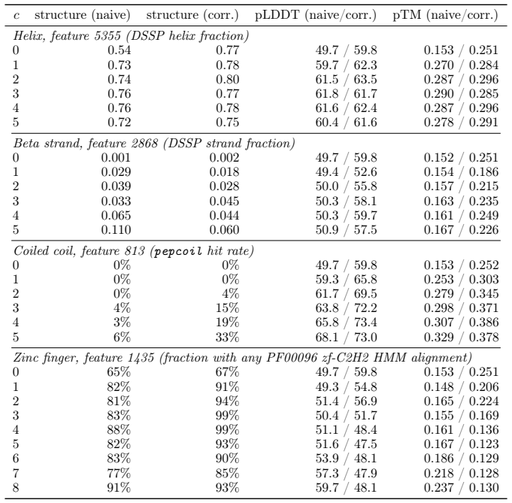
Table 7 : Structural steering byc, naive/GLP-corrected,n=100per cell. Structural column: DSSP secondary-structure fraction (per-chain residue fraction in that class) for Helix and Beta strand; EMBOSSpepcoilhit rate for Coiled coil; and, for Zinc finger, the fraction of sequences with any PF00096 zf-C2H2 profile-HMM alignment (a graded measure, no complete motif forms).
Original paper · CC BY 4.0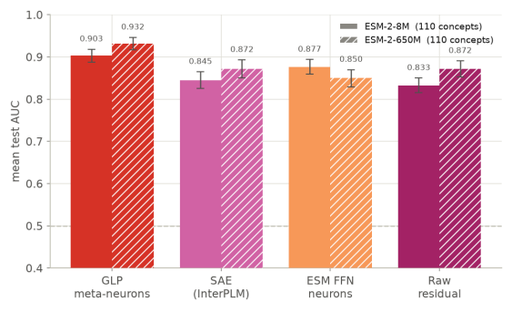
Figure 9 : 1-D probing mean test AUC by method and host (ESM-2-8M solid, ESM-2-650M hatched; 95% bootstrap CI). GLP meta-neurons lead at both host sizes.
Original paper · CC BY 4.0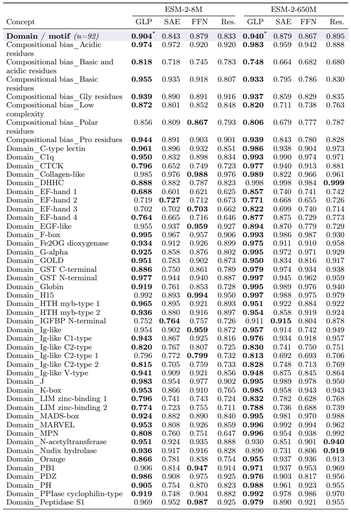
Table 8 : Per-concept test AUC, all 110 concepts, both hosts. Bold marks the highest value in each row within a host. Shaded rows are category means; * marks a lead over the runner- up withp<0.05(two-sided paired Wilcoxon over the category’s concepts, uncorrected). Categories withn≤4cannot reach this threshold even if the leader wins every concept.
Original paper · CC BY 4.0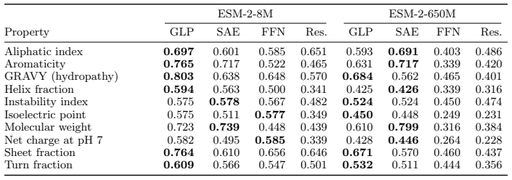
Table 9 : Per-property test Spearmanρ, all 10 continuous properties, both hosts. The shaded row is the mean, with the Wilcoxonpfor the leader against the runner-up.
Original paper · CC BY 4.0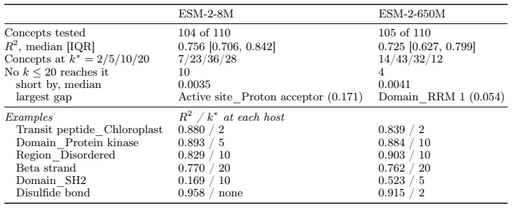
Table 10 : Falsification tests on the concepts GLP wins.R2: meta-neuron regressed on the full SAE dictionary (held-out).k ∗: fewest top-kSAE features whose joint probe matches its test AUC (“none” if nok≤20does).
Original paper · CC BY 4.0Quote from the paper
Daniel Hinjos, Lucía Urcelay (2026). Generative Latent Priors for Interpreting and Steering Protein Language Models. arXiv:2611.09818v1. https://arxiv.org/abs/2611.09818v1
BibTeX
@misc{hinjos2026generative,
  title = {{Generative Latent Priors for Interpreting and Steering Protein Language Models}},
  author = {Daniel Hinjos and Lucía Urcelay},
  year = {2026},
  eprint = {2611.09818},
  archivePrefix = {arXiv},
  url = {https://arxiv.org/abs/2611.09818v1}
}