Paper commentary
Dataset Collections: Challenges of Large-Scale Data Aggregation in 3D Medical Image Datasets
Perceptual hashing finds 118,487 duplicate pairs across 1034 public 3D medical datasets
- Problem Stacked public datasets reuse the same scans, so training and test sets can overlap. Exact checksums miss copies that were recompressed, reoriented or resampled, so overlaps stay hidden.
- Method MAP is a lightweight metadata profile for recording provenance and deduplication decisions in dataset collections. The authors also screen each volume with a 4096-dimensional binary perceptual hash, instead of exact checksums, and flag close pairs by Hamming distance.
- Results The authors identify 118,487 duplicate pairs in the collection, which they present as a lower bound. Hamming distance of at most 100 finds 56,051 of these pairs.
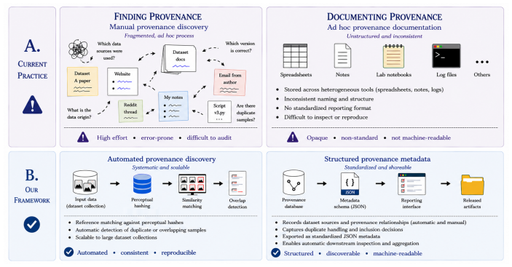
Figure 2 :Structural Provenance Documentation via Metadata Profiling.(A) Provenance is currently reconstructed manually from papers, websites, notes and correspondence, and documented ad hoc across heterogeneous tools. (B) We screen dataset collections for overlap by perceptual hashing against a reference hash database (Section 3) and record provenance and deduplication decisions as structured, machine-readable MAP metadata (Section 4).
Original paper · CC BY 4.0 · Extracted the figure area from page 5 of the original PDF.Why stacked collections break independence
Dataset collections stack public datasets, and that scale is what makes them useful for training 3D models. The catch is that the same scan often travels through several releases, so the collection holds it more than once. Reuse can also run several hops deep, for example through successive versions of a dataset such as BraTS. It can also pass through overlapping datasets released under different names, such as LiTS and MSD03.
Such repeats break the assumption that samples are drawn independently, and they inflate the apparent size of the training set.
Multi-path and multi-hop chains make the overlap hard to trace, because a source can sit behind several outgoing edges. In one case, AutoPET is included by both FLARE23 and DAP-Atlas, so training on one and evaluating on the other can break independence. In the second case, LiTS reaches AbdomenAtlas1.1 through both CT-ORG and AbdomenCT1k.
The damage shows up at evaluation time, because a test set can share volumes with the training data. Cross-validation folds can also share duplicates unless the overlap is controlled, which makes validation scores look better than they should. Post hoc cleaning looks like the obvious fix, but collections often lack stable identifiers and a record of how each file was transformed.
Cryptographic checksums catch only byte-identical copies, because a change in compression, orientation or voxel spacing gives a completely different hash.
Perceptual hashes as a first-pass screen
The key idea is to swap exact file matching for a coarse code that stays stable when a volume is only lightly reprocessed. Perceptual hashes instead aim for visually similar inputs to yield identical or nearby codes, and similarity is measured by Hamming distance on binary vectors. The authors adapt the average-hash family described by Krawetz to 3D volumes.
Each image is first resampled to a fixed 16×16×16 grid, which gives a common shape regardless of the original resolution.
The pipeline then computes the global median intensity of that resampled grid. The hash is 4096-dimensional, so every eligible image yields one binary vector of that length. Because the threshold is relative to the median, the code ignores the global intensity scale and stays steady under transformations such as intensity clipping. The authors note that this also discards high frequency details, which is the price of that robustness.
All hashes are stacked into one shared matrix, which an Annoy approximate nearest-neighbor index with 1024 trees searches. Candidates retrieved from the index are scored by Hamming distance, and duplicate and near-duplicate pairs are set by configurable thresholds. This avoids exhaustive pairwise comparison, so the search scales across the full collection.
The method needs no patient identifiers, DICOM headers, scanner metadata or acquisition records, and the codes can be shared without the images. On the reported run, Hamming distance of at most 100 found 56,051 of the 118,487 duplicate pairs, and 44,727 of those were exact pairs at distance 0.
How many duplicates the collection contains
The authors collected 1034 datasets from TCIA, OpenNeuro, Huggingface, grand-challenge and Kaggle, holding 564,885 3D volumes. Because 782 of these datasets come from OpenNeuro, they treat that source as one, which leaves 253 dataset-level units. The authors count 118,487 duplicate pairs in total, and they present this figure as a lower bound.
The perceptual hash, with a Hamming distance of at most 100, accounts for 56,051 of these pairs. Of those hash matches, 44,727 pairs are exact, meaning their Hamming distance is 0. The hash therefore covers only part of the 118,487 pairs, so it can't be the whole answer. The other 62,436 pairs came from dataset-specific variants of the deduplication algorithm, such as intensity clipping, plus manual tracing of overlaps.
These extra steps contribute more pairs than the hash does, since 62,436 exceeds 56,051.
Overall, 64,888 volumes have at least one duplicate. Deduplication removes 40,635 duplicated copies from the collection. That leaves 524,250 unique volumes, which the authors report as a 7.2% reduction in effective dataset size. A single volume can appear in several pairs, so the pair count overstates the number of copies that get removed.
Figure 3 maps these overlaps as a network, with nodes for datasets and edges for shared duplicate links.
Overlap network across datasets
Of the 253 dataset-level nodes, 136 show at least partial overlap with another dataset. The smaller clusters mostly reflect repeated challenge iterations, reuse of data across challenge tasks, and the OpenNeuro ecosystem.
The authors read this as a densely connected reuse ecosystem, not as independent flat unions of datasets. Perceptual hashing detects visual identity rather than causal lineage, so each edge is evidence of image-level overlap. A concrete chain shows the pattern: LiTS appears in CT-ORG, and both CT-ORG and AbdomenCT1k are later included in AbdomenAtlas1.1.
Multi-path reuse adds another layer, because FLARE23 and DAP-Atlas both include AutoPET.
Manual validation shows that the flagged edges are precise, with 989 true duplicates among the flagged pairs and a PPV of 0.99. At the same threshold, 974 duplicates were missed, so the hash-based network has limited recall. The authors chose this low threshold on purpose, so the detected duplicates count as a lower bound. Figure 3 also includes edges from dataset-specific deduplication and manual overlap tracing, not only from hash matches.
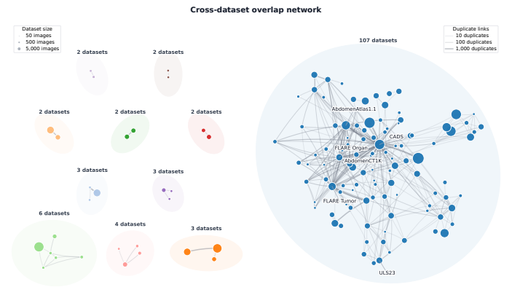
Figure 3 :Cross-dataset overlap network revealed by exact and near-duplicate 3D medical images.Each node represents a public dataset or dataset collection, and edges connect datasets that share at least one image pair with perceptual Hamming distance ≤100 or identified through dataset- specific deduplication and manual overlap tracing. Node size indicates the number of images in a dataset, edge size indicates the number of duplicate links associated with a dataset, and shaded regions denote connected components in the overlap graph. The largest component contains 107 datasets, including widely reused datasets and collections such asAMOS, KiTS, and AbdomenAtlas, illustrating that public dataset collections are not independent flat unions but part of a densely connected reuse ecosystem. Because perceptual hashing detects visual identity rather than causal lineage, edges should be interpreted as evidence of image-level overlap rather than complete provenance relationships.
Original paper · CC BY 4.0How reliable the flagged duplicates are
The authors checked the hash's precision and recall by labelling 5,000 image pairs by hand. Each test pair is an image paired with its top-1 candidate from the ANN search. They drew 1,000 pairs below the threshold of Hamming distance 100, which the pipeline flags as duplicates. They also drew 4,000 pairs above the threshold, which the pipeline doesn't flag, so the sample covers both sides of the cut.
Of the flagged pairs, 989 were true duplicates, giving a positive predictive value of 0.99. Among the unflagged pairs, 3,026 were indeed no duplicates, giving a negative predictive value of 0.76.
The authors read these numbers as precise candidates with limited recall, so the hash likely underestimates provenance-related duplication. They chose the low threshold on purpose so that detected duplicates are reliable.
Because of this, the manual check measures only the pairs the hash can see, and it can't count what the hash never matches.
Limits of similarity-based deduplication
Perceptual hashing breaks under several common transformations, which is the first limit of this approach. The authors analyse the effect of transformations on hash similarity in Section D.
The hash targets exact and near-exact duplicates, so it can't identify semantically related images that aren't identical. A formal view makes this explicit: a simple transformation T can give pHash(T(A)) different from pHash(A), even though both come from the same acquisition. A matching pair shows that two images look alike, but it doesn't show how one was derived from the other.
Nor does a match reveal how an image was transformed or redistributed across datasets.
Deduplication answers whether samples look similar, but it can't say whether they are causally related. That makes deduplication a lossy proxy for tracing data reuse, so post hoc deduplication stays incomplete. Public datasets rarely provide complete lineage information, and a curator may know only the repository name, citation, or DOI.
The authors argue that these limits call for explicit provenance rather than hashing alone. Their MAP profile records reuse, overlap, and deduplication decisions as structured metadata, so the lineage that hashes can't reveal gets documented.
Recording provenance with MAP
Hashing can flag overlaps but cannot say why they exist, so the authors add a metadata profile for recording provenance. MAP, short for Metadata for Aggregation and Provenance, is a lightweight metadata profile for dataset collections, paired with a web-based tool. Instead of a narrative format like Datasheets for Datasets, MAP focuses on structured provenance and reuse relationships.
MAP works on five principles: minimal, simple, structure-agnostic, traceability-first, and adoptable. The profile exports as JSON, so users can publish it alongside their collections.
A guided interface lets users populate the profile before they export it as structured JSON. The fields can also be integrated into existing metadata frameworks, such as VIDS.
Paper info
- Authors
- Yannick Kirchhoff, Saikat Roy, Elisa Stegmeier, Hamideh Haghiri, Constantin Ulrich, Maximilian Rouven Rokuss, Tassilo Wald, Karol Gotkowski, Benjamin Hamm, Raphael Stock, Nico Disch, Michael Baumgartner, Dimitrios Bounias, Anand Deshpande, Stefan Dinkelacker, Stefan Dvoretskii, Katharina Eckstein, Selen Erkan, Jessica Kächele, Kim-Celine Kahl, Balint Kovacs, Lucas Kulla, Moritz Langenberg, Philipp Schader, Stephen Schaumann, Dasha Trofimova, Shuhan Xiao, Sebastian Ziegler, David Zimmerer, Marco Nolden, Fabian Isensee, Klaus Maier-Hein, Ralf Floca
- Venue
- arXiv · Preprint
- First published
- 2026-11-6
- Added
- 2026-11-10
- Updated
- 2026-11-6
- Version
- v1
- arXiv
- 2611.10144
- Category
- eess.IV · cs.CV
- Original paper terms
- CC BY 4.0
- What we show
- Paper info, commentary and permitted figures from the original paper
AI commentary is a separate explanation from the original paper and may contain errors. The original paper and figures follow each source's terms of use and any rights noted separately.
Abstract
The development of deep learning-based medical AI depends on high-quality annotated data. Yet, dataset creation remains constrained by the need for expert radiologist annotations, limiting curated datasets to relatively small cohorts. To overcome this limitation, recent efforts increasingly aggregate disparate public datasets into large-scale dataset collections. However, combining datasets at scale often obscures data provenance, introducing substantial risks of reuse propagation, unintended leakage, bias amplification and distorted data distributions. In this work, we study these problems on a massive collection of 565k 3D radiological images across 1034 public datasets and provide practical resources to address them. Firstly, we formalize dataset collections as a distinct paradigm in medical image analysis and characterize their structural challenges, including reuse propagation, duplication, and provenance fragmentation. Secondly, we perform a large-scale empirical study of duplication on this collection and demonstrate extensive exact and near-duplicate reuse across public datasets via perceptual hashing and manual tracing, identifying a lower bound of 118k duplicate pairs. We make the perceptual hashes publicly accessible for comparison through our website, providing researchers with a standardized reference for identifying potential overlaps and shared provenance. Thirdly, since hashing alone cannot detect all duplicates, we introduce MAP (Metadata for Aggregation and Provenance), a lightweight, portable metadata profile for documenting provenance, known overlaps, and deduplication decisions in dataset collections. Our contributions help dataset collections shift from coarse aggregations to reliable and provenance-aware data scaling mechanisms in medical image analysis. A web tool supporting our work is available at https://mic-dct.dkfz.de/.
Quote from the paper
Yannick Kirchhoff, Saikat Roy, Elisa Stegmeier, Hamideh Haghiri, Constantin Ulrich, Maximilian Rouven Rokuss, Tassilo Wald, Karol Gotkowski, Benjamin Hamm, Raphael Stock, Nico Disch, Michael Baumgartner, Dimitrios Bounias, Anand Deshpande, Stefan Dinkelacker, Stefan Dvoretskii, Katharina Eckstein, Selen Erkan, Jessica Kächele, Kim-Celine Kahl et al. (2026). Dataset Collections: Challenges of Large-Scale Data Aggregation in 3D Medical Image Datasets. arXiv:2611.10144v1. https://arxiv.org/abs/2611.10144v1
BibTeX
@misc{kirchhoff2026dataset,
  title = {{Dataset Collections: Challenges of Large-Scale Data Aggregation in 3D Medical Image Datasets}},
  author = {Yannick Kirchhoff and Saikat Roy and Elisa Stegmeier and Hamideh Haghiri and Constantin Ulrich and Maximilian Rouven Rokuss and Tassilo Wald and Karol Gotkowski and Benjamin Hamm and Raphael Stock and Nico Disch and Michael Baumgartner and Dimitrios Bounias and Anand Deshpande and Stefan Dinkelacker and Stefan Dvoretskii and Katharina Eckstein and Selen Erkan and Jessica Kächele and Kim-Celine Kahl and Balint Kovacs and Lucas Kulla and Moritz Langenberg and Philipp Schader and Stephen Schaumann and Dasha Trofimova and Shuhan Xiao and Sebastian Ziegler and David Zimmerer and Marco Nolden and Fabian Isensee and Klaus Maier-Hein and Ralf Floca},
  year = {2026},
  eprint = {2611.10144},
  archivePrefix = {arXiv},
  url = {https://arxiv.org/abs/2611.10144v1}
}