Paper commentary
Beneath the Surface: What We Overlook When We Talk About Agent Evolution
Agent harness evolution gains can hide tasks lost along the way
- Problem A higher aggregate score can hide tasks that an evolved agent stops solving. Deployment cost and performance beyond the guiding tasks also stay unseen.
- Method The authors split reliability from coverage, tracking task turnover against the Seed, and test each evolution step separately.
- Results Every one of the sixteen evolved agents both gained and lost covered tasks. In one general-task case, reliability rose by 5.2 points while ten previously covered tasks were lost.
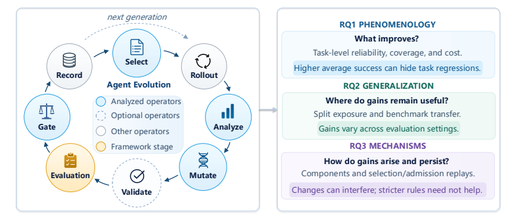
Fig. 1 :The agent harness evolution procedure (left) and our analyses of Phenomenology, Generalization, and Mechanisms (right).
Original paper · CC BY 4.0 · Xiaobo Wang, Zimu Wang, Siyu Ye, Jiaqi Li, Min Tang, Jun Bai, Yuling Shi, Ruobing Wang, Jingjing Zhang, Chaofan Wang, Kai Wu, Mengnan Qi, Kai Cai, Xiaodong Gu, Qi Liu, Zilong Zheng · Beneath the Surface: What We Overlook When We Talk About Agent Evolution · Original paper figure · Extracted the figure area from page 2 of the original PDF.Why a higher benchmark score is not enough
Agent harness evolution keeps the model weights fixed and changes the system around the model.
Deployment cost and performance beyond the guiding tasks stay unseen when only that score is reported. It can also make adaptation to the evolution tasks look like general improvement.
In one general-task case, reliability rises by 5.2 points while ten previously covered tasks are lost. Most reliability gains also increase deployment cost, so a higher score can come with a higher bill. The problem is not that evolution fails, because the gains are real for some tasks. A single aggregate score simply cannot show which tasks changed in which direction.
The authors therefore ask three questions about phenomenology, generalization, and mechanisms. They ask whether evolution yields reliable and efficient improvements, or whether it suffers from coverage trade-offs and hidden costs. They also ask whether gains survive in novel environments or tasks, and how specific operators create and keep useful changes.
Meaningful progress, in their framing, needs gains that are reliable across tasks, affordable, and effective beyond the evolution tasks.
Judging each evolution decision by its own consequence
The study stops treating one aggregate score as the target for every step of evolution. Reliability measures average success across passes, so it shows how consistently an agent solves tasks. Coverage instead asks whether a task is solved in at least one pass, which measures empirical reach. Task turnover tracks coverage gains and losses against the Seed, so it exposes how success gets redistributed.
Evaluating select means checking subsequent gains, because a Parent with the highest current score may not improve most. Analyze should be grounded in trace evidence, while mutate should be checked against the dependencies of a change. Gate needs assessment of both retained quality and the alternatives it keeps alive. Deployment cost and external evaluation then decide how broadly each benefit stays useful.
The authors apply this lens to four recipes, AHE, HyperAgents, A-Evolve and GEPA, run on MiniSWE and Codex. The general-task benchmark is τ3-Banking with 97 tasks, and the coding benchmark is Terminal-Bench 2 with 89 tasks. Deployment cost is estimated per task from recorded call costs, scaled by k. Evolution cost is reported separately, summing the charges of the calls made during search.
The central question is whether gains are reliable, affordable, and effective on tasks that did not guide evolution. The authors also ask how each operator helps keep beneficial modifications rather than only create them. Feedback can be narrower than the effects of a change, so one evaluation may miss behavior elsewhere.
Setting up four recipes on two harnesses
The comparison pits four evolution recipes against each other: AHE, HyperAgents, A-Evolve, and GEPA, all run with GPT-5.4. AHE and HyperAgents form the implementation-centric group, which puts its weight on agent engineering. A-Evolve and GEPA form the reflection-centric group, which distills execution feedback into reusable changes. Each recipe runs on two harnesses, so the authors can compare evolution designs under one common process.
MiniSWE 2.4.5 is source-editable, so it permits changes to the inner source. Each recipe implements seven operators: select, rollout, analyze, mutate, validate, gate, and record. Validate is optional, so the mechanism analysis concentrates on select, analyze, mutate, and gate because they decide which Parents are used and which Candidates persist.
General tasks come from τ3-Banking, which contains 97 tasks. Coding tasks come from Terminal-Bench 2, which contains 89 tasks. The authors split both benchmarks into Train, Validation, and Test. Evolution draws on Train and Validation evidence for search and admission, and the authors keep Test for Seed and Champion evaluation. An evolution algorithm starts from a Seed and runs for G generations, and each generation proposes new harnesses.
The rule Q picks the final Champion from the archived harness versions.
Task turnover counts coverage gains and losses against the Seed. Deployment cost over k passes equals the mean recorded per-task cost multiplied by k. The Phenomenology analysis reports eight-pass aggregates in Table 1 and uses k values of 1, 2, 4, and 8 in Figure 3.
What repeated evaluations reveal about gains and losses
The authors compare each frozen Champion with its Seed over eight passes in Table 1. For MiniSWE with AHE on τ3-Banking, Avg@8 moves from 27.4 to 32.9, a gain of 5.4 points. Pass@8 for the same pair climbs from 54.6 to 66.0, an 11.3-point rise, so coverage grows too. In one general-task case, reliability rises by 5.2 points while ten previously covered tasks are lost.
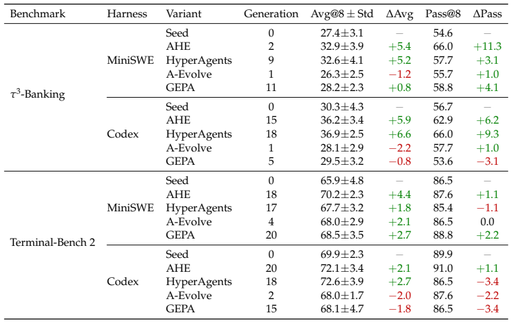
Table 1 :Reliability and empirical coverage across eight passes. Generation 0 is the Seed; later entries give the selected Champion’s Generation. Scores are percentages and deltas are percentage points.
Original paper · CC BY 4.0Figure 2 shows that every one of the sixteen Champions both gains and loses covered tasks. Coverage therefore doesn't grow monotonically, so the authors report gains and losses separately. Table 1 shows reliability gains in eleven of sixteen lineages and coverage gains in ten. Cost tells a different story: eight of the eleven reliability-improving Champions cost more per trial than Seed.
The other three lower-cost gains all come from the source-editable harness on coding tasks.
Per-trial cost and deployment efficiency can diverge, as Figure 3 shows. MiniSWE with AHE on τ3-Banking reaches 56.7% coverage in four passes. Seed needs eight passes to reach its 54.6% coverage, and the AHE run gets there at lower deployment cost. Efficiency therefore depends on both the cost of each attempt and the attempts needed for a coverage level.
Do gains reach tasks the evolution never saw
Within the same benchmarks, Test reliability rises for ten of the sixteen evolved lineages. Seven of the eight implementation-centric cases fall in that group, across both harness types and both task domains. The authors read this as improvement that reaches tasks excluded from the feedback that guided evolution. Reflection-centric gains depend more on the harness, since most source-editable cases improve.
Every outer-layer-only reflection-centric case declines, so the split follows both harness and paradigm.
For transfer, the authors carry general-task Champions to the full τ2-bench and coding-task Champions to DeepSWE v1.1. On the coding target, coverage rises for seven of eight Champions across both harness types and paradigms. Reliability moves the other way for source-editable Champions. All of them improve general-task transfer reliability, but they lose coding-task transfer reliability, even though three coding cases gain coverage.
Because the two outcomes diverge, reliability and coverage need separate checks for each target. A gain on the general-task target doesn't show persistence on the coding target, so the authors assess each outcome separately.
Which Parent is worth improving?
The test asks whether select picks the Parent whose Candidates gain the most under a shared process. Each Champion yields three Candidates through the same A-Evolve analysis and mutation steps. Each benchmark and harness gives one four-Parent pool, and each Parent's three branches share one Train pass. We score the best Parent by how far its Candidates' mean Test Avg@8 rises above its own score.
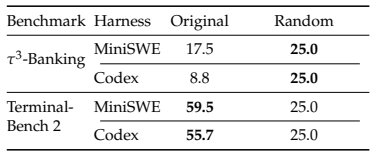
Table 4 :Best Parent selection rates (%). Higher values are bold.
Original paper · CC BY 4.0Table 4 compares the selection rate of the Original rule with a Random rule that samples uniformly. Both τ3-Banking rates fall below the 25.0% random baseline. The highest-scoring agent doesn't produce the largest mean improvement in any of the four pools.
The authors read this reversal as selection signals aligning with further improvement differently across domains. Current score alone can't identify the Parent with the most improvement potential, so subsequent gains need measuring too. This test covers only four pools, one for each benchmark and harness pair.
Do specific changes beat generic reminders?
The authors split each Champion into isolated Components, which are functionally related changes bundled with their dependencies. They set each Component against a generic reminder, such as checking tools and verifying results. Table 5 holds the isolated Components and complete Champions, while Table 6 holds the Seed with a generic reminder.
Each case has at least one winner across both harnesses and domains, so the gap isn't confined to one setting.
The authors take this gap as a reason to ground diagnoses in traces that name what to change and what to keep.
Combinations matter because six of eight Champions beat either isolated Component in reliability. That group includes every coding-task case, so combining changes helps most on the coding side. Two general-task cases, one per harness, favor only a subset of the Components. In one coding case, only the full combination improves over Seed. The authors read these patterns as a reason for mutate to keep dependencies and check harmful interactions in the complete Candidate.
When stricter admission throws away useful candidates
The gate decides which Candidates stay in the search, and the authors compare two versions of it. The original gate is compared with a constrained gate that asks for higher mean success and incumbent-relative mean regression of at most 0.05. Each score averages four method-specific pools per harness, and the reporting outcomes stay hidden from the decisions.
Constrained admission cuts best-Candidate retention from fifteen pools to six. The source-editable harness loses normalized score, while the outer-layer-only harness gains it on both domains.
The gain for the outer-layer-only harness comes from smaller sets that keep only a best Seed. So the normalized number alone doesn't show whether useful alternatives survived the gate. The authors conclude that admission quality needs preservation, set size, and Candidate identity read together. They didn't test a new gate rule in this section, and Appendix D.4 gives the per-pool results.
How AGE changes the four operators
AGE keeps the A-Evolve recipe and swaps in four revised operators. Other operators, the model and evaluator contracts, and the harness editing limits stay fixed. The select revision keeps the highest Validation score as its objective and changes only exact ties. Among tied Parents, it prefers the one with the fewest Seed-relative regressions on Validation tasks.
When comparable evidence is missing, a seeded generator draws uniformly from the original highest-score tie set.
The analyzer reads the current rollout and, when one is available, a preceding rollout on the selected lineage. It keeps the last 30 records in stored order and caps tool arguments at 600 characters and tool results at 800. The judge scores 0 to 3 for visible breakdown, 4 to 6 for partial or ambiguous progress, and 7 to 10 for visible completion.
These behavioral scores guide diagnosis, while benchmark scores still drive select and gate. Each judge request gets one attempt with a 600-second timeout, and a failed response returns a sentinel score of −1.
The mutation agent must state the observed behavior, the inferred mechanism, and the expected trade-off before it chooses files. It makes one coherent intervention, checks the affected interfaces, and keeps behavior that succeeded in the traces. Its changes may span multiple files and layers, and it proposes a validation case for the expected benefit.
The gate keeps the strict Parent-relative score rule and adds a cost tie-break for equal scores.
Every rollout executes the 50 Train tasks afresh, while canonical scoring runs 20 Validation tasks on τ3-Banking and 19 on Terminal-Bench 2. MiniSWE may change inner source and outer artifacts, whereas Codex may change only outer artifacts.
Did AGE beat A-Evolve
Table 10 sets AGE beside the four existing methods and uses the Seed as the reference point. AGE installs four revised operators in the A-Evolve recipe, so A-Evolve is the closest baseline. On τ3-Banking with MiniSWE, AGE reaches Pass@8 of 66.0, while A-Evolve reaches 55.7.
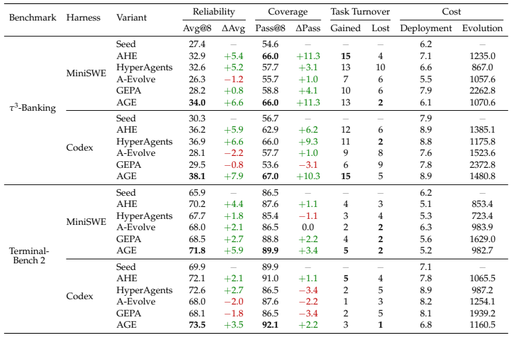
Table 10 :Comparison of AGE with existing evolution methods. Score changes are relative to the Seed. Costs follow Equation 3, withk=8 for deployment and 20 generations for evolution.
Original paper · CC BY 4.0AGE improves reliability and coverage over A-Evolve in all four settings. A-Evolve reaches 28.1 and 57.7 in that same setting. AGE also loses fewer Seed-covered tasks in three settings and ties in the fourth.
Eight experts reviewed the four operator revisions before they entered validation. Direction agreement averaged 6/8, and evidence support averaged 6.25/8. Problem addressing averaged 6.5/8, and proposal endorsement averaged 6.75/8. These judgments support validating the revisions, but they don't show that the revisions raise benchmark scores.
The authors read the consistency across domains and harnesses as support for evidence-guided revision. The discussion argues that evaluation should test the consequence of each decision rather than reuse one aggregate score.
What the results don't establish
The main comparisons rest on two benchmarks, τ3-Banking with 97 tasks and Terminal-Bench 2 with 89 tasks. External transfer goes to one target per benchmark, τ2-bench from τ3-Banking and DeepSWE v1.1 from Terminal-Bench 2. So the transfer findings describe these two external targets, and they say little about other domains.
Every recipe run uses GPT-5.4, so the results don't show how other models behave under these recipes. The authors ran each recipe with two harnesses, MiniSWE and Codex, so other harness designs remain untested. Each AGE run uses search random seed 0, and they didn't test other seeds. Their evidence on whether one run's trajectory generalizes to other runs therefore rests on this single seeded lineage per recipe.
Eight experts reviewed all four operator revisions, which is a small panel for judging the revisions. Direction agreement averaged 6/8, so the experts' choices matched the proposed direction for most, but not all, of the experts. Expert judgments show that the proposals look sound to reviewers, but they don't measure whether the revisions improve agents.
Neither benchmark scores nor expert approval show that the agents are safe to deploy.
The experiments run in isolated benchmark environments, not in live user-facing services. The authors keep fixed evaluation contracts and harness-specific editing permissions, so their conclusions hold under those constraints.
Paper info
- Authors
- Xiaobo Wang, Zimu Wang, Siyu Ye, Jiaqi Li, Min Tang, Jun Bai, Yuling Shi, Ruobing Wang, Jingjing Zhang, Chaofan Wang, Kai Wu, Mengnan Qi, Kai Cai, Xiaodong Gu, Qi Liu, Zilong Zheng
- Venue
- arXiv · Preprint
- First published
- 2026-11-5
- Added
- 2026-11-6
- Updated
- 2026-11-5
- Version
- v1
- arXiv
- 2611.07624
- Category
- cs.AI
- Original paper terms
- CC BY 4.0
- What we show
- Paper info, commentary and permitted figures from the original paper
AI commentary is a separate explanation from the original paper and may contain errors. The original paper and figures follow each source's terms of use and any rights noted separately.
Abstract
Agent harness evolution enables recursive self-improvement (RSI) without updating model weights. We examine whether higher benchmark scores yield reliable, efficient, and transferable improvement. We evaluate four methods across harnesses, general and coding tasks. Repeated evaluations, controlled agent expansion, component interventions, and admission replays reveal recurring patterns. All sixteen evolved agents gain previously uncovered tasks while losing previously covered ones. In one general-task case, reliability rises by 5.2 points despite losing ten previously covered tasks. Most reliability gains also increase deployment cost. Specific changes usually outperform generic reminders, but their benefits can change when combined. The highest-scoring agent does not yield the largest mean improvement in any of our four pools, and stricter admission can discard useful alternatives. Transfer selectively preserves gains: coverage usually falls on the general-task target across both harness types and paradigms, but rises on the coding target with the outer-layer-only harness. These findings motivate preservation-aware evaluation, tested decision rules, and explicit applicability conditions. As a constructive follow-up, EvoAudit turns these diagnostics into revisions of select, analyze, mutate, and gate, achieving the best performance.
Quote from the paper
Xiaobo Wang, Zimu Wang, Siyu Ye, Jiaqi Li, Min Tang, Jun Bai, Yuling Shi, Ruobing Wang, Jingjing Zhang, Chaofan Wang, Kai Wu, Mengnan Qi, Kai Cai, Xiaodong Gu, Qi Liu, Zilong Zheng (2026). Beneath the Surface: What We Overlook When We Talk About Agent Evolution. arXiv:2611.07624v1. https://arxiv.org/abs/2611.07624v1
BibTeX
@misc{wang2026beneath,
  title = {{Beneath the Surface: What We Overlook When We Talk About Agent Evolution}},
  author = {Xiaobo Wang and Zimu Wang and Siyu Ye and Jiaqi Li and Min Tang and Jun Bai and Yuling Shi and Ruobing Wang and Jingjing Zhang and Chaofan Wang and Kai Wu and Mengnan Qi and Kai Cai and Xiaodong Gu and Qi Liu and Zilong Zheng},
  year = {2026},
  eprint = {2611.07624},
  archivePrefix = {arXiv},
  url = {https://arxiv.org/abs/2611.07624v1}
}