Paper commentary
From What Is Used to What Is Missing: Rethinking Dynamic Rank in LoRA
GEAR adds LoRA rank only where missing task directions are found
- Problem Dynamic-rank LoRA methods only reallocate a fixed rank budget. They cannot tell whether the current adapter space is missing task-relevant directions, because standard factor gradients cannot observe directions outside the current space.
- Method GEAR estimates the dominant normal singular directions by randomized probing, without forming the full gradient. It optimizes inside the current space and adds rank only when the scored new directions pass a budget and per-module limit.
- Results On LLaMA3-8B, GEAR raises the average commonsense score from 86.61 to 88.45 while reducing trainable parameters from 42.0M to 14.4M.
Why rank rules miss missing directions
LoRA writes the update as a product of two thin matrices, so the rank r sets both the parameter budget and the directions the update can reach. Dynamic-rank methods try to spend that budget better, and AdaLoRA reallocates a prescribed rank budget by the importance of singular components. GeoLoRA combines gradient-driven basis augmentation with spectral truncation, so rank can both shrink and grow.
That leaves open whether task-relevant descent directions sit outside the adapter altogether.
Only the second cause justifies increasing rank. Existing rank-allocation criteria don't separate these two cases, so it is hard to tell whether extra capacity is really needed.
The paper's central view is that dynamic rank should depend on what the current space already represents and on what task-relevant descent information it cannot access. The authors claim that standard factor gradients reveal the tangent component, while the normal component stays unobservable under fixed rank. Consequently, factor gradients cannot distinguish under-optimization in the current space from directions that need rank expansion.
The paper proves this barrier: for a fixed-rank factorization, the unobservable subspace of the factor-gradient map is the normal space of the rank-r manifold. Two gradients give the same factor-gradient observation exactly when their tangent components match. So the ambiguity comes from the fixed-rank parameterization itself, not from factorization.
Tangent information therefore optimizes the existing degrees of freedom, while normal information measures the value of rank expansion.
Splitting the gradient into tangent and normal parts
The key idea is to split the gradient at a rank-r matrix into a tangent part and a normal part. The tangent part holds the directions the current space can already reach, while the normal part holds directions outside it. GEAR uses the tangent part to optimize inside the current space and the normal part to decide whether rank should grow.
Figure 1 sketches this split and the performance trade-off it gives on commonsense reasoning.
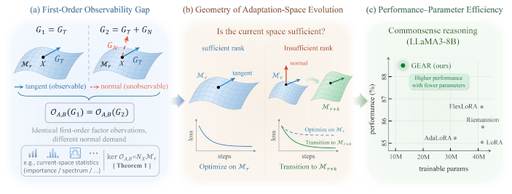
Figure 1 : Motivation and overview of GEAR. (a) standard factor-gradient observations are insensitive to normal components, soidentical first-order observations can correspond to different rank requirements. (b) GEAR distinguishes optimization within the current manifold from expansion toward task-relevant directions beyond the current first-order reachable space. (c) this geometry- guided rank evolution yields a stronger performance–parameter trade-off on commonsense reasoning.
Original paper · CC BY 4.0 · Peng Xue, Guodong Fan, Guang-Yong Chen, Xing Chen · From What Is Used to What Is Missing: Rethinking Dynamic Rank in LoRA · Original paper figure · Extracted the figure area from page 2 of the original PDF.Standard backpropagation returns two factor gradients, the B-gradient GA transposed and the A-gradient B transposed times G. The factor-gradient observation operator captures the first-order information about G that standard factor backpropagation exposes. The authors show that the kernel of this observation map is exactly the normal space of the fixed-rank manifold.
Two gradients therefore give the same factor observation exactly when their tangent parts agree. So one observation can match a gradient the space already covers, or one that needs new rank.
Factor gradients show the tangent part, but the normal part stays unobservable from them. Rank evidence therefore has to come from another signal, and the normal spectrum supplies it. Under the local quadratic model, the expansion gain equals eta squared times the sum of squared leading normal singular values, from i equals 1 to k. That gain is the summed squared leading normal singular values, which measures how much a k-rank expansion can lower the model.
GEAR estimates this normal spectrum with randomized probing rather than building the full gradient G.
How one GEAR update runs
Each update starts from the tangent gradient, built from two contractions, \( U^\top G \) and \( GV \), so the full gradient is never formed. The tangent gradient is \( G_T = U(U^\top G) + (I-UU^\top)GVV^\top \). A forward-equivalent factor pair built from U, zeros, C and the transpose of V makes backpropagation return those contractions.
The state then takes a step \( X^- = X - \eta G_T \) and is retracted back to rank r. The retraction works on compact factors: thin QR reduces the update to a small core, and a truncated SVD of that core gives the rank-r state.
At audit steps, GEAR estimates the dominant normal singular directions by randomized probing, without forming the normal gradient. A zero-initialized variable P enters the forward pass as a probe, so the output stays the same while its gradient carries a random sketch. Projecting that gradient onto the left complement gives \( Y=(I-UU^\top)\nabla_P f=G_N\Omega \), and orthogonalizing Y gives a basis Q for the dominant left singular subspace.
A second probe yields \( Q^\top G \), and a small core from it gives the leading normal singular values and vectors.
Each candidate direction is scored by its squared estimated singular value divided by the cost of one more rank dimension in that module. The score is \( a_{\ell,i}=\hat\sigma_{\ell,i}^2/(n_\ell+m_\ell) \), and a global budget caps the total added parameters. A per-module limit caps each module's rank, so no module grows without bound. An accepted expansion appends the new directions to the basis, and their optimizer states start at zero.
Before training, TGI seeds the space from task-gradient sketches on a small calibration set, so the start is aligned with the task instead of random. Because that initial product is nonzero, the frozen weight is reduced by it, so the pretrained mapping is kept at the start. The frozen weight becomes \( \tilde W = W - sX_0 \). The authors use one extra round of probing, p = 1, in their experiments.
Commonsense reasoning results
The commonsense experiment asks whether GEAR keeps its accuracy edge while using fewer trainable parameters. The authors test eight commonsense benchmarks, including BoolQ, PIQA, SIQA, HellaSwag, WinoGrande, ARC-e, ARC-c, and OBQA. They use LLaMA3-8B and Qwen2.5-7B as backbone models. Each score is a mean over three random seeds, and the trainable parameter count is listed next to it.
FlexLoRA was the strongest baseline in Table 1, and the gap is 1.84 points. The authors read this as a better trade-off rather than a larger budget, since the final ranks come from accepted expansions.
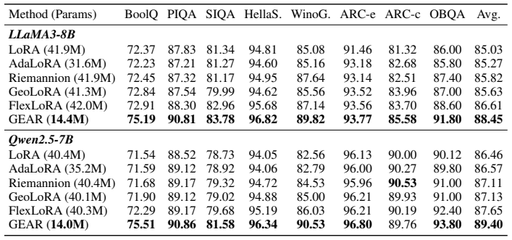
Table 1 : Commonsense reasoning performance on LLaMA3-8B and Qwen2.5-7B. We report the mean over three runs with different random seeds. Best results are shown inbold.
Original paper · CC BY 4.0The same ordering appears on the second backbone, so the result holds across both models. The authors attribute the gain to expanding along normal directions while optimizing accessible directions on the manifold.
GLUE and VTAB-1K results
On GLUE with DeBERTa-v3-base, the reference rank is 8, GEAR starts at rank 4, and the upper bound is 16. GEAR scores 89.63 with 1.5M trainable parameters, compared to 88.85 for FlexLoRA with 1.9M. That is 0.78 points higher, and GEAR uses about 21% fewer parameters. GEAR posts the highest score on seven of the eight tasks, with the clearest gains on MRPC, RTE and STS-B.
The authors read this as evidence that the benefit doesn't depend on one task structure.
The VTAB-1K experiment tests the same rank-evolution idea on ViT-B/16 across 19 recognition tasks. These tasks are grouped into Natural, Specialized, and Structured domains. The rank configuration matches the one used in the NLU experiments.
Across all settings, GEAR gives the strongest average with fewer trainable parameters than the best adaptive-rank baseline. The authors attribute the gains to adaptively chosen final ranks rather than to a larger rank budget. That supports their hypothesis that finding useful directions outside the current space makes rank growth more efficient.
Limitations of the experiments and the theory
The authors evaluate GEAR on four backbones: LLaMA3-8B and Qwen2.5-7B for commonsense reasoning, DeBERTa-v3-base for GLUE, and ViT-B/16 for VTAB-1K. They didn't test GEAR on other backbones, model sizes, or task families beyond these three benchmark groups. Ablation studies sit in Appendix E, so the main text doesn't isolate the contribution of each component.
Theorem 2 holds under the local quadratic model q_η, so its optimality claim applies at the current point X. The rank-expansion gain it gives is measured against the tangent space of the manifold at X. GEAR doesn't compute the full normal gradient G_N, and it estimates the dominant normal spectrum through randomized probing instead. Theorem 3 bounds the gap between the estimated and exact rank-k expansion by 2ηε(τ_k + ε), where ε is the normal estimation error.
Full details of this validation step sit in Appendix B.2, outside the main text.
GEAR runs rank-growth audits only between the first audit step and t_final. After t_final, the rank stays fixed, and training proceeds only with manifold optimization.
Paper info
- Authors
- Peng Xue, Guodong Fan, Guang-Yong Chen, Xing Chen
- Venue
- arXiv · Preprint
- First published
- 2026-11-5
- Added
- 2026-11-6
- Updated
- 2026-11-5
- Version
- v1
- arXiv
- 2611.07349
- Category
- math.OC · cs.LG
- Original paper terms
- CC BY 4.0
- What we show
- Paper info, commentary and permitted figures from the original paper
AI commentary is a separate explanation from the original paper and may contain errors. The original paper and figures follow each source's terms of use and any rights noted separately.
Abstract
Parameter-efficient fine-tuning with LoRA is governed by rank, which controls parameter budget and locally accessible task updates. Existing dynamic-rank methods mainly focus on capacity allocation, leaving unresolved whether the current adaptation space is sufficient for the task. We characterize the first-order information boundary of standard factor gradients, showing that their unobservable subspace coincides with the normal space of the low-rank manifold. Thus, factor gradients alone cannot distinguish under-optimization within the current space from task-relevant directions beyond its first-order reach. This motivates a geometric view of rank evolution, where tangent information optimizes existing degrees of freedom and the normal spectrum quantifies the value of new ones. Under a local quadratic model, we show that leading normal singular directions yield the locally optimal rank expansion, with spectral energy determining its gain. Building on this characterization, we propose GEAR, which turns the tangent--normal decomposition into rank evolution through tangent-space optimization, matrix-free normal-spectrum estimation for rank expansion, and task-induced geometric initialization. Across language and vision benchmarks, GEAR achieves the best average performance in all evaluated settings with substantially fewer trainable parameters. On LLaMA3-8B, it raises the average commonsense score from 86.61 to 88.45 while reducing trainable parameters from 42.0M to 14.4M.
Quote from the paper
Peng Xue, Guodong Fan, Guang-Yong Chen, Xing Chen (2026). From What Is Used to What Is Missing: Rethinking Dynamic Rank in LoRA. arXiv:2611.07349v1. https://arxiv.org/abs/2611.07349v1
BibTeX
@misc{xue2026from,
  title = {{From What Is Used to What Is Missing: Rethinking Dynamic Rank in LoRA}},
  author = {Peng Xue and Guodong Fan and Guang-Yong Chen and Xing Chen},
  year = {2026},
  eprint = {2611.07349},
  archivePrefix = {arXiv},
  url = {https://arxiv.org/abs/2611.07349v1}
}