Paper commentary
Sparse Anchors for Visual Multi-Session Registration in Changing Environments
Sparse absolute anchors register robot trajectories across changing construction sites
- Problem Localizing every frame fails when a scene changes and repeated structures cause false matches. Persistent visual content shrinks between visits, so per-frame image localization loses coverage and a few bad matches corrupt the whole trajectory.
- Method Sparse Anchors keeps only verified absolute poses and fuses them with within-session relative poses. It checks retrievals with a far-margin test, geometric verification, and sequence consensus, then refines anchors and runs pose-graph optimization.
- Results The method reaches 94.4% recall within 1m on 15 cross-session HILTI26 experiments. HLoc reaches 65.3% at the same threshold.
Why single-image localization breaks down across visits
A robot that revisits a construction site must place its new recording inside the map built during an earlier visit. Between visits, crews add, remove, or change walls, installations, and finishes, so fewer features persist across sessions. Repetitive, low-texture structures add a second problem, because they can make a query look like a place it never visited.
Image-based localization such as HLoc depends on distinctive, persistent correspondences, so it weakens when those correspondences disappear. HLoc localizes each query observation on its own and doesn't use within-session relative-pose constraints.
Point-cloud registration of independently built maps has the same weakness, because temporal change erodes the geometric overlap it needs. ColabSfM addresses the domain gap for sparse SfM reconstructions, but both learned registration methods face a substantial domain shift in this setting. Localizing every frame therefore lets a few bad matches spread their damage across the whole trajectory.
The authors instead use image localization only to obtain sparse, reliable absolute anchors.
Sparse anchors combined with within-session relative-pose constraints can still recover the complete query trajectory. A wrong retrieval would produce a faulty absolute constraint, so the authors give precision priority over how many retrievals they keep. The approach therefore needs a filter that accepts only distinctive retrievals before any pose is estimated.
Trusting a few anchors instead of every pose
The key idea is to trust only a sparse set of cross-session poses and let within-session motion carry the rest of the path. The query session's relative geometry is taken as consistent, so a few correct anchors can place the whole path even when most frames have no match. Instead of localizing every query observation, the approach uses image-based localization to obtain sparse, reliable absolute anchors.
Within-session relative-pose constraints then connect these anchors into one complete trajectory in the reference map frame.
A single wrong retrieval injects a wrong absolute constraint, so the authors favor precision over retrieval density. The first check is distinctive retrieval: the spatial far-margin compares the best match against the strongest alternative outside an exclusion radius. The margin is accepted only when m_far(k) reaches τ_far, and the exclusion radius of 10 m with a threshold of 0.01 are set in the implementation.
The second check is geometric verification, where generalized PnP with RANSAC rejects inconsistent matches and returns a locally verified pose hypothesis. Because a locally plausible pose may still belong to the wrong place, this trajectory-level test matters more than the per-frame check.
The surviving anchors are refined by featuremetric alignment against the reference Gaussian feature field, which corrects small image-to-map misalignments. The refinement optimizes only the six-degree-of-freedom body pose while the Gaussian map stays fixed. A pose-graph optimization then combines the refined anchors, within-session relative-pose factors, and consensus-aligned priors into the final trajectory.
The priors keep poorly constrained regions from drifting away from the consensus alignment. The output is the full query trajectory in the reference frame, with alignment and metric scale recovered during registration.
From retrieval to trusted anchors
The first stage scores each reference observation by its similarity to the query observation, using a descriptor that averages the per-camera MegaLoc descriptors. A top-1 match alone isn't enough, because neighboring reference observations often depict the same place and receive similarly high scores. The spatial far-margin instead compares the best match with the strongest alternative outside an exclusion radius of 10 m.
A retrieval is accepted when this margin reaches at least 0.01, so the pipeline favors precision over retrieval density.
For each accepted pair, the Hungarian algorithm picks the one-to-one view assignment that maximizes total descriptor similarity. LoMa-B then matches features only between the selected view pairs, and the matches are lifted to 3D using reference geometry. Generalized PnP with RANSAC returns one shared multi-camera body pose from the inliers and requires at least 20 inliers.
This locally verified pose can still belong to the wrong place, which is why the pipeline checks it against the query trajectory next.
Sequence consensus asks whether many poses agree on one similarity alignment between the query trajectory and the reference map. Candidate alignments come from spatially separated pose pairs, and the query trajectory is split into spatial cells. The consensus transform predicts each query pose in the reference frame, and each cell receives equal weight during refitting.
A valid consensus needs at least six anchors across three cells, and if no distributed and stable consensus exists, the session is rejected. The inliers of this consensus become the absolute anchor set that passes to featuremetric refinement.
Refining anchors and fusing them into the trajectory
The learned feature encoder Φ extracts query features from each camera image, and the refinement compares them with features rendered from the reference Gaussian map. Only the six-degree-of-freedom body pose is optimized, with the Gaussian map kept fixed, so the update changes the pose and nothing else. The pose update is applied as an exponential map to the generalized PnP pose, and one shared body pose is fitted across all valid cameras.
Refinement only touches the retained anchors, so it corrects small misalignment rather than recovering from a wrong place.
The featuremetric step runs with DINOv3 ViT-S/16 features, 32 Adam steps and a learning rate of 10 to the power of minus 3. Pose corrections are capped at 0.03 in normalized translation and 3 degrees in rotation, which keeps the update local. The pose-graph optimization then receives the refined anchors, the within-session relative-pose factors and the consensus-aligned priors.
Relative-pose measurements are formed as Z_kl = T_QBk^-1 T_QBl, and the scale estimated by sequence consensus stays fixed during optimization. The priors stop poorly constrained regions from drifting away from the consensus alignment.
The trajectory-level gain is modest because the corrections from the anchors are propagated by PGO. At the image level, the generalized PnP poses already give valid starting points, and refinement aligns persistent structures with the reference Gaussian rendering.
Does the far-margin pick more reliable retrievals?
The spatial far-margin gives AUCPR 0.678, compared to 0.488 for the top-1-top-2 margin and 0.499 for the top-1 retrieval score. This comparison is made at the retrieval stage, before any pose is estimated.
The top-two margin is weak here because neighbouring reference observations of the same place score almost equally. The far-margin skips those neighbours, so it asks whether the chosen place stands out from spatially separated alternatives. The authors say this matters in repetitive construction sites, where similar views can come from distant regions.
Registration against baselines
Table I compares the anchor pipeline with HLoc, FPFH with ICP, ColabSfM and Register Any Point over 15 cross-session experiments. The pipeline reaches 62.5% recall within 0.5 m, 94.4% within 1 m and 100.0% within 5 m. HLoc, which uses the same MegaLoc retrieval and LoMa-B matching front end, reaches 45.5%, 65.3% and 70.7% at those thresholds.
The authors matched HLoc's front end to their own to ensure a fair comparison. Within 1 m, the pipeline's 94.4% recall sits well above HLoc's 65.3%.

Figures from the paper TABLE I: Aggregate multi-session registration performance over 15 cross-session experiments. Translation and rotation RMSE are computed only for poses with translation error below5 m, whereas recall is evaluated over all query observations. All metrics are micro-averaged over query observations.
Original paper · CC BY 4.0HLoc localizes each query observation on its own and never uses within-session relative-pose constraints. The authors blame HLoc's losses on failures that strike when cross-session matches are missing or unclear. Among poses with translation error below 5 m, the pipeline reaches a t-RMSE of 0.600 m, compared with 0.944 m for HLoc. Its r-RMSE of 1.204° is also far lower than HLoc's 15.21°.
So the pipeline wins on coverage and on error among the poses it keeps.
FPFH with ICP, given the ground-truth scale, reaches 11.22% recall at 0.5 m and 34.59% at 1 m. Its t-RMSE of 1.793 m is lower than the 2.254 m of ColabSfM and the 2.314 m of Register Any Point. The authors attribute the weaker learned methods to domain shift, since Register Any Point is general-purpose and ColabSfM is trained on trajectories of one scene.
Register Any Point reaches only 1.34% at 0.5 m and 19.38% at 5 m. FPFH registration stays well below the image-based approach, which the authors read as support for their first claim.
What sequence consensus and PGO each contribute
Raw generalized PnP hypotheses are badly wrong, with a translation RMSE of 12.398 and a rotation RMSE of 68.144. Their recall within 0.5 m is only 25.7%, which points to severe outliers before any filtering. This row covers only directly localized observations, while the other configurations estimate the full query trajectory. Sequence consensus therefore has to run before optimization, because raw PnP outputs can't be trusted as absolute constraints.
Recall within 0.5 m rises only to 45.2%, so the authors conclude that PGO alone is unable to fully offset bad absolute constraints. Its rotation RMSE drops to 1.334, and recall within 0.5 m climbs to 49.9%, compared with 2.297 and 45.2% for PnP with PGO.
The table lists a rotation RMSE of 1.218 for this configuration, below the 1.334 of consensus alignment alone. The authors read this as support for filtering hypotheses before trajectory optimization instead of jointly optimizing all locally verified hypotheses. They didn't evaluate a configuration that drops PGO but keeps featuremetric refinement.
Consensus therefore makes the anchors usable, and PGO adds a further gain on top.
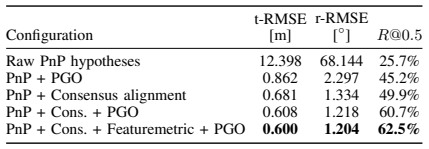
Figures from the paper TABLE II: Ablation of sequence consensus, pose-graph optimiza- tion, and featuremetric refinement. Unlike Tab. I, RMSE is com- puted without an error gate.
Original paper · CC BY 4.0What featuremetric refinement adds
Featuremetric refinement changes the trajectory-level result only slightly in this paper. The authors expect a modest gain here, because refinement touches only verified anchors and PGO spreads the correction along the trajectory.
Refinement runs only on the absolute anchors that sequence consensus kept, so it targets small image-to-map misalignments rather than wrong place hypotheses. Its input is the generalized PnP pose, which already gives a geometrically valid starting point for the optimization. The refinement minimizes the discrepancy between query features and rendered reference features, with the Gaussian map held fixed.
The image-level effect is clearer, as Fig. 4 shows with and without refinement. Persistent structures line up better with the Gaussian rendering, while poses that are already well aligned keep their alignment. The authors read this as support for their third claim, that refinement improves fine image-to-map alignment. They didn't test refinement on anchors that sequence consensus had rejected, so its role there is outside this evidence.
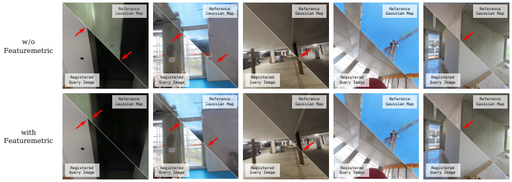
Fig. 4 : Qualitative effect of featuremetric pose refinement. Top row shows alignment after sequence consensus and PGO. Bottom row additionally uses featuremetric refinement, which corrects residual misalignment when present while preserving already well-aligned poses.
Original paper · CC BY 4.0 · Yunus Talha Erzurumlu, Niklas Trekel, Saurabh Gupta, Nico Koltermann, Olga Vysotska, Jens Behley, Louis Wiesmann, Cyrill Stachniss · Sparse Anchors for Visual Multi-Session Registration in Changing Environments · Original paper figure · Extracted the figure area from page 7 of the original PDF.Limits of the evidence
The evidence comes from one construction-site dataset, HILTI26, which the authors use for all their experiments. The authors build 15 cross-session experiments from seven reference sessions. Those exclusions remove sessions where SfM failed to produce even one consistent map. HILTI26 spans eight months of one project, while the authors contrast it with the several days of HILTI23.
The paper reports no experiment on a second site, so transfer to other environments remains untested.
Featuremetric refinement assumes that each anchor view holds enough persistent scene content for reliable alignment. Refinement touches only anchors that survive sequence consensus, so its gain on the whole trajectory stays small. The authors therefore rest their third claim on the image-level comparison in Fig. 4. Fig. 4 is qualitative, so the paper offers no image-level number for the alignment gain.
Table I's RMSE counts only poses with translation error below 5 m, while recall uses all query observations. The RMSE values therefore describe only the poses that passed that gate. The query session's within-session relative geometry is assumed consistent, and its alignment and metric scale are unknown. The metric scale is recovered during registration, and sequence consensus fixes it before PGO.
When no sufficiently distributed and stable consensus exists, the method rejects the session instead of forcing a global registration. The paper gives no rate of rejected sessions, so the cost of rejection stays unmeasured.
Paper info
- Authors
- Yunus Talha Erzurumlu, Niklas Trekel, Saurabh Gupta, Nico Koltermann, Olga Vysotska, Jens Behley, Louis Wiesmann, Cyrill Stachniss
- Venue
- arXiv · Preprint
- First published
- 2026-11-3
- Added
- 2026-11-6
- Updated
- 2026-11-3
- Version
- v1
- arXiv
- 2611.05084
- Category
- cs.CV · cs.RO
- Original paper terms
- CC BY 4.0
- What we show
- Paper info, commentary and permitted figures from the original paper
AI commentary is a separate explanation from the original paper and may contain errors. The original paper and figures follow each source's terms of use and any rights noted separately.
Abstract
Repeated robotic monitoring requires localization across visits to the same environment, even if the environment changes. Such changes can substantially reduce persistent visual content, and repetitive structures can lead to incorrect cross-session correspondences. In this paper, we address visual multi-session registration of a new data recording (the query session) to a previously reconstructed reference map. Under substantial visual and structural changes, cross-session localization may be possible only for parts of the trajectory. In our approach, we therefore rely on a sparse set of reliable absolute pose constraints and combine them with within-session relative-pose information to register the complete trajectory to the reference map. We first estimate absolute alignment hypotheses through visual place recognition, local feature matching, and geometric verification. We then use sequence consensus to reject hypotheses that are inconsistent with a common query-to-reference alignment and retain the remaining poses as absolute anchors. These anchors are refined through featuremetric alignment against a Gaussian feature field and combined with within-session relative-pose constraints in a robust pose-graph optimization. We evaluate our approach on 15 cross-session experiments from the challenging HILTI26 construction-site dataset, covering substantial scene changes and difficult-to-match environments. Our method achieves 94.4% recall within 1m and 100.0% within 5m, outperforming independent image localization, which peaks at 65.3% and 70.7%, respectively, as well as direct registration of independently reconstructed Structure-from-Motion geometry. Our results show that sparse, reliable absolute anchors can provide accurate and complete trajectory registration even when reliable cross-session correspondences are available only for part of the query session.
Quote from the paper
Yunus Talha Erzurumlu, Niklas Trekel, Saurabh Gupta, Nico Koltermann, Olga Vysotska, Jens Behley, Louis Wiesmann, Cyrill Stachniss (2026). Sparse Anchors for Visual Multi-Session Registration in Changing Environments. arXiv:2611.05084v1. https://arxiv.org/abs/2611.05084v1
BibTeX
@misc{erzurumlu2026sparse,
  title = {{Sparse Anchors for Visual Multi-Session Registration in Changing Environments}},
  author = {Yunus Talha Erzurumlu and Niklas Trekel and Saurabh Gupta and Nico Koltermann and Olga Vysotska and Jens Behley and Louis Wiesmann and Cyrill Stachniss},
  year = {2026},
  eprint = {2611.05084},
  archivePrefix = {arXiv},
  url = {https://arxiv.org/abs/2611.05084v1}
}