Paper commentary
Translating KV Caches Between Hybrid-Attention Language Models: MLA Latents, Linear-Attention States and Sparse-Attention Indexers
Hybrid-model caches need a separate translation mechanism for each cache object
- Problem Handing a conversation to another model normally means re-reading the whole history. KV-cache translation worked only for grouped-query attention, not for compressed MLA latents, linear-attention states, or sparse-attention indexers.
- Method KV-cache translation maps the source model's cache into the target's own format, so the target continues without re-reading. Each cache object gets its own mechanism: token-wise linear maps for latents, and state copies or replays for recurrent states.
- Results The hybrid MLA pair matches native quality within the paired confidence interval. Needle recall at 2 to 32K rises from 0.09 to 0.99 with token identity.
Why a hand-off has to re-read the history
Latent agent-to-agent communication passes richer information, but it keeps both models in the loop and doesn't replace the target's prefill.
KV-Lingo showed this for two GQA models with the same tokenizer. Its GQA recipe assumes that every cache object is a per-token key and value. Frontier models no longer cache plain per-token keys and values. Sparse-attention indexers add a small indexer key per token, and each query attends only to the top-k tokens the indexer selects. Linear-attention layers such as KDA and GDN keep no per-token cache, only a fixed-size recurrent state.
A token-wise map can't produce a recurrent state, because the state is never expanded back into per-token entries.
The paper tests this on pairs that contain the flagships' cache objects at 16 to 125B scale. Pair A is Kimi-VL-A3B with 27 MLA layers, paired with Kimi-Linear-48B-A3B with 20 KDA and 7 MLA layers. Pair B is Qwen3.5-27B paired with Qwen3.8-27B, two GDN and gated-attention hybrids with identical cache geometry. Pair C is a one-direction, one-seed run from Qwen3.8-27B to Qwen3.8-Flash-Next, a target with a sparse-attention indexer.
One mechanism per cache object
The core move is to give every cache object its own mechanism and capture point, instead of one map for all of them. Per-token objects get a token-wise linear map, so the translator maps each token's cached vector on its own. A recurrent state can't be produced token by token, so the authors either copy it with a correction or replay the target's own recurrence.
Exact long-range recall needs a further input, token identity, which the authors read back from the source's own MLA cache.
For the MLA latent, the capture point is the pre-norm, un-rotated latent, read from the hooks on kv_a_proj_with_mqa. The translator writes that latent back through the target's own kv_a_layernorm, and the target applies its own RoPE where it has one. Kimi-Linear is NoPE, so nothing is rotated on that side. Token identity works because the layer-0 latent of an MLA model is a deterministic function of the token alone.
The authors decode the id by nearest-neighbour lookup in a codebook of 163,840 rows, one per vocabulary entry.
Only the translator is trained, since both models stay frozen, and it never sees the source's hidden states. The translated object is written into the target's own cache tensors, as if the target had prefilled the prompt. Capture point ① is the raw projection output before the norm, and ③ is the engine's cached tensor. On the GQA pair, ③ matched ① on needle recall and judged quality, though not on every metric.
Sparse indexer keys get a different treatment: the source has no indexer, so the predictor writes a raw key that the target pools and rotates.
Each object's result is tied to the pair that tested it, so the table lists the evidence for each recipe. A state copy with a closed-form bilinear correction reached native level on Pair B, which has the same state geometry on both sides. A replay without any source state failed on Pair A when the zero state was used, with val KL rising from 0.082 to 0.344.
Checking the recipe on a GQA pair
The authors first ask whether the KV-Lingo recipe holds on a plain grouped-query attention pair before any hybrid is tried. Part 1 replicates KV-Lingo between Qwen3-8B and Qwen3-4B in both directions, using one seed and 2000 of KV-Lingo's 5000 steps. The comparison is run at capture point ① against the values KV-Lingo reported.
The linear premise holds: R2 falls within 0.01 to 0.04 of the paper, and heads align above chance at a diagonal share of 0.237 versus 0.125. The distilled translators reach the small model's native judge score and gold-in-answer, and needle recall is 1.00 at 2 to 8K. Validation KL stays about twice the paper's value, because the authors fit Stage 1 on 0.55M tokens against its 2.8M.
CoQA F1 stays 0.07 below native because translated answers run longer, while gold-in-answer stays at native. Capture point ③ matches ① on needle recall at 1.00 and 0.978 up to 8K, and on judge at 4.81 and 4.84.
The multi-turn check runs five alternating CoQA turns over 100 dialogues. Segment-wise transfer reaches a mean F1 of 0.621, compared to 0.650 for re-prefill. Naive re-translation falls to 0.283 at turn 5, which reproduces the collapse KV-Lingo reported.
Token-wise maps on a five-token prompt
In the Pair A forward direction, the source Kimi-VL-A3B has 27 MLA layers and the target Kimi-Linear-48B-A3B has 7 MLA and 20 KDA layers. A 5-token prompt gives the source 27 × 5 vectors of length 576, and the translator has to produce 7 × 5 target latents and 20 target states. Each source vector is a 512-d latent plus a 64-d rotary key, so the cache holds exactly what MLA stores per token and layer.
The translator builds the target latents with one linear map per target layer, applied to each token on its own. That map uses no attention and no context, so each token is translated without seeing its neighbours.
For a target MLA layer l, the map takes the concatenated source latents of its ν source layers and adds a bias. The source layers are picked by relative depth, so each target layer reads the source layers at the same depth. Target MLA layer 1 reads source layers 3 and 4, so W_l is 576×1152 when no token channel is added. With the target's 2304-d token embedding appended, W_l grows to 576×(1152 + 2304).
The token embedding comes from the id that the translator decodes from the source's layer-0 latent.
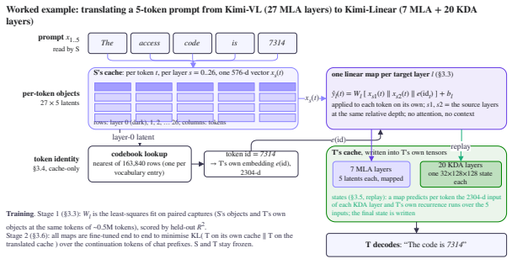
Figure 7 :The translator on a 5-token prompt (Pair A forward). Per-token objects (MLA latents) are mapped layer by layer with a linear map on the concatenation of a few source layers and the target’s embedding of the decoded token id; the per-prompt KDA states are produced by replaying the target’s own recurrence over predicted per- token inputs. Stage 1 fits the maps in closed form; Stage 2 fine-tunes them with a KL loss against the target reading its own cache.
Original paper · CC BY 4.0 · Povilas Kvedaras, Tomas Rasymas · Translating KV Caches Between Hybrid-Attention Language Models: MLA Latents, Linear-Attention States and Sparse-Attention Indexers · Original paper figure · Extracted the figure area from page 17 of the original PDF.The authors fit W_l in closed form by least squares on paired captures of about 0.5 to 0.7M tokens. The fit is scored by held-out R², which measures the share of the target object's variance the map explains. The KDA states can't be mapped token by token, so the translator predicts each token's input to a KDA layer instead. The target's own recurrence then runs over those predicted inputs, which keeps the target's dynamics.
Recovering token identity for exact recall
A linear map of a 576-d latent keeps the gist of a token but not its exact identity.
Each row is the layer-0 latent that entry produces, passed through a fixed 576→128 projection to save memory. For every cached layer-0 latent, the translator finds the nearest row and takes that row's token id. The recovered id gets the target's own input embedding, 2304-d, and that vector is appended to the input of every MLA and KDA map.
Neither variant reads any source hidden state, so the translator uses only what the source cache holds. There the ids are passed explicitly, and the target's layer-0 latent is computed exactly from them.
On Pair A forward, needle recall rose from 0.09 for the seed without token identity to 0.99 at 2–32K for the cache-only finalist. At 64K, the cache-only variant reached 0.83 and the token-ID variant reached 1.00. The seed row's needle recall at 64K is 0.00, so the token signal is what makes long-range recall work. Exact long-range recall therefore depends on token identity, not on the linear latent alone.
Copying or replaying a recurrent state
A recurrent layer keeps one matrix per head, updated token by token, plus a short conv window of the last three inputs. Because the state is never expanded back into tokens, a token-wise map can't produce it. The translator therefore has two routes, and the choice depends on whether the source has a matching state to start from.
The first route copies the source's final state and conv window into the target when both models share the same state geometry. On Pair B, both sides have 48 heads of 128×128, so the copy is possible without reshaping. The copy-plus-correction variant then applies a closed-form bilinear map to each value head, \( \hat S_h = A_h\, S_h^{\mathrm{src}}\, B_h \), with \( A_h, B_h \in \mathbb{R}^{128\times128} \).
Copying moves the 148MiB of Pair B states once, so its cost is O(1) in the prompt length.
When the source has no such state, as with Kimi-VL, the replay route takes over. A map predicts, for each token, the 2304-d normalised input that a KDA layer would have received.
Pair B tests this on its same-geometry hybrids, where copying the source's GDN states and mapping the 16 attention layers token-wise already reaches native task quality. The closed-form bilinear correction lowers the distributional gap on top of the plain copy.
Distillation after the closed-form fit
Stage 1 makes each layer's object close in least squares, but the target's next-token distribution is what decides the answer. Stage 2 therefore fine-tunes all translator parameters, including the maps, the token channel and the state maps, end to end. The target reads its own cache as the teacher, and the student reads the translated cache.
Teacher and student read the same continuation tokens, and the loss is a KL divergence between their next-token distributions at every continuation position. The loss is averaged over continuation tokens and conversations, so each position pushes the student towards the teacher's distribution. The method needs no labels and no second model, only chat prefixes.
Pair A trains on 4,000 conversations, which is 2000 steps at batch 8, and Pair B trains on 950 conversations. Validation KL uses 63 held-out conversations for Pair A and 64 for Pair B. Validation KL is the same quantity as the training loss, measured on held-out conversations. The validation sets and the probes are the same items that every evaluation reports.
Quality on the hybrid pairs
The hybrid pairs are judged against each target's own cache, and the results split by direction and by pair. The hybrid-to-full-MLA direction, Pair A forward, stays below native on several metrics. The forward chat judge reads 5.15 against 6.02 for native, and CoQA F1 is 0.20 lower because translated answers run longer. The authors trace the CoQA gap to answer length rather than content, since gold-in-answer sits at native level.
GSM8K drops 7.5 points and ARC drops 0.05 in the same forward run. The reverse Pair A direction, from Kimi-Linear back to Kimi-VL, is the easier one and the paper's authors call it that. Its one-seed confidence interval includes 0 on each task metric, yet gold-in-answer and ARC still point 0.03 to 0.04 below native. That result is a single seed, so the authors don't claim a paired interval for the judge gap of the forward run.
On Pair B, same-shape GDN hybrids reach the native level in both directions. The forward finalist recalls 12 of 12 needles at 64K and at 128K, which is 16 times the training cap. Its gain over the plain state copy is distributional, with CoQA first-token KL falling from 0.73 to 0.24. Validation KL drops by 0.0035, with a paired interval of −0.0044 to −0.0027.
The reverse direction reaches the same validation KL as the forward one, at 0.0155 against 0.0159. The reverse run also keeps native CoQA and recalls 12 of 12 needles at 64K and 128K.
The one significant gap in the reverse Pair B direction is behavioural, not a KL or accuracy effect. The forward state-copy translator inherits that habit at 28%, while the forward bilinear correction removes it at 0%. The reverse bilinear translator makes Qwen3.5 refuse 6 of 100 needles as sensitive, and Qwen3.5 never refuses natively. The authors read the copied state as carrying policy-like features, which matters when a cheaper model's cache is handed to a flagship.
The time to first token is the speed result behind these quality numbers. At 64K tokens, the target starts answering 18.7 times sooner for hybrid to full MLA, and 46.8 times sooner for Pair B, than after a re-read. Both timings come from Transformers runs on the same GPUs, not from a serving engine.
Multi-turn switches and naive re-translation
Multi-turn transfer is tested by alternating turns between the two models and checking what the answering model's cache holds. Segment-wise transfer translates each new segment only once, so nothing in the history is translated twice. In the GQA replication, segment-wise transfer reached a mean F1 of 0.621 over 5 alternating CoQA turns, against 0.650 for re-prefill.
Naive re-translation fell to 0.283 at turn 5 in that replication, which is KV-Lingo's multi-turn finding.
On Pair A, where both directions are lossy, naive re-translation collapses much further. F1 falls to 0.22 at turn 5, and the naive minus segment-wise gap there is −0.380. The target's KL at turn 4 rises to 2.35 under naive re-translation. On Pair B the degradation is milder, with F1 at turn 5 down by 0.124. Both pairs' per-turn curves are plotted in Figure 18, which shows the collapse on Pair A and a milder drop on Pair B.
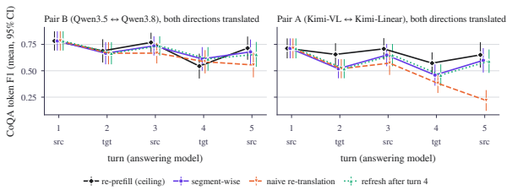
Figure 18 :CoQA F1 per turn over 5 alternating turns, both directions translated (mean, 95% CI over 50 dialogues). Segment-wise transfer stays close to the re-prefill ceiling; naive re-translation degrades by turn 5, mildly on Pair B and to a collapse on Pair A. Refresh after turn 4 equals segment-wise through turn 4 by construction.
Original paper · CC BY 4.0Its value shows in longer chats, where a one-direction 10-turn check on Pair A with 20 dialogues recovers turns 6 to 10 with AUC 0.571. Segment-wise transfer reaches an AUC of 0.536 in that same check. The refresh costs about 10 times the catch-up time of segment-wise, at 1.0 seconds against 0.1 seconds cumulative.
For the state layers, Pair A replays the target's own KDA recurrence over the translated segment. Replay reaches an AUC of 0.575 on Pair A, while copying the state from the whole source history reaches 0.563. Pair B instead copies the mapped source state, which costs O(1) in the prompt length.
Which layers carry the recall
The paper splits the translated cache into parts and swaps each part for the target's native object to see where the information sits. Swapping in every layer reproduces the native floor, with validation KL at 0.0034 for Pair A and 0.0004 for Pair B, so mixing translated and native parts is sound. On the Pair A seed, which has no token identity and reaches needle 0.13 on this subset, one native layer can carry the recall.
Layer 23 alone gives 0.80 recall and layer 15 gives 0.58, while the other MLA layers stay at or below 0.18. Making all 20 KDA states native doesn't help, leaving recall at 0.03. For the finalists, single layers barely move validation KL, and the token channel of the finalist covers exactly these recall layers.
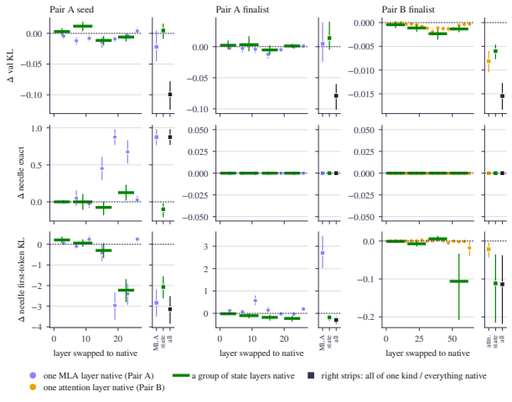
Figure 19 :Change in validation KL, needle recall and needle first-token KL when one translated layer (or a group of state layers) is replaced by the target’s native object, with paired 95% CIs. For the Pair A seed, native deep MLA layers restore exact recall; for the finalists single layers barely move KL.
Original paper · CC BY 4.0Neither half suffices on its own in either pair. Attention or MLA layers with empty states, or states with empty attention layers, lose every needle and raise validation KL to 0.28 to 0.64. The recurrent state isn't optional, because the finalist's maps with zero KDA state drop Pair A CoQA F1 to 0.087 and ARC to 0.477. On Pair B, zero GDN state makes the target lose the conversation, with 237 of 300 CoQA answers starting a new system turn.
On Pair B, the residual splits between attention and state. Making all 16 attention layers native halves validation KL from 0.0159 to 0.0078. Making all 48 GDN states native cuts it by 38%, down to 0.0099.
Sparse-attention indexer keys
A sparse-attention target needs its indexer keys to pick the right blocks, so the question is whether predicted keys can keep the needle. The target, Qwen3.8-Flash-Next, has 36 GDN layers and 12 QSA layers, and its indexer keys are block-pooled.
Pooled needle recall was 0.87 and 0.84 with predicted keys, compared to 0.88 and 0.85 with native keys. The target itself reached a pooled recall of 0.91 on the same items. The closed-form translated keys also gave a CoQA F1 of 0.80 and 0.77 with predicted keys, versus 0.77 with native keys. The authors also compared the indexer route with attending densely over the translated prefix, which is exact but saves no decode work.
The rehearsal covers one cross-model pair, one seed and up to 1000 steps, with 12 to 20 needle items per length. The combined score depends on the KL reference, at 0.92 with the pair's own step-0 KL and 0.61 with Pair B's. They didn't rehearse DSA on MLA caches, IndexShare or low-precision indexer storage. DeepSeek-V4's compressed multi-token entries are not rehearsed at all.
Limits at scale and seeds
The authors start with scale, because their pairs fit one machine while the flagships do not. The pairs span 16–125B total parameters and 3–27B active parameters. The flagships are 6–35× larger in active parameters, so feasibility at 300B+ stays a hypothesis. Every pair shares one tokenizer, so cross-family transfer, such as DeepSeek to Kimi, needs a token aligner they haven't validated.
The sparse-attention indexer rests on thin evidence: one QSA target, one cross-model pair, one seed and up to 1000 steps. DSA on MLA caches, IndexShare and low-precision indexer storage aren't rehearsed, and DeepSeek-V4's compressed multi-token entries aren't rehearsed at all.
Pair A forward sits below native on several metrics. Chat judge falls by 0.87 (5.15 versus 6.02), GSM8K by 7.5 points, CoQA F1 by 0.20 because of answer length, and ARC by 0.05. Translated states can carry the source's style and safety policy, and KL and accuracy don't detect it. Pair B reverse shows 6% needle refusals, and the evidence rests on two markers on one pair.
Several results have only one seed, so their confidence is weaker. The judge gap of Pair A forward on the deterministic re-run has no paired CI, and the token-ID finalist of Pair A wasn't run in the multi-turn harness. Gold-in-answer and ARC sit 0.03–0.04 below native for the Pair A reverse, a one-seed CI that includes 0. Pair B reverse speed wasn't measured, so the speed claims rest on the other runs.
Timing was measured in Transformers rather than in a serving engine, and the Pair A cold arm carries an FP8 dequantisation that the authors report separately. The authors state transfer to 300B+ flagships as a hypothesis, and they say the next experiment should test it.
Paper info
- Authors
- Povilas Kvedaras, Tomas Rasymas
- Venue
- arXiv · Preprint
- First published
- 2026-11-9
- Added
- 2026-11-10
- Updated
- 2026-11-9
- Version
- v1
- arXiv
- 2611.12062
- Category
- cs.LG · cs.CL
- Original paper terms
- CC BY 4.0
- What we show
- Paper info, commentary and permitted figures from the original paper
AI commentary is a separate explanation from the original paper and may contain errors. The original paper and figures follow each source's terms of use and any rights noted separately.
Abstract
A model that takes over another model's conversation must normally re-read the whole history; a text hand-off shortens the re-read only by dropping content. KV-cache translation instead maps the source's cache into the target's own format, so the target continues from the full context without re-reading it. It works for grouped-query attention (GQA), but open-weights frontier models now cache compressed latents (MLA), sparse-attention indexer keys and fixed-size linear-attention states. We replicate KV-Lingo on a GQA pair and then give, for each of these objects, where to capture and inject it and a mechanism that reaches native quality. We study two hybrid pairs at 16-48B scale in both directions, Kimi-VL-A3B - Kimi-Linear-48B (MLA - MLA + Kimi Delta Attention) and Qwen3.5-27B - Qwen3.8-27B (Gated DeltaNet hybrids), plus a sparse-attention target (Qwen3.8-27B - Qwen3.8-Flash-Next). MLA latents translate with token-wise linear maps; recurrent states are copied with a closed-form correction or synthesised by replaying the target's own recurrence. Exact long-range recall needs token identity: decoding token ids from the source's layer-0 MLA latent raises needle recall from 0.09 to 0.99 at 2-32K and to 0.83-1.00 at 64K, eight times the longest training prompt. The hybrid full-MLA direction is within the paired confidence interval of native quality on every task metric, and same-shape GDN hybrids reach the native level in both directions (apart from 6% refusals inherited from the source), with time to first token 18.7 and 46.8 times shorter than a re-read at 64K tokens. Segment-wise multi-turn transfer stays at the re-prefill level; naive re-translation collapses. On the sparse-attention target, predicted indexer keys recall the needle as well as the target's own keys (one seed). We state as a hypothesis how the recipes transfer to 300B+ hybrid flagships.
Quote from the paper
Povilas Kvedaras, Tomas Rasymas (2026). Translating KV Caches Between Hybrid-Attention Language Models: MLA Latents, Linear-Attention States and Sparse-Attention Indexers. arXiv:2611.12062v1. https://arxiv.org/abs/2611.12062v1
BibTeX
@misc{kvedaras2026translating,
  title = {{Translating KV Caches Between Hybrid-Attention Language Models: MLA Latents, Linear-Attention States and Sparse-Attention Indexers}},
  author = {Povilas Kvedaras and Tomas Rasymas},
  year = {2026},
  eprint = {2611.12062},
  archivePrefix = {arXiv},
  url = {https://arxiv.org/abs/2611.12062v1}
}