Paper commentary
Definitions, Label Names, or Demonstrations? Auditing What Governs LLM Annotation
LLM annotators often follow label names over the definitions they are given
- Problem High accuracy doesn't show whether LLM annotators apply the researcher's category definitions. Their correct labels could instead come from label names or labeled demonstrations.
- Method The authors move each definition to a different label, then score whether predictions follow the new or original mapping.
- Results On CCC, Mistral-7B matched the original mapping in 55.80% of predictions, but followed the written definition in only 10.75%.
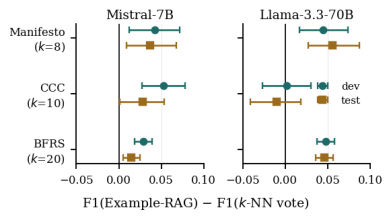
Figure 1 : Weighted- F1 difference between Global codebook-plus-demonstrations prompting and direct kNN using the same demonstrations. Positive values favor the LLM prompt; error bars show paired 95% con- fidence intervals. The numeric results are in Table 16
Original paper · CC BY 4.0 · Viraj Mishra, Shubham Gupta, Dhruv Gupta, Yuehong Cassandra Tai, Qunhua Li · Definitions, Label Names, or Demonstrations? Auditing What Governs LLM Annotation · Original paper figure · Extracted the figure area from page 6 of the original PDF.Why accuracy can't settle the rule
LLM annotators are usually judged by how often their labels agree with human coders. A correct label, though, can come from three places: the definition in the codebook, a prior link between a label name and a category, or the labeled demonstrations in the prompt. Those sources usually point to the same answer, so accuracy alone can't show which one the model used.
This matters for construct validity. A model can keep reproducing historical labels while missing the operationalization the researcher intended, especially when definitions change or past annotations depart from the written rules.
Earlier work has shown that label names, definitions and demonstrations each move LLM classification. Swapping label-definition pairings or removing codebook parts can change performance a lot (Halterman and Keith, 2026a). Models also weigh definitions and demonstrations unevenly (Milios et al., 2023; Mohammadi et al., 2025).
The authors ask two things: whether fine-tuning makes a model more responsive to supplied definitions, or only strengthens the original mapping. They also ask how predictions move when definition mappings and demonstration mappings are varied on their own.
Reassigning definitions as a test
The audit keeps each category entry's text and attaches it to a different output label. If a model follows the entry, its predictions move to the reassigned label. If it keeps the historical mapping, its predictions stay on the original label. The counterfactual codebook pairs each definition d_j with label ℓ_π(j), where π is a derangement.
A prediction for a text from category j counts as Definition when it equals ℓ_π(j). It counts as Original when it equals ℓ_j, the label the dataset originally assigned. Other covers any other valid output label, and Invalid covers outputs that fit none of these. Scoring each prediction against both mappings lets the audit separate definition adherence from preservation of the original mapping.
The outcome reveals which mapping a prediction matches, not which information source produced the match.
The authors repeat the same audit after task-specific fine-tuning. Paired changes in the Definition and Original rates then show whether the model moves toward the supplied mapping or the original one. For the zero-shot audit, the authors run ten independent rearrangements on 1,000 documents per dataset.
The audit is a diagnostic test, so it doesn't propose a new taxonomy of annotation rules. It also doesn't reveal the internal cause of a match, so the authors limit their claims to observable behavior.
Original labels win under reassignment
Mistral-7B labels 1,000 documents per dataset with the retained codebook and no demonstrations. Each dataset gets ten independent rearrangements of the definition-label pairs. The audit scores each prediction as Definition, Original, Other, or Invalid. Counterfactual F1 covers only valid outputs, so invalid outputs get their own column.
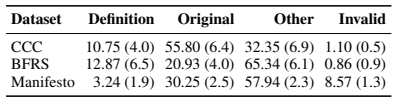
Table 2 : Zero-shot audit outcomes for Mistral-7B, in per- cent, across ten definition–label rearrangements (mean with standard deviation in parentheses; 1,000 documents per dataset).
Original paper · CC BY 4.0On CCC, Mistral-7B matched the original mapping in 55.80% of predictions. Definition adherence on CCC reached only 10.75%. On Manifesto the gap is wider, with 30.25% original-label agreement against 3.24% definition adherence. BFRS shows 20.93% original-label agreement and 12.87% definition adherence. Across the three datasets, the model keeps the historical mapping more often than it follows the written definition.
The CCC Definition column has a standard deviation of 4.0 across rearrangements. The CCC Original column has a standard deviation of 6.4 across rearrangements. Definition adherence varies most on BFRS, where its standard deviation is 6.5.
Manifesto has the lowest definition adherence and the highest invalid rate, which the paper links to choosing among 49 labels. The audit shows which mapping a prediction matches, not the information source behind it. So the result describes behavior under conflict, not the internal cause of each prediction.
Fine-tuning strengthens the old mapping
Mistral-7B-Instruct-v0.2 and Llama-3.1-8B-Instruct were the two models in the fine-tuning audit. Base and fine-tuned models were scored on 1,000 documents across ten rearrangements, so paired changes isolate training. Paired comparisons used a hierarchical bootstrap with 5,000 replicates that resamples rearrangements and then documents.
Fine-tuning raised original-label agreement in all six model–dataset combinations, by 4.63–29.44 points. The rise held in all 60 rearrangement-level comparisons. The largest original-label gain appeared for Mistral-7B on BFRS, at +29.44 points.
Definition adherence, by contrast, fell on CCC for both models. Definition adherence changed unreliably in three of the model–dataset combinations. Only Llama-3.1-8B-Instruct on Manifesto showed a rise, of 1.96 points.
That 1.96-point gain was smaller than the 4.63-point gain in original-label agreement for the same model. The authors read this as reinforcement of the original mapping rather than greater responsiveness to definitions. Standard weighted F1 also improved, so better scores can reproduce original annotations without greater definition adherence.
The audit tests adoption of a revised label–definition mapping, not new category boundaries.
Neighborhood labels behind retrieval gains
Global Example-RAG ranks all training examples by cosine similarity with all-mpnet-base-v2 and keeps the k nearest, with labels attached only after retrieval. Class-wise Example-RAG takes two examples per represented category instead, which guarantees coverage but can include weakly relevant texts. Mistral's development data chose k as 8, 10 and 20 for Manifesto, CCC and BFRS.
At matched demonstration counts, Global Example-RAG significantly outperformed Class-wise Example-RAG on Manifesto and BFRS for both models and both splits. For Mistral on Manifesto, the codebook-plus-demonstration prompt rose from .416/.404 to .580/.551 in development/test F1 when Global demonstrations were added. Class-wise retrieval still trailed Global demonstrations alone in all 12 comparisons, even though it used more demonstrations.
The question is whether the LLM does more than the labels of its neighbors. Direct kNN predicts the modal label among the same retrieved examples, and it recovers 74% and 75% of Mistral's Global codebook-plus-demonstration gain on Manifesto development and test data. On BFRS the recovered share is 88% on development data and 93% on test data.
The figure shows that the LLM prompt beats kNN by only .015 to .056 weighted F1 in five of six model-dataset pairs.
So retrieval mostly supplies a local input-label mapping, and the LLM adds a smaller share on top. The authors note that the LLM's advantage is largest when the leading labels have similar support. With unanimous neighbor labels, kNN matches or exceeds the LLMs.
Definitions versus demonstrations under conflict
Relabeling the retrieved demonstrations while keeping their texts fixed shows whether labels steer predictions beyond the texts' content. With reassigned demonstration labels and no codebook, Reassigned demos reach test F1 of .402 to .594. These scores fall below the matching Global labels-demonstrations scores in all six comparisons. Adding the original codebook prompt, which is the Demo conflict condition, recovers .005 to .048 in five comparisons.
The same codebook prompt loses .028 for Llama on CCC.
Rewriting the labels of the same demonstrations so they agree with reassigned definitions, as Aligned does, changes the picture. Aligned raises test F1 by .114 to .401, and every paired difference is significant. For Mistral on Manifesto, the reassigned-target F1 is .415 under Definition conflict and .529 under Aligned. The original-target F1 for that model and dataset under Original is .551.
On CCC, Mistral's reassigned-target F1 drops to .221 under Definition conflict.
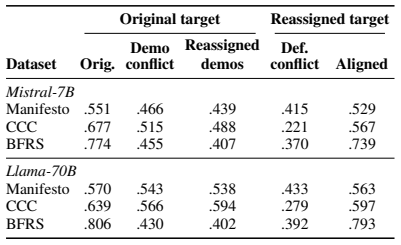
Table 5 : Test weighted F1 under original, conflicting, and aligned mappings. Targets follow the column group; Table 1 defines the conditions.Reassigned demoomits codebook information. Retrieved texts remain fixed.
Original paper · CC BY 4.0Aligned doesn't fully restore the original mapping, since it stays significantly below Original in ten of twelve comparisons. Across development and test sets, the other two comparisons show no significant difference between Aligned and Original. When every definition gets a different label, Mistral's mean test F1 rises from .021 to .025 under Definition conflict.
It reaches .485 to .704 under Aligned, a significant gain for every reassignment.
Demonstrations therefore set the followed mapping strongly, and the original codebook only partly offsets reassigned labels. Editing definitions alone could leave the model tied to an older policy stored in other components.
What the limitations leave open
Reassignment keeps category meanings intact, so the audit measures responsiveness to a given label–definition pairing. It doesn't test whether a model learns new category boundaries, since the audit tests adoption of a revised mapping only. The authors treat the counterfactual mappings as diagnostic checks rather than as a proposed taxonomy.
Agreement with a competing mapping doesn't show what caused a prediction. The audit therefore reports which mapping a prediction matches, and it can't identify the information source behind that match. The inference that fine-tuning reproduces historical labels rests on behavioral agreement alone.
The authors note that other models may weigh definitions, labels and demonstrations differently. The conflict tests use predefined label swaps and reassignments, with category content and retrieved texts held fixed. They don't show how models respond to isolated mislabeled examples. Ambiguous wording in codebook entries falls outside what these tests cover.
The retrieval comparison has its own limit, because Global and Class-wise Example-RAG change relevance and label concentration together. So the authors can't attribute the Global advantage to relevance alone. Direct kNN recovers 74 to 93% of the gain on Manifesto and BFRS, which bounds how much the LLM itself adds.
Paper info
- Authors
- Viraj Mishra, Shubham Gupta, Dhruv Gupta, Yuehong Cassandra Tai, Qunhua Li
- Venue
- arXiv · Preprint
- First published
- 2026-11-6
- Added
- 2026-11-9
- Updated
- 2026-11-6
- Version
- v1
- arXiv
- 2611.09457
- Category
- cs.AI
- Original paper terms
- CC BY 4.0
- What we show
- Paper info, commentary and permitted figures from the original paper
AI commentary is a separate explanation from the original paper and may contain errors. The original paper and figures follow each source's terms of use and any rights noted separately.
Abstract
Large language models (LLMs) are increasingly used to annotate social-science texts, but high accuracy does not establish that they apply researcher-supplied category definitions: predictions may instead reflect prior associations with category labels or labeled demonstrations. We introduce a counterfactual audit that reassigns definitions among output labels, distinguishing adherence to supplied definitions from preservation of a dataset's original mapping. Across three political-text datasets, models rarely follow reassigned definitions, and standard fine-tuning strengthens the original mapping without reliably increasing definition adherence. We then study retrieval-augmented annotation. Retrieving the nearest training examples generally outperforms retrieving examples separately within each category despite using fewer demonstrations. On the two tasks with substantial gains, direct \(k\)-nearest-neighbor classification recovers 74--93\% of the improvement, indicating that neighborhood labels provide much of the predictive signal. Relabeling fixed demonstrations redirects predictions, whereas aligning demonstrations with reassigned definitions substantially increases adherence to the new mapping. Thus, accuracy-improving interventions need not increase codebook adherence; definitions, category labels, demonstrations, retrieval, and training data should be aligned and validated jointly.
Quote from the paper
Viraj Mishra, Shubham Gupta, Dhruv Gupta, Yuehong Cassandra Tai, Qunhua Li (2026). Definitions, Label Names, or Demonstrations? Auditing What Governs LLM Annotation. arXiv:2611.09457v1. https://arxiv.org/abs/2611.09457v1
BibTeX
@misc{mishra2026definitions,
  title = {{Definitions, Label Names, or Demonstrations? Auditing What Governs LLM Annotation}},
  author = {Viraj Mishra and Shubham Gupta and Dhruv Gupta and Yuehong Cassandra Tai and Qunhua Li},
  year = {2026},
  eprint = {2611.09457},
  archivePrefix = {arXiv},
  url = {https://arxiv.org/abs/2611.09457v1}
}