Paper commentary
RGBT Salient Object Detection: A Large-scale Dataset and Benchmark
- Problem Existing RGBT salient object detection data are too small and too simple to train deep networks, and the earlier sets carry alignment defects.
- Method Builds VT5000 from 5000 aligned RGBT pairs annotated for 11 challenges, then trains ADFNet, a two-stream VGG16 network that fuses modality features with CBAM, PPM, FAM and an edge loss.
- Results ADFNet reached a max F-measure of 0.863 and an MAE of 0.048 on VT5000 in the comparison table.
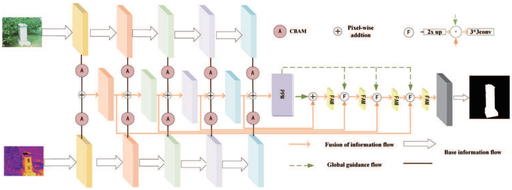
Fig. 5 . The overall architecture of our method. VGG16 is our b ackbone network, in which different color blocks represent different convolution blocks of VGG16.
Original paper · CC BY 4.0 · Zhengzheng Tu, Yan Ma, Zhun Li, Chenglong Li, Jieming Xu, Yongtao Liu · RGBT Salient Object Detection: A Large-scale Dataset and Benchmark · Original paper figure · Extracted the figure area from page 7 of the original PDF.The data gap behind RGBT salient object detection
RGB-only salient object detection struggles when the object looks like its surroundings, and RGB imaging is strongly affected by lighting and weather. Thermal infrared imaging records the heat radiated from the object surface, and the authors note that different places on one surface radiate almost the same heat, which makes thermal data a complementary cue rather than a copy of appearance.
Depth maps offer a similar kind of help for RGBD work, but they show uniform values for surfaces that face the depth camera head on, which limits what depth can add.
VT821 was the first RGBT set, and its samples contain alignment errors, black borders introduced by the alignment step, and mostly simple scenes. VT1000 was captured with a newer camera, yet the RGB and thermal images still need alignment, and its scene complexity and diversity did not grow much over VT821.
The earlier RGBT methods merge the two modalities without a learned fusion strategy, let background noise enter during fusion, and leave object boundaries unclear.
Capturing and annotating VT5000
Two FLIR cameras, the T640 and the T610, record the thermal and visible images, and the two sensors share imaging parameters. Because the parameters match, the pairs do not need the manual alignment that caused errors in the earlier sets.
The authors collected more than 5500 pairs, selected 5500 that differ from one another as much as possible, and kept 5000 pairs on which six viewers agreed about the salient objects they noticed first. Adobe Photoshop was used to outline each salient object by hand, giving pixel-level ground truth masks.
Eleven challenge attributes are annotated: big and small salient objects, multiple objects, low illumination, center bias, cross-boundary objects, similar appearance, thermal crossover, clutter, out-of-focus and bad weather. An object counts as big when its pixels exceed 0.26 of the image pixels, and as small when they fall below 0.05 of the image pixels.
Table I counts how often attributes co-occur, so 371 pairs are both big-object and center-bias samples. Imaging-quality labels mark whether the object is unclear in the RGB or the thermal image, and these labels are attached as two extra attributes.
The 2500 pairs in the training split are separated from the remaining pairs used for testing. The training split holds more big salient objects than the testing split, while the testing split holds more small ones, so the authors describe training as more general and testing as harder.
How ADFNet fuses the two streams
ADFNet runs two VGG16 streams, one per modality, initialized from a pre-trained VGG16 model. Each stream yields five levels of features, and attention modules weight those features before the two modalities are combined.
The channel branch of CBAM pools each block's features with average pooling and with max pooling; the max-pooled descriptor is kept because the authors expect it to capture discriminative cues that average pooling misses. The two pooled descriptors pass through convolution layers, their outputs are summed, a sigmoid turns the sum into channel weights, and these weights multiply the input features.
\[ MC_{R_i} = \big(\sigma(\mathrm{Conv}(\mathrm{AvgPool}(X_{R_i})) + \mathrm{Conv}(\mathrm{MaxPool}(X_{R_i})))\big) \ast X_{R_i} \]
The spatial branch pools the channel-refined map along the channel axis with average and max pooling, joins the two maps, and applies a k by k convolution followed by a sigmoid. \[ MS_{R_i} = \big(\sigma(f_{k\ast k}([\mathrm{AvgPool}(MC_i), \mathrm{MaxPool}(MC_i)]))\big) \ast MC_{R_i} \] The spatial branch therefore highlights informative positions, which the authors say matters most in the shallow layers when removing CBAM leaves redundant information.
Earlier work suggests that fusing modalities only at a shallow or only at a deep layer does not use the useful features well, so the network fuses at every block. At the first block the two attention-weighted maps are added; from the second block on, the previous fused map is convolved and then the two new maps are added. \[ F_i = \begin{cases} MS_{R_i} + MS_{T_i}, & i = 1 \\ \mathrm{Conv}(F_{i-1}) + MS_{R_i} + MS_{T_i}, & i = 2,3,4,5 \end{cases} \] This keeps both low-level and high-level information in the fused features.
The Pyramid Pooling Module takes the fused top-level features and gives global context, because the receptive field of a deep stack is too small to cover the whole image. Its four branches are global average pooling, two intermediate branches that adaptively average-pool to 3*3 and 5*5, and an identity mapping. The resulting guidance is passed down the top-down pathway with up-sampling, so each level receives global information.
The Feature Aggregation Module takes features at downsampling rates of 2, 4, 8 and 16 and converts them to several scales with average pooling. Its four branches are combined through up-sampling and a 3 by 3 convolution, which the authors use to reduce aliasing caused by up-sampling.
Edge loss and the training objective
The cross entropy term compares the predicted saliency map with the ground truth pixel by pixel, and it is the general guidance for the saliency map.
Cross entropy alone does not give crisp boundaries, so the authors apply a Laplacian to both the ground truth and the predicted map and apply cross entropy to the resulting boundary maps. The idea follows an earlier boundary method, but the authors use a simpler strategy.
The Laplacian is the sum of second partial derivatives, and the second derivative responds to edges. \[ \Delta f = \frac{\partial^2 f}{\partial x^2} + \frac{\partial^2 f}{\partial y^2} \] The response is passed through an absolute value and a tanh, which the paper describes as mapping the boundary values into the range 0 to 1. \[ \Delta \tilde{f} = \mathrm{abs}(\tanh(\mathrm{conv}(f, K_{laplace}))) \]
The edge loss applies cross entropy to the boundary maps of the ground truth and the prediction, with a leading minus sign. \[ L_E = -\sum_{i=0}^{\mathrm{size}(Y)} \big(\Delta Y_i \log(\Delta P_i) + (1-\Delta Y_i)\log(1-\Delta P_i)\big) \] The total objective adds the two terms without a weighting factor given in the paper. \[ L_S = L_C + L_E \]
Training and evaluation settings
Training uses Adam with weight decay 5e-4 for 25 epochs, with an initial learning rate of 1e-4 that is reduced to 1e-5 after the 20th epoch. Inputs are originally 640*480 and are resized to 400*400, and training uses random horizontal flipping. Only the VGG16 backbone starts from pre-trained weights, the rest is randomly initialized, and fixed random seeds are set, so the authors treat each setting as one run on a single Titan Xp GPU.
The 2500 VT5000 pairs are the training set, and the remaining VT5000 pairs are tested together with VT821 and VT1000. The authors report single runs because repeated runs differ only slightly, attributed to floating-point error.
Performance is measured by precision-recall curves, obtained by thresholding the saliency map, by F-measure and by mean absolute error. \[ F_\beta = \frac{(1+\beta^2)\cdot \mathrm{Precision}\cdot \mathrm{Recall}}{\beta^2\cdot \mathrm{Precision}+\mathrm{Recall}} \] Beta squared is set to 0.3. \[ MAE = \frac{1}{W\times H}\sum_{x=1}^{W}\sum_{y=1}^{H}|S(x,y)-G(x,y)| \] The MAE averages the pixel-wise absolute difference between the prediction S and the ground truth G over the W by H pixels of the image.
Ten baselines are compared: PoolNet, RAS, BASNet, CPD, R3Net, PFA, PiCANet, EGNet, MTMR and SGDL, and MTMR and SGDL are the two traditional methods. The compared methods run on RGBT data with published code, without post-processing, and with the same evaluation code.
Comparison with prior RGBT and RGB methods
On VT5000 specifically, the F-measure is 9.9% higher than PoolNet and the MAE is 3.3% lower.
Against PiCANet, which also uses attention, the F-measure is 1.5% higher on VT821 while its MAE is 0.1% higher, which is worse. On VT1000 the F-measure is 5.9% higher and the MAE 2.6% lower, and on VT5000 the F-measure is 7.5% higher and the MAE 1.8% lower.
Against CPD, the F-measure is 1.8% higher on VT821 with MAE 0.2% lower, 0.9% higher on VT1000 with MAE 0.3% lower, and 1.6% higher on VT5000 with MAE 0.1% higher.
Against EGNet, the most recent compared method, the F-measure is 0.6% higher on VT1000 and 2.4% higher on VT5000. The text also says EGNet's MAE is 0.1% lower on VT1000 and 0.3% lower on VT5000 than ADFNet's, so EGNet has the lower MAE on both sets. The authors attribute ADFNet's advantage over EGNet to refining edges without a separate edge model, to PPM's global guidance, and to the complementary thermal branch.
Table III reports F-measure per challenge, and the SA and SSO gains over PoolNet are reported as 10.8% and 14.8%. The table values are 0.727 for PoolNet and 0.835 for ADFNet on SA, and 0.658 for PoolNet and 0.806 for ADFNet on SSO. The authors attribute the SA gain to thermal data separating the object from a background that looks similar in RGB, and they note that small objects remain hard for every modality.
Across the eleven challenges and the two quality labels listed in Table III, ADFNet has the highest F-measure in every row except CIB, where it ties with CPD at 0.860.
The authors rank VT5000 as intermediate in difficulty, with VT821 the hardest and VT1000 the easiest. They attribute VT1000's ease to its many simple samples, and VT821's difficulty to randomly added noise and weaker sample quality.
Visual comparisons cover rows that each include at least one challenge, and the authors state that the proposed method keeps the objects clear, suppresses the background and gives objects well-defined contours.
What CBAM and the edge loss each add
The ablation starts from a PoolNet-based basic network and varies CBAM and the edge loss, and it is scored by max F-measure and MAE on the VT5000 testing set. Figure 7 shows the saliency map and fused features from layers 1 to 4, with and without CBAM, which the authors use to argue that CBAM retains spatial details.
The basic network reaches max F-measure 0.836 with MAE 0.057, and adding CBAM alone raises the max F-measure to 0.857 and lowers MAE to 0.052. Adding the edge loss alone lowers the max F-measure to 0.825 and raises the MAE to 0.063. Using both components gives the best ablation result, with max F-measure 0.863 and MAE 0.049.
With the edge loss alone, the loss decreases overall but fluctuates strongly during training. The authors explain this by noise: CBAM suppresses noise, but when too much redundant noise remains, the extracted edges become unreliable and training becomes unstable. Their reading is that the attention mechanism is needed to locate the salient object, and the edge loss then refines its edges.
The comparison table reports max F-measure 0.863 and MAE 0.048 for ADFNet on VT5000, while the ablation table reports MAE 0.049 for the same max F-measure.
The full configuration takes 982.65s for one training epoch on 2500 samples and 383.30s for testing on 2500 samples.
Extension to RGBD datasets
Five RGBD methods, DMRA, MMCI, AFNet, A2dele and S2MA, were run on the RGBT test sets with their default settings. On VT5000, ADFNet reaches max F-measure 0.863 with MAE 0.048, above S2MA's 0.837 and MMCI's 0.797. On VT821, S2MA's max F-measure is 0.812 against ADFNet's 0.804, and on VT1000 both reach 0.923. The authors attribute the weaker results of DMRA and A2dele to modules designed for the depth map or to a distillation strategy.
For the RGBD experiment, ADFNet is trained on 1485 pairs from NJU2K and 700 pairs from NLPR, and evaluated on DES, LFSD, SSD and STEREO. On DES, S2MA reaches max F-measure 0.944 against ADFNet's 0.901, and on LFSD the values are 0.862 for S2MA and 0.863 for ADFNet. The authors describe ADFNet as performing similarly to the state-of-the-art RGBD methods on the four RGBD datasets.
Limitations
The authors list alignment-free RGBT salient object detection and unsupervised or weakly supervised settings as open directions. The imaging-quality labels are described for future weakly supervised work, and the reported experiments do not use them.
The authors state that thermal data become unreliable when thermal crossover occurs, while visible imaging is not affected by temperature. VT5000 contains more thermal crossover samples because the images were captured in summer and autumn.
Each setting is reported as a single run, so run-to-run variation is not measured. The F-measure per challenge is the only per-challenge measure reported, and the MAE is not broken down by challenge. EGNet has lower MAE than ADFNet on VT1000 and VT5000, and CPD has a higher MAE on VT5000, so the best F-measure does not mean the best MAE.
The ablation covers only CBAM and the edge loss on the PoolNet-based network, and the edge loss alone degrades the result. The RGBD extension uses the standard architecture without a design specific to thermal images.
Paper info
- Authors
- Zhengzheng Tu, Yan Ma, Zhun Li, Chenglong Li, Jieming Xu, Yongtao Liu
- Venue
- arXiv · Preprint
- First published
- 2020-7-7
- Added
- 2026-11-6
- Updated
- 2022-5-23
- Version
- v6
- arXiv
- 2007.03262
- Category
- cs.CV
- Original paper terms
- CC BY 4.0
- What we show
- Paper info, commentary and permitted figures from the original paper
AI commentary is a separate explanation from the original paper and may contain errors. The original paper and figures follow each source's terms of use and any rights noted separately.
Abstract
Salient object detection in complex scenes and environments is a challenging research topic. Most works focus on RGB-based salient object detection, which limits its performance of real-life applications when confronted with adverse conditions such as dark environments and complex backgrounds. Taking advantage of RGB and thermal infrared images becomes a new research direction for detecting salient object in complex scenes recently, as thermal infrared spectrum imaging provides the complementary information and has been applied to many computer vision tasks. However, current research for RGBT salient object detection is limited by the lack of a large-scale dataset and comprehensive benchmark. This work contributes such a RGBT image dataset named VT5000, including 5000 spatially aligned RGBT image pairs with ground truth annotations. VT5000 has 11 challenges collected in different scenes and environments for exploring the robustness of algorithms. With this dataset, we propose a powerful baseline approach, which extracts multi-level features within each modality and aggregates these features of all modalities with the attention mechanism, for accurate RGBT salient object detection. Extensive experiments show that the proposed baseline approach outperforms the state-of-the-art methods on VT5000 dataset and other two public datasets. In addition, we carry out a comprehensive analysis of different algorithms of RGBT salient object detection on VT5000 dataset, and then make several valuable conclusions and provide some potential research directions for RGBT salient object detection.
Quote from the paper
Zhengzheng Tu, Yan Ma, Zhun Li, Chenglong Li, Jieming Xu, Yongtao Liu (2020). RGBT Salient Object Detection: A Large-scale Dataset and Benchmark. arXiv:2007.03262v6. https://arxiv.org/abs/2007.03262v6
BibTeX
@misc{tu2020rgbt,
  title = {{RGBT Salient Object Detection: A Large-scale Dataset and Benchmark}},
  author = {Zhengzheng Tu and Yan Ma and Zhun Li and Chenglong Li and Jieming Xu and Yongtao Liu},
  year = {2020},
  eprint = {2007.03262},
  archivePrefix = {arXiv},
  url = {https://arxiv.org/abs/2007.03262v6}
}