Paper commentary
Where Did the Update Go? Certifying Declared Change Envelopes for Model Updates
Declared change envelopes let teams certify where a model update changes behavior
- Problem Regression tests and churn rates measure total change, so they can't certify an update that is meant to change some decisions. Teams need to know whether the change stayed inside the region they declared in advance.
- Method The developer commits to a region of inputs before training. Leakage is the share of out-of-scope decisions that change, estimated from unlabeled traffic with anytime-valid tests.
- Results Domain and policy LoRA updates keep only 7 to 36 percent of their changed decisions inside the declared scope. Anchoring to the incumbent's decisions lets updates certify 5% leakage.
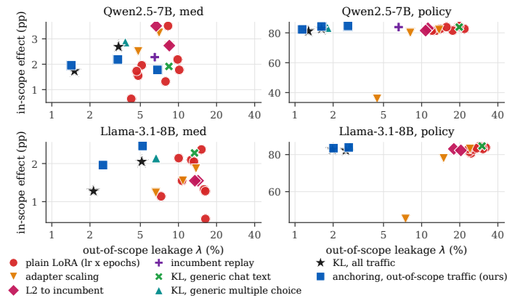
Figure 3 : In-scope effect versus out-of-scope leakage for every way of trading them off that
Original paper · CC BY 4.0 · Muhammad Usama, Muhammad Saad Qadir · Where Did the Update Go? Certifying Declared Change Envelopes for Model Updates · Original paper figure · Extracted the figure area from page 16 of the original PDF.Why global update checks miss the point
Teams already check model updates with regression tests, negative-flip rates and churn, and these measure how much a model changed over all traffic. Decomposing the global disagreement rate makes this explicit: it equals the envelope mass times the in-scope change rate, plus the complement's share times the leakage. For the Qwen policy update, the envelope mass is 8.9% and the in-scope change rate is 23.7%, so the global disagreement is at least 2.1% even if the update leaked nothing.
Label-based tests have a different blind spot: they are indifferent to where accuracy-neutral changes occur. With outcome labels, the out-of-scope accuracy change is the wrong-to-right rate minus the right-to-left rate, so flips between two wrong answers stay invisible.
The estimand that answers the regulators' question is decision change restricted to the complement of a region fixed before the update existed. A scoped certificate needs that commitment, because a region chosen after training could be drawn around the realized footprint and give zero leakage. Committing the region by hash before training is what makes a small leakage value informative.
The guarantee also needs no labels, since deployment traffic is unlabeled.
A declared region and the leakage it counts
The idea is to commit to a region of inputs before training and then count the decisions that change outside it. The authors call this region a declared change envelope, and the share of out-of-scope decisions that change is the leakage.
With E the envelope and Δ the change indicator, leakage is λ(E) = P(Δ = 1 | x not in E). Leakage compares two models rather than scoring them against labels, so an operator needs only unlabeled traffic to estimate it. The paper also reports envelope mass m(E) with every leakage value, because a small λ(E) only means something when the envelope is small.
The envelope has to be committed before training, because a region chosen after training could be set equal to the footprint and show zero leakage. Choosing the region from audit data is ruled out for the same reason.
Deployed inference isn't bitwise reproducible, so some observed changes are numerical noise rather than real updates. The authors measure this with a self-disagreement floor, and re-batching the Qwen incumbent changes 0.71% of audit decisions. No certificate on raw decisions can be issued below this floor, so it sets the smallest leakage that can be resolved.
The margin lemma says that an update which moves option scores by δ can only flip decisions whose top-two gap is at most 2δ. That is why both numerical noise and mild updates act mainly on fragile decisions, and the paper also reports decisive leakage above a margin threshold τ.
How the certificate is computed
The certificate runs a Beta-mixture martingale over unlabeled audit draws, so the operator can monitor continuously and stop once the bound is met. Leakage is certified from the indicator Z_t, which equals the footprint change on inputs the envelope doesn't cover. The audit inputs are assumed i.i.d. draws that the update never saw during training or selection.
Repeatedly checking a fixed-sample bound inflates the error, which is why the authors use the mixture instead. The mixture certificate's upper bound U_t is the supremum of p where the mixture likelihood ratio stays below 1/α.
So stopping at any data-dependent time σ with U_σ at most ε yields a valid certificate at level ε. Its closed form uses the Bernoulli relative entropy kl, so a certificate at level ε is issued once t·kl(λ̂_t‖ε) exceeds log((t+1)/α). With no change observed, the bound shrinks to log((t+1)/α) divided by t. A perfectly contained update at ε = 0.02 and α = 0.05 is certified after 451 unlabeled out-of-scope samples.
The one-sided test of Proposition 5 certifies a contained update at ε = 2% after 172 samples, within 16% of the lower bound. The authors apply this test at level α/16 because their commitment hashes did not record ε. Under the same simulation the mixture sequence falsely certifies 0.05% and the one-sided test 3.3%.
Per-update certificates can be summed into a bound on drift outside all declared scopes over a sequence of updates. The bound grows linearly in T, so it turns vacuous after roughly 1/ε updates of leakage ε. Each step's confidence sequence runs at level α_t = 6α/(π²t²), so the union over steps stays at α. The experiments draw audit traffic from a pool of 34,136 queries, with an anchor set of 30% and a disjoint audit set of 70%.
Do trained LoRA updates stay inside their declared envelope
The footprint of a trained LoRA update is measured against its declared envelope, and the first result is that most changed decisions fall outside it. Domain and policy LoRA updates keep only about 7 to 36 percent of the decisions they change inside their declared scope. Qwen2.5-7B's medical LoRA update changes 22.1% of in-scope decisions and 9.9% of out-of-scope decisions.
Only 33.5% of that update's footprint lies inside its envelope, which the paper reports as containment.
The Figure 1 breakdown shows that these changes spread across most traffic domains, not only the medical ones. So a medical update leaks into legal, STEM and news traffic as well, and the envelope captures only part of what it touched. The re-batching floor for the Qwen incumbent is 0.71%, so the out-of-scope change of the medical update is about fourteen times that floor.
Aggregate accuracy hides this footprint, because net out-of-scope accuracy moves by at most 1.3 points for the medical and legal updates on both main models.
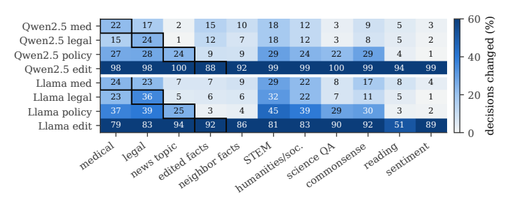
Figure 1 : Percentage of decisions changed per traffic domain by the controlled LoRA updates
Original paper · CC BY 4.0The policy update reaches its goal, refiling 83% of Science/Technology articles as Business. Its out-of-scope accuracy drops by 7 to 11 points, and 90% of its footprint lies outside news classification. The Llama medical update shows the same pattern, with 15.9% of in-scope and 15.6% of legal decisions changing on Llama. Preference optimization leaks comparably, with decision-token DPO at 9.0% on Qwen medical and 17.4% on Llama medical.
What leakage tracks
Across 256 trained variants, leakage tracks the update's KL divergence to the incumbent on out-of-scope inputs, with a Spearman correlation of 0.94. The residual standard deviation of that fit is 0.34 in log units. Figure 2 plots this relation for every trained variant, spanning LoRA, full fine-tuning, DPO, GRPO, RLVR, and knowledge editors on six models.
The pointwise bound from Lemma 8 uses where the KL falls, not only its average. Lemma 8 says that a decision can change only when the total variation between the two letter distributions is at least half the incumbent's gap. Below 6% leakage, the pointwise bound ranks variants with a Spearman of 0.89, against 0.74 for mean KL. Variants with the same mean KL of 0.01 to 0.03 nats leak between 1.4% and 5.2%, so the mean alone misses the spread.
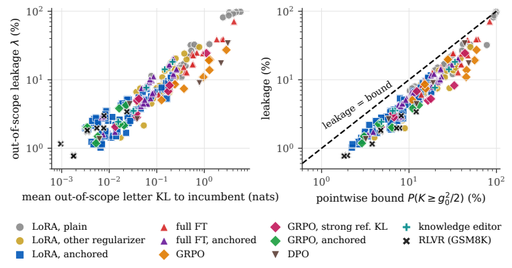
Figure 2 : Every trained variant (256 variants, six models, all update types, plain and
Original paper · CC BY 4.0The authors read the lemma as a guarantee and treat its tightness as an empirical finding. The averaged form of Remark 7 has a median of 8.0 times the observed leakage and is uninformative for 53 of the 256 variants. The relation holds within each update type, with Spearman 0.71 to 0.96 for mean KL, and within each model, with 0.96 to 1.00.
Anchoring the update to the incumbent
Decision anchoring adds a term that keeps the candidate's option-letter distribution close to the incumbent's on unlabeled prompts in the deployment format. The authors argue that this constrains out-of-scope KL directly, rather than leaving it to however the network generalizes. Anchoring is added to each update type unchanged, so the same term applies to LoRA, full fine-tuning, DPO, and GRPO.
Anchoring works only when the anchor prompts share the deployment's decision format, because generic chat text doesn't work.
On the confirmatory set, twelve of the thirteen candidates certify 5% leakage on a fixed audit order after 350 to 1,850 samples. The thirteenth, Llama medical GRPO, ends at an upper bound of 5.3%, which is the one candidate that didn't certify. Anchoring keeps large intended changes, but on one of the two main models it costs part of a small medical gain.
Three of the held-out medical gains are within noise, so those certificates cover updates whose intended effect cannot be confirmed. Table 6 reports the held-out certificates and bootstrap intervals for each candidate.
Written answers and sequences of updates
Written answers are the first test: do the certificates still hold when models write free-form answers instead of option letters? Plain updates change 9.1–35.2% of written answers, while anchored updates change 1.6–3.4% against a generation floor of 0.2–0.5%. Plain updates can exceed their letter leakage because they stop stating an answer within 24 tokens, which is a format leak.
The sequence test asks whether per-update certificates add up when updates are applied one after another. After four plain updates, drift outside the union of declared scopes reaches 19.0% on Qwen and 41.1% on Llama. After four anchored updates the same drift is 4.3% on Qwen and 5.8% on Llama, below the certified bounds of 12.0% and 17.6%.
Drift certified directly gives 5.2% and 6.8%, and the anchored edit step is weaker than its plain counterpart.
Limits: open-ended outputs and the floor
The approach stops working where the numerical floor is too high for a certificate to resolve leakage.
The lifetime bound from Theorem 6 grows linearly with the number of updates, so it becomes vacuous after roughly 20 updates at ε = 5%. The audit used one benchmark pool and one prompt format, so the authors tested only a shift between domain groups, not temporal drift or a change of prompt format. Most results use two seeds, while Mistral, the 1.5B results and RLVR use one seed each.
The free-form and chat results rely on an LLM judge, Qwen2.5-32B-Instruct, whose error rate the authors didn't measure against human labels.
Paper info
- Authors
- Muhammad Usama, Muhammad Saad Qadir
- Venue
- arXiv · Preprint
- First published
- 2026-11-3
- Added
- 2026-11-5
- Updated
- 2026-11-3
- Version
- v1
- arXiv
- 2611.04192
- Category
- cs.LG
- Original paper terms
- CC BY 4.0
- What we show
- Paper info, commentary and permitted figures from the original paper
AI commentary is a separate explanation from the original paper and may contain errors. The original paper and figures follow each source's terms of use and any rights noted separately.
Abstract
Deployed language models are updated continually, and regulators increasingly accept changes that were declared in advance. Showing that an update changed behavior only where it was declared to is a different statistical problem from bounding how much it changed: a useful update is meant to change some decisions, so global disagreement and regression bounds cannot certify it. We formalize the problem with declared change envelopes. Before training, the developer commits to a region of inputs, and every decision that changes outside it counts as leakage. Leakage compares two models, so it can be certified from unlabeled traffic with anytime-valid tests whose sample cost we bound from above and below, and per-update certificates compose into a bound on lifetime drift outside all declared scopes. We measure leakage for LoRA and full fine-tuning, preference optimization, reinforcement learning, and knowledge editing on models from 1.5B to 72B parameters. Narrow updates leak widely: domain and policy LoRA updates keep only about 7-36% of the decisions they change inside the declared scope. Across 256 trained variants, leakage tracks the update's KL divergence to the incumbent on out-of-scope inputs (Spearman 0.94). None of the customary remedies we tested makes a rule-like update certifiable without giving up much of its intended change. Distilling the incumbent's decisions on unlabeled prompts in the deployment format does: anchored LoRA, GRPO, and (at a small learning rate) full fine-tuning updates certify 5% leakage from a few hundred to a few thousand unlabeled samples, and the certificates replicate on held-out traffic and on written answers. The certificates cover decision-like outputs only; on open-ended chat, re-batching alone changes 11-21% of responses and no update certifies. Code: https://github.com/Usama1002/declared-change-envelopes
Quote from the paper
Muhammad Usama, Muhammad Saad Qadir (2026). Where Did the Update Go? Certifying Declared Change Envelopes for Model Updates. arXiv:2611.04192v1. https://arxiv.org/abs/2611.04192v1
BibTeX
@misc{usama2026where,
  title = {{Where Did the Update Go? Certifying Declared Change Envelopes for Model Updates}},
  author = {Muhammad Usama and Muhammad Saad Qadir},
  year = {2026},
  eprint = {2611.04192},
  archivePrefix = {arXiv},
  url = {https://arxiv.org/abs/2611.04192v1}
}