Paper commentary
Tight PAC-Bayes Generalisation Guarantees for Large Language Model Judges
Compression bounds can certify LLM safety judges without held-out data
- Problem Validation bounds need held-out labelled data, which is scarce for safety. Earlier LLM bounds certify a model's own generative risk, not a judge's risk over another generator's outputs.
- Method LoRA-GT is a PAC-Bayes certificate that bounds a judge's risk by the compressed length of its adaptor. It shares one quantisation scale across layers, so the description gets shorter and the bound tighter.
- Results LoRA-GT gave the tightest certificates in all 40 model, dataset and loss cases tested. Its guarantees need no held-out safety data.
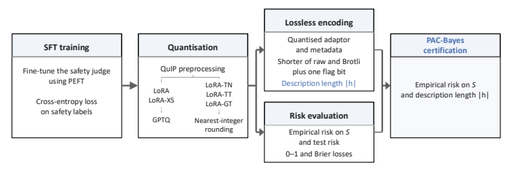
Figure 7 :Training and certification pipeline.Models are trained via SFT, quantised using Hadamard incoherence processing with either GPTQ (LoRA, LoRA-XS) or nearest-integer rounding (LoRA-TN, LoRA-TT, LoRA-GT), encoded using the shorter of raw and Brotli with a one-bit flag, and evaluated using empirical test risk and PAC-Bayes certificates.
Original paper · CC BY 4.0 · Tom A. Lamb, Philip H. S. Torr, Tim G. J. Rudner · Tight PAC-Bayes Generalisation Guarantees for Large Language Model Judges · Original paper figure · Extracted the figure area from page 28 of the original PDF.Why held-out bounds and LLM bounds fall short
Guardrail models such as Llama Guard decide whether a model output gets blocked, escalated or allowed. A validation bound is the standard way to certify a fixed predictor, but it needs data held out from training. Labelled safety data are often scarce, so holding that split back is costly.
Distribution-free alternatives such as conformal prediction and distribution-free risk control also calibrate on held-out data. A judge that classifies another generator's outputs is a different target, so those results don't transfer directly.
The authors instead ask whether simple adaptations can give strong predictive performance and tight guarantees without holding out safety data. They certify a judge's risk over prompt–response pairs drawn from a fixed generator, using PEFT adaptations of pre-trained safety backbones.
The key idea: the adaptor's code length sets the complexity
Each adapted judge is treated as one hypothesis, identified with the compressed code of its adaptor. The frozen backbone, the seeded adaptor parameterisation and the decoder M are fixed, so that code alone reconstructs the judge. Under the Solomonoff prior PSol, a shorter code receives more prior weight, so a compact adaptor pays a smaller complexity penalty.
The Elias δ code gives a description-length bound that is tighter than the Elias γ code used in prior work [34].
The certified quantity is the judge's risk over prompt–response pairs drawn i.i.d. from the joint distribution PD,G induced by a fixed generator. The judge is compared with ground-truth labels under a 0–1 loss for classification or a Brier loss, with both taking values in [0,1]. Because the judge is a single fixed predictor, its posterior Qh is a point mass on it, so the certificate needs no Gibbs sampling.
Safety systems typically deploy one fixed judge to monitor a given generator, which is why this construction fits practitioner use.
The bound comes from a generalised Catoni bound, and its free parameter λ is minimised inside the bound rather than fixed in advance. Minimising over λ avoids the union-bound penalty that a fixed-λ Catoni bound would add, and it needs no held-out data. Combined with the Elias δ length bound, this gives the Oversight Model Certificate, computed with β set to 0.05.
The certificate holds simultaneously for all hypotheses in HJ with probability at least 1−β over the sample S.
From a trained adaptor to a short binary code
Quantisation maps each real adaptor parameter onto a small set of integer levels, plus a reconstruction scale. The quantised representation is a pair of integer values z and reconstruction parameters s, and the reconstructed parameters are the dequantised values. Because each layer has only u trainable values, nearest-integer rounding is used instead of a second-order scheme such as GPTQ.
Data-driven schemes like GPTQ choose z to limit changes in model outputs, which the authors judge unnecessary at this size. The symmetric codebook uses qmax equal to 2 to the power b minus 1, minus 1, with one global scale s greater than 0. Each reconstructed value is the integer level times s, and the integer levels are then compressed losslessly with Brotli.
In LoRA-TT each layer keeps its own bfloat16 scale, so at u=1 and 2 bits those scales cost more than the weights themselves. On Llama-Guard-3-8B with 32 layers, the weights need only 64 bits while the scales need 512. Replacing the per-layer scales with one global scale takes the total from 576 to 80 bits, an 86% reduction. LoRA-GT is the tied variant of LoRA-T, in which one vector is shared within each layer, now paired with that global scale.
With the metadata gone, the complexity term is set more by the weights than by reconstruction overhead.
The integer length of the code is written with the Elias δ code, which the authors use in place of Elias γ. Elias δ gives a tighter description-length bound than Elias γ, so the authors adopt it. Together, quantisation and lossless compression set the description length that enters the certificate. Shorter descriptions contribute a smaller complexity term, so a compact adaptor pays a smaller penalty in the bound.
Does tightness follow adaptor complexity?
LoRA-GT gave the tightest certificate in all 40 model–dataset–loss cases. The authors read this as tightness tracking adaptation complexity more closely than the size of the base judge. LoRA-GT shares one quantisation scale across layers, which keeps the loss in predictive performance small. Figure 8 extends the Llama Guard 3 1B and 8B comparison to all five models.
LoRA-GT gave the tightest certificates under both losses, with generally modest changes in test risk.
LoRA has the largest compressed description lengths, three to four orders of magnitude above the rest. LoRA-XS, LoRA-TN and LoRA-TT follow in that order, and LoRA-GT has the shortest codes. Tying and global-scale quantisation each cut the description length further. Figure 10 plots these lengths on a log scale at 2 and 4 bits, with LoRA-T settings given as (r, u).
The certificates follow the same order, so shorter codes gave tighter bounds in these experiments.
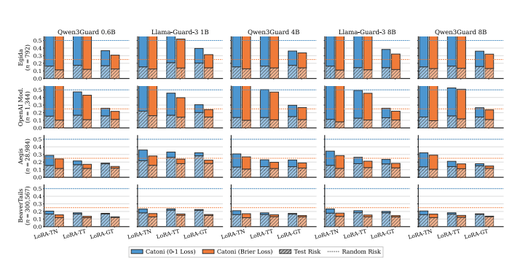
Figure 8 :Complete comparison of LoRA-T variants.Catoni PAC-Bayes certificates under 0–1 and Brier loss across all five models and four benchmarks. Hatching shows test risk and dashed lines mark random-risk baselines.
Original paper · CC BY 4.0On Nemotron 4B under 0–1 loss, LoRA-T gave the tightest certificate on each of the four benchmarks. LoRA and LoRA-XS produced substantially looser bounds on that model. The authors ran this third model family to check whether the pattern extends beyond Llama Guard and Qwen3Guard.
Elias δ coding is 4 to 12 bits shorter than Elias γ for every adaptor, which is small relative to |h|.
Coding, compression and scale choices tighten the bound
Elias δ coding shortens the hypothesis description that feeds the complexity term of the certificate. On Llama-Guard-3 1B with BeaverTails at 2 bits, Elias δ is shorter than Elias γ for every adaptor tested. The saving is 4 to 12 bits per adaptor, which is small next to the description length itself. Both codes are valid prefix-free codes, so the authors can swap in the shorter one without changing the analysis.
The authors use Elias δ in all reported bounds, and the same swap could apply to prior compression-based certificates.
The compressor is the last step that sets the description length of an adaptor. Brotli gave the shortest output in every row of the table, between 5 and 17% shorter than gzip. Prior compression-based work used gzip, so their complexity penalties could be tightened by a stronger compressor. The authors note this substitution would leave the analysis unchanged.
The quantisation scale is the other choice that acts on the bound, and it is tested separately for LoRA-GT. The searched scale is compared with the no-clipping scale s∗ while the adaptor and bit-width stay fixed. The searched scale gave lower mean certification-sample distortion at every bit-width. At 3 and 4 bits the description length did not change, so the tighter bounds there come from lower distortion alone.
At 2 bits the effect on test risk is clearest, and at 4 bits it is small.
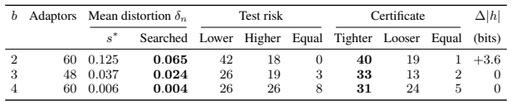
Table 9 :Effect of scale search on LoRA-GT.Mean distortion is lower with the searched scale at every bit-width. Counts report changes relative to the no-clipping scale s∗. ∆|h| is the mean change in description length.
Original paper · CC BY 4.0Holding data out versus certifying the full sample
The authors varied the held-out fraction from 0.1% to 50% and compared KL-inversion bounds against certificates computed on the full training set. At small held-out fractions, the PAC-Bayes certificate came out tighter on every benchmark, by up to 0.27 on Egida and 0.24 on OpenAI Moderation. Validation bounds caught up at around 10% held out on those two benchmarks and at 1% on Aegis.
On BeaverTails, the two approaches stayed within 0.03 of each other. Holding out more data shrinks the concentration penalty, but it also leaves less data for adaptation.
A validation bound is a deterministic function of empirical validation risk and sample size, so it ignores the length of the adaptor's code. When plotted against description length, the KL-inversion bound shows no explicit dependence on |h|. Two adaptors with equal held-out error get the same guarantee, even when their descriptions differ by three orders of magnitude.
PAC-Bayes certificates instead trade empirical risk against complexity, so more compressed adaptors come out tighter.
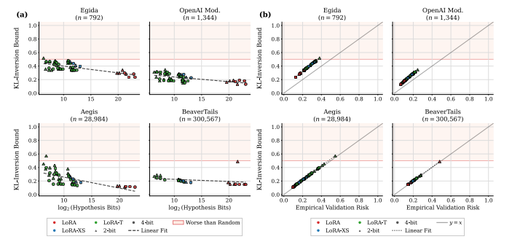
Figure 11 : Validation-based KL-inversion bound trends. (a) Bound against description length, which does not enter the validation-bound formula. (b) Bound against empirical validation risk is near-linear, since the bound is a deterministic function of validation risk and nval. This contrasts with the PAC-Bayes certificates of Figure 3, which vary systematically with compressibility.
Original paper · CC BY 4.0The authors also compared selecting adaptors by their certificate against selecting them by validation risk on a 10% held-out split. Average test risk was 0.217 under certificate selection and 0.209 under validation selection. Certificate selection gave tighter guarantees on every benchmark, with the largest gains of 0.17 on Egida and 0.07 on OpenAI Moderation.
On those two benchmarks, validation selection picked longer u=4 adaptors.
Where the guarantees stop applying
The certificate covers only the deployment distribution that the generator induces, and the certification sample must be drawn from that distribution. The paper treats distribution shift as a longstanding challenge for generalisation guarantees, and it stays beyond the scope of this work.
They didn't test whether compact adaptations at substantially larger scales keep low quantisation-induced functional distortion. Whether such larger adaptations would admit similarly tight guarantees also remains open, and the paper marks it as future work.
It also needs an i.i.d. certification sample and a loss ℓ in [0,1]. The certificate makes no assumptions on the learning algorithm itself, so the training procedure can change freely. The bound holds uniformly over the hypothesis class, which allows selection after observing the sample, provided the description includes the configuration information.
Paper info
- Authors
- Tom A. Lamb, Philip H. S. Torr, Tim G. J. Rudner
- Venue
- arXiv · Preprint
- First published
- 2026-11-16
- Added
- 2026-11-17
- Updated
- 2026-11-16
- Version
- v1
- arXiv
- 2611.20818
- Category
- cs.LG
- Original paper terms
- CC BY 4.0
- What we show
- Paper info, commentary and permitted figures from the original paper
AI commentary is a separate explanation from the original paper and may contain errors. The original paper and figures follow each source's terms of use and any rights noted separately.
Abstract
Large language model (LLM) judges are increasingly used to monitor the outputs of LLM-based AI agents, yet formal guarantees on the reliability of these judges remain largely absent, limiting confidence in their use for safety-critical oversight. We consider certifying such a judge and define its risk over safety classifications of prompt--response pairs drawn from a deployed generator. We apply a PAC-Bayes framework to this setting, refining existing compression-based methodology with the use of tighter bounds and more efficient coding. We show that standard parameter-efficient fine-tuning can yield non-vacuous and even tight certificates for safety judges, for both classification and Brier risk, without holding out data for validation. We introduce LoRA-GT, which shares a single quantisation scale across layers and achieves the tightest certificates with minimal degradation in predictive performance. Across five guardrail models and four benchmarks, we find that certificate tightness is governed more by adaptation complexity than by base model scale. Finally, we show how far quantisation can be pushed before the resulting increase in risk outweighs the bound tightening gained from shorter descriptions. Together, these results provide a practical route toward certifiable scalable oversight and offer insight into how the complexity of safety adaptations shapes generalisation.
Quote from the paper
Tom A. Lamb, Philip H. S. Torr, Tim G. J. Rudner (2026). Tight PAC-Bayes Generalisation Guarantees for Large Language Model Judges. arXiv:2611.20818v1. https://arxiv.org/abs/2611.20818v1
BibTeX
@misc{lamb2026tight,
  title = {{Tight PAC-Bayes Generalisation Guarantees for Large Language Model Judges}},
  author = {Tom A. Lamb and Philip H. S. Torr and Tim G. J. Rudner},
  year = {2026},
  eprint = {2611.20818},
  archivePrefix = {arXiv},
  url = {https://arxiv.org/abs/2611.20818v1}
}