Paper commentary
Does the Voice Matter? Evaluating Frustration Detection on Deployed Clinical Voice-Agent Calls
Transcript-only frustration detection misses short patient turns in clinical voice calls
- Problem Transcript-only systems miss frustration on short patient turns, which make up most real clinical speech. Acted benchmarks rarely contain such turns, so their accuracy hides the gap.
- Method The authors run five audio-capable models on each turn, once as audio and once as transcript, and ask for a frustrated or not-frustrated label. Input-specific prompts send audio to delivery and transcript to words.
- Results Among turns the frontier pair confidently clears, audio lets through 6.9 % frustrated turns against 13.0 % for the transcript.
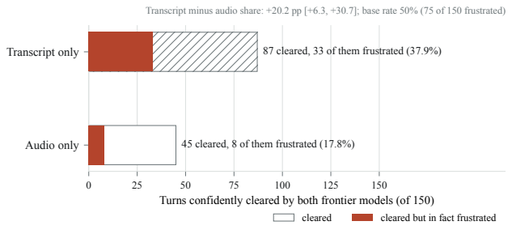
Figure 4 : Turns each input modality confidently clears, and how many of them were in fact frustrated. The transcript clears 87 of 150 turns and 37.9 % of those were frustrated; audio clears 45 and 17.8 % were. The audio rate holds only when its prompt directs the model to delivery (Section 5.5).
Original paper · CC BY 4.0 · Michael, Annika, Ellis, Zachary, Zhou, Yuxiang, Thio, Samuel, He, Yajie Vera, Hazel, Spencer, Joselowitz, Jared · Does the Voice Matter? Evaluating Frustration Detection on Deployed Clinical Voice-Agent Calls · Original paper figure · Extracted the figure area from page 8 of the original PDF.Why transcript-only triage looks adequate
Voice agents now place routine follow-up calls, so some automated triage is becoming necessary. Frustrated patients can drop out or hang up before the agent gets important clinical details, so a triage layer should catch that state.
Whether the words alone are enough is largely untested on real clinical speech. Patient answers are mostly short, with about 59 % of patient turns at one or two words. The acted IEMOCAP corpus that the field relies on has only 13 % such turns, so its benchmarks rarely test short answers. Across 2073 real clinical calls and 151 IEMOCAP dialogues, the length gap between the two sources is large.
A short turn leaves little lexical evidence while keeping its delivery, and that delivery is where the voice could help. The phrase "Some of the time" was labelled frustrated in Call A and not frustrated in Call B. A transcript-only system cannot tell those two turns apart, so it clears both. On one-word turns, transcript-only detection doesn't exclude chance.
Data, models and conditions
The six-call evaluation set has 150 patient turns, with 75 frustrated and 75 not frustrated. Three annotators labelled each turn on their own, and a majority vote set the final label. Because the classes are balanced, chance sits at 50 % and guessing gains nothing. The acted control uses 150 IEMOCAP turns, 76 frustrated and 74 not frustrated, drawn from 45 of the 151 dialogues.
The authors then added 24 calls that Annotator 1 labelled alone, keeping their natural prevalence. After inconclusive turns were dropped, the 24 added calls leave 564 turns, and 65 of them (11.5 %) are frustrated. Together with the six calls, the 30-call set holds 714 turns, and 140 of them (19.6 %) are frustrated.
Five models accept audio directly, and none receives fine-tuning or task-specific training. Gemini 2.5 Flash, Gemini 2.5 Pro and Gemini 3.8 Flash run through Vertex AI, while Qwen2.5-Omni 7B and Voxtral Mini 3B run as open models. Gemini 3.8 Flash and Voxtral Mini 3B enter only in the 30-call extension. Every model runs at temperature 1.0, because greedy decoding would hide run-to-run variation rather than remove it.
Each turn goes to the model twice, once as audio and once as transcript, and the model sees it in isolation. Input-specific prompts send the audio to delivery and the transcript to the words, while an identical prompt gives both inputs one instruction. The model must answer with a constrained frustrated or not-frustrated label.
The trained baseline uses frozen WavLM Base+ features from one intermediate layer, pooled over the turn. Each turn is classified three times, and the majority of the three gives its prediction. Balanced accuracy, the mean of recall and specificity, is the main metric throughout. Turn length counts words after bracketed annotation markers are stripped, in buckets from one word to 21 or more words.
Short turns defeat transcript-only detection
On one-word clinical turns, transcript-only detection doesn't clear chance with confidence, and the paper reports the spread across conditions. The strongest transcript condition reaches 54.8 % balanced accuracy and the weakest reaches 47.1 %. The authors also note that audio degrades on the same turns, reaching 42.1 % to 70.3 %, with the open model on clinical audio sitting below chance.
The acted control shows the same failure on one-word turns, where text scores 51.2 % on acted speech against 54.8 % on clinical speech. Recall on one-word text is 11.1 % for the acted corpus and 9.5 % for the clinical one. Because the two corpora sit within four points at one word, the paper argues the short-turn failure is not specific to the clinical recordings.
Length alone is nearly as informative: a logistic regression given only the word count reaches 58.0 % on the clinical set. The authors take the point that a system which can't beat word count hasn't shown it uses the voice.
Predictions track turn length more than the labels do, which is the mechanism behind the short-turn gap. The authors stress that this evidence is correlational and doesn't show length is the causal input.
The transcript condition wrongly clears 33 frustrated turns among the 87 it clears, and 19 of those are one or two words long. Table 3 shows the miss rate falling as turns lengthen, from 73.1 % for one or two words to 16.7 % for eleven or more words. A transcript-only system therefore clears short frustrated turns without any signal to flag them.
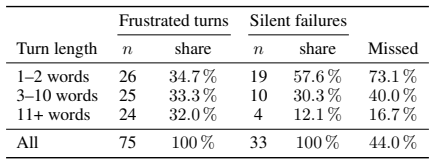
Table 3 : Where the transcript condition’s silent failures fall. A silent failure is a confidently cleared turn that was labelled as frustrated by the human annotators (a falsely-cleared turn). Short turns are a third of the frustrated turns and well over half of the silent failures, and the miss rate falls as turns lengthen. Figure 14 plots the two shares.
Original paper · CC BY 4.0Whether audio helps depends on the prompt
Audio adds to the transcript only under one kind of instruction, and the paper tests that split directly. That interval includes zero, so the frontier audio gain is not established on its own. Gemini 2.5 Pro's audio flags 23 of the 39 frustrated one-word turns under input-specific prompts.
Among the turns the frontier pair confidently clears, the transcript lets through 13.0 % frustrated turns against 6.9 % for audio. Voxtral's gap shrinks under the identical prompt, because its audio rises from 52.7 % to 62.0 %.
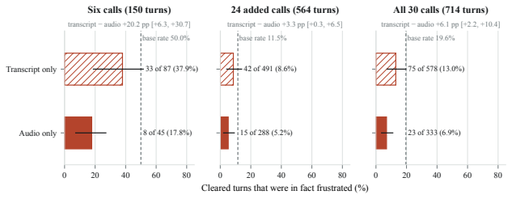
Figure 7 : Share of the frontier pair’s confidently cleared turns that were frustrated, on the six calls (33 of 87 for the transcript, 8 of 45 for audio), the 24 (42 of 491, 15 of 288) and all 30 (75 of 578, 23 of 333), with 95 % bootstrap intervals over calls. Each part’s frustrated base rate is marked: 50 %, 11.5 %and19.6 %.
Original paper · CC BY 4.0The prompt changes the picture, because one identical prompt for both inputs removes the frontier gain. Across the 30 calls, no model's audio-minus-text interval excludes zero under the identical prompt. The paper reports these differences as -0.1 pp, 0.9 pp, -0.7 pp, -5.7 pp and -1.2 pp for the five models. Gemini 2.5 Pro's audio flags only 4 of the 39 frustrated one-word turns under the identical prompt, against 23 under input-specific prompts.
Trained probes on clinical calls and the short-turn failure
The clinical probe sits on a frozen WavLM Base+ encoder, with one intermediate layer chosen from layers 6 to 9 of 12. The authors score these probes on 30 clinical calls, splitting them into five folds by patient and scoring out of fold. They also fit a second probe on acted IEMOCAP speech, so the two training sources can be compared.
Trained on the 30 clinical calls, the SVM reaches 71.6 % (63.2 % to 78.2 %) balanced accuracy. The logistic regression reaches 70.3 % (59.8 % to 77.1 %), which is level with Gemini 2.5 Flash on audio at 70.2 %. Both probes sit well above the word-count baseline, so the clinical training helps on average. Most of that accuracy comes from the six calls, where the two probes reach 76.0 % and 79.3 %.
On the 24 added calls they fall to 63.0 % and 56.6 %.
Across its three split seeds, the SVM's confident clears were 10.2 % frustrated. That sits between the frontier pair's audio rate of 6.9 % and its transcript rate of 13.0 %. The six calls are balanced and triple-annotated, while the 24 are single-annotated at 11.5 % prevalence.
What a triage design should do with short turns
A transcript-only system clears a short frustrated turn without raising any flag. The authors call that miss silent, and accuracy hides it, so they treat accuracy as the wrong measure here.
The failure follows turn length rather than the patients or the recordings. It reappears on the acted benchmark once that benchmark contains short turns. The fix is cheap: report the length distribution, test on the lengths a system meets in deployment, and add a length-only baseline. On this data, word count alone reaches 57 % to 58 %, so a model that can't beat it gives no evidence that it uses the voice.
Adding audio doesn't upgrade a system automatically, because the model and its instruction set whether it helps. Under one prompt for both inputs, that gain disappears for every model the authors tested. For deployment, a short patient turn shouldn't be cleared on the transcript alone, so it becomes a candidate for routing to audio or a person.
No tested system makes that route safe alone, because directed audio from the strongest model finds most short frustrated turns but raises many false alarms.
Gemini 3.8 Flash reads transcripts about as well (67.4 % against 66.6 % on 30 calls) but catches only 4 of 39 frustrated one-word turns. The authors can't attribute that drop to label source, class balance or prevalence alone.
Limitations: where the evidence stops
The absolute rates reflect the authors' sampling rather than deployment prevalence, so the levels shouldn't be read as field numbers. The study judges a single affective state, frustration, and treats it as a binary label. Their transcripts are uncorrected Whisper output, which adds a source of error the six calls don't have. Its pooled prevalence describes neither part, so the authors rest prevalence-sensitive claims on the 24 calls.
Only five models were tested zero-shot, three from one provider, and only frozen-encoder probes were trained. Two Gemini 2.5 models are scheduled for retirement, so their audio gains may not persist in later deployments. The conclusion is narrow: a transcript-based system's short-turn behaviour has to be measured on the target distribution.
Paper info
- Authors
- Michael, Annika, Ellis, Zachary, Zhou, Yuxiang, Thio, Samuel, He, Yajie Vera, Hazel, Spencer, Joselowitz, Jared
- Venue
- arXiv · Preprint
- First published
- 2026-11-16
- Added
- 2026-11-17
- Updated
- 2026-11-16
- Version
- v1
- arXiv
- 2611.21001
- Category
- cs.CL · cs.AI
- Original paper terms
- CC BY 4.0
- What we show
- Paper info, commentary and permitted figures from the original paper
AI commentary is a separate explanation from the original paper and may contain errors. The original paper and figures follow each source's terms of use and any rights noted separately.
Abstract
Autonomous voice agents now conduct routine clinical follow-up calls, so some automated triage is unavoidable. A patient becoming frustrated is one thing that triage should catch. These systems typically read only the transcript the speech-to-text stage produces, not the voice, and whether that is enough is largely untested on real clinical speech. We study per-turn frustration detection on real patient calls from a deployed clinical voice agent: 150 turns from six calls labelled by three annotators, with a length-matched acted corpus as a control, and 714 turns from 30 calls. Patient turns are overwhelmingly short: across the deployed calls, roughly 59% are one or two words, against 13% in the full acted corpus, and a corpus accuracy gap remains even after the acted set is length-matched. On one-word turns, transcript-only detection does not exclude chance. Across five audio-capable language models, the transcript flags 3 or 4 of the 39 frustrated one-word turns in the 30 calls, and a classifier given only the word count reaches 57.3%. Whether audio helps depends on the model and on the instruction. Asked to attend to delivery, two Gemini 2.5 models gain 3.0 pp over the transcript across 30 calls (-1.0 to 7.5 pp). Of the turns they confidently clear, 6.9% were in fact frustrated for audio against 13.0% for the transcript, a difference of 6.1 pp (2.2 to 10.4 pp). Across the 30 calls, given one prompt identical for both inputs, no model's audio-text interval excludes zero. Under the input-specific prompts, a newer Gemini model and two smaller open models do worse with audio than with the transcript (-3.5, -8.6 and -10.6 pp). A WavLM probe trained on the clinical calls matches the best prompted model overall (71.6%) but misses every frustrated one-word turn in the 24 added calls. When a patient's turn is short, the transcript alone is not enough to rule out frustration.
Quote from the paper
Michael, Annika, Ellis, Zachary, Zhou, Yuxiang, Thio, Samuel, He, Yajie Vera, Hazel, Spencer, Joselowitz, Jared (2026). Does the Voice Matter? Evaluating Frustration Detection on Deployed Clinical Voice-Agent Calls. arXiv:2611.21001v1. https://arxiv.org/abs/2611.21001v1
BibTeX
@misc{annika2026does,
  title = {{Does the Voice Matter? Evaluating Frustration Detection on Deployed Clinical Voice-Agent Calls}},
  author = {Michael, Annika and Ellis, Zachary and Zhou, Yuxiang and Thio, Samuel and He, Yajie Vera and Hazel, Spencer and Joselowitz, Jared},
  year = {2026},
  eprint = {2611.21001},
  archivePrefix = {arXiv},
  url = {https://arxiv.org/abs/2611.21001v1}
}