Paper commentary
EDiffSR: An Efficient Diffusion Probabilistic Model for Remote Sensing Image Super-Resolution
- Problem Diffusion-based remote sensing super-resolution relies on a heavy UNet noise predictor and a bicubic-upsampled condition, which is costly at inference and leaves prior information in the LR image unused.
- Method Replaces the UNet with EANet, a U-shaped network of Efficient Activation Blocks, and builds the diffusion condition with CPEM from LR features, trained on a reversed-state objective and sampled by integrating the reverse SDE with Euler-Maruyama.
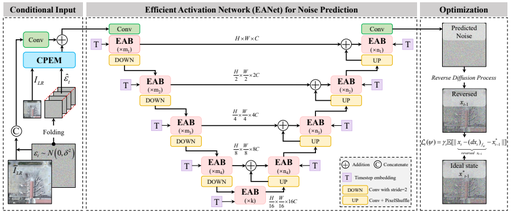
Fig. 3 . Overall framework of our EDiffSR. It consists of three parts: the condition part, Efficient Activation Network (EANet), and the optimization part. In the condition part, CPEM is designed to explore more priors from the original LR image. EANet takes the condition as input and characterizes the noise distribution. Compared to the primary Unet, it is more efficient and effective owing to the efficient activation block (EAB). The optimization process adopts the maximum likelihood learning for a more stable diffusion process.
Original paper · CC BY 4.0 · Yi Xiao, Qiangqiang Yuan, Kui Jiang, Jiang He, Xianyu Jin, Liangpei Zhang · EDiffSR: An Efficient Diffusion Probabilistic Model for Remote Sensing Image Super-Resolution · Original paper figure · Extracted the figure area from page 4 of the original PDF.Why the baseline recipe is costly for remote sensing SR
Regression-trained SR networks minimize pixel errors, and the authors argue that this pushes outputs toward over-smooth results. GAN-based SR restores more texture, but its adversarial training is unstable and can collapse into artifacts. Diffusion probabilistic models avoid much of that instability because their forward and reverse processes are principled and well defined, which makes them a natural alternative.
Within diffusion-based SR, most of the cost sits in the noise predictor: SR3 uses a large UNet denoiser, and the authors say DPM-based SR methods generally depend on large models for noise prediction. IRSDE uses the same SDE formulation as EDiffSR but also relies on a UNet architecture for noise prediction. The second gap is the condition: most such methods feed in the bicubic-upsampled LR image, which the authors argue may lose critical structure information.
The study therefore asks whether a much lighter noise predictor can keep perceptual SR quality, and whether features extracted from the LR image can replace the bicubic condition. EDiffSR answers both questions with the EANet noise predictor and the CPEM condition module, and keeps the SDE formulation of Luo et al. for the diffusion process.
Forward diffusion as a mean-reverting SDE
The forward process starts from the ground-truth HR image x0 and moves toward a state built from the bicubic-upsampled LR image µ and a Gaussian noise term ε. It is written as a mean-reverting SDE \[ dx = \lambda_t (u - x)\,dt + \phi_t\,dw \] where w is a standard Wiener process, λt sets how fast the state is pulled toward u, which plays the role of µ, and ϕt sets the volatility.
Choosing ϕt²/λt = 2δ² makes the equation solvable in closed form, with δ² the stationary variance.
As t grows, m_t approaches µ and n_t approaches δ², so the terminal state is approximately µ plus noise, which is the goal of the forward process.
Writing the state as x_t = m_t(x) + √n_t ε_t with ε_t standard Gaussian gives a training score of −ε_t/√n_t, so predicting the noise is equivalent to predicting that score.
Reverse process and the noise-prediction target
Sampling follows the reverse-time SDE, which combines the mean-reverting drift with a score term and a reverse-time Wiener increment. During training the ground-truth x0 is available, so the score can be taken in its conditional form \[ \nabla_x \log p_t(x\mid x_0) = -\frac{x_t - m_t(x)}{n_t} \] and this conditional score is the one used in training.
The noise predictor f_ψ takes x_t, u, v and t and outputs an estimate of ε_t, where v is the original LR image. The first objective is a weighted sum over time steps of the distance between predicted and true noise, \[ L(\psi)=\sum_{t=0}^{T}\gamma_t\,\mathbb{E}\big[\lVert f_\psi(x_t,u,v,t)-\varepsilon_t\rVert\big] \] where γt is a positive weight, in the spirit of DDPM.
The paper later replaces this objective with one defined on reversed states.
Building the condition with CPEM
The condition is \[ I_t = f_{\mathrm{CPEM}}(v,\hat\varepsilon_t) + f_3([\mu,\varepsilon_t]) \] where v is the LR image, ε̂_t is the folded noise sample, µ is the bicubic-upsampled LR image, and [·] is channel-wise concatenation. f_3 is a 3 × 3 convolution, so the CPEM output is summed with a convolution applied to µ concatenated with ε_t.
Pixel folding, written ε̂_t = Fold(ε_t), reduces the spatial scale of the noise sample without losing spatial information, so the noise matches the LR scale.
A 3 × 3 convolution and a PixelShuffle layer then produce the condition, I_CPEM = PixelShuffle(Conv(I_deep)).
Earlier DPM-based methods use the bicubic-upsampled image as the condition, whereas CPEM learns the condition from the LR image, so it can carry prior features rather than an interpolated copy. Algorithm 1 applies this enhancement step inside each training iteration.
EANet and the Efficient Activation Block
The authors argue that most pixels in SR are already given by the LR input, so a large network running heavy computation is redundant here, while a lightweight network can still predict the noise well. EANet is a U-shaped encoder-decoder built from EABs, and each EAB combines depth-wise convolution, simple channel attention and simple gate operations.
Inside an EAB the time step t is projected by an MLP into modulation vectors, and the input is normalized and modulated as \[ F = f_{1\times1}\big(\alpha_1 \odot \mathrm{Norm}(X) + \beta_1\big) \] where Norm is layer normalization.
The modulated features pass through three depth-wise branches with 3 × 3, 5 × 5 and 7 × 7 kernels, and each branch applies simple gate activation and simple channel attention, F_k = SCA(SimpleGate(f_k(F))). The simple gate is an element-wise product of two halves of the channels, and the simple channel attention removes the convolution layer and the sigmoid activation of standard channel attention.
The three branches are concatenated and fused by a 1 × 1 convolution, then modulated again with α2 and β2 after layer normalization. A final gated projection, Y = f_1×1(SimpleGate(f_1×1(F̄))), produces the EAB output.
The encoder uses EABs and a stride-2 convolution to downsample, the decoder uses EABs and PixelShuffle to upsample, and EANet also contains k EABs in its middle. In the final model the encoder block counts [m1, m2, m3, m4] are 14, 1, 1, 1, the decoder counts [n1, n2, n3, n4] are 1, 1, 1, 1, the channel number is C = 64, and k = 1.
Training objective and reverse-SDE sampling
The overall framework has a condition stage, the EANet noise predictor and an optimization stage, and the condition stage feeds EANet while the optimization stage defines the loss.
The authors report that a direct noise-distance loss makes diffusion training unstable, because predicting the instantaneous distribution of noise is hard. They minimize instead a distance between the reversed state produced from the predicted noise and an ideal reversed state x*_{t-1}, following a maximum likelihood strategy from Luo et al.
The ideal state is given in closed form by Eq. (17) from x_t, x0 and µ. The authors argue that this reduces optimization instability because most pixels in the reversed states are known.
Algorithm 1 computes the condition, predicts the noise, substitutes the score into the reverse update, takes the loss against x*_{t-1}, and runs gradient descent until convergence, with T = 100.
At inference, sampling starts from a random terminal state x_T drawn from N(0, δ²) and integrates the reverse SDE step by step with the Euler–Maruyama method, using the pre-trained EANet at each step.
Data, training budget and metrics
The training set has 3,000 AID images of 640 × 640 pixels, with 100 images drawn from each of 30 categories. The test set has 300 held-out AID images, 10 per category, plus 700 DOTA images and 1,000 DIOR images, all at 512 × 512, which gives 2,000 test images in total. Simulated sets use bicubic interpolation for degradation, while NWPU-RESISC45 is used only for real-world analysis, with 315 images cropped to 128 × 128.
All experiments are ×4 SR.
The simulation experiments use FID, LPIPS, DISTS, PSNR and SSIM against the ground truth, and the real-world experiment uses the reference-free NIQE and AG. FID measures the feature-level distance between generated and ground-truth image distributions, which is the property the study targets when it talks about generative quality.
Quantitative results on AID, DOTA and DIOR
The authors say EDiffSR is favorable in most scene categories, while the diversity of remote sensing scenes keeps generalization a challenge.
Table II lists FID per test set, and EDiffSR is lowest on AID (49.45), DOTA (21.26) and DIOR (21.79). The closest diffusion entries in that table are IRSDE at 23.91 on DOTA and 22.28 on DIOR.
On LPIPS the GAN-based models are lower than EDiffSR in some entries, for example MSRGAN at 0.1722 and SPSR at 0.1772 against 0.1898 for EDiffSR on DIOR. The text gives a 0.0647 LPIPS gain over SR3, but that difference matches the AID column (0.2534 against 0.1887) rather than DIOR.
EDiffSR has the lowest DISTS on AID (0.0561) and DIOR (0.0590). On DOTA, IRSDE reports DISTS 0.0550 against 0.0556 for EDiffSR, so the text's statement that EDiffSR is best there does not match the table. EDiffSR reaches the lowest NIQE on AID (14.22) and DOTA (14.20), while on DIOR SPSR has 15.13 against 15.16 for EDiffSR.
EDSR, RCAN and HAT-L have higher PSNR than EDiffSR on the three test sets, for example 30.81 for HAT-L against 27.40 for EDiffSR on AID and 33.99 against 28.30 on DOTA. Among the diffusion models, EDiffSR reaches 27.40 dB on AID against 26.24 dB for SR3 and 27.19 dB for IRSDE, with SSIM 0.6805 against 0.6585 for IRSDE. The authors attribute the PSNR-oriented models' advantage to optimizing MSE, which favors pixel averaging.
Visual and real-world evidence
On the AID examples center_256 and mediumresidential_170, RCAN and HAT-L look blurred, while GAN models add artifacts that differ from the ground truth. For mediumresidential_170, EDiffSR keeps more context detail, such as road markings, than IRSDE and SR3, which use bicubic conditions. The authors read this as evidence that the CPEM condition carries useful edge priors.
On DOTA, the authors single out img_591, where only EDiffSR restores sharp building detail, and img_036, where MSRGAN, SR3 and IRSDE show distortion. ESRGAN recovers road line directions in img_036 but with oversharpening, while EDiffSR keeps a more natural appearance.
On the DIOR zoomed examples img_895 and img_366, the authors say the other methods produce wrong distributions of roof detail or stadium structure, while EDiffSR does not.
On the NWPU-RESISC45 real-world set, EDiffSR gives the lowest NIQE (16.3013) and the highest AG (4.7461) in Table III, with IRSDE next at 16.5357 NIQE and 4.2690 AG. The text describes HAT-L as blurred, MSRGAN as producing pseudo-details, and SR3 as weak on dense line edges, while EDiffSR keeps high-frequency texture with less blur. Both real-world metrics are reference-free, so they indicate natural-looking detail rather than fidelity to a ground truth.
Ablations of CPEM, EANet and EAB design
With UNet as the noise predictor, adding CPEM raised the average FID from 32.42 to 32.68, while with EANet, adding CPEM lowered it from 31.11 to 30.83. The ablation's FID and PSNR are averages over AID, DOTA and DIOR. The parameter counts are 137.15M for the baseline, 137.59M for Model-1, 26.34M for Model-2 and 26.79M for EDiffSR. The main text gives 26.31M for the reduced model, which does not match the 26.79M for EDiffSR or the 26.34M for Model-2 in Table V.
A visual comparison on img_074 from DOTA is used to show that the model with CPEM recovers more edges and boundaries.
Single-scale 3 × 3, 5 × 5 and 7 × 7 depth-wise kernels give FID 30.98, 31.17 and 31.06, while the multi-scale EAB gives 30.83. PSNR is 27.59, 27.77 and 27.89 for the single-scale variants and 27.75 for the multi-scale design, so the multi-scale design does not have the highest PSNR. The authors describe the multi-scale benefit as modest.
The authors compare channel numbers C = 128 and C = 64 in a figure: C = 128 gives slightly better FID, while C = 64 yields the highest PSNR. The final model uses C = 64 to balance model size against performance.
Parameter count and sampling time
The authors describe a reduction of nearly 80% in parameters compared with IRSDE, and a sampling time 7 times shorter than SR3.
The FID and PSNR columns in Table VII show EDiffSR at 30.83 and 27.75, which match the values in the ablation tables. Each model has a single running time in the table, with no batch size stated.
Open problems
The authors state that the diffusion sampling process consumes massive computational cost, which hinders real-time use. Speeding up diffusion sampling is listed as future work.
EDiffSR does not model the multiple degradations present in remote sensing images, so the authors expect limited adaptability to real-world scenes. Extending the model to blind SR is listed as a future direction.
The quantitative comparisons use bicubic degradation on AID, DOTA and DIOR, and the real-world evaluation uses only NWPU-RESISC45 without ground truth. On PSNR and SSIM, EDiffSR is below EDSR, RCAN and HAT-L, so it does not lead on fidelity metrics. The retrained baselines follow their official implementation settings, so their results depend on those settings.
Paper info
- Authors
- Yi Xiao, Qiangqiang Yuan, Kui Jiang, Jiang He, Xianyu Jin, Liangpei Zhang
- Venue
- arXiv · Preprint
- First published
- 2023-10-30
- Added
- 2026-11-6
- Updated
- 2023-10-30
- Version
- v1
- arXiv
- 2310.19288
- Category
- eess.IV · cs.CV
- Original paper terms
- CC BY 4.0
- What we show
- Paper info, commentary and permitted figures from the original paper
AI commentary is a separate explanation from the original paper and may contain errors. The original paper and figures follow each source's terms of use and any rights noted separately.
Abstract
Recently, convolutional networks have achieved remarkable development in remote sensing image Super-Resoltuion (SR) by minimizing the regression objectives, e.g., MSE loss. However, despite achieving impressive performance, these methods often suffer from poor visual quality with over-smooth issues. Generative adversarial networks have the potential to infer intricate details, but they are easy to collapse, resulting in undesirable artifacts. To mitigate these issues, in this paper, we first introduce Diffusion Probabilistic Model (DPM) for efficient remote sensing image SR, dubbed EDiffSR. EDiffSR is easy to train and maintains the merits of DPM in generating perceptual-pleasant images. Specifically, different from previous works using heavy UNet for noise prediction, we develop an Efficient Activation Network (EANet) to achieve favorable noise prediction performance by simplified channel attention and simple gate operation, which dramatically reduces the computational budget. Moreover, to introduce more valuable prior knowledge into the proposed EDiffSR, a practical Conditional Prior Enhancement Module (CPEM) is developed to help extract an enriched condition. Unlike most DPM-based SR models that directly generate conditions by amplifying LR images, the proposed CPEM helps to retain more informative cues for accurate SR. Extensive experiments on four remote sensing datasets demonstrate that EDiffSR can restore visual-pleasant images on simulated and real-world remote sensing images, both quantitatively and qualitatively. The code of EDiffSR will be available at https://github.com/XY-boy/EDiffSR
Quote from the paper
Yi Xiao, Qiangqiang Yuan, Kui Jiang, Jiang He, Xianyu Jin, Liangpei Zhang (2023). EDiffSR: An Efficient Diffusion Probabilistic Model for Remote Sensing Image Super-Resolution. arXiv:2310.19288v1. https://arxiv.org/abs/2310.19288v1
BibTeX
@misc{xiao2023ediffsr,
  title = {{EDiffSR: An Efficient Diffusion Probabilistic Model for Remote Sensing Image Super-Resolution}},
  author = {Yi Xiao and Qiangqiang Yuan and Kui Jiang and Jiang He and Xianyu Jin and Liangpei Zhang},
  year = {2023},
  eprint = {2310.19288},
  archivePrefix = {arXiv},
  url = {https://arxiv.org/abs/2310.19288v1}
}