Paper commentary
CAST-Bench: Tracing Every Sound to Its Source in Multi-Shot Audio-Video Generation
CAST-Bench traces each generated sound back to its intended source
- Problem Existing audio-video benchmarks report overall quality and alignment scores that hide which sound went missing, came from the wrong source, or was lost across shots.
- Method CAST-Bench builds each prompt from a structured specification that links every sound to its emitter, subject and shot, then scores outputs with 18 metrics.
- Results Every shared model scored lower on multi-shot prompts, with Seedance-2.0 at 78.03 on single-shot and 72.15 on multi-shot.
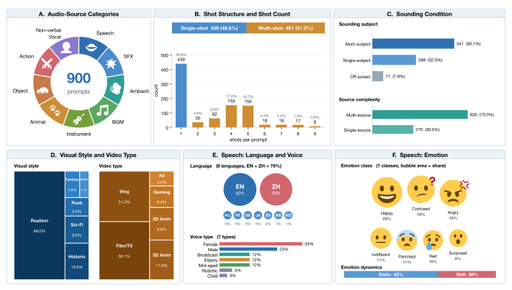
Figure 3 :Composition of the CAST-BENCH prompt suite.The suite spans nine audio-source categories (A), single- and multi-shot structures with one to nine shots (B), sounding-subject and source-complexity conditions (C), visual styles and video types (D), speech languages and voice types (E), and emotion classes and dynamics (F). Detailed statistics and subclass breakdowns are provided in Appendix B.3.
Original paper · CC BY 4.0 · Yucong Liu, Qi Tian, Shuyuan Tu, Kaihang Pan, Weijie Kong, Chao Pan · CAST-Bench: Tracing Every Sound to Its Source in Multi-Shot Audio-Video Generation · Original paper figure · Extracted the figure area from page 5 of the original PDF.Why sound-source errors stay hidden
Joint text-to-audio-video models now generate speech, animal sounds and ambient audio alongside the picture. A prompt can ask who speaks, which emotion they use, or whether a dog barks off-screen. For such a prompt, the output must contain the requested sound, emitted by the intended source, synchronized with the action, and carrying the right content.
The authors call this combined requirement an audiovisual contract.
Multi-shot narratives make this contract harder, because a sound must also stay bound to its character or animal across cuts. A dog's bark can end up attached to the wrong animal, and a line can go to the wrong character. A single quality score can't show which binding broke or why, since these breakdowns are systematic rather than corner cases.
The authors point to three gaps in existing suites. First, sound-source coverage is rarely a controlled sampling axis, so the sources present depend on incidental scene content. Second, aggregate audio scores blur distinct failures, because one score can't separate whether an event was generated, came from the specified source, or was timed correctly.
Tracing each sound to its emitter
CAST-BENCH fixes the reference before any prompt is written, so each requirement can be checked on its own. Each prompt starts as a structured specification that links every audio event to its emitter, subject, and temporal slot. The specification names the requested subjects, sounds, and dialogue, and it associates shot-specific requirements with the relevant shots.
The generator receives only the natural-language prompt, while the evaluator also reads the paired annotation.
Because each requirement has its own check, a missing sound, a wrong speaker, and a mistimed mouth motion appear as separate signals. Sound-Source Match estimates the temporal offset between audio and visual activity, but it doesn't verify the source assignment of every sound. Audio Generation checks requested content through event-presence questions, so a soundtrack can be clear yet still miss an event.
Speaker ID Match and Line Correctness separate speaker assignment from dialogue accuracy, which helps locate speech failures. Because the specification lists shots, an event that appears in the wrong shot can be identified, and single-shot and multi-shot results are reported separately.
Coverage is fixed by design rather than left to whatever a scene happens to contain. The authors allocate 100 prompts to each of nine sound categories, giving 900 prompts. The 900 prompts include 439 single-shot and 461 multi-shot narratives. Separate reporting by shot setting keeps one-shot scores from diluting the cross-shot failures where sound-source binding is hardest.
How the 900 prompts were built
The authors start from observations of publicly available audiovisual examples, which reveal the recurring kinds of audible content the benchmark should cover. Every prompt gets a structured specification before any prompt text exists, recording its subjects, sound events, and the shot each event belongs to. The six task attributes join these labels in the specification, so coverage can be inspected before generation starts.
GPT-5.5 renders each specification into a natural-language prompt, keeping the subjects and dialogue from the annotation along with the shot order. The conversion adds no new requirements, so the prompt doesn't carry content the specification never asked for. Generators see only the rendered prompt, while evaluators also read the paired annotation.
The structural layer verifies category labels, entity references, and the order of shots. The semantic layer compares each rendered prompt with its specification to flag omitted or added events. The authors also screen for near-duplicate prompts and check how well the categories are covered. Figure 2 places these steps in a four-stage pipeline, followed by expert validation and coverage repair.
The suite contains 439 single-shot prompts and 461 multi-shot prompts, and the multi-shot ones request two to nine shots. Those shot counts sum to 2,499 requested shots across the suite. Figure 3 shows the subject split: 288 prompts have one visible sounding subject and 541 have several. Speech prompts span nine languages, and English and Chinese together account for 79 of the 100 speech prompts.
Across the full suite, 168 prompts require on-screen text.
How the 18 metrics produce a score
TransNetV2 splits every video at shot boundaries, so shot-level metrics can run on each segment. The specialist branch runs estimators for aesthetics, human anatomy, OCR, face identity, lip sync and ASR. The LLM branch covers six rubric-based modules, from Motion Plausibility to Speaker ID Match. Text Rendering compares recognized text with the strings the prompt requests.
GPT-5.5 writes a large pool of questions from the prompt, the specification and each metric's evidence schema. The pool is filtered for entailment, observability, non-redundancy and coverage of required fields, which leaves the final question bank. Qwen3-Omni judges the audio and Qwen3-VL judges the video, and each answers binary questions or fixed metric-specific scales.
VL then checks those identities and lines against the cast table and the dialogue in the prompt. Detailed results keep the reporting scale of each metric, and the two offset metrics are reversed during normalization.
Every metric is mapped to a 0 to 100 higher-is-better scale, which reverses the two lower-is-better measures. Speaker ID Match is defined on 2 to 10, so it spans 20 to 100 after mapping. Weights aren't renormalized per sample, so each metric averages only over the samples where it is defined. Ovi, LTX-2.3 and daVinci-MagiHuman are left out of the multi-shot evaluation because they don't support multi-shot generation.
Single-shot and multi-shot leaderboards
The top of the leaderboard barely shifts when prompts move from one shot to several. Seedance-2.5 leads single-shot prompts at 78.11, ahead of Seedance-2.0 at 78.03 and MiniMax-H3 at 77.97. The same three systems take the top spots on the multi-shot subset, scoring 73.28, 72.15 and 69.45. Veo3.1 is the exception, dropping from fifth among the nine shared models to eighth.
Across the nine shared models, the mean total is 74.30 on single-shot prompts and 63.59 on multi-shot prompts. Every shared model scores lower on the multi-shot subset than on the single-shot subset. The 10.71-point gap is not a clean comparison, because the two subsets use different metric compositions. The single-shot subset has 12 non-priority metrics, while the multi-shot subset has 13.
Seedance-2.0's Motion Plausibility falls from 0.983 to 0.783 when its prompts become multi-shot. Its Audio Generation score drops from 0.715 to 0.613. Its Line Correctness score drops from 0.884 to 0.589, the sharpest fall among these three metrics.
Audio scores and visual scores don't move together across the single-shot models. On the eight audio and semantic alignment metrics, LTX-2.3 averages 75.2, close to Seedance-2.0 at 76.3. LTX-2.3's visual group mean is 84.1, compared with 94.6 for Seedance-2.0. The authors conclude that high visual scores alone don't establish audiovisual correctness.
Their inspection also found text that breaks under multilingual and artistic fonts, and style that drifts across shots.
Speaker count and shot count effects
Speaker count and shot count each lower the G3 Audio & Semantic Alignment score, and the two effects stack. The authors restricted this analysis to the speech prompt subset and compared one-speaker and multi-speaker prompts within each shot setting. Table 3 lists the per-model values, from Seedance-2.0 at 79.40 for one speaker down to Kling3.0 at 65.43 for several speakers in single-shot prompts.
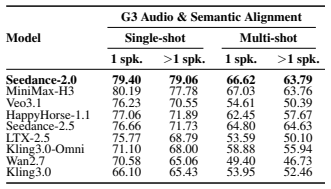
Table 3 : G3 Audio & Semantic Alignment score (0–100) by speaker count and shot set- ting.
Original paper · CC BY 4.0The pattern holds for every model, which makes it a property of the task rather than of one system. The authors read this as two separate bottlenecks, multi-speaker dialogue and cross-shot continuity, rather than a weakness of one architecture.
The shot-count analysis tracks the total score for Seedance-2.0, Wan2.7 and Kling3.0 from one to nine requested shots. Seedance-2.0 falls from 78.03 to 69.97, Wan2.7 from 70.43 to 56.79, and Kling3.0 from 68.74 to 53.37. Those drops correspond to 8.06, 13.64 and 15.37 points, so Seedance-2.0 keeps more of its score as shots increase.
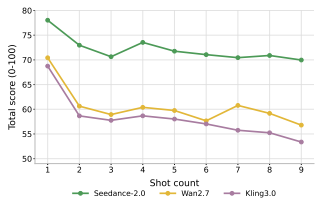
Figure 5 : Model scores across different shot counts.
Original paper · CC BY 4.0The authors checked whether the shot-count comparison depends on the prompt subset used. The ordering of the three systems stays unchanged within each shot setting, and multi-shot scores remain below single-shot scores at every ratio.
Stability and agreement with people
The authors test sampling sensitivity by scoring Seedance-2.0, Wan2.7 and Kling3.0 on 25%, 50%, 75% and 100% of the prompts. Figure 6 plots each subset size separately for single-shot and multi-shot prompts. The ordering of the three systems stays the same within each shot setting. For each model, the multi-shot score stays below the single-shot score at every sampling ratio.
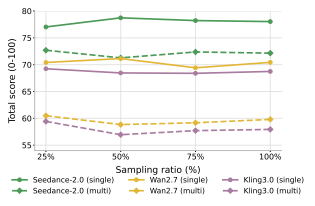
Figure 6 : Overall score for three representa- tive models as the evaluated prompt subset grows from 25% to the full suite.
Original paper · CC BY 4.0Three annotators score each video independently, and Appendix E covers the aggregation and reliability details. Video-level Spearman point estimates are 0.833 for the single-shot subset and 0.784 for the multi-shot subset. For individual metrics, the estimates are 0.872 for Speaker ID Match, 0.767 for Sound-Source Match and 0.602 for Motion Plausibility.
These are point estimates, so they show how closely the automatic and human rankings agree.
The authors read the stable ordering and the consistent multi-shot gap as a sign that the evaluation is fairly stable. The nine shared models get lower multi-shot aggregates, with the clearest gaps in lip synchronization, line correctness and motion plausibility.
Limits of the current evidence
Ovi, LTX-2.3 and daVinci-MagiHuman can't produce multi-shot clips, so the multi-shot comparison covers only nine models. Those nine shared models are the only ones scored on both single-shot and multi-shot prompts, so the cross-shot gap rests on that set. All nine shared models score lower on multi-shot prompts, with mean aggregates of 74.30 single-shot and 63.59 multi-shot.
The Kling models received Chinese prompts, while every other model received the original English prompts. A cross-model comparison therefore picks up a language difference alongside differences in the generators themselves. Outputs are 720p for most models, daVinci-MagiHuman runs at its native 540p, and clips are nominally 10 s, or 8 s for Veo3.1.
Each model was run with three independent seeds or repeated API calls.
Most metric scores depend on specialist estimators and Qwen judges rather than on human raters. Qwen3-Omni judges audio and Qwen3-VL judges video, so the reported scores reflect this particular judge stack. The overall score uses fixed weights, with five priority metrics at 10% each and the remaining applicable metrics sharing the other 50% equally.
The authors name multi-person speech, consistent speaker identity across shots and cross-shot event retention as unresolved challenges for current generators.
Paper info
- Authors
- Yucong Liu, Qi Tian, Shuyuan Tu, Kaihang Pan, Weijie Kong, Chao Pan
- Venue
- arXiv · Preprint
- First published
- 2026-11-2
- Added
- 2026-11-6
- Updated
- 2026-11-2
- Version
- v1
- arXiv
- 2611.05422
- Category
- cs.SD · cs.AI
- Original paper terms
- CC BY 4.0
- What we show
- Paper info, commentary and permitted figures from the original paper
AI commentary is a separate explanation from the original paper and may contain errors. The original paper and figures follow each source's terms of use and any rights noted separately.
Abstract
Existing benchmarks for joint text-to-audio-video (T2AV) generation evaluate perceptual quality and audiovisual alignment, but balanced sound-source sam?pling and separate reporting by shot structure remain limited. This makes it dif?ficult to determine whether a specific sound is missing, attributed to the wrong source, or lost across shot transitions. To address this, we introduce CAST?BENCH, a benchmark designed to trace every generated sound back to its in?tended source in multi-shot audio-video generation. The core idea is to formu?late T2AV correctness as an audiovisual contract in which each requested sound must be emitted by the right source, synchronized with the corresponding visual action, and carry the right semantic content. Concretely, the benchmark orga?nizes 900 prompts into 9 sound-source categories, with 100 prompts per cate?gory, spanning speech, animals, instruments, ambient sounds, and other emitter types. The prompts include 439 single-shot and 461 multi-shot narratives, each derived from a structured specification that links every audio event to its emit?ter, subject, and temporal slot. The benchmark provides an 18-metric evaluation suite covering three dimensions: Visual Performance, Content Consistency, and Audio & Semantic Alignment. We further benchmark 12 representative gen?erators and find that visual quality is nearly saturated across leading systems, yet audio semantic scores still differ markedly. Across the nine shared mod?els, multi-shot prompts receive lower aggregate scores under the subset-specific scoring rules and yield different model rankings. Multi-person speech, con?sistent speaker identity across shots, and cross-shot event retention remain the main unresolved challenges. All prompts and evaluation code are available at https://github.com/yucong-liu/CAST-Bench-public.
Quote from the paper
Yucong Liu, Qi Tian, Shuyuan Tu, Kaihang Pan, Weijie Kong, Chao Pan (2026). CAST-Bench: Tracing Every Sound to Its Source in Multi-Shot Audio-Video Generation. arXiv:2611.05422v1. https://arxiv.org/abs/2611.05422v1
BibTeX
@misc{liu2026cast,
  title = {{CAST-Bench: Tracing Every Sound to Its Source in Multi-Shot Audio-Video Generation}},
  author = {Yucong Liu and Qi Tian and Shuyuan Tu and Kaihang Pan and Weijie Kong and Chao Pan},
  year = {2026},
  eprint = {2611.05422},
  archivePrefix = {arXiv},
  url = {https://arxiv.org/abs/2611.05422v1}
}