Paper commentary
Reconciling Privacy with Provenance for Language Model Watermarks
Private watermarks can still estimate how much a language model is used
- Problem Per-text watermarks reveal the origin of each text, so users paraphrase to evade them and erase the signal. Tracking individuals is also a privacy problem that many users object to.
- Method RGS gives each text one keyed red or green bit instead of one bit per token, and reweights candidates to stay within a privacy budget so that no single text reveals much.
- Results On C4 at ε of 1, RGS reaches 0.0019 MSE and 0.0038 mean absolute bias in estimating aggregate usage.
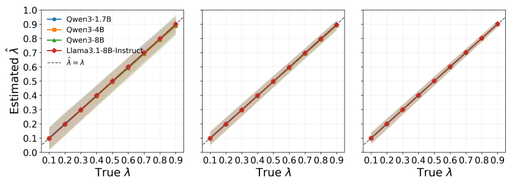
Figure 1 : RGS prevalence estimates on C4. Left to right:ε = 1, 2, 3. Markers show means and shading shows 5th–95th percentiles over keys and repetitions.
Original paper · CC BY 4.0 · Elise L. Han, Tatsunori Hashimoto · Reconciling Privacy with Provenance for Language Model Watermarks · Original paper figure · Extracted the figure area from page 13 of the original PDF.Why per-text watermarks clash with privacy
Language model watermarks inject a recoverable statistical signal into generated text, so a detector holding the secret key can flag model output. A red-green watermark gets its power from a bias toward green tokens that is applied at every token position. Because the bias repeats across positions, a moderately long text carries an exponentially increasing watermark signal.
That per-text power is the source of the friction, since a single text can reveal its LM origin with high confidence.
The authors call this a paradox: the precision and accuracy of a watermark lead users to behave in ways that sabotage it. Many regulatory and monitoring goals, however, only need population-level tracking rather than a verdict on each text. So the authors ask whether provenance goals can be met without violating individual privacy, and they answer yes.
The authors' answer is to make each text's contribution too weak to identify it, while keeping the population prevalence estimable. The core claim is that individual texts still carry enough signal to estimate aggregate prevalence, yet cannot reliably identify any individual. To build this, the paper turns to randomized response from survey design, where respondents keep plausible deniability.
The watermark they build, the Red-Green Sequence (RGS), is locally differentially private and limits what any single text reveals.
One keyed bit per sequence, sized by privacy
RGS borrows the randomized response idea from surveys, where each respondent reveals one noisy bit. The noise is set by a privacy level, and randomized response still lets aggregation recover the mean of the true bits. Local differential privacy formalizes that level as a bound on the likelihood ratio of any output under the two values of the private bit.
RGS applies the same idea to watermarks, so the watermarked output probability stays within a factor of e^{ε} of the base model probability.
A token-level watermark would leak one red-green label per token, giving a long bit string that is hard to keep private. So RGS encodes exactly one red-green bit per sequence, which is the minimal information needed for frequency estimation. The cost is that drawing M candidates for every output is wasteful compared with token-level watermarks, which are essentially free.
The parallel sampler draws M candidates, colors them with a keyed hash, and sums the base probabilities of the green ones into P_G. It then sets Q_G to the minimum of e^{ε} P_G and 1 minus e^{-ε} times (1 minus P_G), and reweights each candidate to fit that target. The rejection sampler is simpler: it draws one candidate at a time and accepts a green one immediately.
A red candidate is accepted with probability e^{-ε}, so red candidates are downweighted by that factor. The experiments use the rejection sampler with a maximum of M = 20 candidates.
The expected number of samples is at most one over the acceptance probability, so stronger privacy means fewer samples are needed. Estimation uses a moment estimator that subtracts π0 from the mean green indicator and divides by π1 minus π0. The estimate is clipped to the unit interval, which keeps it a valid prevalence. For the rejection sampler, the nominal watermarked green probability is π1 equal to e^{ε} π0 divided by e^{ε} π0 plus 1 minus π0.
Do the estimates hold up in experiments?
On C4, the authors build 50 Monte Carlo mixtures of 2000 texts for each prevalence from 0.1 to 0.9. Each mixture is tested at privacy budgets ε of 1, 2 and 3, using 20 randomly sampled keys. The main weakness is relative error at small true λ, which the authors link to the sampling noise of randomized-response style estimates.
The harder test uses a single prompt and only 100 total samples per mixture, at ε of 2. The authors attribute the essay result to its higher per-prompt entropy. The coding estimates still have relatively low bias, which the authors call promising given very low diversity and entropy.
The bias-control experiment uses 1,000 C4 prompts, sampled from Llama-3.1-8B-Instruct at temperature 0.2, truncated to 20 tokens. The authors compare π0 values from 0.1 to 0.5 at ε of 2, measuring mean absolute percentage error. The π0 that optimizes separation at ε of 2 is σ(−ε/2), which equals 0.27.
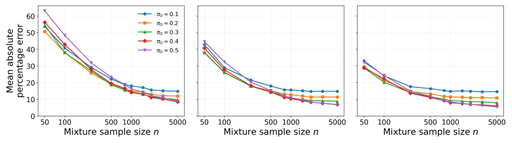
Figure 3 : MAPE versus mixture sizenfor differentπ0. Left to right:λ= 0.2,0.3,0.4.
Original paper · CC BY 4.0Where the estimator bias comes from
The analysis treats the keyed coloring as ideal, so distinct fixed sequences get independent green labels with probability π0. Under that assumption, the key-averaged green probability equals π0, and its variance is π0(1 − π0) times the squared ℓ2 norm of the base distribution. High-entropy base distributions keep each green fraction close to π0, because a small squared ℓ2 norm means little variance across keys.
Low entropy therefore leaves more variance per text, and more room for the green fraction to drift away from π0.
The unwatermarked bias U(k) has zero key-average, and its variance is driven by cross terms between different prompts' distributions. Diverse prompts make those cross terms small, so the unwatermarked bias concentrates near zero even when each prompt has low entropy. The watermarked bias B(k) behaves differently, because both samplers upweight green probability through a concave function.
Jensen's inequality then gives a non-positive key-averaged bias, so the nominal separation d cannot be fully realized at finite entropy. The key-conditional MSE splits into a sampling term bounded by 1/(4n) and bias terms that need not shrink with n.
Shrinking d = π1 − π0 trades some variance for less bias, which is the reason the authors tune π0 upward. For the rejection sampler, the normalized key-averaged bias is non-increasing in π0 on (0, 1). The authors say that a larger π0 helps at large sample sizes, where sampling noise shrinks but systematic bias remains.
Where the results and guarantees stop
The sequence-level hash is sensitive to minor edits, so robustness is still an open problem for RGS. The authors suggest locality sensitive hashing or error correcting codes as possible mitigations, but they don't test either. A token-level watermark is more edit-robust, yet controlling its total privacy leakage over long sequences remains an important problem.
Memoized randomized response can protect repeated queries, but it randomizes both groups, while the watermark can only randomize the watermarked group. Reusing one noisy report could shift the detection signal away from the unwatermarked baseline and reveal watermark status over time.
The bias result holds only in expectation over keys, so for a fixed key B(k) can have either sign. Because of that sign uncertainty, the nominal separation d can't be fully realized when the prompt distributions lack perfect entropy. The experiments cover Qwen3-1.7B, Qwen3-4B, Qwen3-8B and Llama-3.1-8B-Instruct, with π0 set to 0.5 unless the authors varied it.
The essay and coding results use only a single prompt, and the authors report them at ε of 2. The bias-control run uses one model, Llama-3.1-8B-Instruct, with temperature 0.2 and ε of 2. The privacy composition over token sequences gives only preliminary promise for frequency estimation. They didn't reach a fixed sequence-level privacy budget with accuracy that they consider sufficient.
Paper info
- Authors
- Elise L. Han, Tatsunori Hashimoto
- Venue
- arXiv · Preprint
- First published
- 2026-11-4
- Added
- 2026-11-6
- Updated
- 2026-11-4
- Version
- v1
- arXiv
- 2611.06100
- Category
- cs.CR · cs.AI · cs.CL
- Original paper terms
- CC BY 4.0
- What we show
- Paper info, commentary and permitted figures from the original paper
AI commentary is a separate explanation from the original paper and may contain errors. The original paper and figures follow each source's terms of use and any rights noted separately.
Abstract
Watermarking has great potential for regulating the use of language models (LMs), but its deployment has been marred by controversy, as many users argue that fine-grained tracking of LM usage violates their privacy. This tension reduces the effectiveness of watermarks, as users engage in evasion strategies such as paraphrasing that can remove much of the watermark signal. We show that provenance and privacy can be reconciled if we shift the goal of watermark design from tracking individuals to estimating aggregate usage. We develop locally differentially private watermarks which provably limit the evidence that any individual text can contribute to detection, while still enabling accurate estimation of population frequencies. We introduce the Red-Green Sequence (RGS) watermark, a private and computationally efficient watermark that achieves accurate frequency estimation at high privacy levels across various models, sample sizes and generation entropies in settings that reflect realistic deployment scenarios. On C4 language modeling tasks, we attain $0.0019$ MSE with $0.0038$ mean absolute bias at a low $\varepsilon$ of 1, while in more challenging settings such as an essay writing task with only 100 text samples, we still find errors on the order of $0.0113$ MSE with $0.004$ mean absolute bias at $\varepsilon=2$.
Quote from the paper
Elise L. Han, Tatsunori Hashimoto (2026). Reconciling Privacy with Provenance for Language Model Watermarks. arXiv:2611.06100v1. https://arxiv.org/abs/2611.06100v1
BibTeX
@misc{han2026reconciling,
  title = {{Reconciling Privacy with Provenance for Language Model Watermarks}},
  author = {Elise L. Han and Tatsunori Hashimoto},
  year = {2026},
  eprint = {2611.06100},
  archivePrefix = {arXiv},
  url = {https://arxiv.org/abs/2611.06100v1}
}