Paper commentary
SafeStart: Mitigating the Overlooked Safety Cost of Active Expert Reduction in MoE LLM Serving
SafeStart keeps MoE models refusing harmful requests while running fewer experts
- Problem Expert reduction speeds up MoE serving, but accuracy benchmarks miss that it can weaken refusal of harmful requests.
- Method SafeStart runs all experts for the prompt and the first eight generated tokens, then switches to the reduced expert set.
- Results SafeStart held the rise in harmful compliance to 0.6 to 2.6 points, while truncation raised it 5.8 to 21.4 points.
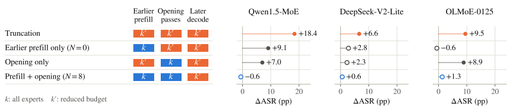
Figure 4 . Prefill and opening-token interventions ( k′ =⌈2k/3⌉ , 472 prompts, refusal suppression, Llama Guard 3). Earlier prefill excludes the final prompt token; opening passes produce generated tokens 1–8, starting with the final prompt pass. Blue: full budget; orange: reduced. All conditions reduce later decoding. Points: ASR changes against the original model; hollow: exact McNemar p≥0.05 (paired tests in Appendix B).
Original paper · CC BY 4.0 · Erfan Baghaei Potraghloo, Saeid Shokoufa, Seyedarmin Azizi, Arya Fayyazi, Souvik Kundu, Mehdi Kamal, Massoud Pedram · SafeStart: Mitigating the Overlooked Safety Cost of Active Expert Reduction in MoE LLM Serving · Original paper figure · Extracted the figure area from page 8 of the original PDF.Why accuracy checks miss the refusal cost
Serving engines can lower k to a smaller k' so each token runs fewer experts, which makes decoding cheaper. In vLLM and llama.cpp, that change takes one line of configuration, so teams can adopt it quickly. Most of these methods are validated on accuracy, perplexity, or reasoning benchmarks. Those benchmarks don't ask whether the model still refuses a harmful request.
Refusal in MoE models depends on a few experts and routers, and removing them can leave accuracy largely intact. So an accuracy score can stay flat while refusal behaviour shifts underneath it. Other serving tricks, like compressing the KV cache or lossy speculative decoding, have already stripped refusals at a modest accuracy price. That pattern suggests the risk for expert reduction is not hypothetical.
The study ran a refusal-suppression jailbreak on nine MoE models, comparing each modified model with the unmodified one prompt by prompt. Under that jailbreak, harmful compliance rose by 18.4 percentage points on Qwen1.5-MoE. Over the same comparison, MMLU dropped by at most 1.8 points. On OLMoE the rise was 9.5 points, and on DeepSeek-V2-Lite it was 6.6 points.
Top-p routing, which uses a threshold rather than a fixed k, raised harmful compliance by up to 30.1 points. A team that checked only accuracy would see a drop of less than two points.
Where the refusal change happens
The refusal change concentrates at the start of a response, according to the authors. Alignment points the same way, because it changes mainly the first tokens of a response. The first generated token comes from the prefill pass, whose last position produces it. Every expert-reduction method changes the prompt tokens too, so the prefill pass is affected as well.
On their evaluation prompts, this leaves at most 0.9 points of the increase. Their appendix checks the first token alone and finds it doesn't carry the increase. For that reason, SafeStart extends the protected span to the first eight generated tokens.
Protecting this span works because the reduced expert budget still governs the rest of the response. The protected span covers only the prompt and a few generated tokens, so the reduced budget still does most of the work.
How SafeStart runs the layer
The router scores each token and keeps the k highest-scoring experts, and some models also add shared experts that see every token. The layer output adds a gated shared expert to a weighted sum over the selected routed experts. Gate normalization decides how those selected weights are set. With top-k renormalization, each weight is its selected score divided by the sum over the selected set, so the weights total one.
Without renormalization, the weights stay as raw scores, so the gate mass falls when fewer experts are kept.
A serving engine such as vLLM runs prefill once over the whole prompt, and its last position produces the first generated token. The switch happens inside the engine, through a fused kernel in vLLM. Figure 1 draws the expert slots for top-k on Qwen1.5-MoE with k= 4 and k′ = 3.
The same schedule covers top-k, top-p, and threshold-based expert budgets. Top-p routing keeps experts until their combined routing weight reaches a threshold, so the count varies from token to token. Uniform top-k truncation keeps only the k′ highest-scoring experts of every token.
Refusal results under truncation
Truncation to about two thirds of the selected experts raised harmful compliance by 18.4 percentage points on Qwen1.5-MoE under the refusal-suppression template. Under human labels the rise on Qwen1.5-MoE was 13.6 points, so the size depends partly on the judge. OLMoE rose by 9.5 points and DeepSeek-V2-Lite by 6.6, and these three of nine models are the ones where the rise is significant.
So refusal can weaken while accuracy holds, which is the gap an accuracy benchmark cannot see.
MMLU drops by at most 1.8 points at this operating point. Top-p routing behaves differently: it keeps a variable number of experts per token until their weights reach a threshold, and it raises harmful compliance by up to 30.1 points. That larger rise comes with a larger accuracy cost.
On the evaluation prompts, computing the prompt and the first generated token with all experts left a residual of 0.9 points of the increase. A residual that small points the search at prefill and the first decode steps rather than at the rest of the response.
Does SafeStart keep the speedup on held-out prompts
The held-out check uses 889 requests whose analysis was fixed before generation, so the prompts were not used to tune the method. On these requests, truncation raised harmful compliance by 5.8 to 21.4 points, while SafeStart left a rise of 0.6 to 2.6 points. On two of the three models, SafeStart was non-inferior to the original model.
SafeStart keeps at least 85% of the offline decode speedup of expert reduction at batch sizes 8 and 32.
With half of the experts, SafeStart scores 3.6 to 3.9 GSM8K points higher than truncation. That comparison is against truncation at the same budget, so it doesn't measure the gap to the original model. The engine patch covers top-k, top-p, and threshold-based expert budgets.
The fix targets a mechanism: without renormalization, removing experts lowers the gate mass that the routed experts carry.
Limitations of the timing and safety results
The timings run on RTX A6000 GPUs, and vLLM's default MoE kernel settings set how each expert is computed. The studied models have at most 57B parameters, so the results say little about larger MoE models.
The engine patch handles single-turn requests only. It doesn't cover quantized MoE kernels or expert parallelism, so those setups need their own tests.
Only three of nine models show a significant rise under this jailbreak. MMLU drops by at most 1.8 points, so an accuracy check alone would miss the refusal change.
On 889 held-out requests, SafeStart leaves a rise of 0.6 to 2.6 points in harmful compliance. The annotators could skip items, and raw model outputs are shared only on request.
Paper info
- Authors
- Erfan Baghaei Potraghloo, Saeid Shokoufa, Seyedarmin Azizi, Arya Fayyazi, Souvik Kundu, Mehdi Kamal, Massoud Pedram
- Venue
- arXiv · Preprint
- First published
- 2026-11-4
- Added
- 2026-11-6
- Updated
- 2026-11-4
- Version
- v1
- arXiv
- 2611.06147
- Category
- cs.AI · cs.LG
- Original paper terms
- CC BY 4.0
- What we show
- Paper info, commentary and permitted figures from the original paper
AI commentary is a separate explanation from the original paper and may contain errors. The original paper and figures follow each source's terms of use and any rights noted separately.
Abstract
Mixture-of-Experts (MoE) language models send each token through a few of many expert subnetworks. Serving methods make these models faster by running even fewer experts per token, and they are validated on accuracy benchmarks. We show that these methods can weaken the model's refusal of harmful requests, and we introduce SafeStart, which largely restores refusal while keeping most of the speedup. In vLLM on one RTX A6000, keeping about two thirds of the selected experts speeds up offline decoding by 15 to 28% at batch size 8. We find that, at this setting, under a jailbreak that tells the model not to refuse, the share of harmful requests that the model answers rises by 18.4 percentage points on Qwen1.5-MoE, 9.5 on OLMoE, and 6.6 on DeepSeek-V2-Lite, the three of nine models where it rises significantly, while MMLU accuracy drops by less than two points. We discover that most of this increase arises while the model processes the prompt and generates its first few tokens. SafeStart therefore runs all experts for the prompt and the first eight generated tokens, and the reduced set of experts afterwards, through a fused kernel in vLLM. With experts removed, SafeStart keeps at least 85% of the offline decode speedup at batch sizes 8 and 32 and brings the change under this jailbreak to between -2.1 and +1.3 points for three expert-reduction methods on these three models. On 889 held-out requests, in an analysis fixed before generation, truncation raises harmful compliance by 5.8 to 21.4 points, and SafeStart leaves a rise of 0.6 to 2.6 points, non-inferior to the original model on two of the three models. Our results show that faster MoE serving need not cost safety: a serving system can keep most of the gain from running fewer experts by running all of them at the start of each response, and it should test refusal, not only accuracy, before it enables such a method.
Figures from the paper
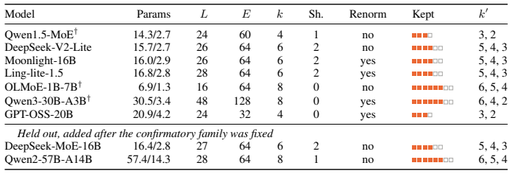
Table 1 . MoE models. Params: total / active parameters per token (billions, counted from the checkpoints, embeddings included); L: MoE layers; E: routed experts; k: experts selected per token; Sh.: shared experts; Renorm: routed weights renormalized over the selected experts; Kept: the k′ =⌈2k/3⌉ slots of the confirmatory point; k′: truncation levels run; †: also in the earlier harness of Appendix D. Appendix A gives revisions and weight formats.
Original paper · CC BY 4.0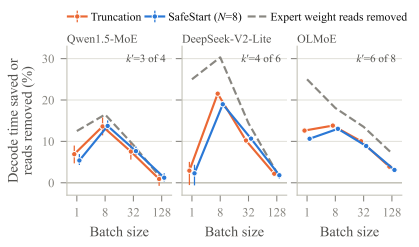
Figure 2 . Decode time saved against the original model, by batch size, for truncation atk ′ =⌈2k/3⌉and for SafeStart withN= 8 (95% bootstrap intervals). Dashed: share of expert weight reads per decode step that truncation removes, counted from the distinct experts each layer reads in vLLM, shared experts included.
Original paper · CC BY 4.0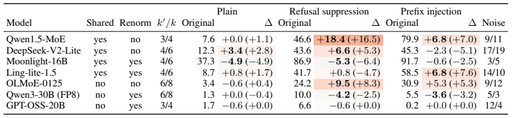
Table 2 . Truncation at the operating point that keeps about two thirds of the selected experts (k′ =⌈2k/3⌉ ). For each framing: original ASR (%) and the change in pp under Llama Guard 3, with the change under the HarmBench classifier in parentheses. Bold: Holm-adjusted exact McNemar p <0.05 over the confirmatory family of 21 tests (7 models × 3 framings). Shading: size and sign of the Llama Guard 3 change. Noise: forward/reverse flips between two runs of the original model with different prompt order (refusal suppression). Other doses appear in Appendix B.
Original paper · CC BY 4.0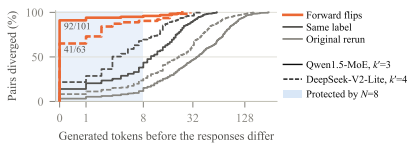
Figure 3 . Share of response pairs whose truncated and original responses have differed by each generated token (refusal suppres- sion). Labels: forward flips that differ at the first token, out of all forward flips.
Original paper · CC BY 4.0
Table 3 . Expert-reduction rules at about two thirds of the selected experts: ASR change under refusal suppression (pp, Llama Guard 3), alone and with SafeStart (N= 8 ) in the engine with the fused kernel; GSM: GSM8K change (points); bold: exact McNemar p <0.05; shading: size and sign of the change. Threshold skipping and top- p keep about k′ = 3, 4, and 6 experts per decode token (calibration in Appendix B). Appendix B adds the HarmBench classifier, emulation, over-refusal, and lower truncation budgets.
Original paper · CC BY 4.0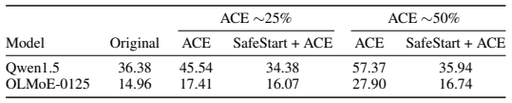
Table 5 .ACE ASR (%) at two skip targets, with and without SafeStart (N= 8).
Original paper · CC BY 4.0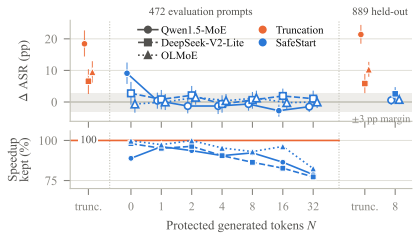
Figure 6 . Protection length N (k′ =⌈2k/3⌉ , refusal suppression). Top:change in ASR against the original model (Llama Guard 3, 95% prompt-bootstrap intervals; hollow: exact McNemar p≥ 0.05; gray band: ±3 pp margin) on the 472 evaluation prompts and, at right, on 889 held-out prompts; trunc. (orange): truncation of every token. N= 0 runs every prompt token but the last at full k.Bottom:share of truncation’s decode speedup at batch size 8 that SafeStart keeps.
Original paper · CC BY 4.0Quote from the paper
Erfan Baghaei Potraghloo, Saeid Shokoufa, Seyedarmin Azizi, Arya Fayyazi, Souvik Kundu, Mehdi Kamal, Massoud Pedram (2026). SafeStart: Mitigating the Overlooked Safety Cost of Active Expert Reduction in MoE LLM Serving. arXiv:2611.06147v1. https://arxiv.org/abs/2611.06147v1
BibTeX
@misc{potraghloo2026safestart,
  title = {{SafeStart: Mitigating the Overlooked Safety Cost of Active Expert Reduction in MoE LLM Serving}},
  author = {Erfan Baghaei Potraghloo and Saeid Shokoufa and Seyedarmin Azizi and Arya Fayyazi and Souvik Kundu and Mehdi Kamal and Massoud Pedram},
  year = {2026},
  eprint = {2611.06147},
  archivePrefix = {arXiv},
  url = {https://arxiv.org/abs/2611.06147v1}
}