Paper commentary
Ab Initio Accuracy Beyond the Cutoff: Distributed Message-Passing Equivariant Attention at Tens-of-Millions-of-Atom Scale
Tessera shards atoms along a curve to scale equivariant force models
- Problem Equivariant message-passing Transformers learn ab initio forces at linear cost, but distributing them is hard. Each rebuild changes neighbor graphs and tensor shapes, so communication and static execution break down at scale.
- Method Tessera sorts atoms along a space-filling curve and cuts them into equal-count shards per GPU. Equal counts keep tensor shapes fixed, so each rebuild interval replays as one CUDA Graph.
- Results On 512 GPUs, Tessera sustains 30.7M atoms at 89.7% weak-scaling efficiency. Neighbor-search cost grows 1.7x across an 8x device increase, versus 3.0x for Morton order.
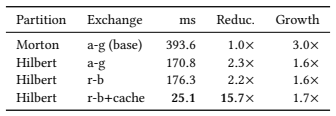
Table 3 . Composing the three neighbor-search mechanisms (a-g=all-gather, r-b=rank-box) at 512 GPUs,50k atoms/GPU; each row adds one mechanism to the row above. “Growth” is the 512-/64-GPU cost ratio, so1 .0is ideal weak scaling. Cached rows are a composed interval-10amortized cost, not a timed interval-10run; the composition and its known bias are stated below. Neighbor pipeline only. Rank-box costs3%against all-gather at this scale rather than saving: the two differ by under9%at every Hilbert point in the observed runs, a margin we do not treat as separable given the single run per point (Section 4.3), and rank-box is the default for its small, fixed-size metadata and reusable peer set, not for latency. At25k atoms/GPU the baseline grows3 .2× over the same range.
Original paper · CC BY 4.0 · Allex Kan, Ji Zhang, Hao Yin, Hao Li, Owen Fu, Xunxing Chen, Lin Huang, Zion Wang, Lucas Li, Jiajun Cheng, Arthur Jiang, Junping Zhao, Jia Zhang · Ab Initio Accuracy Beyond the Cutoff: Distributed Message-Passing Equivariant Attention at Tens-of-Millions-of-Atom Scale · Original paper figure · Extracted the figure area from page 21 of the original PDF.Why cutoff models stop short
Empirical force fields are cheap, and they carry molecular dynamics to millions of atoms. Their fixed charges cannot polarize, bonds cannot break, and charge transfer never happens, so they fail where the chemistry gets interesting. Density functional theory fills that gap, but its cost grows as \(O(N^3)\), which keeps it at hundreds to a few thousand atoms.
Machine-learning force fields keep the cost linear in atom count, and the strictly local ones reach a hundred million atoms. A strictly local model, however, never passes a learned feature beyond a single cutoff.
Message-passing equivariant Transformers restore that propagation by stacking finite-radius attention layers. A few layers reach 20 Å and beyond, and the stack used in this paper reaches 23 Å. That reach is also why the class is hard to distribute, because the further a model looks, the more atoms each evaluation needs.
The difficulty splits into three parts, one for each layer of the stack. Equivariant operators such as Clebsch–Gordan tensor products fit neither the dense kernels nor the BF16 precision that FlashAttention assumes. The graph must be cut across devices, and the cut has to be re-derived from live coordinates during the trajectory. Every re-derivation changes edge counts, so the full forward and backward pass cannot simply be replayed as it is.
Placing atoms on a space-filling curve
The paper settles on one placement rule that serves all three goals at once, and the counts it fixes drive the tensor shapes. Quantizing coordinates onto a space-filling curve, sorting, and cutting the list into equal-count segments gives each rank exactly floor(N/K) or ceil(N/K) atoms. Because the counts are exact, every node-indexed tensor keeps one shape, which the captured CUDA Graph requires.
Equal-volume cells bound each rank to 27 cells including its own, but their counts drift with density and break static shapes. An equal-count cut that ignores geometry balances perfectly, but a rank's neighbors can live anywhere, degenerating toward all-to-all with about K peers. That estimate assumes uniform density, so it understates the spread on an inhomogeneous system.
The peer count is where the curve pays off, and the numbers show how the peer set grows with the machine. Balance and static shapes come from the cut, so the choice of curve only changes locality. Morton interleaves coordinate bits, which is cheap, but a contiguous interval can split into several disconnected fragments. A fragmented shard's bounding box also covers the gaps between its pieces, so the rank requests more peers than its geometry needs.
The authors therefore adopt Hilbert as the default and keep Morton as the ablation baseline. Part of that gap reflects how the two implementations normalize the quantization axes, not curve topology alone.
Between re-cuts, a rebuild is triggered when displacement exceeds the trigger, so the topology is re-derived on its own clock.
Neighbor search and the cached graph
The neighbor search prunes candidates in three levels, and every level is conservative, so it drops only atoms provably beyond the cutoff. Level 3 is a brute-force cutoff-radius search via FAISS, not an approximate nearest-neighbor query.
Level 1 is cheap in communication because each of the K devices summarizes its atoms by one coarse axis-aligned bounding box. The K by K test marks device pairs active whenever atoms on one device may fall within the cutoff of another device's queries. That descriptor stays under 2 KiB per rank, so one metadata all-gather lets every rank rebuild the full request matrix locally.
Level 1 with rank-box publishes a fixed small descriptor, while All-gather sends every device's full candidate set to every other device.
The topology outlives the geometry on two clocks, so the authors rebuild only on a schedule or when a displacement trigger fires. An all_reduce(MAX) over the local triggers makes that decision unanimous, which keeps the exchange plans consistent and the captured graph valid. The edge sets and communication plans are built once per rebuild and cached, so a cache hit pays nothing for construction.
That traced forward and backward pass is replayed as a static CUDA Graph on each intervening step, instead of being dispatched kernel by kernel. Partition, neighbor search and graph capture therefore hold or fail together, because a rebuild changes the shapes that the graph depends on.
Overlapping the exchange and moving integration onto the GPU
The forward pass splits each attention operator into a local branch and a remote branch, so the exchange can run while local work proceeds. The remote feature exchange launches asynchronously on the communication stream, and the local branch runs on the compute stream. Launch order decides whether the overlap survives, because heavy local kernels queued first delay the exchange.
A naive forward-only overlap leaves the remote exchange and remote-gradient work in a serial tail during backward. Under reverse traversal, post.backward fires early, so the reverse exchange starts once the received-feature gradient exists. The backward accumulation then runs through the shared dependency exactly once, with no additional activation memory.
The conventional MD loop keeps rank 0 at the centre of every step. Rank 0 scatters positions and reduces forces through one network endpoint, which K minus 1 ranks contend for every step. Because re-encoding re-derives ownership, a centralized driver invalidates the topology cache on every step.
The decentralized engine integrates each rank's own atoms on the GPU, so the rank-0 integrator leaves the per-step path. Each step ends with an all_reduce(SUM) of energy, temperature and virial, whose payload does not depend on N.
Single-GPU and neighbor-search results
On a 10k-atom toy system on H100, the base configuration takes 363.4 ms per step. The authors read this as fusion removing both launch overhead and intermediate tensors. For that reason the trajectory validation keeps TF32 off.
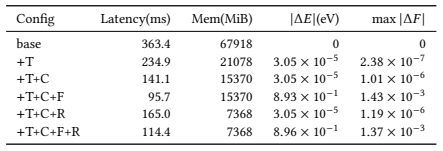
Table 2 . Ablation on a 10k-atom toy system on H100. Config abbreviates T=Triton, C=torch.compile, F=TF32, R=activation recompu- tation, applied cumulatively left to right. Precision metrics are relative to the base (no T/C/F/R).
Original paper · CC BY 4.0Across three per-GPU loads, efficiency stays between 77% and 90%.
Neighbor-construction time shows the placement effect most clearly, measured from 64 to 512 GPUs at 25k atoms per GPU. The slope matters more than the absolute cost, because it decides whether the stage keeps up as the machine grows.
The overall 15.7× figure is composed from separately measured rebuild and hit steps, not from one interval-10 run.
Trajectory checks and the heterogeneous penalty
The per-atom energy drift stays at about 0.42 μeV/atom/ps rather than growing over the run. They don't present the check as a same-input equivalence test.
Almost all of that gap comes from forward compute, which runs 17–20% higher on both the cache-hit and rebuild paths. Repartition costs 92.7ms per event for KCl and 87.5ms for the capsid. The margin shifts with trajectory phase, from 13–33% across three windows, so the authors treat it as a range.
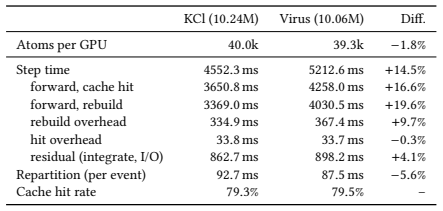
Table 6 . Per-step cost under matched hyperparameters on the same A100 cluster, near-uniform KCl vs. heterogeneous Norovirus capsid, over steps3000–4000. The capsid holdsfeweratoms per GPU, so the penalty is not a load artifact. Rows compose as Step ≈ hit rate×(fwd,hit+hit ovh.)+(1−hit rate)×(fwd,rebuild+rebuild ovh.)+residual.
Original paper · CC BY 4.0The authors attribute the penalty to equal atom counts not meaning equal work. Protein-dense regions carry more edges per atom than the water beside them, while the cut balances atoms, not edges. An edge-weighted cut would rebalance this, but it would give up the exact-count invariant the captured graph rests on. Whether the gap widens with device count is something they didn't test.
Limits of the evidence
Strong scaling stops paying off around 160 GPUs, where the fall in step time steepens. Recomputation is required at the low end of the range, so the efficiency figure is only comparable against the 64-GPU reference. The authors trace the deviation to the forward-labeled phase, not to neighbor-cache management or repartition cost.
The authors attribute this to wait time at the attention All-to-All, because a rebuild's ghost-atom exchange re-aligns the ranks.
Equal atom counts don't mean equal edge counts, because protein-dense regions carry more edges per atom than the water beside them. The authors didn't test whether the gap widens with device count.
TF32 leaves water and solvation structure alone, with K–O first-peak heights agreeing to 0.5%.
The exchange still grows with the machine, and the rank-0 sort scales with the problem.
Paper info
- Authors
- Allex Kan, Ji Zhang, Hao Yin, Hao Li, Owen Fu, Xunxing Chen, Lin Huang, Zion Wang, Lucas Li, Jiajun Cheng, Arthur Jiang, Junping Zhao, Jia Zhang
- Venue
- arXiv · Preprint
- First published
- 2026-11-4
- Added
- 2026-11-6
- Updated
- 2026-11-4
- Version
- v1
- arXiv
- 2611.06122
- Category
- cs.DC · cs.AI · physics.bio-ph
- Original paper terms
- CC BY 4.0
- What we show
- Paper info, commentary and permitted figures from the original paper
AI commentary is a separate explanation from the original paper and may contain errors. The original paper and figures follow each source's terms of use and any rights noted separately.
Abstract
Molecular dynamics predicts molecular motion from atomic forces and trajectory integration. Density functional theory (DFT) provides first-principles forces, but its $O(N^3)$ cost limits simulations to thousands of atoms; empirical force fields scale to millions but miss bond breaking and charge transfer. Equivariant message-passing Transformers learn the ab initio potential at linear cost. Stacked layers propagate information beyond a single cutoff, giving four layers a receptive field up to 23Å. At this frontier, scale is limited by communication: layers exchange boundary features across devices, force backpropagation repeats the exchange, and moving atoms change neighbor graphs and tensor shapes. We present Tessera, a distributed runtime that fixes workload shapes between rebuilds. It sorts atoms along a space-filling curve into equal-count shards, ensuring identical atom counts and tensor shapes per rank. Peer sets scale as $K^{0.5}$, not $K$. A conservative neighbor skin preserves topology across updates, enabling each rebuild interval to replay as one CUDA Graph. Fused kernels, three-level neighbor search, and overlapped All-to-All complete it. On 512 GPUs, Tessera sustains 30.7M atoms at 89.7% weak-scaling efficiency (77--90% across three per-GPU loads); per-step time rises 1.11--1.29x as machine and problem grow 16x. Graph reuse cuts full-step time $1.87\times$. Across an $8\times$ device increase, neighbor-search cost grows $1.7\times$, versus $3.0\times$ for Morton order. In a live $10.24$M-atom salt solution, NVE energy drift is $0.42\,μ$eV/atom/ps over $10$ ps, and structure matches a serial reference. A 10.06M-atom Norovirus capsid sustains 100 ps of NVT at $\approx 8$ ps/day on 256 A100 GPUs. Over 200,000 steps, it has no broken bonds or anomalously close pairs and uses three compiled variants, with no graph breaks or eager fallbacks.
Quote from the paper
Allex Kan, Ji Zhang, Hao Yin, Hao Li, Owen Fu, Xunxing Chen, Lin Huang, Zion Wang, Lucas Li, Jiajun Cheng, Arthur Jiang, Junping Zhao, Jia Zhang (2026). Ab Initio Accuracy Beyond the Cutoff: Distributed Message-Passing Equivariant Attention at Tens-of-Millions-of-Atom Scale. arXiv:2611.06122v1. https://arxiv.org/abs/2611.06122v1
BibTeX
@misc{kan2026initio,
  title = {{Ab Initio Accuracy Beyond the Cutoff: Distributed Message-Passing Equivariant Attention at Tens-of-Millions-of-Atom Scale}},
  author = {Allex Kan and Ji Zhang and Hao Yin and Hao Li and Owen Fu and Xunxing Chen and Lin Huang and Zion Wang and Lucas Li and Jiajun Cheng and Arthur Jiang and Junping Zhao and Jia Zhang},
  year = {2026},
  eprint = {2611.06122},
  archivePrefix = {arXiv},
  url = {https://arxiv.org/abs/2611.06122v1}
}