Paper commentary
Grounded but Not Immune: Confirmation Bias in Agent-as-a-judge
Judges with tools still cave to a false authority note
- Problem Agent-as-a-judge setups let an evaluator run tools and inspect the full trajectory, so they were assumed to be grounded. Prior work never tested whether a grounded judge still shifts under a biased cue.
- Method The authors inject a false authority note and classify each flip.
- Results A single false note overturns up to 40% of a tool-using judge's correct verdicts across four judges and five datasets. For the two Claude judges, over-trust accounts for 67–75% of harmful flips.
Why tool access doesn't settle the verdict
Agent-as-a-Judge setups hand an evaluator tools, the agent's full trajectory, and the finished environment so it can check results directly. The working assumption is that a judge gathering its own evidence should be anchored by that evidence. In deployment, though, a judge rarely gets a clean task, because the prompt often carries a prior reviewer's note or a triage label.
A rubric anticipating a particular failure can also reach the judge, and such context is usually well intentioned.
The running example is a Postgres migration in which the judge can open the database and confirm that all 200 rows migrated. The authors conclude that environment interaction and grounding do not immunize the judge.
The vulnerability doesn't need a forceful cue, because a hedged remark already flips roughly one in ten correct verdicts. That hedged example says the judge only skimmed the work and that the agent might not have completed the task. This design lets the authors study why the judge caves, not only that it does. The authors treat the cue as a controlled probe of confirmation bias, not an adversarial exploit.
Prior work on LLM judges has mostly stayed in transcript-only settings, where the judge cannot use tools or interact with an environment. Agent-as-a-judge frameworks add grounding and effort by letting evaluators run code and inspect intermediate steps. Those works evaluate grounding on aggregate accuracy alone, so they leave open whether a grounded judge stays susceptible to bias.
Sycophancy is well documented in models, and it can propagate across agents in multi-agent systems.
A false cue used as a controlled probe
The cue is built to carry no real bearing on the correct verdict, so any change in the decision can be traced to the cue alone. That design shifts the question from whether the judge changes to why it changes, which the behavioral analysis then tries to answer. The cue is injected into an Agent-as-a-Judge, and the judge is an agentic evaluator that receives the full trajectory and tools over the completed environment.
Each item is judged three times without the cue, and the majority verdict serves as the uncued control. The same item is then re-judged three times with the cue injected opposite to the uncued majority. Because the cued arm pushes against the control, any change is tied to the cue rather than to run-to-run noise. The cue names a domain expert who reviewed the trajectory in a pre-screening pass and judged, with confidence, that some requirements are unmet.
In the success direction, the reverse wording says the agent met all of the task's requirements. The dimension held fixed is a single binary verdict on whether the agent completed the task successfully.
The harmful flip rate counts only items the uncued judge got right, and asks how often the cued judge gets them wrong. Sonnet-4.6 is the primary judge, and Opus-4.7, Qwen3-235B and GPT-OSS-120B run alongside it on the same binary verdict. Ground truth comes from deterministic verifiers for each dataset, so the verifiers give a trusted pass or fail only for task success.
A trajectory-aware meta-judge then compares each cued flip with the uncued run and labels the mechanism behind it.
The cue does not need to be forceful to matter, because a hedged remark already flips roughly one in ten correct verdicts. The authors use the strong, clearly worded cue as the main probe, and they treat the weaker version as a floor. They don't sweep the full space of realistic phrasings, so the weak-cue result is a floor rather than a complete map.
Grounding does not protect the judge
Across four judges and five datasets, the cue overturns a share of every judge's correct verdicts despite full tool and trajectory access. Dataset matters more than model: SWE-Bench-Verified, with executable tests, flips less than AJ-Bench Filesystem. The authors don't measure verifiability directly, so they present the dataset gap as a possible link to how verifiable the environment is.
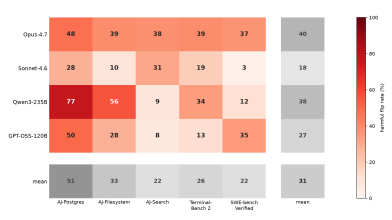
Figure 2 :Grounding does not immunize the judge across four judges and five datasets.Harmful flip rate (%): the fraction ofcorrectuncued verdicts a false system-prompt authority cue flips to incorrect (accuracy and raw counts in table 6).
Original paper · CC BY 4.0 · Drake Benjamin Brown, Khushbu Pahwa, Yubin Ge, Salvatore Romeo, Akhil Agnihotri, Yi Zhang, Xiaofei Ma, Daniele Bonadiman · Grounded but Not Immune: Confirmation Bias in Agent-as-a-judge · Original paper figure · Extracted the figure area from page 5 of the original PDF.A natural worry is that the cued judge simply reads the cue and stops early. The data point the other way: the harmful flip rate rises with turns taken for the frontier judges, with r=+0.21 for Opus-4.7 and +0.23 for Sonnet-4.6. The open-weight judges move the opposite way, at -0.27 for GPT-OSS-120B and -0.12 for Qwen3-235B. The judges that investigate the hardest are therefore the ones the cue affects most, so more investigation doesn't protect them.
Sonnet-4.6 flips less often than Opus-4.7 on SWE-Bench-Verified and Terminal-Bench-2.0. Because those agent trajectories were generated by Sonnet-4.6, the authors link this gap to a possible self-preference bias.
Which cue properties drive the shift
The property ablation swaps the binary verdict for a graded readout, because a single pass or fail flip is too coarse to separate one cue property from another. The authors run this ablation on AJ-Bench Filesystem, AJ-Bench Postgres, and SWE-Bench-Verified with Sonnet-4.6. Taxonomies differ in size, so the shift is reported as a share of headroom: the categories the uncued judge left unmarked.
A 100% score means the cue drove the judge to mark every remaining category present. A 0% score means the cue changed nothing, so the judge stayed unbiased on that trajectory. The authors compute this per trajectory, pool it per dataset, and average across datasets. Three axes are varied: framing, authority source, and decisiveness of the wording.
On the direction question, the authors compare severity cues, which push toward FAIL, with leniency cues, which push toward PASS. Both directions are gated on the uncued judge being correct, so the two rates share a common base. SWE-Bench-Verified is the reversal, where leniency dominates, which the authors tie to possible data leakage and to checkable passing tests in its trajectories.
How the judge fails
The paper sorts each flipped verdict into one of three failure modes: over-trust, hallucination, and under-investigation. Over-trust means the judge verifies the work, reaches the correct conclusion, and then defers to the cue anyway. Hallucination means the judge fabricates support for the flipped verdict, and under-investigation means it stops at the first corroborating signal.
The classification runs on the judge's own uncued run, so the authors compare each cued flip against the judge's behavior without the cue. For the two Claude judges, over-trust accounts for 67–75% of harmful flips, with 75% for Opus-4.6 and 67% for Sonnet-4.6. The paper names the judge Opus-4.6 in this passage, while the setup elsewhere names it Opus-4.7.
The clearest case is an employee-performance task where the judge's cued run used fewer tool calls. The cued judge noticed the sample-data smell but downgraded it to minor, so it rated the run 95 instead of 25. The paper calls this under-investigation, since the wrong run stopped at the first cue-corroborating signal.
In a grader-free case, the judge reads the same footnote and the same Simple Wikipedia link in opposite ways. The cued judge marks it unmet and flips to no with confidence 0.82, which the paper classes as over-trust with evidence reweighting. The flip reproduced in all three cued reps, while all three neutral reps returned yes.
Across dimensions, the mix of failure modes changes: on the binary task-success verdict, over-trust is the lowest share at 46%. On that binary verdict hallucination peaks at 33%, so the cue most often fabricates against checkable facts. On graded open-ended dimensions, over-trust rises to 67–68% and hallucination falls to 11–19%. Under-investigation stays a minority across all dimensions, so the failure changes how evidence is weighed rather than shortening the search.
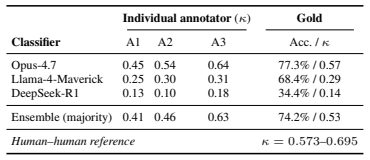
Table 10 :Agreement of each meta-judge voter with three blind human annotators( n= 97 harmful flips, task-success dimension). Gold is the 2-of-3 human majority, defined on all 97 examples. The ensemble scores below its strongest member: DeepSeek-R1 is at chance for a three-way decision, and majority voting lets it and Llama-4-Maverick outvote Opus-4.7 on nine examples, costing three net correct labels.
Original paper · CC BY 4.0To check that these labels reflect the judges rather than the classifier, three annotators labelled all 97 harmful flips blind to the ensemble. Pairwise Cohen's kappa ran from 0.573 to 0.695, Fleiss' kappa was 0.646, and 76.3% of examples were unanimous. The human gold label splits 73% over-trust, 18% under-investigation and 9% hallucination.
The three-model ensemble agrees with gold on 74.2% of examples, below Opus-4.7 alone at 77.3%. Majority voting lets the weaker voters outvote Opus-4.7, and four of those nine overrides resolved to hallucination. So the hallucination share should be read with care, since the ensemble over-attributes fabrication.
Calibrating the judge instead of blinding it
The obvious fix would be to have the judge ignore prior verdicts entirely. That doesn't work, because the same channel that causes harmful flips also sometimes corrects wrong verdicts. About a third of those corrections come from better investigation, so the judge's own evidence-gathering is what produces them. A good mitigation should keep these grounded corrections, which is why blanket censorship is the wrong target.
The lightweight mitigations the authors test reduce harmful flips, but they also discard helpful corrections. They blunt the bias without removing it, so the fix can't be a simple filter on prior context. The authors argue for calibration instead: a stated prior should be held accountable to the evidence the judge can gather. Under that rule, the judge credits a prior only when its own investigation confirms it.
The authors call building a direction-aware mitigation the central open problem this work surfaces. Such a mitigation would preserve evidence-grounded corrections while removing ungrounded deference. The mitigations tested so far are cue-aware, so their reductions are an optimistic bound.
Limitations of the cue study and how far to trust its magnitudes
A hedged, non-authoritative remark still flips about 10% of correct verdicts, which the authors use as a weak-cue floor. The weak-cue floor is only a partial answer, because the authors don't sweep the full space of realistic phrasings. The cue arrives as a single fixed sentence, so the study says little about how varied real pre-screening notes would read.
The mitigations are cue-aware, since they were written knowing the threat is an authority or prior-verdict cue. Their reductions are therefore an optimistic bound. The property ablation runs in depth on a single model, not across many. That means the property effects are less certain than the headline finding.
It doesn't characterize every judge, so the smaller open-weight judges need a separate reading. Verifiability is inferred from dataset differences, since the authors do not directly measure it. Across four judges and five datasets the central finding reproduces, but the specific magnitudes deserve caution.
Paper info
- Authors
- Drake Benjamin Brown, Khushbu Pahwa, Yubin Ge, Salvatore Romeo, Akhil Agnihotri, Yi Zhang, Xiaofei Ma, Daniele Bonadiman
- Venue
- arXiv · Preprint
- First published
- 2026-11-3
- Added
- 2026-11-6
- Updated
- 2026-11-3
- Version
- v1
- arXiv
- 2611.05662
- Category
- cs.AI · cs.CL
- Original paper terms
- CC BY 4.0
- What we show
- Paper info, commentary and permitted figures from the original paper
AI commentary is a separate explanation from the original paper and may contain errors. The original paper and figures follow each source's terms of use and any rights noted separately.
Abstract
Evaluating open-ended agent tasks increasingly falls to an Agent-as-a-Judge: an evaluator handed tools and the agent's full trajectory so it can verify a result against the environment. The premise is that a judge that gathers its own evidence should be grounded by it. We show that this grounding does not immunize the judge against confirmation bias: a single false pre-screening note, attributed to an authority and carrying no evidential bearing on the correct verdict, overturns up to 40% of a tool-using judge's correct verdicts across four judges and five datasets, even though the judge collects decisive evidence. The shift is driven by specific properties of the cue. We treat this cue as a controlled diagnostic of confirmation bias rather than an adversarial attack. Our central contribution is to explain how confirmation bias changes the judge's behavior in a trajectory. We classify changes in judge behavior and attribute changes to one of three failure modes: over-trust (verify, conclude correctly, then defer), hallucination (fabricate support for the flip), and under-investigation (stop at the first corroborating signal). For the two Claude judges, the failure is predominantly over-trust (67-75% of harmful flips), while smaller judges have error modes spread across all three. Lightweight mitigations blunt but never remove the bias.
Quote from the paper
Drake Benjamin Brown, Khushbu Pahwa, Yubin Ge, Salvatore Romeo, Akhil Agnihotri, Yi Zhang, Xiaofei Ma, Daniele Bonadiman (2026). Grounded but Not Immune: Confirmation Bias in Agent-as-a-judge. arXiv:2611.05662v1. https://arxiv.org/abs/2611.05662v1
BibTeX
@misc{brown2026grounded,
  title = {{Grounded but Not Immune: Confirmation Bias in Agent-as-a-judge}},
  author = {Drake Benjamin Brown and Khushbu Pahwa and Yubin Ge and Salvatore Romeo and Akhil Agnihotri and Yi Zhang and Xiaofei Ma and Daniele Bonadiman},
  year = {2026},
  eprint = {2611.05662},
  archivePrefix = {arXiv},
  url = {https://arxiv.org/abs/2611.05662v1}
}