Paper commentary
CounterFactual Retrieval for Evidence-Aware Individual Animal Identification
Counterfactual retrieval shows whether animal re-identification relies on the animal or background
- Problem Standard retrieval scores can't show whether a match came from the animal or from background cues. Benchmarks can also leak identity through context, so high scores can overstate how reliable a model is once deployed.
- Method CFR is an evaluation protocol that reruns the same retrieval task on full, foreground-only, and shortcut-only images. Instead of one score, it gives an evidence profile built from these views.
- Results On NDD20, MiewID scored 45.8 full-image but only 28.7 on CFR, showing that its match rested far less on the animal than the standard score suggested.
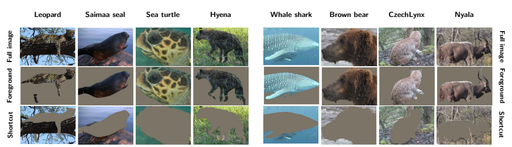
Figure 2 .CounterFactual views.For each image, the provided mask allows us to generate matched full-image, foreground-only, and shortcut-only inputs. Such views alter the available visual evidence and enable evidence-aware evaluation.
Original paper · CC BY 4.0 · Ankit K. Upadhyay, Aleksandr Algasov, Ekaterina Nepovinnykh, Fedor Zolotarev, Tuomas Eerola, Heikki Kälviäinen, Charles V. Stewart, Lukas Picek · CounterFactual Retrieval for Evidence-Aware Individual Animal Identification · Original paper figure · Extracted the figure area from page 5 of the original PDF.Why full-image retrieval can mislead
Standard Retrieval@k only tells a reader whether the correct individual lands in the top k, not which visual cue got it there. The benchmark score rewards all of these without showing which one carried the match. Field images vary across cameras, observers, locations, seasons, and capture conditions, so a score that rewards such context can overstate reliability once a model is deployed.
A zero-shot check makes the problem concrete. On BrownBearHeads, DINOv3 scored 99.0 with the full image and 72.4 with shortcut-only inputs, where the random rate is 1.6. On LeopardID2022, the shortcut-only view still scored 46.3 for DINOv3, far above its random rate of 1.1. Table 1 shows these shortcut-only scores even though none of the models were trained on the datasets in that table.
So the question shifts from whether a model retrieves the right animal to what evidence made the match possible.
The paper's motivation is that this gap also matters for how the benchmark community evaluates models. Many benchmark designs leak information across evaluation examples, and rank-k accuracy and mAP don't reveal that leakage.
Three views of one retrieval task
CFR keeps the query, the gallery, the identity labels and the model fixed, and changes only the image the model sees. Each annotated image gets matched counterpart inputs built from its foreground mask, so every view comes from the same original annotation. The foreground-only input keeps the animal pixels and fills everything else with a constant neutral image c.
The shortcut-only input swaps the roles: the animal's texture goes to the neutral fill while the background stays. A separate silhouette-only view fills the animal region with a constant silhouette image, so only the body outline remains.
The same model embeds every view, and the retrieval rule ranks gallery images by their similarity to the query. For each view, the authors count the queries whose top-k list contains at least one gallery image of the correct identity, giving the rate R_T@k. Raw rates aren't comparable across datasets, because gallery size and positives per query vary.
The random baseline Rrand@k handles that, and Section 3.5 turns each view's rate into a signal above it.
Shortcut signal is taken from the shortcut-only view, and the silhouette view joins it only for datasets where outline is not part of the biometric. The authors fix this choice per dataset from the intended biometric, not from the model. Whale flukes, for example, keep outline as identity, so their silhouette is reported separately.
This setup lets one retrieval score be read as an evidence profile instead of a single number. The full-image score is compared with the foreground-only score on the same queries and gallery. Standard evaluation hides different evidence profiles, so the same Retrieval@1 can come from the animal or from the scene.
From retrieval rates to CFR and SSI
Raw retrieval rates shift with the query-gallery structure, so the authors need a baseline for each dataset. For each query, the random baseline uses K_i = min(k, |G_i|), and a random ranking succeeds if one positive lands in the top K_i. Averaging that success probability over valid queries gives R_rand@k. For k = 1, the baseline reduces to the number of positives divided by the gallery size, averaged over queries.
Each view's above-chance signal is S^T@k = max(0, R_T@k − R_rand@k), which removes expected chance hits and floors below-chance results at zero.
The shortcut signal comes from the shortcut-only view, and the formula depends on the intended biometric of the species. For surface-pattern species, the authors take the larger of the texture-removed shortcut signal and the silhouette signal. For outline-identified species such as whale flukes, silhouette stays out of the shortcut signal and is reported separately.
That choice is fixed per dataset, so it doesn't change with the evaluated model.
CFR starts from the full-image and foreground signals, each divided by its headroom, 1 − R_rand@k. Taking the minimum of these two normalized values makes CFR conservative. A high CFR needs strong full-image retrieval and foreground retrieval that holds up, so a drop in either pulls CFR down. CFR doesn't subtract or penalize shortcut signal, so the authors report shortcut recoverability separately.
SSI divides the shortcut signal by the full-image signal and caps the result at one, which requires S_full@k > 0. A high SSI means the benchmark holds predictive shortcut cues, not that the evaluated model failed.
Building foreground masks at scale
Every counterfactual view is built from the foreground mask, so the mask quality sets the ceiling for the whole evaluation. The authors generate foreground candidates with SAM3, which is a promptable segmentation model, and they use one prompt per dataset. A body-part prompt lets head or flank datasets segment the visual evidence they actually depend on.
That default holds unless dataset-specific checks reject the candidate. The authors keep every rejected candidate with its metadata, so the rejections can be audited and debugged later. Images with several animals or different annotated body parts follow the original annotations, so each mask matches its own record.
To check the masks, the authors compared them against 400 manually drawn reference masks, with 50 from each of the random datasets. The median IoU is 98.2%, and the mean IoU is 96.1%. Also, 95.1% of samples exceed 90% IoU, which supports using the masks for foreground and background interventions. The rejected low-confidence candidates act as a second sanity check.
Annotations without an accepted mask are left out of the main CFR evaluation, so the masks don't introduce silent gaps into the scores. Across 34 datasets, the release covers roughly 0.5M images, and the authors store accepted masks as run-length-encoded JSON, one file per dataset. Counterfactual views are generated on demand from each image and mask pair, so all views share the same original annotation.
Evidence profiles across datasets and models
The authors ran MiewID and MegaDescriptor under every view and set their full-image scores beside their evidence profiles. On OpenCows2020, MiewID reached 99.1 full-image, 98.4 foreground-only, and a CFR of 98.4. Its shortcut-only score was 73.3, which gives an SSI of 73.0. The foreground carries this match even though shortcut-only inputs stay predictive, so the benchmark holds extra identity-correlated evidence.
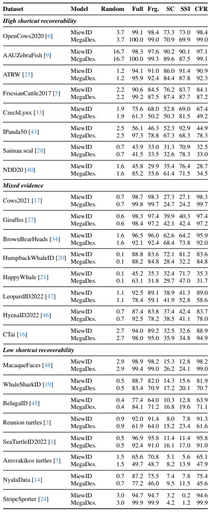
Table 2 .Counterfactual foreground retrieval performance.Re- evaluating MiewID and MegaDescriptor on selected representa- tive datasets shows that full-image Retrieval@1 often hides qual- itatively different evidence profiles. Some datasets are cleanly foreground-supported, some are overdetermined by both animal and shortcut evidence, and others show weak foreground support despite high shortcut recoverability. See full results in Tab. S4.
Original paper · CC BY 4.0NDD20 is the opposite case, and the paper calls it the setting where standard evaluation is most misleading. MiewID scored 45.8 full-image, but its foreground-only score was 29.9 and its CFR fell to 28.7. Its SSI of 76.4 means much of the signal also appears in shortcut-only views. Here, a full-image score gives only thin support for animal-foreground identification.
Two models can share a full-image score and still differ in evidence. On StripeSpotter, MiewID scored 94.7 full-image, with an SSI of 0.2 and a CFR of 94.6. Foreground-only retrieval there largely preserves the useful signal, while shortcut-only retrieval contributes little. NyalaData shows that low SSI doesn't equal accuracy: MiewID's CFR was 75.4, while MegaDescriptor's was 45.6.
On IPanda50, MegaDescriptor reached 97.3 full-image, versus 56.1 for MiewID. Its CFR of 78.3 comes with an SSI of 68.3, while MiewID's SSI was 92.9 and its CFR 44.9. The full-image gap therefore hides a difference in both foreground support and shortcut recoverability. CFR and SSI have to be read together, because a low SSI only describes the shortcut side.
Foreground-mixed training as a test
A natural explanation for weak foreground scores is that the model never saw masked inputs during training, so the authors tested that by retraining. They trained four MegaDescriptor-L-384 checkpoints on the same 22-dataset collection, with the reference MegaDC using full images only. Because all checkpoints are evaluated on the same accepted annotations and CFR protocol, the comparison isolates the training mixture.
HyenaID2022 makes the same transition, even though it is unseen during training.
The mitigation is only partial, because some datasets leave the shortcut-driven regime while CFR stays low. AerialCattle2017 stays high in both CFR and SSI at every exposure level, so foreground-mixed training doesn't remove all identity-correlated dataset cues. Unfamiliar masked inputs therefore explain part of the foreground deficit, and the remaining part points at the data.
Limits of the evidence profile
CFR works as a diagnostic, so it shows whether retrieval stays tied to animal-visible evidence. It doesn't explain where a shortcut comes from, so feature-level tools such as Grad-CAM and attention visualization can help trace that origin. Silhouette enters the shortcut signal only for surface-pattern species, and that choice is fixed per dataset rather than per model.
Annotations without an accepted mask drop out of the main CFR evaluation. The profiles in Table 2 cover MiewID and MegaDescriptor on selected datasets, while the full results sit in Tab. S4.
Only MegaDescriptor-L-384 was retrained for the mixing test. They didn't test other backbones under foreground mixing, so their evidence profiles remain unknown. AerialCattle2017 stays high in both CFR and SSI at every exposure level, so mixing doesn't remove every dataset cue.
Low SSI doesn't mean accurate retrieval, as NyalaData shows with lower CFR for MegaDescriptor than for MiewID. SSI is an evidence-confounding indicator, so a high value isn't a direct sign of model failure. CFR rewards a method only when both the full-image and foreground-only retrieval are strong, because it takes the minimum of the two.
Weak foreground support points toward the recognition model, while strong shortcut recoverability points toward the benchmark itself.
Paper info
- Authors
- Ankit K. Upadhyay, Aleksandr Algasov, Ekaterina Nepovinnykh, Fedor Zolotarev, Tuomas Eerola, Heikki Kälviäinen, Charles V. Stewart, Lukas Picek
- Venue
- arXiv · Preprint
- First published
- 2026-11-4
- Added
- 2026-11-6
- Updated
- 2026-11-4
- Version
- v1
- arXiv
- 2611.06864
- Category
- cs.CV · cs.AI · cs.LG
- Original paper terms
- CC BY 4.0
- What we show
- Paper info, commentary and permitted figures from the original paper
AI commentary is a separate explanation from the original paper and may contain errors. The original paper and figures follow each source's terms of use and any rights noted separately.
Abstract
Automated identification of individual animals is moving from small curated studies toward shared benchmarks and reusable foundation models. This progress is useful, but current evaluation leaves the evidence behind a match unresolved, i.e., high retrieval accuracy does not show whether a model used animal features or identity-correlated shortcuts. We address this with Counterfactual Foreground Retrieval (CFR), an evidence-aware evaluation protocol. CFR evaluates the same query-gallery task under different views: full image, foreground-only, and shortcut-only. The full-image measures standard retrieval performance; the foreground-only measures foreground-supported retrieval; and shortcut-only view measure how much identity signal is recoverable from background, or silhouette. This turns a retrieval score into an evidence profile: how well the model performs on the original images, how much of that performance remains when only the animal is visible, and how much identity signal remains recoverable when the animal is removed. We release around 0.5M masks for 34 datasets and code for mask generation and CFR evaluation.
Quote from the paper
Ankit K. Upadhyay, Aleksandr Algasov, Ekaterina Nepovinnykh, Fedor Zolotarev, Tuomas Eerola, Heikki Kälviäinen, Charles V. Stewart, Lukas Picek (2026). CounterFactual Retrieval for Evidence-Aware Individual Animal Identification. arXiv:2611.06864v1. https://arxiv.org/abs/2611.06864v1
BibTeX
@misc{upadhyay2026counterfactual,
  title = {{CounterFactual Retrieval for Evidence-Aware Individual Animal Identification}},
  author = {Ankit K. Upadhyay and Aleksandr Algasov and Ekaterina Nepovinnykh and Fedor Zolotarev and Tuomas Eerola and Heikki Kälviäinen and Charles V. Stewart and Lukas Picek},
  year = {2026},
  eprint = {2611.06864},
  archivePrefix = {arXiv},
  url = {https://arxiv.org/abs/2611.06864v1}
}