Paper commentary
From Certified Pairs to a Certified Hub: Reasoner-Checked Crosswalks for the Information Exchange Standard
Reasoner checks can certify IES crosswalks before they are merged
- Problem Hand-written mappings from the Information Exchange Standard to domain ontologies were never checked for validity. Matchers and reviewers miss errors that only show up when the merged ontology is reasoned over.
- Method Certification checks each mapping against both class hierarchies and weakens any claim the hierarchy does not support. The team then merges the mappings into a hub and runs the HermiT reasoner over it.
- Results Certification alone removed all 526 conservativity violations from the raw crosswalks, while review alone left 73.
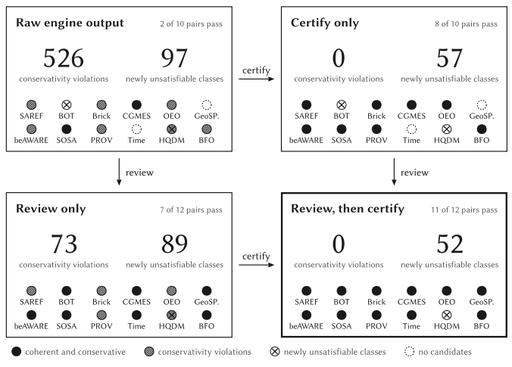
Figure 1 : What review and certification each contribute, summed over the twelve pairs of Table 4. Each panel is one crosswalk condition. The large numbers are the total conservativity violations and the total newly unsatisfiable classes, and each token is one pair. Certification alone clears every violation but keeps BOT’s homonym; review alone removes the homonym but leaves violations on five pairs. Every newly unsatisfiable class in the lower panels comes from HQDM.
Original paper · CC BY 4.0 · Fabio Rovai · From Certified Pairs to a Certified Hub: Reasoner-Checked Crosswalks for the Information Exchange Standard · Original paper figure · Extracted the figure area from page 12 of the original PDF.Why hand-written IES mappings need a formal acceptance test
A national digital twin is meant to be an ecosystem of twins linked by mappings to a common foundation. The paper proposes a test that does define validity, and applies it to every mapping and every hub of mappings around one common ontology.
Building records, energy records and sensor feeds each speak a different language, from construction management to grid models to observation ontologies.
Every time a twin grows, whether through a new asset class or a new domain data source, someone writes and checks new mappings by hand. The research community has strong tools for each half of the problem: matching, SKOS typing, SSSOM serialization and OWL 2 reasoning with HermiT. A recent bulk LogMap run aligned IES with several building ontologies, yet those alignments were neither reviewed nor tested for conservativity.
Certify each correspondence, then reason over the merge
The authors certify each correspondence against both class hierarchies and then test the merge with HermiT. The key move is to keep proposing a correspondence apart from accepting it, so a matcher's confidence is never the final word.
The two criteria, coherence and conservativity, come from earlier logic-based alignment repair work. What the authors add is applying them to IES and the domain ontologies around it, with a SKOS-strength downgrade and human review in front. They expected this to work because the certifier only ever weakens a claim, so it can't invent an equivalence that the hierarchies don't support.
How a crosswalk moves through the pipeline
A crosswalk moves through five stages: align, review, certify, reason, and serialize. The Open Ontologies engine runs in a deterministic configuration with a single confidence threshold and one-to-one cardinality. Each alignment runs three times, and the three candidate sets are compared for equality.
The pipeline doesn't invent correspondences for source classes without a counterpart; it records how many remain unmapped. Each surviving candidate receives a SKOS predicate: exactMatch for an equivalence, broadMatch or narrowMatch for a subsumption, and closeMatch or relatedMatch for weaker links. The rows go into an SSSOM table, one row per correspondence, carrying its subject, object, predicate, and origin.
Certification computes each subject's ancestors in its own ontology and translates them through the crosswalk itself. It compares those translated ancestors with the target's ancestors that some row maps onto. A row is downgraded when the hierarchy supports only a weaker predicate, for example an exactMatch whose object is the more specific concept, which becomes a narrowMatch.
A row is upheld with a coverage gap when some ancestors have no counterpart through the mapping, so the pipeline records which ones were untranslatable. Certification never strengthens a claim, and a closeMatch is never rewritten, because a compatible hierarchy isn't evidence of identity.
The reasoning stage turns the SKOS crosswalk into OWL axioms and runs HermiT over the merge. Exact rows become equivalence bridge axioms, broad and narrow rows become subclass axioms, and close and related rows add no axiom. Algorithm 2 rejects a merge that is inconsistent, and otherwise checks for newly unsatisfiable classes. It also counts conservativity violations, which are subclass relationships the merge entails between named, satisfiable classes of one input that the input alone doesn't entail.
Review and certification fail in different places
Certification on its own removed every conservativity violation in the raw engine crosswalks, and it removed no correspondence. After certification those same crosswalks forced none, on every pair, and the certified crosswalks kept every reviewed correspondence. Certification changes the strength of a correspondence, so it never deletes one; it only moves an equivalence to a weaker predicate.
The engine proposed that the IES top-level Element is the same as BOT's Element, which BOT declares disjoint from bot:Zone. The raw BOT merge made 8 new classes unsatisfiable, three in BOT and five in IES, and certification kept the Element equivalence as an exact match. Only the reviewer's rejection of that homonym, mapping bot:Element to the IES built-entity class instead, brought the count to zero.
Review on its own removed the homonym but left 73 violations on five pairs, because a reviewer can't see that a hierarchy supports only a subsumption.
HQDM is the exception, because it was already incoherent with 39 of its 229 classes unsatisfiable before any alignment. The raw crosswalk added 89 unsatisfiable classes, and the certified crosswalk still left 52 IES classes unsatisfiable. A single exact match from ies:Asset to hqdm:asset, a class HQDM cannot populate, empties ies:Asset and every IES class beneath it.
Neither review nor certification caught that correspondence, so the authors argue that certification should refuse it before assigning any strength.
What happens when pairs become a hub
The reviewer kept the engine's match between the two Floor classes, and certification weakened it to a subsumption rather than removing it. IES has no disjointness axioms, so the IES and Brick merge stays coherent and the error stays invisible there. In the hub, Brick's levels are forced under both, and they become empty.
The repaired hub entails 290 cross-links between targets, and nobody stated any of them. Brick's room types fall under SAREF4BLDG's building space and under BOT's space and zone, and that is the kind of link the hub delivers. The paper treats these links as entailments of the certified crosswalks, not as reviewed correspondences, so a published hub should label them that way.
The core hub fails for a different reason, and no crosswalk can fix it. With all seven targets it is inconsistent, because the Open Energy Ontology and BFO 2020 contradict each other. Leaving out the Open Energy Ontology's 232 named individuals still leaves three classes unsatisfiable, which shows the conflict sits in the axioms. Without the Open Energy Ontology, the core hub is coherent and conservative but entails none of those links.
The full core hub is also the expensive one for the reasoner. The acceptance test can only check what its axioms can contradict, so a zero count is weaker evidence when a target lacks disjointness axioms. The certified HQDM crosswalk shows the same limit, since it equates an IES event with an HQDM event that no axiom forbids. Certification bounds the logical damage a crosswalk can do, but the reviewer still has to decide whether the crosswalk means the right thing.
Where the acceptance test is blind
The HQDM pair shows where certification and the reasoner both fail to see a problem. The raw crosswalk added 89 unsatisfiable classes, 73 in IES and 16 in HQDM. The certified crosswalk still made 52 IES classes unsatisfiable. The cause is one exact match, between ies:Asset and hqdm:asset, a class HQDM cannot populate. That equivalence empties ies:Asset and every IES class beneath it.
Removing that single row leaves no new unsatisfiable class, so the authors treat this as a diagnosis rather than a repaired result.
Certification doesn't have that rule, so it assigns a strength to a mapping that says nothing true. The earlier orientation search, which queries the reasoner during the search, produced a certified 21-axiom IES-to-HQDM bridge. The lighter pipeline of this paper doesn't reproduce that bridge.
Coherence and conservativity don't establish that a crosswalk is correct. The certified HQDM crosswalk holds ies:Event as an exact match for hqdm:event. The earlier work calls this a false friend, because an IES event is a durative happening while an HQDM event is an instantaneous boundary. Neither the hierarchy test nor the reasoner objects, since no axiom in either ontology forbids the identification.
Certification limits the logical damage a crosswalk can do, but judging its meaning stays with the reviewer.
The coherence test can only fire where axioms exist to contradict a merge. For those pairs, only the conservativity half of the test has teeth.
Extending the building vocabulary for retrofit
The authors build a small OWL module that reuses open IES building classes as parents and ranges. On top of those classes, the module adds a retrofit-planning layer with a project, a regional programme, and a measure hierarchy. The layer also includes a recommendation type, so building-performance recommendations can be analysed at scale.
The module adds 14 classes, 7 object properties, and 10 datatype properties, with 123 triples added and no base triples dropped.
That derivation runs under a Horn rule approximation of OWL, so it is sound in one direction only. A new consequence signals a real change of meaning, but finding none doesn't prove the extension conservative in OWL. The authors therefore run HermiT on the merge as an independent check, and HermiT reports no new unsatisfiable class. The planner finds no new consequences over the base vocabulary, and the ABox of 90 individuals is consistent.
Planning takes a median 0.72 s, applying takes 0.046 s, diffing takes 0.039 s, and the HermiT merge check takes 0.33 s.
The module ships with a SHACL data contract for building-performance certificate data. All five violations fall on the two records built to fail, so the contract catches exactly the planted errors. A genuine open certificate, a mid-terrace house with band D and potential B, passes, as does every valid synthetic record.
The extension is version 0.1.0 and deliberately small, so it models the planning layer and leaves assessment alone. The base ontology already covers the assessment process, so the extension doesn't repeat it. For this step the answer is yes, though the building results speak only for this revision of IES 4 and its building extension.
Limits of the certified hub
The building results rest on a copy of IES 4 that doesn't match the 4.3.1 release. So the authors say the building results speak for this revision of IES 4 and its building extension. They don't claim the results carry over to IES 4.3.1 or IES 5.
The coherence test can only fail where the axioms give it something to contradict. No IES profile has a disjointness axiom, and three targets, the IEC grid model, DCAT and SOSA/SSN, carry none either. For those pairs a zero coherence count is weak evidence, so only the conservativity half has teeth.
ifcOWL needs buildingSMART distribution channels, so the built-environment anchor rests on SAREF4BLDG, BOT and Brick instead. HealthDCAT-AP wasn't obtainable as an OWL or SHACL artifact, and ISO 15926 has no openly licensed OWL available. BORO and IDEAS had no openly fetchable reference OWL either, so the authors reach the BORO method through HQDM.
BFO stays thin because its opaque numeric identifiers leave name matching little to work with. Only one broad and one close match survived review, and a deeper IES-to-BFO mapping remains manual community work. Open questions include whether a refusal rule for unsatisfiable targets closes the HQDM gap, which the authors leave to follow-up work.
Paper info
- Authors
- Fabio Rovai
- Venue
- arXiv · Preprint
- First published
- 2026-11-4
- Added
- 2026-11-6
- Updated
- 2026-11-4
- Version
- v1
- arXiv
- 2611.06628
- Category
- cs.AI · cs.DB · cs.LO
- Original paper terms
- CC BY 4.0
- What we show
- Paper info, commentary and permitted figures from the original paper
AI commentary is a separate explanation from the original paper and may contain errors. The original paper and figures follow each source's terms of use and any rights noted separately.
Abstract
A national digital twin was conceived as an ecosystem of twins connected through mappings to a common foundation, but the roadmap that promises to confirm those mappings are valid never says what valid means. We give the test a precise form, coherence and conservativity of the merged ontology, borrowed from logic-based alignment repair, and apply it to the Information Exchange Standard (IES), first pair by pair and then to whole hubs. Crosswalks from IES into thirteen ontologies across seven sector groups, anchored on the building ontologies BOT, Brick, and SAREF4BLDG, pass through separate stages of matching, human review, certification of each SKOS correspondence against the two class hierarchies, and reasoning with HermiT. Pair by pair, the stages catch different failures: certification alone removed all 526 conservativity violations of the raw crosswalks, review alone left 73, and together they made eleven of twelve overlapping pairs coherent and conservative. Pairwise certification does not compose. Merging the three certified building crosswalks into one hub made five Brick classes unsatisfiable, through a homonym between the IES and Brick notions of a floor that only BOT's disjointness axioms expose; rejecting that one row gave a coherent and conservative hub that entails 290 cross-ontology links nobody wrote down. The core hub is inconsistent before any crosswalk is added, because two published standards, the Open Energy Ontology and BFO 2020, contradict each other; with either one left out it is coherent and conservative. A hub, not a pair, is the unit an ecosystem of twins has to certify.
Figures from the paper
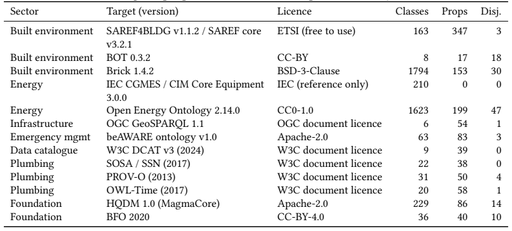
Table 1 : Target ontologies in the crosswalk matrix, with version, licence, size, and number of disjointness axioms. IES-side sizes are given per profile in the text; no IES profile has a disjointness axiom.
Original paper · CC BY 4.0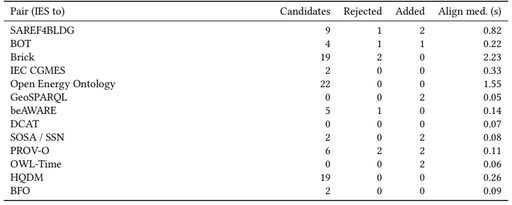
Table 2 : Alignment summary per pair. Threshold, informative scoring, and one-to-one cardinality are fixed across all pairs (Section 3.2). All pairs were deterministic across three runs. Of the seven rejections, five are same-word homonyms, one pairs differently named classes with different meanings (IESSystemStateand BrickSystem_Status), and one maps ontoowl:Thing.
Original paper · CC BY 4.0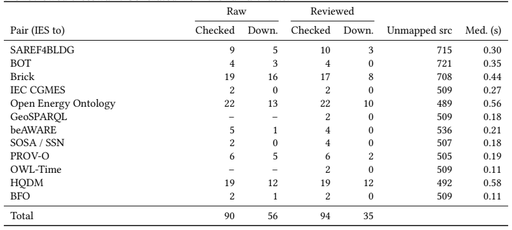
Table 3 : Certification outcomes per pair, on the raw engine crosswalk and on the reviewed crosswalk: correspondences checked and downgraded because the hierarchy did not support the claimed strength. A dash marks a pair with no engine candidates. Unmapped counts source terms of the materialised hierarchy with no row in the reviewed crosswalk; the time is the median of three certification runs on the reviewed crosswalk. Generated from the run artifacts.
Original paper · CC BY 4.0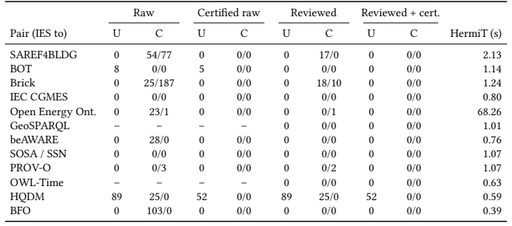
Table 4 : Coherence and conservativity under four crosswalks per pair. U is the number of classes made unsatisfiable by the merge that are satisfiable in their own ontology; C is the number of conservativity violations on the source and target vocabularies (source/target). A dash marks a pair with no engine candidates. On an incoherent merge, C counts only classes that stay satisfiable. DCAT has no class overlap and is omitted. HermiT time is the median of three runs on the reviewed merge.
Original paper · CC BY 4.0
Table 5 : Reasoning over whole hubs. Inputs counts the IES profile and its targets; rows are the reviewed and certified crosswalk rows merged in. Unsat counts classes unsatisfiable in the hub but satisfiable in their own input; violations are conservativity violations summed over all inputs; cross-links are entailed subsumptions between classes of two different targets, neither an IES class. HQDM, already incoherent on its own, is left out of the core hub. Generated from the run artifacts.
Original paper · CC BY 4.0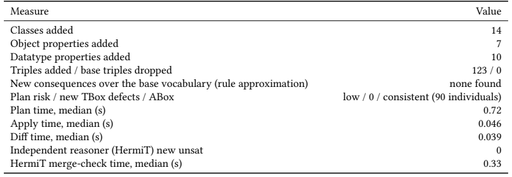
Table 6 : Building-ontology extension for regional retrofit, measured on an Apple M3 Max. Plan, apply, diff, and reasoning times are medians of three runs.
Original paper · CC BY 4.0Quote from the paper
Fabio Rovai (2026). From Certified Pairs to a Certified Hub: Reasoner-Checked Crosswalks for the Information Exchange Standard. arXiv:2611.06628v1. https://arxiv.org/abs/2611.06628v1
BibTeX
@misc{rovai2026from,
  title = {{From Certified Pairs to a Certified Hub: Reasoner-Checked Crosswalks for the Information Exchange Standard}},
  author = {Fabio Rovai},
  year = {2026},
  eprint = {2611.06628},
  archivePrefix = {arXiv},
  url = {https://arxiv.org/abs/2611.06628v1}
}