Paper commentary
Beauty Is Human: When People Love AI-Generated Art, They Think a Human Made It
People who like AI art more often believe a human made it
- Problem Studies that label AI art measure how ratings drop, but nobody tests whether viewers' own beliefs about the maker shape enjoyment. When no label is given, people form their own guess about authorship.
- Method The authors compare the same picture judged by its fans with the same picture judged by everyone else. They hold respondent and picture fixed in a linear probability model, using a public AI Art Turing Test.
- Results Favourites were judged human-made 22.1 percentage points more often than the same pictures judged by others. The association held for AI-generated and human-made favourites alike, and it is an association, not a proven cause.
Where the human premium has been studied
Generative models now make pictures and poems that people struggle to tell apart from human work. When nobody labels a work, viewers form their own belief about who made it. That self-formed belief could shape how much a person enjoys the work, which is the question this section takes up. Most research on AI art instead tells people who made a work and then measures how their ratings drop.
Telling viewers a painting was made by AI lowers their ratings of its beauty, profundity, creativity, and value.
Laboratory studies show that images, music, and haiku believed to be machine-made receive lower ratings. One study randomized whether people rated or categorized first, and lower ratings for machine-made works still appeared.
Four processes could produce the link, and each predicts a different pattern in the data. Belief-driven evaluation holds that a person who suspects a work is human-made enjoys it more. Aesthetic response as evidence holds that people read their own pleasure as a sign of a thinking maker. The other two, shared perceptions and response consistency, could also link the judgments.
Holding the person and the picture fixed
The core move compares the same picture as judged by its fans with the same picture as judged by everyone else. Because every respondent judged the same 50 pictures, each favourite can be checked against both the respondent's own other judgments and the judgments of other people.
The authors fit a linear probability model in which the human-made judgment depends on a favourite indicator, with respondent and picture fixed effects. So the coefficient beta is the favourite gap that remains after those two baselines are removed, and the authors call it an association rather than a cause. The fixed effects remove stable differences between respondents and pictures, but they don't capture one respondent's particular reaction to one picture.
Clustering by respondent treats the 50 pictures as fixed, so the authors also cluster by respondent and picture to include variation across pictures. They also leave out one picture at a time, dropping that picture and the respondents whose favourite it was. They replace the respondent effect with a respondent-by-cluster effect, so a favourite is compared only with that respondent's judgments of pictures in the same cluster.
Because the clusters are built from the same judgments, they are estimated on a random half of respondents and applied to the other half. The subgroup and attitude analyses are secondary and exploratory, and none of the analyses was preregistered.
Favourites are judged human more often
Respondents called their own favourite human-made 76.6% of the time, compared to 54.6% for the same pictures judged by everyone else. The estimate holds the respondent and the picture fixed, so a popular picture judged human by everyone doesn't explain the gap. The fixed-effects estimate is 22.1 pp with an SE of 0.4, and the 95% CI runs from 21.3 to 22.9.
The authors checked the association picture by picture, comparing each picture's fans with everyone else who judged it. Forty-five of these estimates remained significant after Holm correction for 50 tests. A random-effects summary gives a mean of 22.4 pp (SE 1.2), with a between-picture standard deviation of 7.4 pp. Dropping one picture at a time moves the estimate only between 21.5 and 22.5 pp.
Even AI-made Ancient Gate was called human by 22% of its fans against 9% of others.
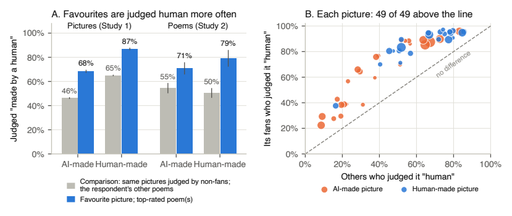
Figure 1 : Favourites are judged human more often. (A) Share of judgments “made by a human” for each respondent’s favourite picture and for the same pictures judged by respondents who did not choose them (Study 1, pictures weighted by their number of fans), and for each respondent’s top-rated poem or poems and their other poems (Study 2), by true source. Bars show 95% intervals from 1,000 bootstrap resamples of respondents (participants for poems). These are raw shares; Table 3 and Table 6 give the fixed-effects estimates. (B) Each dot is one of the 49 pictures with at least 30 fans: the share of its fans (vertical) and of all other respondents (horizontal) who judged it human. Dot size is proportional to the number of fans; the dashed line marks equal shares.
Original paper · CC BY 4.0 · Zihan Chen, Di Zhu, Lei Nico Zheng · Beauty Is Human: When People Love AI-Generated Art, They Think a Human Made It · Original paper figure · Extracted the figure area from page 8 of the original PDF.The association did not depend on the true source of the picture, since the favourite effect was 21.8 pp for AI-made favourites. For human-made favourites the estimate was 22.4 pp, with an SE of 0.5. The difference between the two is 0.5 pp, with a 95% CI of −1.0 to +2.1 when clustered by respondent. The authors read this as showing that the association is not confined to correctly recognized human works.
Favourites were also not a sign of human authorship, since AI-made pictures made up 55.6% of favourites against 52.2% of other picks.
Opinions of AI art and the favourites people name
Opinion of AI art tracks the favourites people choose, but in a narrower way than the favourite association itself. Respondents' opinions were spread across the scale, with 33% negative, 24% neutral and 42% positive among the 10,212 who answered.
The belief gap is sharper for AI-made favourites alone. Two patterns account for that gap, and the first is the choice of pictures. Holding the favourite picture fixed, the most negative respondents were still 8.9 pp (95% CI 4.2 to 13.7) more likely to believe their AI-made favourite was human-made.
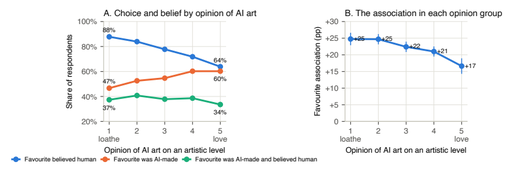
Figure 2 : Choice and belief by opinion of AI art (Study 1). (A) By opinion of AI art, the share of respondents whose favourite was AI-made, whose favourite they believed human-made, and whose favourite was AI-made and believed human-made. (B) The favourite association within each opinion group, with 95% confidence intervals.
Original paper · CC BY 4.0The groups share many favourites, which makes the same-picture comparison more informative.
The share of respondents who named an AI-made favourite they believed human-made is the product of two shares. The probability of an AI-made favourite rose with opinion, while the probability of judging it human fell, so the product stayed roughly flat. Of the favourites these respondents believed human-made, 43% were AI-made, so the pattern is not confined to a small group.
A poetry check with ratings first
Porter and Machery's poetry experiment offers a second medium in which liking is rated before the source judgment. The told-nothing condition is the main sample, with 230 participants and 2,300 judgments. In that condition, participants rated each poem before saying whether a human or an AI program wrote it.
Poems judged human were rated 0.89 points higher than poems judged AI-written, holding the poem fixed. Telling participants that named poets wrote the poems raised their ratings by 0.81 points, against an AI program as author. The gap between the two is 0.08 points, with a 95% CI of −0.16 to 0.31, so the two effects look similar in size. The two gaps are different estimands, so the authors compare them only for scale and don't test them against each other.
In the told-nothing condition, AI-written poems were rated 1.12 points lower than human-written poems. That contrast was 18.5 pp for AI-written poems and 32.7 pp for human-written poems, a difference of 14.3 pp.
What the explanations say
The authors coded each free-text explanation with a keyword list covering six kinds of reasons. Three of the categories point toward what a work expresses: merit, intention and personal liking.
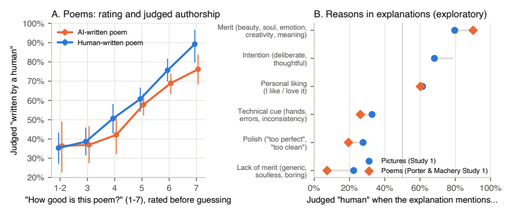
Figure 4 : (A) Share of poems judged “written by a human” by the rating given just before the judgment (Study 2, told- nothing condition), by true source, with 95% intervals from 1,000 bootstrap resamples of participants. (B) Exploratory: share of judgments “human” among explanations matched by each keyword category, for pictures (Study 1) and poems (Study 1 of Porter and Machery). Intention is shown for pictures only; fewer than 30 poem explanations matched it.
Original paper · CC BY 4.0Merit keywords matched only 1.7% of picture explanations and 8.5% of poem explanations. Explanations that matched merit keywords usually accompanied a human judgment, at 80% for pictures. For poems, merit-matched explanations accompanied a human judgment 90% of the time. Explanations with lack-of-merit keywords accompanied a human judgment only 22% of the time for pictures.
Technical-cue keywords matched 13.9% of picture explanations, and those judgments were human 33% of the time. Within the same picture or poem, the merit difference stayed at +20 points for pictures, with a 95% interval of 17 to 22. Fans matched merit keywords in 7.7% of explanations of their own favourite, against 1.6% for other respondents.
The poetry explanations come from a study that asked for judgments and confidence but not ratings.
Limitations
The fixed-effects estimates describe an association, and they don't establish that liking causes a human-made judgment. Respondent and picture fixed effects strip out stable differences between people and pictures, but they leave person-specific responses to particular pictures unmeasured. The 22.1 pp estimate from 9,152 respondents is therefore a contrast within this sample, not a measured effect of liking.
The beauty-is-human inference is one candidate among four, and the data don't exclude any of them. Observational data can't separate these processes completely, and they aren't mutually exclusive. Response consistency predicts the association whichever judgment comes first, and these data can't rule it out. The reminder experiment that would test the inference was not run.
That prediction holds only if the reminder leaves source beliefs, attention, and the reading of the work unchanged. A shared perception that either source can evoke, such as a sense of intention, would also produce the association for AI-made works.
The poetry explanations come from a different study that asked for no ratings. The poetry reanalysis rests on 230 participants and ten poems, a small set of works. The 50 pictures are the set used in the test, and the estimates aren't predictions for pictures selected in other ways.
The survey didn't measure whether people who rate AI art highly still value human authorship. The pattern doesn't show which way the influences between opinions and choices run. The two poetry quantities are different estimands, so the authors compare them only for scale.
Paper info
- Authors
- Zihan Chen, Di Zhu, Lei Nico Zheng
- Venue
- arXiv · Preprint
- First published
- 2026-10-28
- Added
- 2026-11-1
- Updated
- 2026-10-28
- Version
- v1
- arXiv
- 2610.38113
- Category
- cs.HC · cs.AI · cs.CY
- Original paper terms
- CC BY 4.0
- What we show
- Paper info, commentary and permitted figures from the original paper
AI commentary is a separate explanation from the original paper and may contain errors. The original paper and figures follow each source's terms of use and any rights noted separately.
Abstract
Generative AI now produces images and poems that people cannot reliably distinguish from human-made work, so people often judge for themselves who made a work. We examine how these perceived-authorship judgments relate to aesthetic preference. In a public online AI Art Turing Test, 11,123 people judged whether each of 50 pictures (26 AI-generated) was made by a human and were asked for their favourite. Among the 9,152 respondents who judged their favourite, a picture was 22.1 percentage points more likely to be judged human-made when it was the respondent's favourite, holding respondent and picture fixed. The association was similar for AI-generated and human-made favourites, was positive for all 50 pictures, and appeared under every reported detection strategy. Respondents most negative about AI art chose fewer AI-generated favourites (47% against 60% among the most positive) but more often believed them human-made, partly because others also judged those pictures human. As a result, in every opinion group a third to two fifths of respondents named an AI-generated favourite they believed human-made. A reanalysis of a published experiment on AI-generated poetry, in which 230 people rated each poem before judging its authorship, found the same pattern, although the AI poems were rated higher. When provenance is hidden, liking and perceived human authorship travel together, consistent with aesthetic response serving as evidence of a human maker and with beliefs about the maker shaping enjoyment. The findings qualify research on bias against AI art, which typically uses explicit labels, and inform AI disclosure policy.
Quote from the paper
Zihan Chen, Di Zhu, Lei Nico Zheng (2026). Beauty Is Human: When People Love AI-Generated Art, They Think a Human Made It. arXiv:2610.38113v1. https://arxiv.org/abs/2610.38113v1
BibTeX
@misc{chen2026beauty,
  title = {{Beauty Is Human: When People Love AI-Generated Art, They Think a Human Made It}},
  author = {Zihan Chen and Di Zhu and Lei Nico Zheng},
  year = {2026},
  eprint = {2610.38113},
  archivePrefix = {arXiv},
  url = {https://arxiv.org/abs/2610.38113v1}
}