Paper commentary
TacMind: Benchmarking and Modeling Tactile Interaction States for Robotic Manipulation
TacMind benchmarks touch over time and learns a tactile state for robot manipulation
- Problem Existing tactile manipulation benchmarks test precision or recognition in fixed setups, so they say little about how touch helps as an interaction changes over time. Comparing methods fairly is also hard because each lab's hardware and scenes differ.
- Method TacMind-Bench offers 128 simulated tasks across Precise, Recognition, and Dynamic regimes. Tac-LeWM learns a tactile state by predicting future tactile latents rather than reconstructing tactile images, and TacMind-0 uses that prediction to refine candidate actions.
- Results On the Standard suite, TacMind-0 scored 20.7 OOD overall, compared to 11.4 for OpenDM0.5.
Why tactile benchmarks miss touch over time
Recent simulation benchmarks mostly target high-precision manipulation and tactile object recognition. Many contact-rich tasks also use configurations that stay fixed during execution. These setups isolate individual tactile skills, but they say little about how touch contributes as an interaction changes over time. The open questions are how touch supports precise control, resolves visual ambiguity, and adapts to changing interactions.
They also leave unclear what complementary cues touch gives when visual observations or object properties vary.
That makes fair comparisons between methods difficult, because each lab's hardware and scene differ.
Learning a useful tactile state is harder, because tactile observations are history-dependent. Similar instantaneous measurements can arise from different interaction trajectories, so a single reading is ambiguous. The authors therefore require a tactile state to be semantically informative, temporally grounded, and action-relevant. This joint-embedding objective keeps the current state predictive of later interaction dynamics without requiring reconstruction of ambiguous sensory details.
A benchmark organized by the role of touch
TacMind-Bench is organized by the role that touch plays in a task, not by object category or manipulation primitive. The benchmark comprises 128 simulated tasks, split into a Standard suite of 28 tasks and an Extra suite of 100 tasks. The Extra suite adds greater diversity in textures and language descriptions, along with tasks involving new objects.
The Precise regime tests insertion and mating, where small contact errors decide task success. Precise tasks also add pickup, transport, and contact establishment, so the evaluation covers a broader manipulation process than terminal contact alone. The Recognition regime tests objects whose pose, texture, or boundary geometry is occluded or visually ambiguous.
Some tactile-search tasks require the robot to accumulate evidence across several contacts before it identifies the target. Dynamic tasks keep the precision demand and add externally driven motion of the source or the target. The Dynamic regime has three settings: moving-target alignment, static-source to moving-target, and moving-source to static-target.
Where possible, each dynamic task is paired with a static counterpart that uses the same object, target, and primitive.
Perturbations form a separate axis, orthogonal to the three regimes, with 12 settings that vary illumination, camera viewpoint, and object scale. Illumination and camera changes alter the visual observations but leave the tactile sensing conditions unchanged. The authors vary object size because moderate scale changes look subtle to the eye while substantially altering the contact geometry.
That property makes scale a direct test of whether touch can regulate grasp force and contact.
Predicting future touch instead of reconstructing it
Tac-LeWM learns its tactile state by predicting the latent of a future tactile chunk, not the future tactile images themselves. The model compares predicted and target embeddings in a latent space, so it never has to reconstruct the tactile images. The authors argue this keeps the state focused on what predicts the interaction, instead of on sensor details that may be ambiguous.
Future touch serves as supervision for the current tactile representation, which is the paper's stated difference from explicit rollout or observation forecasting.
The predictor takes in the current tactile state, the intervening actions, and an auxiliary visual feature. The future targets come from the same tactile encoder, so Tac-LeWM doesn't need a separate target network. The visual feature comes from a frozen DINOv3 encoder that helps disambiguate future tactile outcomes. The encoder and predictor are optimized jointly, which lets the predicted future embeddings shape the tactile state directly.
The prediction loss averages the squared distance between predicted and target embeddings over the prediction horizon C. The offset Δ sets how far ahead the target chunk starts, and C sets how many future embeddings are matched. To reduce representation collapse, the authors add a SIGReg term weighted by λ, following LeWM. The complete Tac-LeWM objective is the prediction loss plus λ times SIGReg applied to the tactile embeddings Z^τ.
Both the tactile encoder Eψ and the predictor Pϕ are optimized under this single objective.
The learned state then feeds the policy, which generates an initial action chunk from the visual, language, and tactile conditioning. The same predictor is reused later, so TacMind-0 can predict the tactile latent of its own candidate action. That predicted latent is the signal used for predictive tactile reflection, which the initial policy alone doesn't condition on.
How the tactile encoder reads deformation and history
The encoder starts by overlaying each finger's marker deformation onto its tactile RGB image. The left and right fingertip observations are then arranged into one mosaic and patchified into encoder tokens. Shear, normal loading, and partial slip produce marker-displacement fields whose directions vary across the contact region. Because those directions don't follow the image axes, the authors project local coordinates along eight directions.
The projection is u_k(x, y) = x cos ϕ_k + y sin ϕ_k, with ϕ_k = kπ/8 and k in {0, ..., 7}.
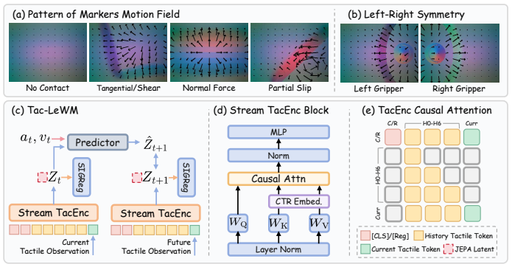
Figure 3 :Overview of Tac-LeWM. (a–b)Marker-motion directions vary with contact conditions, while the left and right fingertip sensors have mirrored spatial layouts. These properties motivate tactile-specific spatial encoding that accounts for directional deformation and cross-fingertip symmetry.(c)Tac-LeWM learns a pre- dictive tactile state by combining a streaming tactile encoder with an action-conditioned latent predictor trained to predict future tactile embeddings.(d)The streaming encoder reuses historical features through cached keys and values, enabling efficient online updates.(e)Causal attention integrates preceding tactile context while preventing access to future observations.
Original paper · CC BY 4.0 · Jiaxin Shi, Zibin Wu, Yichi Zhang, Jianghua Duan, Siyu Zhu, Weihao Yuan · TacMind: Benchmarking and Modeling Tactile Interaction States for Robotic Manipulation · Original paper figure · Extracted the figure area from page 5 of the original PDF.The right sensor is mounted mirrored, so its column index is flipped into a shared canonical frame. The flip x_can = W_cell − 1 − x_raw changes only the positional coordinates and leaves the input image unchanged. A separate learnable finger embedding keeps the sensor identity of each token, since the coordinates alone don't carry it. The projected coordinates and the temporal index enter the encoder as rotary transformations of queries and keys.
For two tokens separated by (Δx, Δy), the rotary phase difference depends on Δu_k, so each direction gives a relative-position cue.
History matters because similar instantaneous contact patterns can come from different preceding interactions. The encoder computes Z^τ_t = E_ψ(τ_t; KV<t), attending to cached keys and values from earlier observations. Current tokens attend to present and past observations, while future observations are excluded from the online state. The global CLS token of the encoder output serves as the interaction state, written z^τ_t = CLS(Z^τ_t).
The predictor and the action policy both consume this latent state z^τ_t.
The state updates incrementally, so the complete history isn't encoded again at each step. The authors describe the KV cache as an efficient implementation of temporal context. The future embeddings used as targets come from the same tactile encoder, not from a separate target network.
Conditioning actions on the tactile state and refining them by reflection
Tac-LeWM supplies the streaming tactile state, and the policy forms the conditioning from the image, the instruction, and that state. Temporal aggregation of the tactile history stays inside the Tac-LeWM encoder, so the action expert only sees the projected tokens.
The action expert is trained with the standard conditional flow-matching loss, which regresses the velocity from noise toward the demonstrated chunk. The authors note that this proposal uses only tactile evidence gathered up to the current time, and it never conditions on the tactile state predicted under its own candidate action.
Given the initial proposal, Tac-LeWM predicts the future tactile latent chunk under that candidate action. The predicted chunk is pooled into one vector, and that vector serves as an extra action-conditioning signal rather than being decoded into tactile images. Refinement uses flow reversal: the base flow is run backward from the initial action to obtain a latent noise, with the original conditioning.
The predicted tactile feature is then injected into the flow-matching layers through adaptive normalization, and the forward pass produces the refined action.
Because of this, the procedure changes the conditions under which the action is generated instead of rebuilding the same proposal. The two tactile signals have distinct roles: the observed state summarizes the interaction history and conditions the first proposal. The predicted state reflects the candidate action and conditions the refinement, so the policy sees both what touch has recorded and what the proposed motion would likely feel.
Two-stage training and online inference of TacMind-0
Tac-LeWM is pretrained with its tactile encoder and predictor optimized jointly, and action representation regularization is applied during pretraining. The training datasets differ in their action representations, so the authors don't enforce a unified preprocessing pipeline across them. A shared action encoder then extracts the action features that condition the predictor.
In the second stage, TacMind-0 freezes the fine-tuned Tac-LeWM encoder and uses it to provide the tactile state z_τt. The action expert is then optimized with the flow-matching loss L_FM. Next, the tactile encoder, the VLM backbone, and the action expert are frozen. Only the Tac-LeWM predictor and the AdaRMSNorm layer stay trainable, using the action loss and the Tac-LeWM training loss.
At inference, TacMind-0 needs neither future nor history tactile observations as inputs. The tactile encoder incrementally updates its KV cache as each new tactile observation arrives, so it doesn't re-encode the full history. The policy first generates the initial action chunk A^(0)_t conditioned on the image, the instruction, and z_τt. When tactile reflection is enabled, Tac-LeWM predicts the future tactile latent from A^(0)_t.
A second conditioned flow pass then produces the refined action A^(*)_t.
TacMind-0 is initialized from the pretrained OpenDM0.5 model, which uses Gemma 3 as its VLM backbone. Its pretraining procedure details are given in the Appendix, so this section doesn't repeat them.
Standard suite results against baselines
The evaluation runs every model on the 28 Standard tasks with the GelSight Mini sensor. Each task gets one in-domain setting and 12 out-of-domain settings, with 20 episodes per setting. Each model trains on 100 demonstrations per task, with an action chunk size of 32 on eight NVIDIA A100 GPUs. Single-task specialists sit apart from the multi-task generalists, since one policy per task avoids cross-task interference.
Among the generalists, TacMind-0 scores 40.0 on Precision in-domain, 50.0 on Recognition, and 10.5 on Dynamic. On Precision, that is above the 30.0 of the single-task ACT+Tactile specialist. On Recognition in-domain, ACT+Tactile reaches 69.1, well above the 50.0 of TacMind-0. On Dynamic in-domain, ACT+Tactile also leads, at 15.9 against 10.5 for TacMind-0.
The authors state that dynamic interaction remains challenging, which the Dynamic numbers reflect.
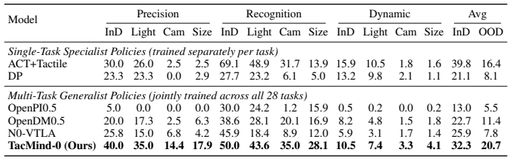
Table 2 :Performance on TacMind-Bench Standard (GelSight Mini).OOD performance is categorized into lighting, camera, and size perturbations.
Original paper · CC BY 4.0Under out-of-domain perturbations, TacMind-0 averages 20.7, compared to 16.4 for ACT+Tactile and 11.4 for OpenDM0.5. Among the generalists, that average is above 7.8 for N0-VTLA and 5.5 for OpenPI0.5. On the Precision light column, TacMind-0 reaches 35.0 against 26.0 for ACT+Tactile. The paper says TacMind-0 surpasses ACT+Tactile on the Precise regime and on overall OOD robustness.
Dynamic OOD stays low for TacMind-0, at 7.4 on the light perturbation.
Table 3 shows the OOD average rising from 11.4 to 15.9 when tactile features are added to the base model. Adding predictive tactile reflection then lifts the OOD average further, to 20.7. The reflection step gives the largest OOD jump on the Precise regime, from 12.4 to 22.4.
Separating streaming tactile state from predictive reflection
Table 3 splits TacMind-0 into three rows: neither addition, streaming tactile features, and the full model with tactile reflection. Its columns report Precise, Recognition and Dynamic success, each in-domain (InD) and out-of-domain (OOD), plus an overall average. Each task is scored over one in-domain setting and 12 OOD settings of 20 episodes each, across the 28 Standard tasks.
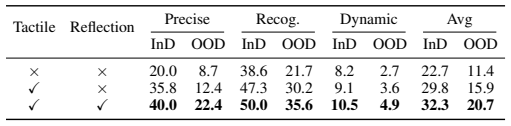
Table 3 :Ablation study of TacMind-0.We evaluate the contributions of streaming tactile features and predic- tive tactile reflection across different evaluation regimes and distributions.
Original paper · CC BY 4.0Without either addition, TacMind-0 scores 20.0 on Precise InD and 11.4 on the overall OOD average. Adding streaming tactile features lifts Precise InD from 20.0 to 35.8 and the overall OOD average from 11.4 to 15.9. The authors say streaming features substantially improve both Precise and Recognition, which they tie to modeling interaction states explicitly.
On Recognition InD, streaming features move the score from 38.6 to 47.3. Dynamic InD moves only from 8.2 to 9.1 in the same step.
Adding predictive tactile reflection to the streaming variant raises the overall OOD average from 15.9 to 20.7. On Precise OOD, reflection moves the score from 12.4 to 22.4. On Recognition InD, reflection moves the score from 47.3 to 50.0, and on Dynamic InD from 9.1 to 10.5. The reflection step passes the tactile latent predicted under the initial action proposal into a second flow pass.
The authors describe these OOD gains from reflection as improved robustness and generalization.
Dynamic OOD also rises from 3.6 to 4.9 with reflection under the same perturbations. The table doesn't include reflection applied to the variant with neither addition, so its separate effect is unmeasured.
Checking the tactile representation and streaming cost
Pretraining makes the tactile representation sharper at reconstructing the current tactile frame. Tac-LeWM's current-frame reconstruction PSNR rises from 31.83 dB to 34.42 dB, and SSIM rises from 0.875 to 0.914. The linear probes are the second check, and they test whether robot and tactile quantities can be decoded from the frozen state.
Pearson correlations reach 0.8981 for proprioception, 0.9053 for gripper state, 0.8976 for actions, and 0.7968 for tactile pad energy.
The memory experiment asks whether future tactile prediction depends on what the history contains, not just on how long it is. Increasing the cache length from k=1 to k=8 raises future tactile reconstruction PSNR from 27.34 dB to 28.98 dB. Shuffling the memory drops that PSNR to 27.90 dB, while polluting the memory drops it to 24.18 dB. The authors take this as evidence that prediction depends on both the temporal ordering and the relevance of past context.
Streaming targets the cost of keeping this history during online control. Instead of re-encoding the full history at every step, the encoder reuses cached historical features. At batch size 1, encoder inference latency falls from 18.36 ms to 10.33 ms. At batch size 256, it falls from 129.79 ms to 29.74 ms. These timings cover the tactile encoder alone, so they don't show the total cost of the reflection pass.
Limitations of the evidence
The benchmark is built in simulation, and the authors record no human-subject data. Tac-LeWM is pretrained on simulation and real-world demonstrations, but the reported policy results come from simulated tasks. Transfer of the policy to real robots isn't evaluated in this paper.
The authors state that dynamic interaction remains challenging, which the paper's conclusion says in its own words. On the Dynamic regime, TacMind-0 reaches 10.5 in-domain, compared to 15.9 for ACT+Tactile and 13.2 for Diffusion Policy. Dynamic tasks therefore remain the weakest regime even for the best generalist model in Table 2.
The experiments use only the GelSight Mini sensor, so the Daimon and DIGIT sensors aren't evaluated in the reported tables. Only the 28 Standard tasks are evaluated, so the 100 Extra tasks don't appear in the reported results. Each task runs 20 episodes per condition, and the tables report single values without variance.
Paper info
- Authors
- Jiaxin Shi, Zibin Wu, Yichi Zhang, Jianghua Duan, Siyu Zhu, Weihao Yuan
- Venue
- arXiv · Preprint
- First published
- 2026-10-30
- Added
- 2026-11-7
- Updated
- 2026-10-30
- Version
- v1
- arXiv
- 2611.00455
- Category
- cs.RO
- Original paper terms
- CC BY 4.0
- What we show
- Paper info, commentary and permitted figures from the original paper
AI commentary is a separate explanation from the original paper and may contain errors. The original paper and figures follow each source's terms of use and any rights noted separately.
Abstract
Tactile sensing provides robots with direct observations of contact physics, local geometry, and interaction dynamics, making it a vital source of feedback for contact-rich manipulation. However, existing tactile manipulation studies are often developed and evaluated within specific task settings, making it difficult to systematically compare how tactile information contributes under different interaction conditions. In this work, we develop a benchmark in simulation comprising 128 tasks organized around three complementary evaluation regimes: Precise, Recognition, and Dynamic. The benchmark further includes controlled static and dynamic task variants and 12 perturbation settings for evaluating robustness under changes in visual and physical conditions. These settings motivate studying tactile information as a temporally evolving interaction representation rather than only as an instantaneous observation. We therefore propose an action-conditioned latent predictive world model that integrates tactile history and learns a tactile state through prediction of future tactile latents. Building on this representation, we design a model that conditions action generation on the learned tactile state and uses predicted future tactile information to refine candidate actions through predictive tactile reflection. Experiments on the proposed benchmark show consistent gains from incorporating tactile information across the evaluated regimes. Project Page: https://tacmind-bench.github.io/
Quote from the paper
Jiaxin Shi, Zibin Wu, Yichi Zhang, Jianghua Duan, Siyu Zhu, Weihao Yuan (2026). TacMind: Benchmarking and Modeling Tactile Interaction States for Robotic Manipulation. arXiv:2611.00455v1. https://arxiv.org/abs/2611.00455v1
BibTeX
@misc{shi2026tacmind,
  title = {{TacMind: Benchmarking and Modeling Tactile Interaction States for Robotic Manipulation}},
  author = {Jiaxin Shi and Zibin Wu and Yichi Zhang and Jianghua Duan and Siyu Zhu and Weihao Yuan},
  year = {2026},
  eprint = {2611.00455},
  archivePrefix = {arXiv},
  url = {https://arxiv.org/abs/2611.00455v1}
}