Paper commentary
Do Multimodal Models Decide Consistently on Equivalent Optical Spectra?
Multimodal models give inconsistent decisions on the same optical spectrum in different formats
- Problem Average accuracy hides whether a model's decision survives a change of spectrum format. Models also rarely say undetermined when the data needed for an answer has been removed.
- Method Fixed arrays are shown in varied formats, and training adds answerable truncations.
- Results Changing only the representation moves accuracy by up to 41 percentage points within one model. Answerable truncations in training removed the shortcut in all six seeds.
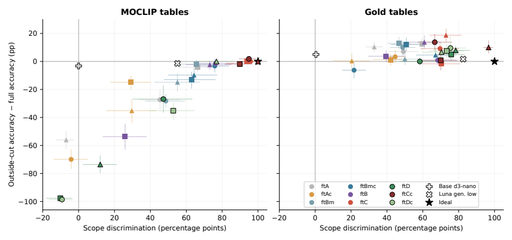
Figure 4 :Scope behavior of every LoRA seed on tables, with 95% instance-bootstrap intervals. Circles, squares and triangles mark seeds 0, 1 and 2; outlined markers are the supplementary arms (ftD, ftCc, ftDc). Open markers show unadapted d3-nano and low-reasoning Luna; the star is the ideal(100, 0).
Original paper · CC BY 4.0 · Ziyuan Wang, Genliang Zhu, Xiaobo Chen · Do Multimodal Models Decide Consistently on Equivalent Optical Spectra? · Original paper figure · Extracted the figure area from page 11 of the original PDF.Why one spectrum can get two answers
A spectrum can reach a model as a table in nanometers, in micrometers, in scientific notation, or as a plot in photon energy. The paper renders each core variant as four tables and two plots, all built from the same underlying samples. A respectable average can hide answers that flip with the format, so average accuracy alone won't settle the question.
The gap is largest on photon-energy tables and plots, which is where representation checks matter most. Equivalent forms still differ for a reader, since eV rows are sorted by increasing energy and the spacing is nonuniform. Spacing runs from 0.060 eV between 450 and 460 nm to 0.024 eV between 720 and 730 nm.
Missing data add a second failure mode that a format check can't catch. A partial spectrum can hide its lowest point, so the lowest visible value may differ from the minimum in the queried range. Removing the segment that holds the relevant extremum makes the question unanswerable, so the right reply is that it can't be determined. Unadapted models rarely give that reply, even when the required evidence is gone.
Native decision models return a choice with probabilities, so a valid output format can look correct while the physical meaning is wrong. The authors test both issues on measured spectra, with labels computed directly from the arrays.
How paired tasks keep each answer key fixed
The authors keep one set of arrays and one answer key per question, and they change only how the spectrum is shown. Energy values come from E[eV] = 1239.841984/λ[nm], so every eV view is computed from the same wavelength samples. Transmission and absorbance are response ratios, so moving the horizontal axis to energy needs no spectral-density correction.
The displayed ranges and units change with the representation, but the answer key stays the same. The authors note that visual and numerical readability can differ even though the samples and answers are equivalent.
For the scope sets, each question states a query interval Q, and each spectrum appears in three forms. The full view is paired with a view that removes samples outside Q, which leaves the answer available. The third view removes the segment inside Q that holds the relevant extremum, so the answer is labeled “cannot be determined”. MOCLIP uses query intervals of 450 to 685 or 605 to 730 nm, and gold uses 450 to 650 or 490 to 800 nm.
Gold has 20 threshold, 16 compare, and 18 sufficiency instances, and only sufficiency questions offer “cannot be determined”.
How representation changes the answers
Within wavelength coordinates, changing only the number format moves most models by small amounts. Most of these format effects stay within plus or minus 5 points. Energy coordinates produce much larger changes, because the eV tables reverse the row order and use uneven spacing. On gold, eV tables lower accuracy by 41 points for Jev, 21 points for Luna gen.
none, 20 points for d3-nano, and 13 points for Luna Decisions.
Plots don't affect the models in the same way. Luna Decisions goes the other way, gaining 15 points on MOCLIP nm plots and 9 points on gold nm plots.
With the eV evidence held fixed, photon-energy wording helps some model and task pairs and hurts others. Jev gains 48 points on gold compare tables and 50 points on gold threshold tables under photon-energy wording. Low-reasoning Luna drops from 100% to 90% on gold threshold tables, so matching the wording to the axis doesn't help every model or task.
The authors read this as a systematic reversal of direction, and on MOCLIP eV tables Jev sits at chance with 50% accuracy. Models also favor the first spectrum, and Luna Decisions chooses it 82% of the time on MOCLIP tables. Agreement across representations largely follows accuracy, so the authors use paired accuracy differences as their main measure.
Abstention on missing evidence
On the main MOCLIP sufficiency set, d3-nano, Jev and Luna Decisions don't answer undetermined in any representation. Its abstention falls to 0% on eV tables and to 0 to 19% on plots, with 16 instances in each cell.
The scope sets separate abstention on missing evidence from abstention on any truncated input. Each question states an interval Q, and each spectrum appears in full, with outside samples removed, or with the inside segment removed. The MOCLIP scope set uses query intervals of 450 to 685 or 605 to 730 nm, with 18 instances per cut type. Dscope compares the undetermined rate after inside cuts with the rate after outside cuts, and its ideal value is +100.
Plot discrimination reaches at most +16 for these configurations. On gold, Jev, Luna Decisions and Luna gen. none choose undetermined on only 0 to 5% of middle-gap requests. After an inside cut, the wrong answer often names the band holding the visible extremum, in 54 to 81% of d3-nano responses and 31 to 54% of Jev responses.
The same-backbone Qwen3.5-2B base model never abstains in the scope sets, so its Dscope is 0 in every representation. Its option letters carry 97 to 99% of the next-token probability, so the missing abstention doesn't come from a malformed readout.
How the LoRA adapter is trained
Only d3-nano gets adapted, and the authors attach LoRA modules to its language-model projection layers. Each module uses rank 16, scale 32 and dropout 0.05. The vision tower, the backbone weights, the readout and the temperature stay frozen, so only the low-rank modules change. Training minimizes cross-entropy over the candidate readout, using AdamW at a learning rate of 10−4 with no weight decay.
Gradients accumulate over eight examples and are clipped at 1.0 before each update.
The training data reuses the evaluation templates, and the authors keep every test structure out of it. It contains neither plots nor specification tasks, so the adapter never sees those formats during training. A hash of the instance identifier sends about 10% of instances to development. Table 8 lists the arms, and ftC adds 72 answerable and unanswerable scope instances to the ftB data.
That gives ftC 3,736 training requests and 456 development requests. ftB uses 2,956 training requests from four tables, while ftA uses only 632 nm-table requests.
Some structures are reused when the authors add answerable truncations or original-task examples. So the development accuracy of these arms isn't measured on fully separate structures.
What adaptation fixes and what it doesn't
Training length changes what ftA learns on the nm table comparisons. After two epochs, ftA stays at chance on compare, with development accuracy of 0.675–0.700. Selected-epoch training in ftAc raised development accuracy to 0.963–1.000 and nm compare accuracy to 85–100%. Representation coverage limits transfer, because ftAc reaches only 41–51% on eV tables against 82–99% on µm tables.
Several seeds still lose 54–70 points on outside cuts, which means they abstain on any truncated input. Adding answerable truncations in ftC gives MOCLIP table discrimination of +96, +94 and +90 across three seeds. Outside-cut accuracy changes are 0, 0 and −1 for those seeds, so the gain doesn't come from blanket abstention. With selected-epoch training, ftCc keeps MOCLIP table discrimination at +95, +90 and +100.
Plot comparison stays at 43–66% for nearly every adapted model, against 52% for the base model. Converting gold absorbance to transmission doesn't recover that transfer.
Limits of the evidence
The evidence rests on narrow optical data, so the results don't reach beyond the spectra tested. MOCLIP's 10 nm sampling doesn't support claims about narrow resonances. The authors selected spectra with clear extrema, which keeps the labels clean but narrows the questions.
The task templates are fixed, and each scope set uses two query intervals whose boundaries are partly tied to answer bands. Only sufficiency tasks offer an abstention option, so abstention can't be compared across the other task types. Two epochs leave ftC seed 1 under-trained, which is why its results are read with care.
The comparisons are exploratory, and the authors didn't correct for multiple testing. Plot comparison stayed at 43–66% for nearly every adapted model, against 52% for the base model, so transfer to plots is limited. The findings apply only to the tested templates, representations and data, and they don't establish a general physical rule.
Answerable truncations removed the shortcut in every training seed. Extra original-task data did so in only one of six seeds. The authors can't verify whether the service routes share the same internal model. They didn't evaluate the native OpenAI decision endpoint, and API models may change over time.
Paper info
- Authors
- Ziyuan Wang, Genliang Zhu, Xiaobo Chen
- Venue
- arXiv · Preprint
- First published
- 2026-10-30
- Added
- 2026-11-7
- Updated
- 2026-10-30
- Version
- v1
- arXiv
- 2611.00428
- Category
- cs.LG · cs.CL · physics.optics
- Original paper terms
- CC BY 4.0
- What we show
- Paper info, commentary and permitted figures from the original paper
AI commentary is a separate explanation from the original paper and may contain errors. The original paper and figures follow each source's terms of use and any rights noted separately.
Abstract
A spectrum can be given to a model as a table in nanometers or as a plot in photon energy, and the decision should not depend on which one it sees. When the data needed for an answer are missing, the model should say so. We test representation invariance and abstention on measured optical spectra of silicon metasurfaces (MOCLIP) and gold nanoparticles, with labels computed from the data. Each spectrum is shown as four tables (nm, $μ$m, scientific notation, eV) and two plots (nm, eV), and partial spectra remove data inside or outside the queried range. We evaluate the decision models d3-nano and Jev 1.13, three GPT-6 Luna configurations and the Qwen3.5-2B base model. Changing only the representation moves accuracy by up to 41 percentage points within one model, mostly on photon-energy tables and plots. With the same evidence, asking in photon energy instead of wavelength helps some model-view pairs by 16-50 points and hurts others by up to 25. When the relevant extremum is removed, unadapted models rarely answer "undetermined". LoRA fine-tuning of d3-nano improves comparisons on the trained table formats, but much of its gain on unanswerable questions comes from a shortcut: it abstains whenever the input is truncated. Training with answerable truncations avoids the shortcut in all six seeds, with a 90-100 point gap between abstention after inside and outside cuts on held-out structures; with the same amount of extra original-task data, five of six seeds keep the shortcut. On gold spectra the two training sets perform similarly. Multimodal language models used for scientific decisions should be tested on equivalent representations and on missing evidence, not only on average accuracy. We release the tasks, per-response results and analysis code.
Figures from the paper
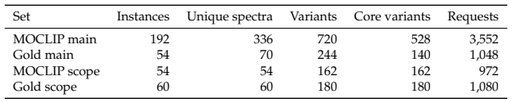
Table 1 :Evaluation sets. Core variants exist in all six representations; energy-worded probes exist only as eV tables and eV plots. Request counts are for a model that supports images.
Original paper · CC BY 4.0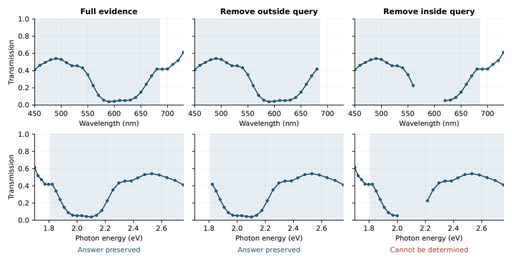
Figure 1 :One MOCLIP scope instance in wavelength and energy coordinates. Shading marks the queried interval and is added for illustration only; model inputs state the interval in the question.
Original paper · CC BY 4.0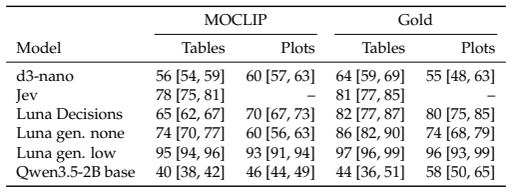
Table 2 :Core-variant accuracy (%, 95% instance-bootstrap intervals). MOCLIP has 528 core variants and gold 140. Jev has no image input. The Qwen3.5-2B base row comes from the supplementary batch.
Original paper · CC BY 4.0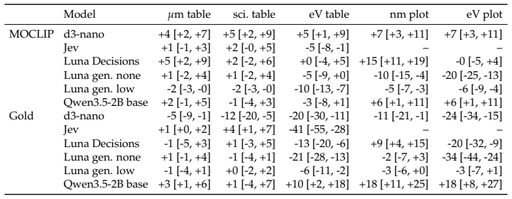
Table 3 :Paired accuracy difference from the nm table on the same core variants (percentage points, 95% intervals).
Original paper · CC BY 4.0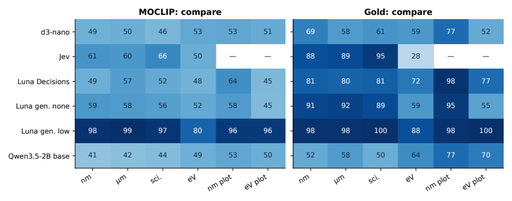
Figure 2 :Accuracy (%) on wavelength-worded compare variants in each representation. MOCLIP cells contain 192 requests from 48 instances; gold cells 64 requests from 16 instances. Compare has two options, so 50% is chance. Jev has no image input; the Qwen3.5-2B base row comes from the supplementary batch.
Original paper · CC BY 4.0
Table 5 :Wording effect on identical eV evidence: accuracy with wavelength wording → photon-energy wording (%), and the paired difference in points with 95% interval. Gold has 16 compare and 20 threshold instances.
Original paper · CC BY 4.0
Table 6 :Row-order control on eV tables (supplementary batch): ascending energy → descending energy (same row order as nm tables), with paired differences and 95% intervals. Compare and middle-gap columns are accuracy and abstention rate (%); scope columns are Dscope (points) on eV tables. Gold compare pools both wordings. Middle-gap cells contain 16 instances.
Original paper · CC BY 4.0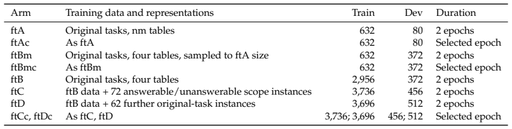
Table 8 :LoRA arms (three seeds each). Train/Dev count rendered requests. Selected-epoch arms run at most nine epochs, keep the best development accuracy (loss breaks ties) and stop after two epochs without improvement.
Original paper · CC BY 4.0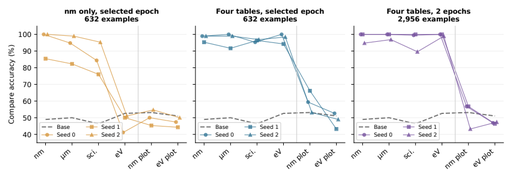
Figure 3 :MOCLIP compare accuracy (core variants) after adaptation; markers identify seeds and dashed curves show the unadapted model.
Original paper · CC BY 4.0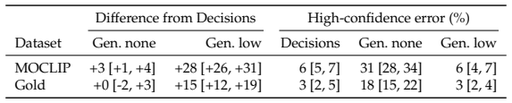
Table 9 :Matched Luna configurations on core requests: accuracy difference from Luna Decisions (points) and high-confidence error fraction (% of all requests with confidence≥0.9 and a wrong answer), with 95% intervals.
Original paper · CC BY 4.0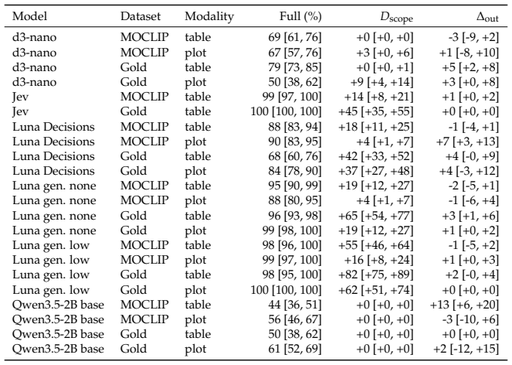
Table 10 :Scope metrics with 95% intervals for unadapted models.
Original paper · CC BY 4.0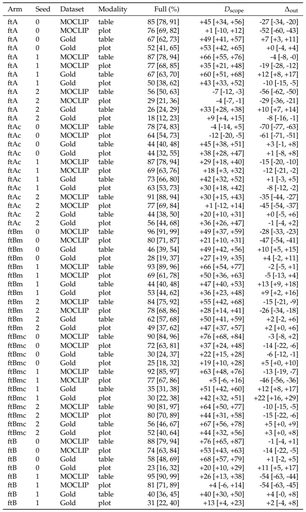
Table 12 :Per-seed scope metrics with 95% instance-bootstrap intervals.
Original paper · CC BY 4.0Quote from the paper
Ziyuan Wang, Genliang Zhu, Xiaobo Chen (2026). Do Multimodal Models Decide Consistently on Equivalent Optical Spectra?. arXiv:2611.00428v1. https://arxiv.org/abs/2611.00428v1
BibTeX
@misc{wang2026multimodal,
  title = {{Do Multimodal Models Decide Consistently on Equivalent Optical Spectra?}},
  author = {Ziyuan Wang and Genliang Zhu and Xiaobo Chen},
  year = {2026},
  eprint = {2611.00428},
  archivePrefix = {arXiv},
  url = {https://arxiv.org/abs/2611.00428v1}
}