Paper commentary
TAP-Out: Tracking Any Point in 360° via Outpainting
TAP-Out tracks points out of view by outpainting a 360-degree scene
- Problem Point trackers lose a point once it leaves the camera's field of view, because they only work on the image plane. Tracking it needs reasoning about unseen scene motion, which current trackers do not do.
- Method TAP-Out outpaints the full 360-degree video with Argus and fills in the missing regions. It then segments the target with SAM2 and renders object-centred crops for CoTracker3 to follow.
- Results On TAPVid360, TAP-Out scores 0.332 out-of-frame accuracy, against 0.106 for CoTracker360.
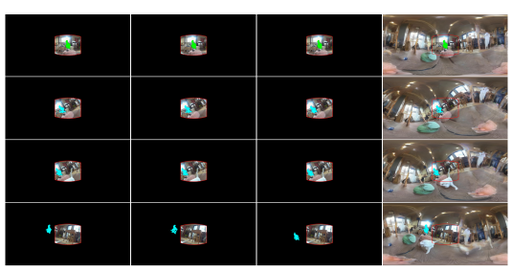
Figure 4 : Further qualitative comparison on TAPVid360 with significant camera motion.
Original paper · CC BY 4.0 · Finlay G. C. Hudson, James A. D. Gardner, William A. P. Smith · TAP-Out: Tracking Any Point in 360° via Outpainting · Original paper figure · Extracted the figure area from page 10 of the original PDF.Why 2D trackers lose points out of view
Point trackers that work on the image plane have no coordinate for a point once it leaves the camera's frustum. Yet a tracker operating in a 3D world should still follow such a point, which is the default behaviour it needs. The TAPVid-360 benchmark asks for exactly that, scoring the egocentric 3D direction to a point even when it leaves the FoV.
Because the score is a direction, the tracker must output a unit-sphere direction rather than a pixel coordinate.
The CoTracker360 baseline adapts CoTracker3 to regress unit-sphere direction vectors. Despite this specialisation, it performs poorly on out-of-view points. The authors trace this to one model being asked to solve high-frequency local correspondence for visible points and high-level world-model inference for hidden points. The authors therefore propose decoupling the two problems, keeping a standard 2D tracker for in-view points.
The authors ask only for a direction on the sphere, not the distance to the point. Depth is especially ambiguous outside the frustum, because no visual evidence constrains the estimate there. They don't need to solve how far away the object is to give that answer.
Every OOV method must extrapolate beyond observed data, and CoTracker360 does so without any explicit visual justification. TAP-Out makes this extrapolation explicit by generating a complete visual scene consistent with the observed video. The method switches to this scene completion path when objects move out of view, so the target stays visible to the tracker.
Outpainting as an explicit world-model prior
TAP-Out handles out-of-view points by recasting the problem as scene completion, so a generative video model supplies the unseen part of the scene. CoTracker360 must predict directions for unseen points without any visual justification. TAP-Out instead generates a complete visual scene that shows why each point is believed to lie in a given direction.
The authors expect even an imperfect hallucinated scene to constrain extrapolation better than direct coordinate regression.
The pipeline first estimates camera poses for each frame, using VGGT when ground-truth cameras are unavailable. Each perspective frame is mapped onto a shared equirectangular canvas in a world frame aligned with the first camera, and translations are discarded. Argus completes the masked panorama, and a composite keeps the observed pixels so that high-frequency input detail is preserved.
SAM2 tracks the query object through the panoramic video, and the centroid of each mask gives a 3D direction. A virtual camera rotates to align its optical axis with that direction, producing object-centred perspective frames where the target stays visible. CoTracker3 tracks the query in these crops, and the tracks are converted back to direction vectors in the original camera frame.
Each stage is a separate module, so a better camera estimator, generator, segmenter or tracker can replace one without retraining the others. The same centred-view outputs extend to video object segmentation and object detection, with boxes computed in the centred view and reprojected.
The trade-off is runtime, because the complete video must be processed before any track is produced. TAP-Out takes about 470 seconds per video, while CoTracker360 takes 0.15 seconds. With ground-truth cameras, TAP-Out reaches an out-of-frame accuracy of 0.332, about 3.1× the 0.106 of CoTracker360. A static reprojection baseline reaches 0.203 on the same out-of-frame metric, which the authors attribute to its inability to model object motion.
With VGGT-estimated cameras, the out-of-frame score falls to 0.135, which the authors identify as a key bottleneck for deployment.
How the TAP-Out pipeline runs step by step
The first stage needs a camera rotation and intrinsics for every frame, taken from ground truth when available and from VGGT otherwise. The first camera frame defines the shared world frame, so its rotation is the identity matrix. Each perspective pixel becomes a ray in normalised device coordinates, which is scaled by the tangent of half the field of view.
That direction is rotated into the world frame with the transposed camera rotation, and translation isn't needed because only direction matters. Azimuth and elevation angles are then mapped to equirectangular pixels, so every frame and query point lands on one shared canvas.
Argus takes the masked equirectangular video and predicts the missing regions, including their spatial layout and object dynamics. Each completed frame is blended with the observed frame using the binary mask of observed pixels. This blend keeps the high-frequency detail of the input, while generated pixels fill the regions outside the original field of view.
SAM2 tracks the query object through the blended panorama, starting from the query point in the first frame. Its masks are coarse because equirectangular video is out-of-domain for SAM2, though the authors judge them adequate for approximate localisation. Each mask yields a centroid, which is converted to a 3D direction and used to aim a virtual camera.
That virtual camera renders object-centred perspective crops in which the query object stays visible and centred.
CoTracker3 runs in offline mode on these crops, with the query points transformed into centred-view coordinates. The tracks are mapped back through equirectangular coordinates and the world frame into the original camera frame. Each stage passes plain outputs to the next, so one component can be swapped without changing the others. The same projection, run in reverse, returns segmentation and detection outputs to the original camera coordinates.
Out-of-frame accuracy against CoTracker360
The evaluation runs on TAPVid360-TAPOut, an 8,887-clip subset chosen because Argus was trained on data partly overlapping TAPVid360-10k. The metric is the fraction of predicted points within an angular threshold of the ground truth, reported for in-frame, out-of-frame and all points. Points count as dynamic when their cumulative world-frame motion exceeds 10 degrees, so the test targets objects rather than background jitter.
Static points can be located by reprojecting their first-frame positions, so they don't test the generative model.
With ground-truth cameras, TAP-Out reaches an out-of-frame δ xavg,oof of 0.332, versus 0.106 for CoTracker360. That is approximately 3.1 times higher, and the authors read it as evidence that explicit scene completion yields more accurate OOV tracks than implicit direction prediction. Its in-frame and overall metrics also exceed CoTracker360 by a wide margin.
The higher AD xavg shows that camera failures can be catastrophic and skew the mean error, which makes camera estimation a key bottleneck for deployment.
Is geometric reprojection enough?
A fair question is whether outpainting is needed at all when camera poses are known. The static reprojection baseline takes each point's first visible position and assumes it stays still in the world. It reprojects that position into subsequent frames using ground-truth camera rotations. It reaches 0.203 out-of-frame, which is well above the 2D trackers but below TAP-Out's 0.332.
The comparison reads directly from Table 1, where both methods are scored on the same out-of-frame metric.
Reprojection works for stationary background points, but it cannot model the moving objects that dominate the benchmark. The authors call a point dynamic when its cumulative world-frame motion exceeds 10°. That threshold is meant to rule out camera estimation jitter and sensor noise, so only real object motion counts. Static points are the cases where reprojection is already near-exact, so they don't test the generative model.
The authors argue that dynamic points are the harder and more rigorous test of the world model.
The static baseline cannot follow an object that moves relative to the background. TAP-Out's gain therefore depends on predicting object dynamics, not on the camera geometry alone. The authors conclude that camera pose estimation gives the geometric foundation, while a generative world model handles object permanence. Static points could be tracked more efficiently by geometric reprojection alone than through the full outpainting pipeline.
Where accuracy drops with camera motion
Out-of-frame accuracy falls as the total camera rotation over the clip grows, according to the regime table. TAP-Out reaches 0.90 for low rotation (0° to 5°), 0.45 for medium rotation (5° to 30°) and 0.21 for high rotation (30° and above). Medium rotation holds 59.6% of the points and high rotation holds 39.6%, while low rotation holds only 0.8%.
The authors measured these regimes on the TAPVid360-TAPOut subset, using total rotation over the video clip as the binning variable.
The low-rotation score rests on very few points, so you should read it with care. The authors link the falloff to the larger unobserved regions that Argus must fill as rotation grows. Argus keeps global layout such as room structure and the horizon, which gives the segmenter spatial anchors. The main failure is identity drift over long occlusions, where generated content slowly departs from the true scene.
The authors argue that imperfect generation still helps, because CoTracker360 must extrapolate directions with no visual explanation.
Re-identification on LaSOT
The authors apply TAP-Out to LaSOT, a benchmark whose clips show objects that leave and re-enter the scene. This setting makes re-identification hard, because the tracker must recognise the object again after it reappears. In the snooker clip, a white ball vanishes while the camera moves.
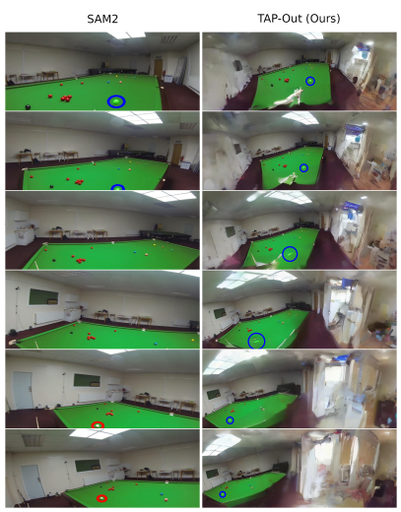
Figure 5 : Eliminating re-identification failures on LaSOT [14]. A standard tracker (SAM2, left) tracks a white ball when visible (blue circles) but fails to re-identify it upon return (red circle) after extended absence. TAP-Out (right) maintains continuous localisation in the equirectangular domain.
Original paper · CC BY 4.0TAP-Out avoids this step by tracking the object continuously in the equirectangular domain. The pipeline first outpaints the input frames into a complete 360 degree panorama. SAM2 then tracks the query object on that panoramic video to produce segmentation masks. The paper notes that equirectangular video is out-of-domain for SAM2, yet SAM2 still gives coarse masks for approximate localisation.
Figure 5 shows the standard SAM2 tracker on the left, marking the ball with blue circles while it is visible. After an extended absence, the standard tracker fails to re-identify the ball on its return, which the red circle marks. On the right, TAP-Out maintains continuous localisation of the ball in the equirectangular domain.
Figure 6 applies TAP-Out to out-of-frame object tracking on LaSOT, with the ground truth and predicted bounding boxes shown. The paper reports these LaSOT results only as qualitative figures, with no accuracy score. The authors didn't measure how often re-identification succeeds across LaSOT clips. The authors list identity drift during long occlusions as a failure mode of the pipeline.
Limits of the offline pipeline
TAP-Out is an offline method, so its latency is the first practical limit. On a single NVIDIA A100 GPU, that gap is a difference of about 3,000× in latency. The authors accept this cost because the tool targets applications such as VFX, video editing, and forensic analysis. In those settings, track quality takes priority over speed, so the trade-off is deliberate.
Accuracy falls as camera rotation grows, because the generative model must hallucinate large unobserved regions. At high motion above 30°, OOV accuracy drops to 0.21, compared with 0.90 at low motion. Long occlusions cause identity drift, and this breaks the segmentation step that localises the object. Camera estimation errors propagate through the whole chain, and the authors name them a key bottleneck for deployment.
A few failures are catastrophic, so the AD xavg rises even when most estimates are accurate. Argus expects world-up-aligned views, so arbitrary camera orientations degrade the outpainting.
Static points could be tracked more efficiently by geometric reprojection alone, without the outpainting pipeline. The static reprojection baseline reaches 0.203 on out-of-view points, which is well below TAP-Out's 0.332. The authors didn't test online variants of the pipeline. They also didn't test distillation or sampling multiple outpainting hypotheses to model uncertainty.
Paper info
- Authors
- Finlay G. C. Hudson, James A. D. Gardner, William A. P. Smith
- Venue
- arXiv · Preprint
- First published
- 2026-10-30
- Added
- 2026-11-7
- Updated
- 2026-10-30
- Version
- v1
- arXiv
- 2611.00406
- Category
- cs.CV
- Original paper terms
- CC BY 4.0
- What we show
- Paper info, commentary and permitted figures from the original paper
AI commentary is a separate explanation from the original paper and may contain errors. The original paper and figures follow each source's terms of use and any rights noted separately.
Abstract
Tracking points that leave the camera's field of view (FoV) requires reasoning about unobserved scene dynamics, a fundamentally different problem from tracking visible correspondences. We present TAP-Out, an offline method that makes this out-of-view (OOV) reasoning explicit by leveraging generative video outpainting as a world-model prior. Given a narrow-FoV input video, TAP-Out outpaints a complete 360° equirectangular video, locates target objects within the panoramic scene via video object segmentation, and synthesises object-centred perspective crops on which standard in-frame trackers operate. This decoupled design composes off-the-shelf foundation models without requiring task-specific architectural modifications. On the TAPVid360 benchmark, TAP-Out achieves state-of-the-art performance, improving OOV tracking accuracy by approximately 3x over the best prior method. We demonstrate its flexibility on out-of-frame object segmentation and detection and we provide detailed diagnostic analyses across motion regimes, static versus dynamic content, and hallucination quality, characterising when and why the approach succeeds or fails.
Quote from the paper
Finlay G. C. Hudson, James A. D. Gardner, William A. P. Smith (2026). TAP-Out: Tracking Any Point in 360° via Outpainting. arXiv:2611.00406v1. https://arxiv.org/abs/2611.00406v1
BibTeX
@misc{hudson2026tracking,
  title = {{TAP-Out: Tracking Any Point in 360° via Outpainting}},
  author = {Finlay G. C. Hudson and James A. D. Gardner and William A. P. Smith},
  year = {2026},
  eprint = {2611.00406},
  archivePrefix = {arXiv},
  url = {https://arxiv.org/abs/2611.00406v1}
}