Paper commentary
ReRead: Wrong Predictions, Useful Representations - Correcting Frozen Robot Policies by Re-reading Their Own Representations
- Problem Frozen robot policies often fail on tasks where the current frame cannot reveal the task phase, and the usual fixes assume the policy's internal representation lacks the needed information.
- Method ReRead keeps the backbone frozen and trains a small corrector on offline demonstrations. The corrector reads the backbone's cached K/V from the current and two previous decisions and outputs an action residual that is added to the candidate action.
- Results Raises Fast-WAM's average Hard11 success rate from 73.45 to 81.45, and its all-50-task average from 90.73% to 92.66%. On the phase-ambiguous task, real-robot success rises from 0% to 36%.
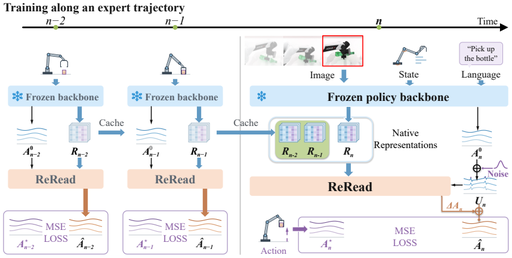
Figure 2 . Illustration of ReRead training along expert trajectories.
Original paper · CC BY 4.0 · Xu Su, Shunlong Xiao, Qintao Yi, Mingkuan Zhao, Xinmiao Yu, Yizhe Li, Zihan Wang, Bokui Chen · ReRead: Wrong Predictions, Useful Representations - Correcting Frozen Robot Policies by Re-reading Their Own Representations · Original paper figure · Extracted the figure area from page 4 of the original PDF.Wrong actions and missing information
Each of these responses assumes that a wrong action means the policy's representations lack the task-relevant information. The alternative explored here is that the information may already be inside the backbone, and only the step from that information to an action may be faulty.
Those caches are normally discarded once actions are output, yet they may hold the phase information that the current frame lacks. A wrong action therefore has two possible origins: the required information was never cached, or it was cached but not read out as the correct action. Only the second origin calls for repairing the readout rather than the backbone.
Splitting the prediction error
The corrector's input is Z = (A0, M), where A0 is the candidate action and M is the memory built from the caches. Under squared loss, the best possible prediction from Z is the conditional mean of the expert action given Z, and the error of the candidate splits into two terms. The first term, K(Z), is the representation error: the smallest error any predictor can reach from the candidate and the caches.
The second term, G(Z), is the readout gap, the distance between that conditional mean and the candidate action.
A residual equal to the conditional mean minus the candidate would remove the whole readout gap, which bounds what any corrector can remove. The measured error reduction of a trained corrector is bounded by the readout gap as a fraction of the initial error, so the representation error fraction is at most one minus that reduction. A large prediction error therefore does not by itself imply a large representation error.
The optimal readout cannot be computed directly, so the bound is estimated with a trained corrector on held-out data.
Reading the caches with a corrector
The frozen backbone receives images, the robot state and the instruction, and produces a candidate action chunk of length H over d action dimensions from sampling noise. After each decision, the native visual and action K/V, the robot state and the decision anchor are stored as a cache record. Decision anchors are spaced by S = 20 executed steps, and the default corrector reads the cache at the current anchor and at the two anchors before it.
The corrector never receives images, so every scene detail it uses has already been encoded by the backbone.
Each cached key and value is projected, together with the robot state, into the corrector's space, and a positional encoding marks the source layer, camera, modality, position and cache age. The candidate action is embedded as the query, so the corrector decides what to read from the caches based on the candidate. The corrector has 198.52M parameters and adds 11.66 ms per decision.
Training without a shortcut
If the candidate were never changed during training, the corrector could lower error simply by calibrating the candidate without reading the caches. To prevent this, sparse Gaussian noise is added only to the candidate values given to the corrector, with each action position selected with probability 0.2 and noise standard deviation 0.05 on the arm joints.
Backbone inputs, native K/V and expert targets stay unchanged, so when the caches determine the target, the residual has to cancel the perturbation.
The objective is an action MSE over valid positions between the corrected chunk and the expert action chunk at the decision anchor. Training steps through each demonstration in anchor order, runs the backbone once per anchor and reuses stored caches as history, so gradients do not pass across decisions.
Hard11 success across three backbones
ReRead was attached to LingBot-VLA, π0.5 and Fast-WAM, which include two VLAs and one video world action model. On Hard11 the average success rate rose from 50.00 to 73.45 for LingBot-VLA, from 30.36 to 43.45 for π0.5 and from 73.45 to 81.45 for Fast-WAM. Those gains correspond to 23.45, 13.09 and 8.00 percentage points. Each Hard11 score covers 25 episodes per task and setting, with local re-evaluation of the backbones and ReRead.
In the paired full-benchmark evaluation, Fast-WAM averaged 90.73% and ReRead raised it to 92.66%. Published values for the other models in the full-benchmark table were not produced under this local protocol.
Candidate versus cache interventions
Adding sparse noise to the candidate at scale 0.10 raises the candidate MSE 2-fold, while the corrected action's MSE rises by only 12.08%.
The two interventions match the two input paths in the residual relation, with the candidate-only change largely cancelled and the cache change passed through re-reading. All conditions use the same weights, so differences come from the replacement of the caches.
Past decisions were rerun with six preset seeds and grouped by their past candidate error into low, medium and high groups. Higher past error gives a slightly smaller gain, yet the highest-error group keeps most of the corrective value.
Whether external perception helps
Four frozen external visual encoders were added as a branch reading frames at t-6, t-4, t-2 and t. Their average success rates range from 78.91% to 80.36%, all below the 81.45% of ReRead without external vision. Table 3 also lists the ablations on K/V sources and history capacity against ReRead.
Reading only the action K/V gives 81.09%, reading only the visual K/V gives 80.55%, and the no-K/V control gives 75.82%. The authors read these results as not supporting insufficient perception as the cause of backbone failures, although only four encoders and one corrector design were compared.
Phase information in past caches
The phase-ambiguous task picks up a bottle, puts it back, opens the gripper and returns to the initial pose, so the frames before grasping and after placing look alike. On Hard11, reading only the current cache gave 78.55% average success, against 81.45% with two past caches.
In simulation, success on the phase-ambiguous task rose from 2% to 50% over 50 paired scenes. On the real Flexiv dual-arm robot, success rose from 0% to 36%.
The mean directional shift, opposite-phase minus same-phase, is +0.33 and is positive in all seven scenes. Replacing only the past action K/V gives shifts of +0.31 and +0.30 for the two sources, close to the full-history shifts of +0.33 and +0.31, while visual K/V or past states give shifts near zero.
Limitations
The main closed-loop comparison uses three backbones and the Hard11 subset, with 25 episodes per task and setting. The phase-ambiguous result rests on one task, with one real-robot setup and 50 paired scenes in simulation.
Paper info
- Authors
- Xu Su, Shunlong Xiao, Qintao Yi, Mingkuan Zhao, Xinmiao Yu, Yizhe Li, Zihan Wang, Bokui Chen
- Venue
- arXiv · Preprint
- First published
- 2026-11-16
- Added
- 2026-11-17
- Updated
- 2026-11-16
- Version
- v1
- arXiv
- 2611.20465
- Category
- cs.RO · cs.AI
- Original paper terms
- CC BY 4.0
- What we show
- Paper info, commentary and permitted figures from the original paper
AI commentary is a separate explanation from the original paper and may contain errors. The original paper and figures follow each source's terms of use and any rights noted separately.
Abstract
When a pretrained robot policy fails on challenging tasks, common remedies include retraining the backbone, adding an external visual encoder, or introducing a memory module. We argue that wrong predictions do not imply wrong representations: a policy can retain the required information yet fail to read it out as the correct action. To test this view, we propose ReRead: with the backbone frozen, a corrector re-reads the current and two previous caches to predict an action residual. The corrector sees no images, is trained solely on offline demonstrations from all 50 RoboTwin 2.0 tasks, and adds only 4.17% latency. Ablations and interventions show that the correction relies on the backbone's own representations: none of four external visual encoders adds further gain, and swapping in past caches from other trajectories sharply increases action error. On the 11 hardest RoboTwin 2.0 tasks, ReRead improves the success rates of LingBot-VLA, $π_{0.5}$, and Fast-WAM by 23.45, 13.09, and 8.00 percentage points, respectively. In paired evaluation on all 50 tasks, it raises Fast-WAM's average success rate from 90.73% to 92.66%. On a Flexiv dual-arm robot, it raises success on a phase-ambiguous task from 0% to 36%.
Quote from the paper
Xu Su, Shunlong Xiao, Qintao Yi, Mingkuan Zhao, Xinmiao Yu, Yizhe Li, Zihan Wang, Bokui Chen (2026). ReRead: Wrong Predictions, Useful Representations - Correcting Frozen Robot Policies by Re-reading Their Own Representations. arXiv:2611.20465v1. https://arxiv.org/abs/2611.20465v1
BibTeX
@misc{su2026reread,
  title = {{ReRead: Wrong Predictions, Useful Representations - Correcting Frozen Robot Policies by Re-reading Their Own Representations}},
  author = {Xu Su and Shunlong Xiao and Qintao Yi and Mingkuan Zhao and Xinmiao Yu and Yizhe Li and Zihan Wang and Bokui Chen},
  year = {2026},
  eprint = {2611.20465},
  archivePrefix = {arXiv},
  url = {https://arxiv.org/abs/2611.20465v1}
}