Paper commentary
Calibrate, Don't Retrain: Decomposing the Value of Annotator Disagreement in Cyberbullying Severity
Calibration lets an existing severity model report annotator label distributions
- Problem Severity models are trained on one majority label per comment, which hides the disagreement among five annotators. Only 4.1% of comments get unanimous labels, so that disagreement is common and the single label discards it.
- Method The authors train models to predict the share of annotators who picked each severity level. They also calibrate an existing model after training, which adjusts its output probabilities without retraining.
- Results Calibrating the matched twin without retraining cut its Brier score from 0.294 to 0.144. Training on label distributions gave a further small gain, to 0.137.
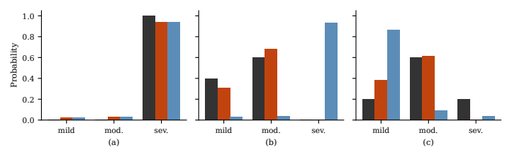
Fig. 6 . Predicted distributions against the 5 human labels for 3 comments: (a) unanimously severe, “@user you are really sh*tty and go die”; (b) split 2-3-0, “tell that fool @user to lay off the haterade. Get a life... ”; (c) split 1-3-1, “A little f*ggish much @user”. Dark bars ( ) show the human label distribution, orange bars ( ) the prediction of the distribution-trained model and blue bars ( ) the temperature-scaled flat baseline. On the unanimous comment all 3 agree. On the split labels the scaled baseline concentrates its mass on a single class while the distribution-trained model follows the shape of the human distribution.
Original paper · CC BY 4.0 · Arslan Bisharat, Katelyn Skees, Manuel Sandoval Madrigal, Mujtaba Nazari, Ayaan Khan, Deborah L. Hall, Mohammed Abuhamad, Yasin N. Silva · Calibrate, Don't Retrain: Decomposing the Value of Annotator Disagreement in Cyberbullying Severity · Original paper figure · Extracted the figure area from page 26 of the original PDF.Why one majority label hides the disagreement
Severity models are usually trained on one majority label per comment, so a 3-to-2 split and a unanimous vote become the same target. The corpus studied here, Insta-CTSR, has five annotators per comment, and all five chose the same severity label for only 4.1% of comments. This matters for moderation, because a mild insult and a credible threat call for different responses.
The paper represents the disagreement as a label distribution over the mild, moderate and severe levels instead of one label. In the example of 3 annotators choosing moderate and 2 choosing severe, the target is 0% mild, 60% moderate and 40% severe. The study set holds the 9,553 comments with a unique plurality, drawn from 11,310 cyberbullying comments.
The 1,757 comments without a unique majority are left out of the study set and used only in the held-out-label analysis. Only 392 comments in the study set are fully unanimous, which is 4.1% of the set.
Agreement stays low even on the study set, where Krippendorff's alpha with an ordinal distance is 0.19 on the three severity levels. Over all annotated comments on the full 4-level scale, alpha is 0.32, because annotators agree that most comments are not cyberbullying. Removing the easy not-cyberbullying split lowers agreement, and the study-set comments stay contested however the scale is defined.
The main experiments therefore rely on this dataset, which keeps all five labels per comment.
Training on the annotators' split
The key idea is to swap the single winning label for the share of annotators who picked each level, such as 60% moderate and 40% severe. The authors call the model trained on that target the distribution-trained model, and it keeps the hierarchical architecture. Both heads use binary cross-entropy, so the training signal follows the annotators' actual split rather than one winning level.
A fair comparison needs a control that differs only in the target, so the matched twin is the same hierarchical model trained on majority labels. Both share the DeBERTa-v3-base encoder, the same hyperparameters, and the same 10-fold folds built at the session level. Every model uses the DeBERTa-v3-base encoder, so the encoder never changes between the two versions.
Because the hierarchy is itself a design choice, a flat model trained with KL divergence against the full three-way distribution checks whether it matters. Label smoothing, with epsilon set to 0.1, and SORD soften the majority label by fixed rules that never see the annotators' own labels.
The post-hoc alternative keeps the trained model unchanged and adds a map after training. The label calibration map has 12 parameters and is a Dirichlet map fitted on label distributions in the training folds. Temperature scaling, the standard repair for overconfident classifiers, divides the output scores by one fitted number.
Accuracy hardly separates the competitive systems
Majority-label macro-F1 puts the 5 strongest systems in a narrow band between 0.68 and 0.70. The hierarchical distribution-trained model reaches 0.696, compared to 0.682 for the Flat 3-class model. The bootstrap interval for that difference, [+0.003, +0.028], lies above zero, so the gain is real but small. It is the only separation macro-F1 gives across the 11 systems, because thread context contributes about as much.
Thread context changes macro-F1 by between 0.005 and 0.033, depending on how the context is removed. So macro-F1 says little about which of these models best matches the human labels.
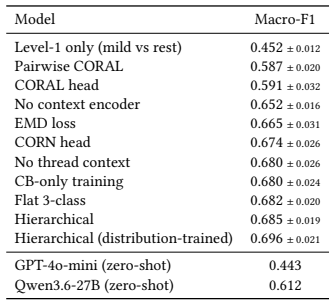
Table 3 . Macro-F1 (mean± SD over 10 folds) for each system. Every system except the distribution-trained one learns from the majority label. The 5 strongest systems fall between 0.68 and 0.70, so macro-F1 barely separates them. For reference, a single annotator compared with the majority label of the other 4 annotators reaches 0.53, and the 2 zero-shot language models (single runs) are shown at the bottom.
Original paper · CC BY 4.0A single annotator, compared with the majority of the other 4 annotators, reaches 0.53 macro-F1. The competitive systems sit well above that reference because they learn from aggregated labels. The comparison isn't like-for-like, since each annotator faces a majority of 4 labels while the models face 5. The zero-shot LLMs scored lower, with GPT-4o-mini at 0.443 and Qwen3.6-27B at 0.612.
The plateau isn't a quirk of one encoder family, since both LLMs fall below the competitive range.
A higher majority-label score doesn't show that a model matches the annotators' judgments better. Majority-label accuracy ignores the spread of the annotators' judgments, which is the aspect this study measures next. The next analysis scores each model against the full label distribution with total variation, the Brier score, and the log score.
Lower is better for each of these scores, and 0 is a perfect match.
Calibration recovers most of the distribution fit
Fidelity is scored with the Brier score, and the matched twin starts at 0.294 before any calibration. Simulation puts the sampling-noise floor at 0.069, the best Brier any model could reach on this corpus. The room for improvement therefore runs from 0.294 down to 0.069.
Temperature scaling fitted to majority labels, with no label distributions, lowers the Brier score to 0.182 and closes about half the gap. The authors read this step as evidence that the label distributions carry information the majority label does not.
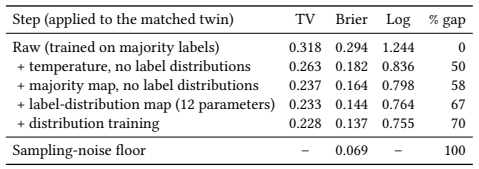
Table 4 . Where the fit to the label distributions comes from. Each step adds the information named to the step above it, starting from the matched twin, the hierarchical model trained on the majority label, and moving toward the sampling-noise floor. TV is total variation, Brier is the Brier score, and Log is the log score. Each measures how far the predicted distribution is from the human label distribution, so lower is better. The last column is the percentage of the closable Brier gap (0.294→ 0.069) that each step reaches. Temperature scaling closes half the gap using no label distributions. A small map fitted to the label distributions closes most of the rest without retraining. Training on the label distributions adds a little more.
Original paper · CC BY 4.0Training directly on the label distributions gives 0.137, a further 0.007 (bootstrap CI [0.005, 0.010]). The gain is not noise, since the distribution-trained model beats its matched twin at every seed.
Fidelity varies with how annotators split, with Brier scores of 0.32 to 0.34 on unanimous comments and 0.06 to 0.07 on 3-to-2 comments. The authors attribute the weak unanimous case to soft-label models that rarely predict near-certainty, so calibration helps most there. A map fitted from one label per comment gives 0.146, the same Brier as one fitted from all five.
Does the pattern hold on other corpora
The authors repeat the decomposition on EPIC, a binary irony dataset, and on ConvAbuse, a five-level abuse-severity dataset. Each corpus gets the same DeBERTa-v3-base encoder fine-tuned on majority labels, and the same sequence of steps. Each result is read against that corpus's own sampling-noise floor, so the replications are judged on their own scale.
The corpora were chosen because they keep per-annotator labels, which the Insta-CTSR dataset does not provide for demographics or a second task.
The label-distribution map adds a further step only on Insta-CTSR, moving it from 50 to 67 percent of the gap. On EPIC the map leaves the value at 63 and on ConvAbuse it drops the value from 27 to 22. Training on the label distributions adds a small, consistent step on all three corpora, reaching 70, 67 and 32 percent.

Table 6 . The decomposition across 3 disagreement corpora, as the percentage of the closable Brier gap reached after temperature scaling with no label distributions, a map fitted to the label distributions, and training on the label distributions. The replication values are means over 5 seeds, with a per-seed SD of at most 4 points. Temperature scaling recovers most of the gap everywhere. The further gain from the label-distribution map appears only on Insta-CTSR. Training adds a small consistent step on all 3.
Original paper · CC BY 4.0The group experiment moves to EPIC, because the Insta-CTSR dataset doesn't record annotator gender. A majority-trained model represents women worse than men, with Brier 0.318 against 0.283.
Men's and women's judgments on EPIC
EPIC records annotator gender, so each model can be scored against men's labels and women's labels separately. Pooling the labels into one majority label therefore erases a split between the groups rather than a shared judgment.
The majority-trained model scores Brier 0.283 for men and 0.318 for women, so it represents women worse than men. The calibrated majority model scores 0.212 for men and 0.249 for women, and the label-preserving model scores 0.205 for men and 0.244 for women. Preserving the label distribution improves men's Brier by 0.007 (95% CI [0.003, 0.010], Wilcoxon p = 0.0002) over the calibrated majority baseline.
For women the improvement is 0.005 (CI [0.002, 0.008], p = 0.003), measured across the 50 fold-by-seed runs.
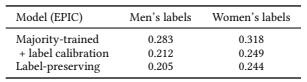
Table 7 . How well each model reproduces each group’s judgments on EPIC, scored as Brier against the label distribution of men and of women separately (lower is better, means over 10 folds and 5 seeds). Preserving the label distribution improves both groups significantly over the calibrated majority baseline, but the gap between them does not narrow (0.037 against 0.038, difference not significant).
Original paper · CC BY 4.0The difference of +0.0015 has a confidence interval of [−0.002, +0.005] (p = 0.44), so the gap doesn't narrow. The reason is structural: one shared model gives one distribution per comment, so it can't weigh men's and women's judgments of the same comment differently. The authors also say this rests on one binary split in an irony task rather than a harm-related task.
Part of the raw-Brier gap may also be a floor effect, since a group with sparser or more dispersed labels has a higher sampling floor.
Model confidence and contested comments
A model's own uncertainty would be a useful router if it were least sure where annotators split, but the paper finds that relation is weak. Calibration lifts the correlation only from 0.117 to 0.143, so it doesn't make confidence track disagreement.
Calibration doesn't fix this, and the detector stays at chance after label calibration. Calibration improves fidelity across the corpus, but it does little for spotting which individual comments will divide annotators.
The authors vary the share of comments sent to humans from 10% to 50%, and they report accuracy on the comments the model keeps. At 30% deferral, the combined ranking reaches 0.772 accuracy, compared to 0.770 for confidence alone, and the bootstrap interval includes zero. Even the oracle with the true label entropy doesn't beat the model's own confidence.
At 50% deferral, the combined ranking reaches 0.828 against 0.797, but the authors call that gain confounded. Deferring the highest-entropy comments removes those whose majority labels are least reliable, so the evaluation set becomes easier. High-entropy comments are where soft-label models under-commit and score worst, so entropy routing would reflect calibration rather than routing quality.
Limits and open questions
The main experiments rest on one corpus, Insta-CTSR, so the findings aren't tested on other annotated comments beyond the two replication corpora. The group analysis uses only EPIC, a binary irony dataset, because the authors' own corpus records no annotator identities. The group result rests on one binary gender split in an irony task rather than a harm-related task, which limits how far it generalizes.
Part of the raw-Brier gap between groups may reflect a higher sampling floor rather than under-representation.
The authors test model behavior, not moderator outcomes, so they frame their recommendation as a design rather than a validated deployment. Whether a displayed distribution improves moderator decisions remains an open question for human-factors research. The zero-shot LLM reference scores come from single runs, so their numbers carry no run-to-run spread.
Gender-targeted attacks produce more disagreement than other topics, but the paper's group analysis doesn't test topic effects.
Paper info
- Authors
- Arslan Bisharat, Katelyn Skees, Manuel Sandoval Madrigal, Mujtaba Nazari, Ayaan Khan, Deborah L. Hall, Mohammed Abuhamad, Yasin N. Silva
- Venue
- arXiv · Preprint
- First published
- 2026-11-11
- Added
- 2026-11-13
- Updated
- 2026-11-11
- Version
- v1
- arXiv
- 2611.15010
- Category
- cs.SI · cs.CL · cs.CY · cs.HC
- Original paper terms
- CC BY 4.0
- What we show
- Paper info, commentary and permitted figures from the original paper
AI commentary is a separate explanation from the original paper and may contain errors. The original paper and figures follow each source's terms of use and any rights noted separately.
Abstract
Machine learning models are often trained on labeled data produced by multiple human annotators. When those annotators disagree, their labels are commonly collapsed into a single majority vote, which discards information about the underlying disagreement. We examine the cost of this practice for cyberbullying severity, a subjective judgment on which annotators disagree heavily. In the corpus we study, all 5 annotators assigned the same severity label to only 4.1% of comments. Turning 5 judgments into one label hides this disagreement and obscures how much the annotators differed in their assessments. In this paper, we ask whether a model can preserve this information by predicting the distribution of annotator judgments instead of a single majority label. We find 3 main results. First, accuracy against the majority label cannot tell competent models apart: 2 models with similar accuracy can differ greatly in how well they match the distribution of annotator judgments. Second, predicting the full distribution requires little extra effort. Calibrating an existing model, which adjusts its output probabilities after training, captures most of the improvement without retraining, across 3 datasets covering severity, abuse, and irony, while training on label distributions adds a small further gain. Third, we examine a dataset that includes annotator demographics, where a single shared model has one advantage and one limit. The advantage is that a model predicting the distribution of judgments matches each demographic group's judgments significantly better than a model trained on majority labels, so both groups gain. The limit is that it does not narrow the gap in performance between the groups, because one shared model cannot encode which group is right on a given comment. Preserving annotator disagreement is therefore a low-cost step toward fairer moderation, though not a complete one.
Quote from the paper
Arslan Bisharat, Katelyn Skees, Manuel Sandoval Madrigal, Mujtaba Nazari, Ayaan Khan, Deborah L. Hall, Mohammed Abuhamad, Yasin N. Silva (2026). Calibrate, Don't Retrain: Decomposing the Value of Annotator Disagreement in Cyberbullying Severity. arXiv:2611.15010v1. https://arxiv.org/abs/2611.15010v1
BibTeX
@misc{bisharat2026calibrate,
  title = {{Calibrate, Don't Retrain: Decomposing the Value of Annotator Disagreement in Cyberbullying Severity}},
  author = {Arslan Bisharat and Katelyn Skees and Manuel Sandoval Madrigal and Mujtaba Nazari and Ayaan Khan and Deborah L. Hall and Mohammed Abuhamad and Yasin N. Silva},
  year = {2026},
  eprint = {2611.15010},
  archivePrefix = {arXiv},
  url = {https://arxiv.org/abs/2611.15010v1}
}