Paper commentary
Maximizing Capacity Utilization of LoRA Adapters for Mitigating the Learning-Forgetting Trade-off
- Problem Standard LoRA updates often spread their energy over far fewer directions than the configured rank allows, so nominal rank is an unreliable guide to adapter capacity.
- Method Adds a Rényi-2 effective-rank penalty, computed from the LoRA factors without an SVD, to the language-modeling loss. A norm-bounded reparameterization is tested as a second route.
- Results At a penalty weight of 0.01, mean Wiki PPL is lower than unpenalized LoRA in every rank comparison at 16 or above, across three models. On Qwen2.5-0.5B at r=896, a weight of 0.1 gives Train PPL 4.53 against 4.77 for standard LoRA.
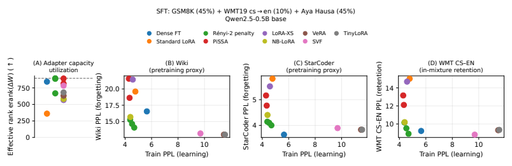
Figure 2 : Dense FT denotes dense down-projection fine-tuning. Mixed-domain continual-learning baselines on Qwen2.5-0.5B (base, not Instruct; rank r=896 unless noted). Each point represents a method–penalty configuration; the legend maps dot colors to adapter type. Points show multi-run means or single-run endpoints; sample SDs are reported in Appendix Table 5.(A)Effective rank erank(∆W) shown as a vertical strip from 0 to nominal rank 896 (horizontal dashed line), with horizontal offsets only for visibility; higher indicates fuller adapter capacity utilization.(B–D)Learning–forgetting trade-offs: Train PPL (mixture learning) versus Wiki PPL, StarCoder PPL (pretraining proxies), and WMT CS–EN PPL (in-mixture translation retention); lower-left is better. The three Rényi-2 penalty points use different regularization weights λ. Unpenalized PiSSA and LoRA-XS have the highest Wiki perplexities; VeRA, SVF, and TinyLoRA limit forgetting with weaker mixture fit. NB-LoRA approaches the λ= 0.01 learning–retention trade-off. Unpenalized PiSSA uses two runs after excluding one resumed execution with apparent data replay; the other multi-run points use three executions. Dense FT, LoRA at λ= 1 , and penalized PiSSA at λ= 0.1 are single runs. Full numeric values and the PiSSA exclusion are documented in Appendix Table 5 and its accompanying text.
Original paper · CC BY 4.0 · Tomohiro Sawada, Kartik Goyal · Maximizing Capacity Utilization of LoRA Adapters for Mitigating the Learning-Forgetting Trade-off · Original paper figure · Extracted the figure area from page 6 of the original PDF.Configured rank is not realized capacity
LoRA is set up by choosing a rank r, and r fixes how many directions the low-rank update can in principle use. The common expectation is that a larger r means a larger adapter, but this only holds if the update actually spreads its energy across the directions it is given. The authors argue that the learning-forgetting trade-off depends on how that energy is distributed, so nominal rank alone does not say how much capacity is in use.
Measured with effective rank, standard LoRA updates use only a fraction of their configured rank, and that fraction shrinks as r grows. For standard LoRA on the mixed-domain proxy, effective rank is 145.0 at r=256 and 265.0 at r=512, which the authors put at about 57% and 52% utilization.
Measuring how evenly the update uses its rank
The accumulated update ΔW is characterized by its Roy–Vetterli effective rank, a continuous relaxation of matrix rank that comes from the entropy of the normalized singular-value spectrum. Writing the normalized spectrum as p_i, the value is the exponential of the Shannon entropy of p, which is the quantity the paper calls erank. \[ \mathrm{erank}(\Delta W) = \exp\big(H_1(p)\big), \qquad p_i = \frac{\sigma_i}{\sum_j \sigma_j} \]
Figure 1 splits the utilization quotient by depth group across GSM8K, Hausa and the mixed-domain sweeps, and the late layers usually sit below the early and middle layers.
A Rényi-2 penalty that avoids the SVD
The main method adds a regularizer to the language-modeling loss that rewards a larger effective rank of ΔW, and it does not change the adapter parameterization. Instead of the Roy–Vetterli value, the penalty uses erank2, the exponential of the Rényi-2 entropy of the squared singular values after normalization. \[ \mathrm{erank}_2(\Delta W) = \exp\big(H_2(q)\big) = \frac{\|\Delta W\|_F^4}{\mathrm{Tr}\big((\Delta W^\top \Delta W)^2\big)} \] Because this is a trace ratio, it can be computed without an SVD, and its gradients avoid the singular-value-gap denominators that arise in losses that depend on singular vectors.
The training objective is the language-modeling loss minus λ times erank2 of the update, with λ ≥ 0 either fixed or scheduled. The experiments use the logarithmic variant, minus λ times the log of erank2, which rescales the per-module gradient by 1/erank2. The penalty can be computed from the low-rank factors A and B, so ΔW does not have to be built explicitly.
Theorem 2 orders the quantities as matrix rank, then erank, then erank2, then 1, so maximizing erank2 raises a lower bound on the Roy–Vetterli rank.
The norm-bounded route
The alternative caps the operator norm of ΔW and maximizes its squared Frobenius norm inside that cap. Under an operator-norm bound of δ, the paper's Theorem 1 gives erank(ΔW) ≥ exp(H2(q)) ≥ ∥ΔW∥²_S2 / δ², which is why maximizing the Frobenius norm pushes effective rank up. NB-LoRA writes the update as 2Y⊤SX, with S diagonal and nonnegative and X and Y obtained from a Stiefel–Cayley map, so the operator norm stays below δ by construction.
The authors found this route feasible, but the reparameterization limits the adapter to a specialized form that often trains unstably, and the Stiefel–Cayley parameterization made optimization difficult in their experiments. The penalty was therefore chosen as the main method because it leaves the adapter parameterization untouched.
Data, baselines and forgetting probes
The primary models are Qwen2.5 base 0.5B, 3B-instruct and 7B-instruct. Single-task runs use GSM8K, Aya Hausa and WMT19 cs-en, while the mixed-domain setting uses assistant-only SFT on a shuffled mixture of GSM8K at 45%, WMT19 Czech–English at 10% and Aya Hausa at 45%.
Forgetting is measured with held-out perplexities on Wiki and StarCoder slices of OLMo-Mix-1124, and in-mixture retention is measured on GSM8K and WMT19 Czech–English. Baselines are standard LoRA, dense down-projection fine-tuning, PiSSA, LoRA-XS, TinyLoRA, SVF, VeRA and unpenalized NB-LoRA, with adapters on all MLP down_proj layers at r=896 unless noted.
Train PPL measures learning on the training mixture, so lower values on Train PPL and on the retention probes are both read as better.
Mixed-domain results: learning and retention
Figure 2 places each method in the trade-off panels, with Train PPL on one axis and the three retention probes on the other, plus a strip showing effective rank. In these panels the favorable region is the lower-left corner.
Dense down-projection fine-tuning had weaker mixture fit, with Train PPL 5.64, but lower StarCoder and GSM8K perplexities of 3.64 and 1.817, against 5.82 and 1.929 for standard LoRA. Penalized LoRA at λ=0.1 reached Train PPL 4.53 and Wiki PPL 14.65, against 5.64 and 16.56 for the dense baseline, which kept the lower StarCoder and GSM8K values, so neither method dominates.
Adding the penalty raised effective rank from 361 to 668, 888 and 896 at λ of 0.01, 0.1 and 1.0. Relative to standard LoRA, every penalty weight lowered Wiki, StarCoder and GSM8K perplexity, and λ of 0.01 and 0.1 also lowered Train PPL, to 4.38 and 4.53 from 4.77.
At λ=1.0, a single run, Wiki PPL was 5.5 points lower and GSM8K PPL 0.13 points lower than the standard LoRA mean, with Train PPL of 4.69 against 4.77 ± 0.09. The WMT cs-en value fell from 15.02 to 8.91, and the authors treat WMT and GSM8K as separate probes.
On Llama-3.2-3B-Instruct at r=3072, λ=0.1 lowered Train PPL from 3.98 to 3.68 and Wiki PPL from 18.5 to 13.3.
Norm-bounded results on Aya Hausa
On Aya Hausa with Qwen2.5-0.5B, Table 1 lists eRank 340.517 for standard LoRA and 503.963 for norm-bounded LoRA without the penalty. Wiki PPL moves from 21.098 for standard LoRA to 20.089 for norm-bounded LoRA. Increasing the Frobenius-norm weight to λ=1.0 raised eRank to 814.076 and lowered Wiki PPL to 19.066.
Train PPL in these Hausa runs is worse than standard LoRA's, and worse than dense down-projection fine-tuning's, so the gain on retention comes with a training-fit cost. In the mixed-domain setting, unpenalized NB-LoRA raised effective rank to 583 from 361 and improved on standard LoRA on every metric, but the authors note that this does not separate effective-rank maximization from norm control.
PiSSA and LoRA-XS with the penalty
Table 2 compares penalty weights for PiSSA and LoRA-XS on single-task GSM8K adaptation with Qwen2.5-0.5B, targeting MLP down-projection matrices at r=896 with α=1792.
Unpenalized PiSSA already reaches erank 829.002, but its Wiki PPL is 23.173. The authors describe the penalty as reshaping how an already high-rank PiSSA update uses its degrees of freedom, rather than only increasing nominal rank.
Unpenalized LoRA-XS has erank 564.981 and Wiki PPL 25.479.
Effect of the penalty across LoRA ranks
Figure 3 plots effective-rank utilization, Wiki PPL and Train PPL against LoRA rank for standard LoRA and two penalty weights, with means taken over three seeds per setting.
For standard LoRA, Train PPL falls from 6.10 at r=4 to 4.38 at r=512, while Wiki PPL rises from 13.62 to 15.53 and StarCoder PPL from 3.93 to 4.18.
At r=128, 256 and 512, λ of 0.01 reduces Wiki PPL by 0.34, 0.53 and 1.04 relative to unpenalized LoRA at the same rank, with Train PPL within 0.07 of it. At r=4 the retention change is small, and λ of 0.1 raises Train PPL from 6.10 to 6.60 without a clear retention gain.
Start-step schedule for the penalty
Table 3 fixes the terminal weight at 0.1 with a linear ramp of width 200 and varies the start step on Aya Hausa for about 500 optimizer steps.
Every penalized start lowers StarCoder and Wiki PPL relative to standard LoRA's 4.05 and 21.8. Train PPL rises as the start moves earlier: standard LoRA is at 22.604, S=0 at 24.737, S=50 at 23.860, S=100 at 23.651, and S=400 at 22.410. At S=400 the erank is 429.841 against 341.397 for standard LoRA, and the ramp does not complete within the run, which ends at effective weight about 0.05.
The authors suggest one reason may be linear mode connectivity: after enough steps training may reach a basin where the solution is robust to perturbations, so a late penalty reshapes the spectrum without disturbing the fit. Early penalties, by contrast, may interfere with the trajectory into that basin, which the authors offer as an explanation for the Train PPL cost.
The second reason is about gradient size: the denominator Tr((ΔW⊤ΔW)²) goes to zero as ΔW goes to zero, so the penalty gradient can be large when the update is small. For the logarithmic penalty the gradient is the gradient of erank2 divided by erank2, and since erank2 lies between 1 and r, the same small-norm behavior carries over.
The mixed-domain sweeps used the early start, so their Train PPL cost at λ=0.1 may be reducible with a later start, but the authors did not rerun those sweeps.
Where the update's singular mass lands
\[ A_{ij} = \cos^2\langle v^{ft}_i, v^{p}_j\rangle \]
A fine-tuned direction counts as aligned when its best overlap with the pretrained basis is at least ϵ² with ϵ=0.9, and as unaligned otherwise. Weighted unaligned mass uses L1-normalized σ_i weights on the fine-tuned singular values, so it measures how much of the spectrum sits on unaligned directions. The authors also compute a soft global coupling, Hsoft, from a Sinkhorn-normalized kernel, and note that the diagnostics are descriptive and depend on the nullspace bases chosen.
Standard LoRA has weighted unaligned mass 0.960 and dense down-projection fine-tuning 0.940, while the penalty at weights 0.01, 0.1 and 1.0 gives 0.972, 0.973 and 0.973. VeRA has weighted unaligned mass 0 and TinyLoRA 0.018, with SVF at 0.001 and LoRA-XS at 0.991. The penalized and standard LoRA adapters place a similar share on unaligned directions, yet the penalized adapters forget far less.
VeRA and TinyLoRA show near-saturated coupling to the pretrained spectrum, with small Hsoft of 0.340 for VeRA and 0.520 for TinyLoRA. A LoRA-like band, including standard LoRA, the penalty, PiSSA and LoRA-XS, leaves at least about 96% of directions unaligned at this threshold, and LoRA-XS places the largest share of spectral weight on unaligned directions.
SVF has near-zero weighted unaligned mass but a much lower unaligned count than the LoRA-like band, so most of its singular mass sits on a few strongly aligned directions.
Limitations
The study focuses on LoRA-style adapters and closely related spectral variants, and other PEFT families or full fine-tuning may need different schedules or parameterizations.
The scheduling experiment is a single short run on Aya Hausa, and the mixed-domain sweeps were run with the early start.
The unpenalized PiSSA mean uses two executions after one resumed run with apparent data replay is excluded, and the penalized PiSSA run at λ=0.1 and the dense baseline are single runs. The reported erank in the diagnostics is the Roy–Vetterli value, which differs from the Rényi-2 surrogate that the penalty optimizes.
Where the penalty sits among LoRA variants
Many LoRA studies treat configured rank or trainable parameter count as a hyperparameter, while the Rényi-2 penalty targets how much of the rank is used within a fixed parameterization.
ReLoRA accumulates high-rank structure over long horizons by merging and restarting updates, whereas the paper asks how a single adapter's rank budget can be used more fully during standard SFT. MiLoRA, AdaLoRA and SVF change which subspace or spectrum is updated, often with an explicit or implicit SVD, and the authors call their penalty orthogonal and complementary to these approaches.
Paper info
- Authors
- Tomohiro Sawada, Kartik Goyal
- Venue
- arXiv · Preprint
- First published
- 2026-11-12
- Added
- 2026-11-14
- Updated
- 2026-11-12
- Version
- v1
- arXiv
- 2611.17191
- Category
- cs.LG · cs.CL
- Original paper terms
- CC BY 4.0
- What we show
- Paper info, commentary and permitted figures from the original paper
AI commentary is a separate explanation from the original paper and may contain errors. The original paper and figures follow each source's terms of use and any rights noted separately.
Abstract
Low-Rank Adaptation (LoRA) often underperforms full fine-tuning, especially in heterogeneous and continual-learning settings in which substantial forgetting occurs. In general, it suffers from an undesirable learning-forgetting trade-off across diverse fine-tuning settings. We identify a potential contributor: LoRA adapters, especially high-rank ones, frequently fail to realize the available capacity afforded by the configured rank. Specifically, we find that standard LoRA updates have effective rank far below their configured rank, limiting how broadly the update energy is distributed. Therefore, we propose training mechanisms that optimize the original objective while maximizing adapter effective rank. Our main method adds a simple, stable, differentiable, and SVD-free Rényi-2 effective-rank regularizer to the language-modeling loss. We also connect capacity maximization to norm-bounded updates. In mixed-domain rank sweeps on three models evaluated with multiple random seeds, a penalty weight of $λ=0.01$ lowers mean Wiki perplexity at every tested rank of at least $16$ relative to unpenalized LoRA. Mean training perplexity improves or increases by at most $0.02$ in all but one model-rank comparison. Single-task and scheduling experiments further show that the balance between learning and retention depends on the configuration. We also observe that several LoRA variants in the literature also suffer from the identified capacity issue, and our approach provides a complementary axis of improvement to LoRA-based parameter-efficient fine-tuning. These results suggest that effective rank is not only a post-hoc diagnostic of adapter quality, but a trainable objective for improving the learning-forgetting frontier. Our code is available at https://github.com/tomohiro-sawada/lora-capacity-utilization
Quote from the paper
Tomohiro Sawada, Kartik Goyal (2026). Maximizing Capacity Utilization of LoRA Adapters for Mitigating the Learning-Forgetting Trade-off. arXiv:2611.17191v1. https://arxiv.org/abs/2611.17191v1
BibTeX
@misc{sawada2026maximizing,
  title = {{Maximizing Capacity Utilization of LoRA Adapters for Mitigating the Learning-Forgetting Trade-off}},
  author = {Tomohiro Sawada and Kartik Goyal},
  year = {2026},
  eprint = {2611.17191},
  archivePrefix = {arXiv},
  url = {https://arxiv.org/abs/2611.17191v1}
}