Paper commentary
Personas Are Not People: Identity as State, Not Attribute
Persona-based simulations cannot capture how identity shifts across contexts
- Problem Synthetic populations use fixed personas, so each simulated person has one profile for every situation. That cannot reproduce how a real person's behavior shifts with context, because the persona never changes.
- Method The authors propose a person-in-context design in which a stable trait profile is stored with a set of identity states. Context selects one identity state per person, and the language model acts out that state.
- Results The authors prove that fixed personas cannot match person-specific behavior under two stated assumptions. On Chameleon, the person-in-context arm recovers extraversion almost exactly, but it does not match the real population on every trait.
Why fixed personas get stuck
A simulated person in today's systems is a persona, a profile or transcript prepared before the run. So the same person can be formal and careful with colleagues and relaxed and joking with friends at dinner.
A single fixed profile has to produce both of those behaviors, so any difference between them comes from the language model improvising. The persona itself never changes, so the design has no step that lets identity shift with the situation. Personality psychology finds that most variation in trait-related behavior sits within persons rather than between them.
The authors make the cost concrete with a city emergency office that pretests a flood evacuation alert on simulated residents.
Identity as a state the situation activates
The decomposition splits behavior into three inputs, a stable attribute vector, an identity state, and the situation itself. The authors write behavior as Y_{p,c,t} = f(τ_p, I_{p,c,t}, X_{c,t}) + ε_{p,c,t}, where τ_p is the stable attribute vector, I_{p,c,t} the identity state, and X_{c,t} the situation. Here p indexes persons, c contexts, and t the time point of an observation, so the same subreddit a week later counts as a new observation.
The authors apply the law of total variance twice, conditioning first on τ_p and then on (I_{p,c,t}, X_{c,t}). A fixed persona still varies with X, because f responds to the situation directly, so within-person variation alone doesn't prove identity matters. What requires I is narrower: the part of within-person variation that is specific to the person.
The authors sort simulation designs by which inputs reach the generation call, not by how many calls they make. In the fixed-persona family the interface is (π_p, X_{c,t}), so any identity-like adaptation comes from the language model's own inference. The memory-evolving family adds a growing record of past interactions, but that record isn't indexed by context.
The person-in-context family stores a stable attribute vector τ_p and a set I_p of identity states, and a subroutine π_I selects one state per context. Adding subroutines to a fixed-persona system doesn't change its family if every subroutine reads only π_p and X_{c,t}. The authors know of no production system that uses the person-in-context design.
The set of identity states can include a baseline state, a default a person returns to when no context is strong. The authors don't claim fixed-persona systems fail at their own goals, such as product testing or predicting individual attitudes.
How the person-in-context arm runs
Arm C works in two steps, and the first builds a shared set of candidate identity states for the whole population. For Chameleon, a Gaussian mixture model (GMM) groups users by their trait scores, so each group holds users with similar trait profiles. For the motivational-themes study, the authors write six states from clinical-recruitment literature, independent of the target study.
They check those states for circularity, and the state content doesn't draw on the target study's results. The authors fix each specification before running it on real data, and any later change gets its own documented version.
The second step matches each person's affinity for each state against the context, and that match picks one active state. In the motivational-themes study, the Medical Skeptic state is driven mainly by trust tier, with activation probability 0.70 for distrust, 0.35 for neutral, and 0.15 for trust. Demographic modifiers are capped, so they can't outvote trust.
In the motivational-themes study, the authors set the cue scores for the four ads as fixed numbers in the code.
All three arms use the same model, Claude Haiku 4.5 at temperature 0.7, and the same elicitation format. That format has the model give a short reasoning first and then a rating. Arm B adds a neutral mention of the context, and Arm C states no fixed trait.
Arm C computes an identity state for each person and context pair, and the model then acts out that state. Arm C runs on 6,632 demographically resampled personas, one theme each, on the same cells as the other arms.
Why the proof rules out fixed personas
The proof starts from the interaction residual of a fixed-persona system, which the authors write as R^A_{p,c} = g(π_p, X_c) + η_{p,c}. Here η is independent sampling noise, and Cov(g, η) = 0, so the residual holds nothing beyond the persona, the context and noise. Because π_p never changes with context, g can't carry information indexed by both the person and the context, however rich the persona is.
So g can be elaborate and context-sensitive, but that sensitivity can't track the person-specific residual Δ_{p,c}.
Proposition 2 says a fixed-persona system's output can't correlate with a real person's specific signature. Any apparent match, the authors argue, comes from matching general type rather than the individual. The Key Assumption says whoever builds the persona has no information about Δ_{p,c} beyond identity state and demographics. The Context Exogeneity Assumption says the context a person appears in carries no such information about Δ_{p,c}.
Under both assumptions, with the independence conditions in Appendix B, Cov(R^A_{p,c}, Δ_{p,c}) = 0 exactly.
A robustness corollary replaces both assumptions with approximate independence, measured by mutual information leaks ε_1 and ε_2. The bound is |Cov(R^A_{p,c}, Δ_{p,c})| ≤ 4M² √((ε_1+ε_2)/2), where M bounds the residuals because ratings lie on a fixed scale.
The authors stress that the proof rules out richer personas and larger models as a fix, since the output depends only on the persona, the context and noise. The paper's empirical check is that Arm A's correlation with the real residual is small, at 0.026 on Chameleon. The result doesn't say fixed personas must show inflated ICC or near-zero interaction variance.
Between-person share and person-specific signal on Chameleon
Chameleon tests whether each arm splits behavior the way real people do, with most variation coming from within each person. The Chameleon dataset has 1,667 Reddit users with three posts each, scored on twenty-six trait dimensions. Only the five Big Five traits are outcomes that each simulation must reproduce, while the other twenty-one dimensions describe the persona.
Arms A and B place the between-person share at 91% and 80%, against a real mean of 0.013. For extraversion, Arm C recovers 0.023 against a real 0.019, almost exactly. On agreeableness, conscientiousness and openness, Arm C stays 24 to 65 times above the real value, and on neuroticism it falls below it. So Arm C fixes the direction of the gap without matching the real split on every trait.
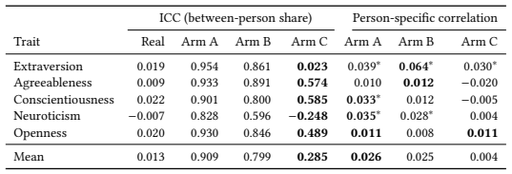
Table 1 . Chameleon results by trait and arm. ICC is the bias-corrected between-person share, and bold marks the arm closest to the real value. Person-specific correlation is the correlation with the real residual Δ𝑝,𝑐 , bold marks the highest value in a row, and an asterisk marks a 95% interval that excludes zero (Appendix Tables 4 and 5).
Original paper · CC BY 4.0The third component checks person-specific signal, the correlation with each person's real residual, and that signal is near zero for every arm. Mean correlations are 0.026 for Arm A, 0.025 for Arm B, and 0.004 for Arm C. Only extraversion is significant for all three arms, which is the pattern Proposition 2 predicts for fixed personas. Small positive fixed-persona values fit the robustness corollary, since a persona built from a user's own posts can carry a little information about that user.
With about 4,570 comparisons per trait, the test detects a correlation of about 0.04 or more at 80% power. It rules out large correlations but can't separate the arms below that size, so the person-in-context design's person-specific recovery remains open.
The next test moves to the motivational-themes study, which uses published results as its target.
Trust and theme on the motivational-themes study
The motivational-themes study asks whether the person-in-context arm reproduces a published interaction between ad theme and trust. The published target has six blood-pressure by trust coefficients, and all six are negative at both trust extremes relative to neutral. The authors ran all three arms on 6,632 demographically resampled personas, one theme each, on identical cells.
Arm C uses six identity states written from the literature, and the Medical Skeptic state is driven mainly by trust tier. Arm C's mean appeal rises from 2.41 under distrust to 3.04 at neutral trust and 3.42 under trust, so it reproduces the trust main effect.
Arm A matches 5 of 6, while Arm B matches 0 of 6 after adding only a theme sentence to Arm A. Guessing would match 3 of 6 on average, so the authors treat the count as a coarse test.
The generation step does respond to the active state, which the paired within-person comparison shows. Among 479 of 6,632 personas that received both a Medical Skeptic response and their own theme's response, the paired differences were -1.76 for appeal, -1.24 for participate and -2.44 for recommend. The same direction held in 87 to 100% of personas, and a forced, matched 30-per-condition check gave non-overlapping 95% intervals.
Amplifying the trust-linked state's activation spread for the blood-pressure theme doesn't close the gap. Under the contribution-to-science baseline it reaches 1 of 6, compared to 2 for the domain-general mechanism, while a pooled-theme baseline gives 3 of 6. Arm A falls to 2 or 3 under the pooled baseline, so the order of the arms depends on the baseline.
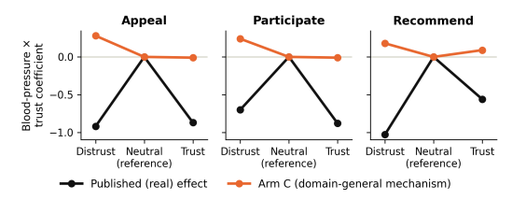
Fig. 2 . The real published effect dips atbothtrust extremes (all six coefficients negative), while the domain-general mechanism shows no dip at either extreme (all six simulated coefficients are−0.01or higher). Published coefficients are log-odds and simulated ones are rating points, so the figure compares shape and sign only. A single-axis activation mechanism cannot resolve this mismatch by calibration alone.
Original paper · CC BY 4.0 · Tamunotonye Harry, Yuanyuan Feng · Personas Are Not People: Identity as State, Not Attribute · Original paper figure · Extracted the figure area from page 12 of the original PDF.Limits of the evidence
The results don't establish much about the design beyond the proof, because the experiments test one implementation of the person-in-context family. Shared biases may carry through that scoring step, a concern raised for LLM-as-judge setups, and the authors didn't test for this.
Person-specific signal is near zero in every arm, with mean correlations of 0.026 for Arm A, 0.025 for Arm B, and 0.004 for Arm C. So the Chameleon test can't yet show whether the person-in-context design recovers person-specific signal.
The motivational-themes study has one rating set per person, so it can't test the person-specific component at all. Its published coefficients serve as an aggregate target, which tests only the person-context interaction in aggregate. Testing the dynamics of identity states would need longitudinal data, which the two datasets don't include.
The proof itself doesn't depend on any of these dataset or implementation limits. The result concerns the fixed-persona design, under the two stated assumptions, whatever the model or dataset.
Paper info
- Authors
- Tamunotonye Harry, Yuanyuan Feng
- Venue
- arXiv · Preprint
- First published
- 2026-11-3
- Added
- 2026-11-6
- Updated
- 2026-11-3
- Version
- v1
- arXiv
- 2611.05292
- Category
- cs.CL · cs.AI · cs.CY
- Original paper terms
- CC BY 4.0
- What we show
- Paper info, commentary and permitted figures from the original paper
AI commentary is a separate explanation from the original paper and may contain errors. The original paper and figures follow each source's terms of use and any rights noted separately.
Abstract
Synthetic populations, large sets of simulated people, are increasingly used in place of real people to pretest surveys, simulate users and communities, and evaluate AI systems. Each simulated person is defined by a persona, a written profile of fixed traits, demographics, and attitudes that a language model is instructed to act out. Every such system assumes that a person's identity is a stable attribute that behaves the same way in every situation the simulation presents. We show that this assumption is not a harmless simplification. Three decades of personality research find the opposite. How a given person behaves varies more across contexts than people vary from one another. Drawing on identity economics, which describes how different situations activate different identities and norms within the same person, we separate behavior into three parts, which are stable traits, the identity a context calls up, and the situation itself. We then prove, under two stated assumptions, that any simulation built on fixed personas, no matter how detailed the personas or how large the underlying model, cannot reproduce the part of a population's behavior that is specific to it and its circumstances. We propose a new evaluation criterion based on this result and a person-in-context design that can meet it in principle. We test one version on a naturalistic Reddit personality corpus and on a published clinical-trial recruitment survey of a community with documented distrust of medical institutions. The design does produce context-dependent behavior when tested directly, but in neither setting does it fully match the real population, and we show where it falls short. The consequence for practice is a risk that synthetic-population evaluations misrepresent the groups whose behavior is most shaped by context, a distortion that richer personas cannot correct.
Quote from the paper
Tamunotonye Harry, Yuanyuan Feng (2026). Personas Are Not People: Identity as State, Not Attribute. arXiv:2611.05292v1. https://arxiv.org/abs/2611.05292v1
BibTeX
@misc{harry2026personas,
  title = {{Personas Are Not People: Identity as State, Not Attribute}},
  author = {Tamunotonye Harry and Yuanyuan Feng},
  year = {2026},
  eprint = {2611.05292},
  archivePrefix = {arXiv},
  url = {https://arxiv.org/abs/2611.05292v1}
}