Paper commentary
LoopQ: Fair, Closed-Loop Evaluation of Quantized Vision-Language-Action Models
Simple rounding quantization matches VLA-specific methods on robot policies
- Problem VLA quantization papers often skip the simplest baseline, round-to-nearest, and compare against AWQ and GPTQ under their own setups. So it is unclear whether new methods actually win.
- Method LoopQ swaps only the quantizer, keeping checkpoint, layers and engine fixed.
- Results At 4 bits, plain RTN matches the calibrated methods, and the paper reports that no quantized pi0.5 or OpenVLA-OFT configuration is faster than its 16-bit model on the H100.
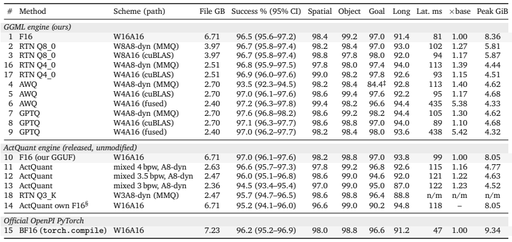
Table 9 :π0.5 on LIBERO: quantized models match their baseline (except AWQ on MMQ and the 3-bitint8-activationmodels), andnoneisfasterthanitsownengine’s16-bitmodel(2,000episodes each). Latency is the closed-loop median per call;×base is relative to that engine’s unquantized model (grey row). Peak memory is device-wide, including the simulator.‡One FP16 overflow in AWQ closed the server; the 68 affected episodes count as failures (97.7% on the 432 executed).§ActQuant’s own F16 release, built from a different (LeRobot) checkpoint than its quantized files; reference only. Row 18 reports task success only (n/m: closed-loop latency and memory not measured); its isolated speed is in table 2.
Original paper · CC BY 4.0 · Syed Umer Bukhari, Magnus Almgren, Ahmed Ali-Eldin · LoopQ: Fair, Closed-Loop Evaluation of Quantized Vision-Language-Action Models · Original paper figure · Extracted the figure area from page 18 of the original PDF.Why generic baselines get skipped
VLA-specific quantization papers often skip the simplest baseline, so a reader can't tell whether the new method actually wins. The VLA backbones are hard to fit within robot memory, latency and power budgets, which makes post-training quantization look like a prerequisite for deployment. Many of these methods claim smaller and faster policies without loss of task success.
The first question is whether the gain holds over a fair baseline, since VLA methods are usually compared with AWQ and GPTQ under the authors' own setups. Plain round-to-nearest (RTN) is rarely included, even though it needs no calibration.
At QVLA's layer scope, plain AWQ reaches 96.6% on OpenVLA-OFT, while QVLA reports 92.5% for AWQ and 96.7% for its own method. Under this comparison, the AWQ baseline looks weaker than it really is, so the claimed margin depends on the baseline chosen. The second question is whether task success is really preserved, and most papers answer it on standard LIBERO.
Those papers use 50, 250 or 500 episodes per suite with no perturbations, which is a narrow test. LIBERO is near saturation at 93 to 98% for the full-precision policies tested, so small losses are hard to see.
The third question is whether the deployed policy is faster, and the bit width alone doesn't answer it. The authors built LoopQ to answer these three questions under one controlled protocol, and concurrent work studies only layer scope and numerical format with RTN.
One protocol, one changed variable
LoopQ changes only the quantizer, so any difference in results can be traced back to the method. The checkpoint, the quantized layers and the inference engine stay the same across every comparison. Calibration data is shared too, with 512 calibration frames per model for AWQ and GPTQ. AWQ uses the official llm-awq search and clipping, while GPTQ uses the authors' own implementation, checked against the reference code.
That check reports 99.7 to 99.997% identical codes on identical Hessians, so the two GPTQ implementations agree closely.
The same W4A16 label can hide very different runtimes, so LoopQ reports each kernel path separately. In llama.cpp, a W4A16 file can run on int8 kernels that also quantize activations. π0.5 and OpenVLA-OFT run real low-bit models, while GR00T N1.5 and UniVLA use simulated quantization. The simulated models are tested only for task success, not for speed or memory.
For π0.5, that means ActQuant's vision and language backbone, and for GR00T N1.5 it means QuantVLA's 116 layers. Each configuration also runs the same LIBERO-plus tasks as its unquantized baseline, so the comparison stays paired. The time is measured on the same engine, so a speed-up always compares a model against its own 16-bit version.
Why the quantized π0.5 stays slow
Weight-only quantization only helps when a layer is memory-bound, because fewer weight bits cut the traffic that dominates its latency. Profiling π0.5 at batch 1 on the H100 NVL splits a 130.5 ms call into 59.4 ms of GPU work and 71.1 ms of host and launch overhead. So most of the call is not GPU compute at all, and the quantized layers cannot touch the host and launch share.
The action expert is the memory-bound part, processing only 10 tokens per flow step at about 10 FLOP/B. That expert holds 12.8% of the parameters yet takes 63% of GPU time, and only 10.5 ms of its 37.5 ms are weight multiplications. Every method the authors ran on π0.5, including ActQuant, keeps the action expert in 16 bits, so the speed ceiling comes from what stays unquantized.
Even if the quantized layers, at 11.0 ms, took no time at all, GPU time would improve by at most 1.23 times. The full call would improve by at most 1.09 times, from 130.5 ms to 119.5 ms. Quantizing the action expert's weights instead would save at most its 10.5 ms of weight multiplications. The other three VLAs don't share this profile: OpenVLA-OFT runs its LLM in one parallel pass over about 600 tokens, while only UniVLA, which decodes tokens one at a time, has a memory-bound backbone.
Measured directly, no quantized π0.5 or OpenVLA-OFT configuration on the H100 beats its 16-bit model. Slowdowns reach 1.06 to 1.58 times on library kernels, while the fused kernel reaches 6.8 times. Dequantization rebuilds FP16 weights on every call, and that extra work is added to layers that are already compute-bound. Figure 3 shows the added time lands only in SigLIP and PaliGemma, while the 16-bit action expert stays constant.
LIBERO shows no loss at 4 bits
On π0.5, RTN, AWQ and GPTQ reach 96.7 to 97.6% on LIBERO at 4 and 8 bits, against 96.5% for the unquantized F16 model. With 2,000 episodes per configuration, the authors say any loss above about 1.5 points would be detected, and none is. ActQuant at 4 bpw matches its own engine's F16 at 96.6 vs. 97.0%, which is not significant. RTN, AWQ and GPTQ stay within 0.6 points on that same model.
Calibration adds nothing measurable here, because plain RTN lands level with AWQ and GPTQ on all four models. The authors tie this to LLM results, where AWQ and GPTQ help over RTN mainly at 3 bits. The one large gap is AWQ on the MMQ kernel, which drops to 84.4% on the Goal suite. An activation in PaliGemma's prefix exceeds the FP16 maximum on one frame, and the server crashes, so the remaining episodes count as failures.
AWQ's offline action error of 3.6% gave no warning of this crash.
At 3 bits, ActQuant loses 2.5 points on π0.5 LIBERO against its own engine's F16, mostly on the long-horizon suite. Its 4 bpw and 3.5 bpw models lose only 0.4 and 0.9 points, and neither is significant. Plain RTN at 3 bits on the same engine reaches 95.7% on LIBERO, 1.2 points above ActQuant and not significantly different.
LIBERO-plus exposes the losses
On π0.5, every policy scores 9 to 17 points lower on LIBERO-plus than on LIBERO. On UniVLA, the gap between the two benchmarks grows to 40 to 44 points. The base VLA explains most of that drop, so the paired change against each model's own baseline is the number that matters.
On GR00T, the generic W4 methods lose at most 0.6 points on LIBERO-plus. QuantVLA, which quantizes the same 116 layers, loses 4.2 points and 12.3 points on the Goal suite. Its LIBERO score is unchanged, so the loss appears only under perturbation. On OpenVLA-OFT, ActQuant loses 4.9 points at 4 bpw and 8.4 points at 3 bpw. RTN, AWQ and GPTQ stay within 1.3 points, and those changes aren't significant.
The camera-viewpoint and language shifts hurt the VLA-specific methods most. Losses grow with difficulty: from level 3 on, ActQuant at 3 bpw falls 6.7 to 8.4 points behind.
The same F16 file loses 3.7 points on LIBERO-plus when run on ActQuant's engine instead of the authors' engine. Both engines score the same on LIBERO, so the gap appears only under perturbation. Both diagnostics are exploratory, so these explanations remain unconfirmed.
Speed depends on GPU and kernel path
On the L4, the int8 kernel path is the only place where quantization speeds up the policy. Every real W4 method on that path beats F16, by 4–7% on π0.5 and 9–14% on OpenVLA-OFT. The dequantize path stays slower there, at 1.11 to 1.25 times. The authors suggest the L4's ridge sits at about 403 FLOP/B, above π0.5's prefix at about 350 FLOP/B, so fewer weight bytes matter more.
They leave per-operator profiling on the L4 to future work, so this explanation isn't confirmed.
On the Jetson AGX Thor, every W4 configuration is slower than F16. The dequantize path costs 1.13 to 1.42 times, and int8 kernels reach 1.93 times, the reverse of the L4. Energy per call rises with latency on the Thor. Memory still drops there, with 4-bit π0.5 going from 7.2 GiB to 3.3 to 3.5 GiB. The engine matters more than the quantizer, since compiled PyTorch runs π0.5 1.5 times faster than the authors' F16 engine.
Task success doesn't depend on the GPU, since the three GPUs agree on 90 to 99% of outcomes on identical episodes. Table 4 shows that LIBERO stays saturated everywhere, and weight-only W4 methods stay within 3.2 points of FP. ActQuant on OpenVLA-OFT loses 3.6 to 5.2 points under perturbation on every GPU, significant on the H100. With only 252 tasks, the smaller effects are not significant, but QuantVLA loses on all three GPUs, from −1.2 to −4.8 points.
On both the L4 and Thor, the 16-bit action expert still takes 41 to 45% of π0.5's GPU time. So speed claims have to name both the GPU and the kernel path, since the same files give opposite answers. Weight-only quantization is faster only when the layers are memory-bound on that GPU, the kernel is fast, and the batch is small.
What the public releases let you check
The authors audited four public VLA-quantization releases, and only ActQuant ships real low-bit files that reproduce its LIBERO results. ActQuant's reported speed-up of up to 1.5 times compares its C++ build against PyTorch on OpenVLA, so it isn't a same-engine comparison. On its own engine, the same ActQuant files run 1.25 to 1.37 times slower than F16.
QuantVLA and QVLA only simulate quantization in their published checkpoints, so the authors couldn't time either one. The authors note that these simulated checkpoints store weights in 16 bits without a low-bit kernel.
QVLA's released code uses a different sensitivity measure from the one in its paper, so it doesn't regenerate the reported results. Measured at QVLA's own scope, plain AWQ reaches 96.6% on OpenVLA-OFT, level with QVLA's 96.7%. That is well above the 92.5% QVLA reports for AWQ, so QVLA's reported margin over AWQ disappears under this protocol.
Limits of this evidence
GR00T and UniVLA use simulated quantization, so they only speak to task success, not to speed. Only ActQuant ships real low-bit files that reproduce its LIBERO results, so the other releases can't be timed. The cross-GPU subset of 252 LIBERO-plus tasks confirms only losses of about 5 points or more.
LIBERO is near saturation, at 93 to 98% success for the full-precision policies tested. The authors' own 2,000 LIBERO episodes detect differences of 1.6 points, and their paired LIBERO-plus tests detect 1.9 to 2.5 points.
The authors measured QuantVLA's gain against FP on GR00T at 2,000 episodes and got −0.2 points. That same QuantVLA setup shows a 4.2-point loss under distribution shift, which LIBERO alone would miss. They didn't test the other releases' claims on hardware beyond the three GPUs they used.
Paper info
- Authors
- Syed Umer Bukhari, Magnus Almgren, Ahmed Ali-Eldin
- Venue
- arXiv · Preprint
- First published
- 2026-11-3
- Added
- 2026-11-6
- Updated
- 2026-11-3
- Version
- v1
- arXiv
- 2611.05093
- Category
- cs.RO
- Original paper terms
- CC BY 4.0
- What we show
- Paper info, commentary and permitted figures from the original paper
AI commentary is a separate explanation from the original paper and may contain errors. The original paper and figures follow each source's terms of use and any rights noted separately.
Abstract
Post-training quantization (PTQ) for vision-language-action (VLA) models promises smaller and faster VLA deployments. However, when analyzing existing VLA quantization works, we realised that it is hard to reason about the performance of the suggested quantization method compared to existing, similar, or in many cases, simpler PTQ methods. We present LoopQ, a closed-loop benchmark that compares multiple quantization policies on the same checkpoint, layers and engine, varying only the method and the kernels. We evaluate RTN, AWQ, GPTQ, ActQuant and QuantVLA on four VLAs with more than 180,000 episodes of LIBERO and LIBERO-plus, compare against QVLA's reported results on the same layers, and benchmark whether the four public VLA-quantization releases can be reproduced. We benchmark the methods on an NVIDIA H100, an L4, and a Jetson AGX Thor. Our results show that while quantization reliably saves memory, 2-3x for real low-bit models, VLA-specific PTQ methods underperform compared to simpler generic baselines. At 4 bits, RTN, AWQ and GPTQ match or exceed ActQuant and QuantVLA, plain RTN matches the calibrated methods, and plain AWQ matches the success QVLA reports for itself. Standard LIBERO hides the losses that do exist: configurations with no significant LIBERO loss lose 1.5-4.3 points under paired LIBERO-plus perturbations. Speed is a weaker story. At batch 1 on the H100, no quantized pi0.5 or OpenVLA-OFT configuration is faster than its 16-bit model (1.06-1.58x slower on library kernels); only the L4 with int8 kernels gains (4-14%), the Thor is slower on every 4-bit configuration, and the engine alone changes latency by 2.1x. Profiling explains why: pi0.5's quantized backbone is compute-bound, while its memory-bound action expert, 63% of GPU time and 13% of the parameters, stays in 16 bits.
Figures from the paper
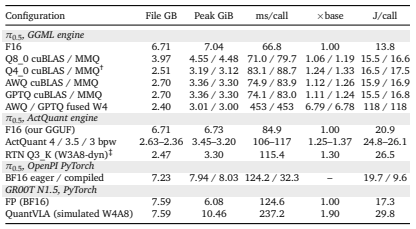
Table 2 :Isolated efficiency on the H100: quan- tization cuts memory but raises latency and energy.Batch 1, 50 calls after warm-up;×base: latency vs. the same engine’s F16.†Later session. ‡Separate session with its own ActQuant-engine F16 (88.5ms; ActQuant 3bpw: 119.3ms,1.35×); ratio vs. that F16.
Original paper · CC BY 4.0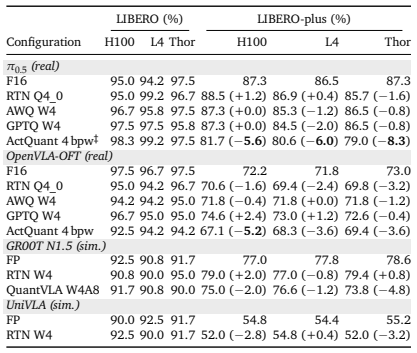
Table 4 :Task success on identical episodes across GPUs(LIBERO: 120 episodes; LIBERO- plus: 252tasks, pairedchangevs.F16onthesame GPU; bold: p<0.05 ). OpenVLA-OFT: real low-bit at ActQuant’s scope.‡Compared with GGML F16, so includes the≈3.7-point engine effect.
Original paper · CC BY 4.0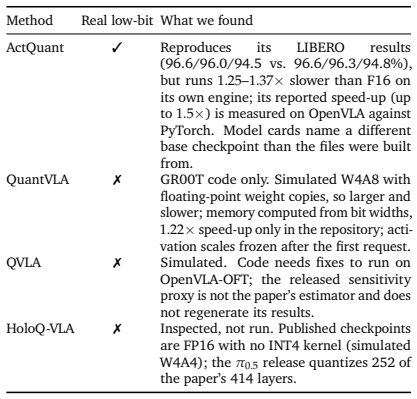
Table 5 :What each VLA-quantization release letsareaderverify(checked October 2026). Real low-bit: low-bit weights and kernels whose mem- ory and speed can be measured.
Original paper · CC BY 4.0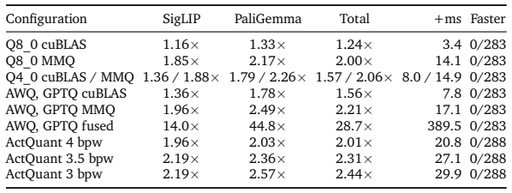
Table 8 : Where the officialπ0.5 BF16 policy spends GPU time (OpenPI PyTorch, eager, batch 1, 10 flow steps). AI: median arithmetic intensity of the component’s weight GEMMs. TFLOP/s, GB/s and % of roof: median achieved values (time-weighted TFLOP/s in parentheses); peaks are datasheet values. PyTorch runs SigLIP on three image slots (two cameras, one masked) and pads the prompt to 200 tokens, giving a 968-token prefix. The total also includes the projector and kernels outside the three components (1.0ms). GEMM includes SigLIP’s patch-embedding convolution; Figure 2 shows only the quantizable linears (11ms).
Original paper · CC BY 4.0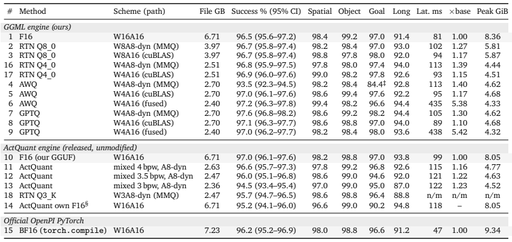
Table 10 : LIBERO-plus success (%) per difficulty level. UniVLA and OpenVLA-OFT levels from their 50% subset (tasks without a level label omitted).
Original paper · CC BY 4.0
Table 12 :Offline action error does not predict closed-loop success(π0.5; mean relative L2 of the action chunk against an unquantized reference, same frames and noise per engine). RTN, AWQ and GPTQ differ by about 20× in error yet reach the same success; ActQuant 4bpw has an error similar to AWQ’s yet loses 2.3 points on LIBERO-plus. ActQuant runs only on its own engine, which draws its own noise, so it is compared with that engine’s F16.
Original paper · CC BY 4.0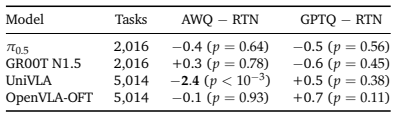
Table 13 : Paired change in LIBERO-plus success of AWQ and GPTQ relative to RTN W4 (points; exact McNemarp). Positive: the calibrated method is more robust than RTN.
Original paper · CC BY 4.0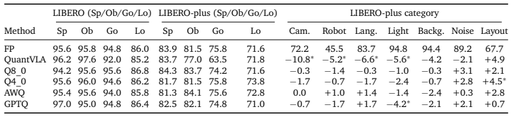
Table 14 : GR00T N1.5 per suite and per LIBERO-plus category. Category columns: success of FP, and paired∆for the others (∗ p<0.05, uncorrected).
Original paper · CC BY 4.0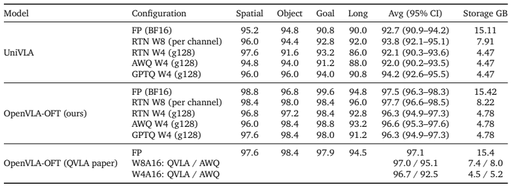
Table 15 : LIBERO success (%) for UniVLA and OpenVLA-OFT with simulated weight-only quantization at QVLA’s 435-module scope, 25 trials per task (1,000 episodes). Weight storage is calculated from the quantized format, not measured. QVLA paper values (OpenVLA-OFT, Table 2 of Xu et al. [2026b]) are the authors’ numbers under their protocol, shown for context only.
Original paper · CC BY 4.0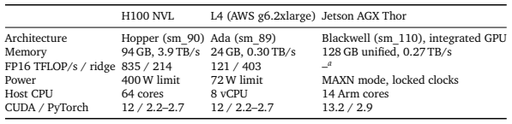
Table 16 :Three platforms, from data center to robot.Ridge: dense FP16 throughput / memory bandwidth (FLOP/B, datasheets); above it, a layer is compute-bound. Energy: GPU-board counter on H100 and L4; GPU rail and whole module on the Thor.aNo published dense FP16 figure.
Original paper · CC BY 4.0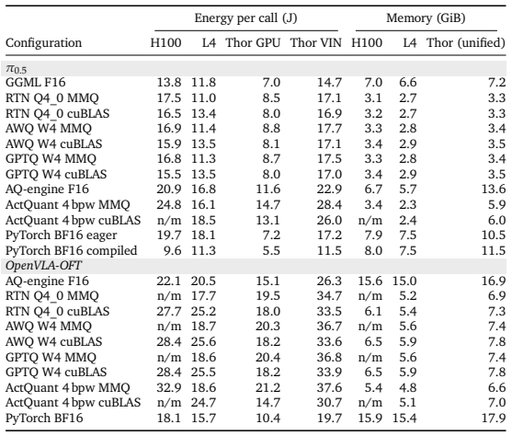
Table 18 : Energy per call (J) and memory (GiB) of the real low-bit configurations. H100 and L4: GPU-board energy (NVML) and per-process peak GPU memory. Thor: GPU-rail (VDD_GPU) and whole-module (VIN) energy, and unified-memory growth (not comparable with the discrete GPUs). n/m: not measured.
Original paper · CC BY 4.0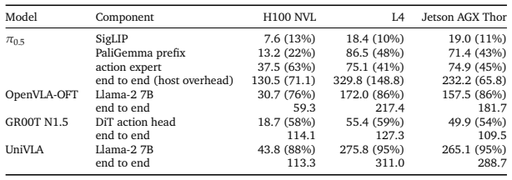
Table 19 : GPU time per policy call by component for the official unquantized models (eager PyTorch, batch 1; ms, share of GPU time in parentheses), and end-to-end time.
Original paper · CC BY 4.0Quote from the paper
Syed Umer Bukhari, Magnus Almgren, Ahmed Ali-Eldin (2026). LoopQ: Fair, Closed-Loop Evaluation of Quantized Vision-Language-Action Models. arXiv:2611.05093v1. https://arxiv.org/abs/2611.05093v1
BibTeX
@misc{bukhari2026loopq,
  title = {{LoopQ: Fair, Closed-Loop Evaluation of Quantized Vision-Language-Action Models}},
  author = {Syed Umer Bukhari and Magnus Almgren and Ahmed Ali-Eldin},
  year = {2026},
  eprint = {2611.05093},
  archivePrefix = {arXiv},
  url = {https://arxiv.org/abs/2611.05093v1}
}