Paper commentary
Same Answer, Different Future: Matched Predictions Do Not Imply Matched Belief Updating in Language Models
Language models with matched predictions can still update beliefs differently
- Problem Matched predictions do not show how beliefs will update on new evidence.
- Method The authors split a belief into content and effective weight, measured as an exchange rate. They prepare states through textual routes and activation steering, then append identical new evidence and measure how much of the old belief persists.
- Results Steered content kept only 0.12 after sixteen new observations, compared with 0.42 for a natural record with the same content.
Why a current answer isn't enough
Language models shift their predictions when given information at inference time, and very different routes can produce nearly the same shift. Observing examples, reading descriptions, receiving instructions, and activation interventions all can produce nearly identical current predictions. Prior work studied the Bayesian properties of in-context learning, its belief-update dynamics, and a unified account with activation steering.
That open question matters because a current prediction doesn't say how a belief will be revised.
A Bayesian example makes the gap concrete. Yet the two posteriors respond differently to the next observation. The stricter test is therefore whether states that agree now keep agreeing under the same additional evidence.
A second obstacle is that one prepared state can be queried in ways that give different answers. Language models generate distributions that differ systematically from the probabilities they describe, so comparing current predictions alone can miss differences in updating. The paper therefore tests belief states on both next-outcome continuations and explicit estimates, using a Bernoulli task with an analytic Bayesian reference.
Separating content from weight
The study splits a belief into two quantities, content and weight, and measures both inside each readout. Weight is read only from an update, so it can't be recovered from the current estimate alone. The characterization is functional, so it assumes no stored neural variable.
The method prepares a state once, then caches the prefix at the boundary where the prompt ends. Every query is forked from that cached boundary, so each readout starts from the same internal state. The sampling readout reads the probability of H against T as the next outcome continuation. An ideal observer gives the same number from both readouts, so any disagreement between them is attributed to the model.
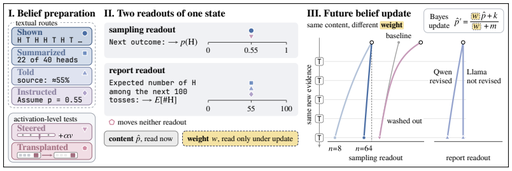
Figure 1 :A belief has a content, which current readouts show, and a weight, which only an update reveals. Both belong to a readout channel, and the route decides all three.I. Four textual routes and two activation-level tests prepare the belief that the next toss is heads with probability 0.55. II. One state, two readouts. III. The same new evidence, forked from each state.
Original paper · CC BY 4.0 · Weihan Li, Junhao Wu, Xinlei Chen, Tianshi Zheng · Same Answer, Different Future: Matched Predictions Do Not Imply Matched Belief Updating in Language Models · Original paper figure · Extracted the figure area from page 2 of the original PDF.New evidence is a segment of m new observations with a proportion kappa of heads, inserted between the boundary and the query. Across a family of states with content proportion pi, the readout is regressed on both pi and kappa, giving the slope a and the sensitivity S. The exchange rate w = m a / S is the number of new observations the old belief is worth.
For a Bayesian observer with prior strength w0 who has seen n observations, the exchange rate equals n.
The retention R = a/a0 compares the old content with its slope before the segment, so routes read with different gain can be compared. The weight is treated as a local exchange rate at one design point, and agreement across segment lengths and units tests whether one weight describes a route.
Routes, readouts and futures: what was run on the three models
The shown route gives a record of 8, 16, 32 or 64 outcomes in order. All routes begin with the same task description, so the coin's unknown fixed probability of heads and the independence of tosses are shared.
Steering adds the mean-difference vector between records with 75% and 25% heads to a shown state at one layer. It is removed before any readout, unless a persistent arm keeps it in place. Hidden-state transplantation copies the residual stream at the last positions of a long record, its frontier, into a short one. The paper's stated routes are minimal pairs, so that each pair changes one thing.
In the document frame the query stays inside the user turn, and the model continues the document. In the assistant frame the assistant's reply begins with the query, giving the assistant-voice continuation.
New evidence comes as a separate segment of m observations, with m at 8, 16 or 32 and a heads proportion of 0.25 or 0.75. A count segment states the same sixteen tosses as 4 H and 12 T, so the study can compare sequences with their sufficient statistic. A state with no content completes the set of futures. The models are Llama-3.1-8B-Instruct, Qwen3-8B and Gemma-3-12B-it, and Gemma enters the weight experiments only through its report channel.
Intervals are 95% bootstrap intervals over families, and equivalence is tested against each model's wording noise floor.
Input format decides which readout carries the belief
The input format decides which readout carries a belief, and the map in Figure 2 shows it across three models. A stated rate moves the estimate in every model and frame, while the document continuation stays where it was. Across the three models and both frames, the slope on the stated rate is at least 0.87 for the estimate and at most 0.13 for the document continuation.
A shown record does the reverse, and the continuation that follows it depends on the model. Qwen's document continuation doesn't follow the record at any length, so the record enters its sampling readout through the assistant frame.
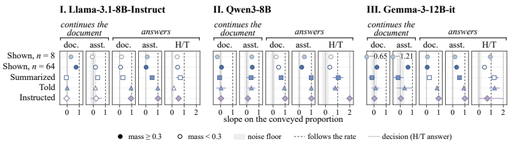
Figure 2 :A statement moves every readout in which the model answers and, but for Qwen’s assistant-voice continuation, none in which it continues the document. A shown record does the reverse.Slope of each readout on the proportion conveyed by the route (1: follows it), with 95% family-bootstrap intervals. Rows: routes; columns: the readouts of the document (doc.) and assistant (asst.) frames and the assistant’s one-token H/T decision, grouped by whether the model continues the document or answers. Gemma’s continuations at n= 8 run against the record (values printed).
Original paper · CC BY 4.0Counts behave like stated rates: they enter the estimate with slopes between 0.5 and 1 and leave the continuation near zero in every model. The record and its count are one belief for an ideal observer, yet the two sit in different channels. The estimate reads a record far less directly than the continuation does. The continuation that carries the record reaches 0.74, 0.45 and 0.64 in the same models.
Counting closes the gap, because Qwen after counting reports the record it counted, with a slope of 0.96 at n = 64. The authors read this as compression, so a record must be reduced to a count, through counting or reasoning, before the estimate uses it.
Weight depends on unit, kind and question
The weight of a belief is set by how its evidence arrives, not by how much evidence it contains. The same sixteen outcomes continued on the record's own line are ignored, with a slope of zero in Llama and 0.08 in Qwen at n = 64.
In the report channel, a summary stating 8 observations is worth 21 to 71 observations across the three models. A summary stating 64 observations is worth 52 to 72 observations in the same models. The count rises eightfold, yet the weight follows it far less, and in Llama not at all. A record and a summary that an ideal observer would treat alike therefore differ in both the channel that holds them and the weight they carry there.
For told rates, Llama treats the rate as a rule, so sixteen contradicting observations leave its estimate nearly where it was. Qwen and Gemma treat the rate as testimony instead and revise it with finite weights of about 95 and 71 observations against written-out evidence. Against a count, Qwen and Gemma revise the rate with about 43 and 42 observations.
Under the expected-count query no model revises an instruction, which the authors treat as a constraint. Under the next-toss question, Llama and Qwen revise an instruction by about 50 observations, while Gemma holds it. The next-toss question also brings the estimate's reading of the record toward the continuation's, and it turns every told rate into testimony.
Changing the question therefore shifts inferred weights by orders of magnitude, while a statement still doesn't enter the sampling readout.
Steering installs content without weight
A steering vector can install the answer, but the first evidence erases it. Qwen receives only the told direction, so the comparison in this section rests on Llama.
After a new segment of sixteen observations, the written content keeps at most 0.12 of its value. The natural record with the same content keeps 0.42 after the same segment. After eight observations, the write keeps about a fifth, against 0.55 for the natural record. The sensitivity to the new segment doesn't change under the write, so a steered state behaves like a natural state whose content the first evidence erases.
The erasure comes from the evidence itself, not from the write's own decay. A passage without observations competes with nothing, so it doesn't erase the write.
A persistent vector, kept in place at every position, behaves differently from the one-shot write. The authors connect this regime to the closed form of Bigelow et al. (2026), where steering acts as a bias on the answer.
A direction taken from told states moves the assistant-voice continuation in Qwen by 0.79 of the natural told difference. A mean-difference direction carries no weight either: the difference between records of 64 and 8 observations, added to the short record, leaves its exchange rate at 3 to 5 observations. The long record alone is worth 17 observations, so the direction doesn't transfer that weight.
Why weight sits in the re-read text
The authors offer one hypothesis to explain all the dissociations they report, and they treat it as an account that fits the data rather than a tested mechanism.
The count is one token, whereas the record was n tokens of evidence, so the model re-reads far less material. A record's weight saturates and follows the segmentation of the text. The question that reads the estimate also changes the weight, because it changes what the model re-reads.
The authors draw two practical consequences from it. A steered belief is undone by sixteen observations and never reaches the model's estimate, so steering sets an answer the model won't defend.
The authors scope this claim to a bare Bernoulli task on three open-weight models, and they tie the weight measurements to the report channel of Gemma.
Where these results stop
The authors confine the study to one quantity: the rate of a Bernoulli source. Their task family offers an analytic reference and a sufficient statistic that is exact. Extending the protocol to a multinomial posterior is left as future work. Richer priors, and beliefs installed in parameters by fine-tuning or model editing, also remain open.
Measurements shift with the prompt format, so a bare stream of symbols moves the exchange rate differently. In that bare format, Gemma's response to new evidence turns positive, as Appendix D reports. Gemma therefore enters the weight experiments only through its report channel. Every main-text figure uses the expected-count query, the end of that range closest to a rule.
As a result, an exchange rate compares routes within one readout and isn't a constant of the model.
The localization of the weight rests on behavioral evidence alone. Hiding part of the record from later positions lowers content and weight in the same proportion, per Appendix K. Such a prediction would have to beat an observer who sees only the text, as Appendix A describes.
Paper info
- Authors
- Weihan Li, Junhao Wu, Xinlei Chen, Tianshi Zheng
- Venue
- arXiv · Preprint
- First published
- 2026-11-5
- Added
- 2026-11-6
- Updated
- 2026-11-5
- Version
- v1
- arXiv
- 2611.07913
- Category
- cs.LG
- Original paper terms
- CC BY 4.0
- What we show
- Paper info, commentary and permitted figures from the original paper
AI commentary is a separate explanation from the original paper and may contain errors. The original paper and figures follow each source's terms of use and any rights noted separately.
Abstract
Language models can produce similar probabilistic predictions after observing outcomes, reading summaries, receiving instructions, or undergoing activation interventions. Whether these routes induce equivalent belief states remains unclear: agreement in current predictions does not establish how a model will respond to subsequent evidence. We investigate this distinction in a Bernoulli inference task with an analytic Bayesian reference. Across three open-weight language models, we prepare states through four textual routes and two activation-level interventions, measure both next-outcome continuations and explicit probabilistic estimates, and append identical new evidence from each prepared state. We quantify the persistence of the initial belief through its effective evidence weight, the number of new observations it is worth. We find that the format of evidence decides which readouts express its content: outcome sequences primarily affect continuations, whereas summaries and stated rates primarily affect explicit estimates. Moreover, effective weights differ substantially across routes, with summaries receiving weights that scale weakly with their stated observation counts and elicitation questions changing inferred weights by orders of magnitude. In a one-shot steering setting, an intervention that reproduces a natural record's immediate prediction loses most of its effect under subsequent evidence. These results show that agreement in current readouts is insufficient to establish equivalence in belief updating: how a belief is acquired and how it is read jointly determine its subsequent dynamics.
Quote from the paper
Weihan Li, Junhao Wu, Xinlei Chen, Tianshi Zheng (2026). Same Answer, Different Future: Matched Predictions Do Not Imply Matched Belief Updating in Language Models. arXiv:2611.07913v1. https://arxiv.org/abs/2611.07913v1
BibTeX
@misc{li2026same,
  title = {{Same Answer, Different Future: Matched Predictions Do Not Imply Matched Belief Updating in Language Models}},
  author = {Weihan Li and Junhao Wu and Xinlei Chen and Tianshi Zheng},
  year = {2026},
  eprint = {2611.07913},
  archivePrefix = {arXiv},
  url = {https://arxiv.org/abs/2611.07913v1}
}