Paper commentary
Beyond Row-Level Prediction: Evaluating and Learning Composition for Reusable Table Representations
Learned composition over frozen cell states gives table embeddings that track partial-view overlap
- Problem Row-level prediction scores don't show whether a table embedding stays useful when only part of the table is seen. Strong tabular models like TabPFN and ConTextTab produce weak table embeddings under simple pooling such as mean or max.
- Method SCDM is a self-supervised loss that trains a small head over frozen ConTextTab cell states. It matches the distribution of embedding similarities to the distribution of partition overlaps, within and across tables.
- Results On synthetic data, the learned head raised the Spearman correlation between embedding similarity and partial-view overlap from 0.04 to 0.43 to 0.50. Gains on real data were smaller but systematic.
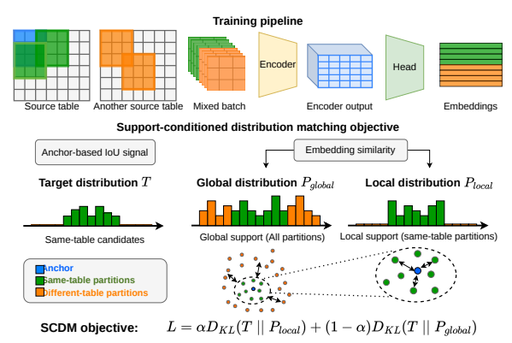
Figure 4 : Learning table-level composition on top of frozenConTextTab. At the top, partitions sampled from one source table and from other source tables are collated into mixed batches, encoded by the frozen backbone, and aggregated by a trainable representation head into table embeddings. At the bottom, support- conditioned distribution matching defines a target distributionT from anchor-based overlap and matches it with local and global similarity distributions induced by the learned embeddings.
Original paper · CC BY 4.0 · Ali Younes, Saeed Ghoorchian, Maximilian Schambach, Georgia Chalvatzaki, Johannes Höhne · Beyond Row-Level Prediction: Evaluating and Learning Composition for Reusable Table Representations · Original paper figure · Extracted the figure area from page 9 of the original PDF.Why row-level scores miss table embeddings
Corpus operations such as indexing, deduplication and overlap estimation need one embedding vector per table. Yet table representation methods are mostly judged by row-level prediction or by supervised downstream tasks. A good row-level predictor can therefore still produce a weak table embedding, which the row-level score never measures.
The authors use composition in this representational sense and don't study compositional generalization. Answering the second question requires measuring the embedding directly, which the authors do with partitions sampled from source tables.
Four desiderata measured on partial views
The benchmark scores every table embedding with four desiderata, so all methods face the same observation interface. D1 checks whether two partial views that share more content end up more similar in embedding space. It is scored as the Spearman correlation with intersection over union between the two partitions. The method never receives partition coordinates or overlap values, which the benchmark uses only for scoring.
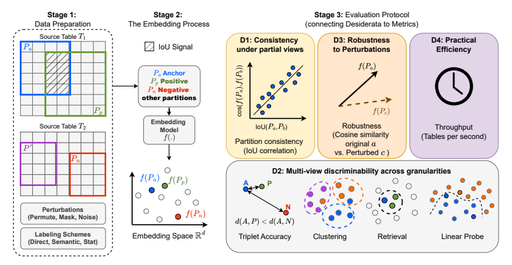
Figure 1 : The evaluation pipeline. Stage 1 samples partitions from source tables and attaches labeling schemes and perturbations. Stage 2 maps each partition to a single table-level embedding, either directly or by composing local encoder states with a fixed or learned compositional rule. Stage 3 measures the four desiderata through concrete metrics, so lightweight baselines and foundation-model-derived representations are compared under the same observation interface. or supervised downstream tasks (Hollmann et al., 2025; Spinaci et al., 2025; Hoppe et al., 2025). Naturally, these evaluations show how well a model predicts, not how good its table-level embedding is.
Original paper · CC BY 4.0D2 checks whether embeddings group and separate partitions under several label granularities. Direct labels mark source-table identity, Semantic labels mark higher-level groups, and Stat labels mark coarse statistical signatures. Semantic+Difficulty adds generator difficulty to the synthetic semantic labels, and it appears only on synthetic data.
Triplet ranking, clustering, retrieval and linear probing read this structure from different angles.
D4 counts tables per second in a controlled encode-only setting. Repeating the full evaluation over 10 random seeds yields 10,000 sampled partition instances per embedder. The real-data benchmark draws its tables from CARTE, OpenML-CC18 and OpenML-CTR23. Table 1 maps each desideratum to its main metric, and Figure 1 shows the three stages of the pipeline.
Fixed pooling leaves the TFMs at the bottom
On synthetic data, HashingSchema and HashingText reach D1 correlations of 0.59 and 0.54. Those four variants also occupy the bottom four places in the descriptive overall ranking.
To check whether mean pooling alone causes this, the authors compute five parameter-free rules from one forward pass. Only the final reduction differs, so encoder, inputs, partitions and seeds stay identical.
A column-renaming check tests whether the benchmark rewards exact header overlap. HashingText, which also reads cell values, changes by at most 0.05 in D1. The authors read this as the fingerprints' lead not resting on header matching alone.
The authors stress that this shows fixed pooling yields weak embeddings, not that the encoder states lack the information.
Learning the rule over frozen states with SCDM
The fixed-pooling results raise a question: do the ConTextTab states lack the information, or does pooling fail to expose it? To separate the two, the authors keep ConTextTab frozen and change only the compositional rule, which is replaced by a lightweight learned head. The head needs no external labels, because the benchmark's own sampling records whether two partitions share a table and how much they overlap.
Each head family, Attention, GatedAttention or GatedMLP, pools the frozen cell states into rows and rows into one table embedding with learned weights. The head changes the aggregation architecture and the training objective together, so the experiment can't separate the two. For an anchor partition A, a mixed batch holds the other partitions, and S is the set of those from the same source table.
The similarity of a candidate Q to the anchor is cos(z(A), z(Q)) divided by a temperature τ = 0.07. The target distribution T gives each same-table candidate its IoU with the anchor, normalized over S and zero elsewhere. The local distribution P_local normalizes the exponentiated similarities over S, while P_global normalizes them over the full batch B.
SCDM sums the two KL divergences, L = α D_KL(T||P_local) + (1 − α) D_KL(T||P_global), so α sets the trade-off between within-table overlap structure and cross-table discrimination.
The heads train on real tables only, with a partition sampler different from the benchmark's, so synthetic results test transfer to unseen table families.
Learned heads lift ConTextTab on consistency and retrieval
The learned heads on frozen ConTextTab states improve the table-level embeddings on the benchmark, with the exception of one configuration. The exception is Attention with α = 1, which gives D1 0.17 and triplet ranking 0.24 versus 0.25. Across the fifteen configurations, the three head families are trained at five values of α, and the sweep is reported in full.
The gains on real data are smaller than on synthetic data, but they are systematic across the sweep.
The authors credit the gain to the composition rule, because the encoder is unchanged and frozen. The heads never see the raw table, so they can use only the information exposed in the frozen states. With the heads, ConTextTab-R Attention ranks first on synthetic data and second on real data, behind HashingText. Pooled ConTextTab ranks 14th and 12th on the two corpora.
The experiment doesn't separate the two possible causes, because the head changes the aggregation architecture and the training objective together. The authors don't identify which of these causes is responsible.
Parent-table retrieval as a downstream check
Each query is a sampled partition, and the candidate corpus holds 100 source tables. A query succeeds when the partial view stays close to its source table and separates from other tables.
On synthetic data, ConTextTab-R Attention reaches Recall@1 0.20, compared to 0.05 for pooled ConTextTab.
SCDM never sees the retrieval metric, but its overlap and same-table signals are close to source recovery, so for the heads this is a consistency check.
These correlations are descriptive and partly expected, because D2 includes the Direct component that retrieval shares. Retrieval tests table selection in a closed corpus, not the full tabular RAG pipeline.
What the heads suggest for model design
The head sees only the frozen ConTextTab cell states, so any gain comes from the rule and its supervision rather than from encoder training.
Either comparison would show whether the aggregator or the loss drives the gain.
A large gain under the learned head would show that the fixed rule limits the pooled embedding. Other TFMs may yield more or less useful embeddings under fixed pooling, so the two-model findings don't generalize automatically.
Where the findings stop
A different similarity function or a learned metric could reorder the twelve methods. The fixed-composition findings rest on two TFMs, so other models may give more or less useful embeddings under fixed pooling.
The learned-composition experiment uses one backbone, ConTextTab, so the compositional rule is the only trained component. Changing the target could therefore shift the fixed-pooling numbers reported here.
Open-world retrieval and multi-table reasoning lie outside the scope of that task. They don't capture variation across training runs.
The learned-head results are averaged over label types, and their split across Direct, Semantic, and Stat labels isn't analyzed.
Paper info
- Authors
- Ali Younes, Saeed Ghoorchian, Maximilian Schambach, Georgia Chalvatzaki, Johannes Höhne
- Venue
- arXiv · Preprint
- First published
- 2026-11-10
- Added
- 2026-11-13
- Updated
- 2026-11-10
- Version
- v1
- arXiv
- 2611.14697
- Category
- cs.LG
- Original paper terms
- CC BY 4.0
- What we show
- Paper info, commentary and permitted figures from the original paper
AI commentary is a separate explanation from the original paper and may contain errors. The original paper and figures follow each source's terms of use and any rights noted separately.
Abstract
Tables are compositional, with content spread across a schema, cell values, rows, and columns. Large-scale operations such as retrieval, overlap estimation, deduplication, and data curation need these local signals composed into one reusable embedding vector per table. Table representation methods, however, are mostly evaluated through row-level prediction or supervised downstream tasks, which do not measure table-level embedding quality directly. We introduce a benchmark that evaluates table-level embeddings through four desiderata: consistency under partial views, discriminability across label granularities, robustness to benign perturbations, and efficiency. Across twelve methods on synthetic and real corpora, lightweight schema- and text-based fingerprints are among the strongest. The sharpest contrast comes from two tabular foundation models, TabPFN and ConTextTab: although both are strong row-level predictors, their states, composed by mean, max, or three further parameter-free pooling rules, trail the strongest fingerprints. We therefore ask whether the gap lies in the encoder or in the compositional rule. Keeping ConTextTab frozen, we learn only the compositional rule over its cell states, using support-conditioned distribution matching (SCDM), a self-supervised loss we propose that matches the distribution of embedding similarities to the distribution of partition overlaps within and across tables. Across all fifteen head configurations, the learned rule raises the Spearman correlation between embedding similarity and partial-view overlap from 0.04 to 0.43-0.50 on synthetic data and improves triplet ranking, clustering, and retrieval, with smaller but systematic gains on real data. A downstream parent-table retrieval task confirms these findings. How local states are composed, and with what objective, substantially affects the quality of table-level embeddings.
Quote from the paper
Ali Younes, Saeed Ghoorchian, Maximilian Schambach, Georgia Chalvatzaki, Johannes Höhne (2026). Beyond Row-Level Prediction: Evaluating and Learning Composition for Reusable Table Representations. arXiv:2611.14697v1. https://arxiv.org/abs/2611.14697v1
BibTeX
@misc{younes2026beyond,
  title = {{Beyond Row-Level Prediction: Evaluating and Learning Composition for Reusable Table Representations}},
  author = {Ali Younes and Saeed Ghoorchian and Maximilian Schambach and Georgia Chalvatzaki and Johannes Höhne},
  year = {2026},
  eprint = {2611.14697},
  archivePrefix = {arXiv},
  url = {https://arxiv.org/abs/2611.14697v1}
}