Paper commentary
Reality Perception Gap: Are AI-Manipulated Video Detectors Ready for the Real World?
Detectors for AI-manipulated video fail once reposting compression is applied
- Problem AI-video detectors are tested on clean, curated clips, but real videos are recompressed by social platforms and captured by imperfect cameras. Detectors trained and scored that way have never been checked on this footage.
- Method RPG runs 10,000 videos through simulated social-media repost chains.
- Results No detector catches more than 15% of fakes at a 1% false-positive rate. Repost compression erases the low-level traces that artifact-based detectors rely on.
Where clean benchmarks stop short
Most clean benchmarks test detectors on outputs from generators that predate the current frontier. Detectors trained on these sets already score above 97%, so there is little headroom left to gain. Real deployment pushes detectors in two opposite directions. Repeated repost compression strips away the subtle artifacts that many detectors depend on.
Imperfect optics, by contrast, add distortion that looks like generative artifacts and produces false positives.
Existing benchmarks also leave three gaps that matter for deployment. As a result, high-stakes scenes like crime, disaster, and conflict rarely appear in them. Second, few benchmarks treat re-encoding as a controlled factor. Third, none reports stripping file metadata or removing cues that human viewers could exploit.
RPG is built to close all three gaps while adding camera-effect footage. Its pipeline also drops file metadata, evens out resolution, and hides playback-speed and border cues. GenBuster-200K's Wild track of 150 forgeries is the closest prior step, but it can't attribute a failure to one transformation. Table 1 lays these benchmarks side by side with RPG.
How RPG adds deployment conditions
RPG keeps real and fake clips tied to the same source pools, then runs every clip through the same repost chains. The idea is that detectors should face the footage people actually share, not the clean outputs of a generator.
Every clip comes from one of three source pools: HowTo100M (26%), OpenVid-HD (21%) and a YouTube crawl of socially fragile categories (53%). General-purpose corpora mostly hold everyday activity, so the authors crawled crime, disaster, surveillance and wartime footage to add. The camera-effect clips show autofocus hunting, chromatic aberration, rolling shutter or high ISO noise, which can mimic generative artifacts.
The split is about 70% AI-manipulated and 30% real.
Fakes come from two routes: image-to-video generation and video-to-video editing. A captioner describes each real clip, and three generators, Wan-2.2, Hunyuan-1.5 and LTX-2, rebuild it from its first frame and that caption. For editing, Wan2.2-Animate swaps the person in 150 human-centric clips, Hi-Light relights 200 clips, and Skyreels-V3 extends real videos.
Relighting is kept to 3% of the fakes, since a single manipulation type that most detectors already fail on would otherwise dominate the aggregate scores.
Every video then goes through a repost chain of simulated re-encodes, using platform profiles measured on real uploads. The platforms covered are WeChat, WhatsApp, TikTok, RedNote, Instagram and X. The authors found AUC barely moved beyond 5 re-encodes, so they capped the chains at 20.
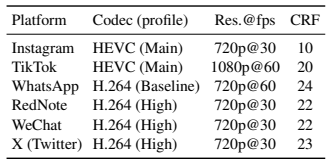
Table 2 . Per-platform compression profiles used, set from real up- load videos per platform. Codec reports the codec and the encoder profile that gates the available coding tools; Res.@fps is the high- est output resolution and frame rate; CRF is the constant-quality target of our x264/x265 encode (lower=higher quality).
Original paper · CC BY 4.0Several steps stop labels from leaking through file properties or human cues. Center crops at 0.8× and 0.9×, applied to 15% of videos each, remove border flaws that a viewer might judge first. All container metadata is stripped, the handler name is set to VideoHandler, and the colour description fields are marked unspecified.
How the 18 detectors fare when always answering fake no longer wins
Roughly 70% of RPG clips are fake, so always answering fake already gives about 70% accuracy. No evaluated detector beats that trivial baseline, so the authors read Macro F1, AUC and TPR@1%FPR instead. Macro F1 corrects for class imbalance, while AUC measures threshold-free ranking quality. Table 3 lists the trivial reference values, such as always-fake at 0.413 Macro F1 and always-real at 0.229.
VLM-based detectors are scored by the log-odds log p(fake) minus log p(real), while binary metrics use each detector's own decision. The log-odds ranks videos like the normalized fake probability but doesn't saturate at high confidence.
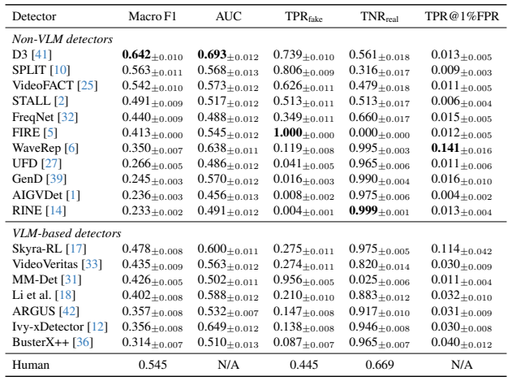
Table 3 . Quantitative results on RPG, ordered by Macro F1 within each group;±gives the 95% bootstrap half-width. A random 70/30 guesser reaches Macro F1 0.504, always-fake 0.413, and always-real 0.229, and random scoring gives AUC 0.500 and TPR@1%FPR 0.010. Human results cover a 22-clip subset with binary labels, so their AUC and TPR@1%FPR are N/A. VLM-based detectors are scored by log-odds.
Original paper · CC BY 4.0Its TPR@1%FPR is only 0.013, so its score distributions overlap too much for a low-FPR operating point. No detector catches more than 15% of fakes at 1% FPR, which the authors read as evidence that none is deployment-ready.
Most VLM-based detectors default to real, so they accept most real clips while catching only a minority of fakes. MM-Det goes the other way, with a TPR fake of 0.956 and a TNR real of 0.025, so it collapses toward fake. Default thresholds therefore range from highly conservative, as with WaveRep, to highly aggressive, as with FIRE and MM-Det.
Each detector therefore needs threshold calibration on held-out data before it is deployed.
Human viewers reach 0.547 accuracy on the 22-clip subset, close to the 0.545 that always-fake labeling gets. The human study drew on 212 undergraduate volunteers and 13 AI specialists, who labeled 12 fake and 10 real clips.
Separating generator shift from re-encoding
A positive control on AIGVDBench separates the two, and the authors ran it with four detectors, WaveRep, GenD, D3 and Skyra-RL. They kept the RPG videos identical across the sweep, so any change along the re-encoding axis comes from re-encoding alone.
Before any compression, generator and content shift alone takes Skyra-RL from 0.74 AUC on AIGVDBench to 0.63 on RPG. Over the same step, WaveRep stays strong, moving from 0.98 to 0.93. So the benchmark's generators and content already hurt some detectors before any repost compression is applied.
Re-encoding reverses the pattern: WaveRep drops from 0.93 to near 0.5 within 5 re-encodes. GenD and Skyra-RL lose a further 0.06 to 0.08 AUC. D3 stays near 0.69 AUC under every condition, so it survives reposting but never gets strong. Beyond 5 re-encodes, every curve stays flat.
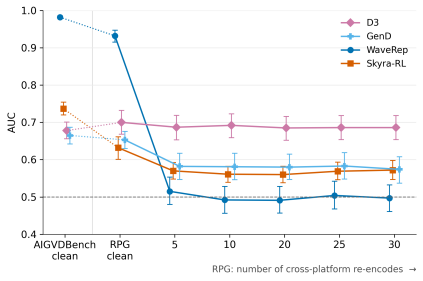
Figure 3 . Positive control and re-encoding sweep. Each point is a detector’s AUC on AIGVDBench, or on the same RPG videos before compression and after 5 to 30 cross-platform re-encodes (right). Each video passes through a mixed chain of platforms.
Original paper · CC BY 4.0 · Xiangrui Liu, Xinmiao Luan, Xinyuan Wang, Zhiyuan Fang, Chi-Yao Huang, Douglas C. Montgomery, Yanjie Fu, Felix Juefei-Xu, YeZhou Yang · Reality Perception Gap: Are AI-Manipulated Video Detectors Ready for the Real World? · Original paper figure · Extracted the figure area from page 6 of the original PDF.Figure 5 shows the mechanism: after 20 re-encodes, the scattered edge responses over sky and smoke disappear in both the real and generated frames. The two re-encoded frames look nearly alike at the noise level, since codec artifacts common to both replace the low-amplitude, high-frequency trace that separated them. The authors connect this to WaveRep's collapse, because WaveRep reads that mid-high frequency residual.
Camera effects and fragile scenes
Camera effects can push real footage into the fake bin for some detectors, and the paper tests this on a dedicated subset of RPG. VideoFACT shows a similar increase of 0.197, so the forensic family follows the same pattern as the spatio-temporal family. Authentic footage then acquires the signature that these detectors associate with generation.
Camera effects are standard in smartphone recording, so this sensitivity directly produces false alarms on everyday user content. The failure reverses on socially fragile fakes, where the VLM-based detectors miss more fakes.
The authors call this a red flag for VLM-based detection, because fabricated videos of these events cause the most harm. Those same scenes are where these detectors are least reliable, so the weakness lands on the highest-stakes content. The authors' fix is to train under deployment conditions, which the Future Directions section develops.
Generator-level differences
Per-generator AUC shows how far each detector's score moves from one generator to the next. The All column matches the aggregate AUC in Table 3, so the single average hides these shifts. Many detectors stay near chance on individual generators, even when they look passable overall.
For WaveRep and D3, SkyReels-V3, a video extension generator, is the toughest of the generators tested. Hi-Light, a video relighting generator, is the second hardest case for WaveRep. The synthesis residuals that WaveRep relies on are weaker in both SkyReels-V3 and Hi-Light outputs. For SkyReels-V3, D3's temporal statistics sit closer to those of real video.
On D3, Hunyuan-1.5 gives the easiest test, against an aggregate D3 AUC of 0.693.
VLM-based detectors depend on the generator even more, according to the paper. Ivy-xDetector is strong on Hi-Light and Wan-Animate, but it drops to near 0.5 on SkyReels-V3. Skyra-RL is strong on LTX-2, yet it falls below 0.5 on Wan-2.2, Hi-Light, and Wan-Animate. Hunyuan-1.5 pushes UFD, RINE, and AIGVDet below 0.5, which suggests a distinctive artifact signature they misread.
Ivy-xDetector reaches an aggregate AUC of 0.649, yet its per-generator results swing from strong to near chance.
Open problems and limits
The authors keep RPG's labels on an evaluation server, so the benchmark can be refreshed without contaminating earlier results. They didn't test audio, since RPG stays visual only, and they list synchronized audio as a next step. The human study covers only 22 clips, 12 AI-manipulated and 10 real, so the authors use it as a perceptual reference.
DeCoF and DeMamba are left out, because neither released a paper-matched checkpoint or enough training details to reproduce one. The benchmark chains stop at 20 re-encodes, while the positive-control sweep goes up to 30.
The second direction asks that robustness be learned under deployment conditions, because WaveRep's mid-high frequency cues don't survive repeated re-encoding. A test would train on platform re-encoded video and evaluate on an independent corpus, which shows whether that gap closes.
The third direction treats the detector families as complementary, since WaveRep leads at 1% FPR and D3 is nearly invariant to re-encoding. Skyra-RL survives re-encoding far better than WaveRep, losing 0.06 AUC against 0.41. The authors also judge their confidence unreliable, since some of these models rank real videos among their most confident fakes.
Grounding decisions in physical and causal plausibility is the other next step, because generated videos still break such rules in ways viewers notice.
The authors propose embedding a signature in the generator's noise latent that the decoder needs, so stripping it breaks the frame.
Paper info
- Authors
- Xiangrui Liu, Xinmiao Luan, Xinyuan Wang, Zhiyuan Fang, Chi-Yao Huang, Douglas C. Montgomery, Yanjie Fu, Felix Juefei-Xu, YeZhou Yang
- Venue
- arXiv · Preprint
- First published
- 2026-11-11
- Added
- 2026-11-13
- Updated
- 2026-11-11
- Version
- v1
- arXiv
- 2611.14941
- Category
- cs.CV
- Original paper terms
- CC BY 4.0
- What we show
- Paper info, commentary and permitted figures from the original paper
AI commentary is a separate explanation from the original paper and may contain errors. The original paper and figures follow each source's terms of use and any rights noted separately.
Abstract
AI-manipulated video detectors are typically evaluated on clean, curated datasets. In deployment, however, videos have usually passed through repost compression on social-media platforms and sometimes were captured by imperfect hardware. To measure detection under these conditions, we introduce Reality Perception Gap (RPG), a benchmark of 10,000 videos from frontier generators and partially synthetic edits, processed with cross-platform repost compression and paired with real footage that carries camera-side optical artifacts. RPG also includes socially fragile content, such as crime and wartime footage, where fabricated videos can cause severe social harm. Across 18 detectors, none catches more than 15% of fakes at a 1% false-positive rate. A positive control and a re-encoding sweep separate two sources of failure: generator and content shift degrades detectors before any compression, and repost compression erases the low-level traces that the artifact-based detectors relies on. Existing detectors therefore struggle when deployment conditions strip away the generation artifacts they rely on. These complementary failures suggest that robust detection requires training under deployment conditions and combining low-level, temporal, and semantic evidence, where passive detection may have reached its limits.
Quote from the paper
Xiangrui Liu, Xinmiao Luan, Xinyuan Wang, Zhiyuan Fang, Chi-Yao Huang, Douglas C. Montgomery, Yanjie Fu, Felix Juefei-Xu, YeZhou Yang (2026). Reality Perception Gap: Are AI-Manipulated Video Detectors Ready for the Real World?. arXiv:2611.14941v1. https://arxiv.org/abs/2611.14941v1
BibTeX
@misc{liu2026reality,
  title = {{Reality Perception Gap: Are AI-Manipulated Video Detectors Ready for the Real World?}},
  author = {Xiangrui Liu and Xinmiao Luan and Xinyuan Wang and Zhiyuan Fang and Chi-Yao Huang and Douglas C. Montgomery and Yanjie Fu and Felix Juefei-Xu and YeZhou Yang},
  year = {2026},
  eprint = {2611.14941},
  archivePrefix = {arXiv},
  url = {https://arxiv.org/abs/2611.14941v1}
}