Paper commentary
RAFT: Reasoning-Aligned Fine-Tuning Improves Robustness of VLA Post-Training
RAFT trains a reasoning adapter first so VLA policies stay robust
- Problem Adapting a generalist VLA policy to a target task with few demonstrations raises success on the demonstrated layout. But the policy can then break when the scene, objects, or instructions shift.
- Method RAFT first trains low-rank adapters on task-relevant reasoning annotations, then freezes them while the policy learns actions from demonstrations.
- Results On a physical DROID robot, RAFT reaches 75.0% out-of-distribution success, compared with 27.9% for plain fine-tuning.
Why narrow demonstrations hurt robustness
A generalist VLA is usually adapted with a small demonstration set collected in a narrow set of environments, because collecting task-specific demonstrations is expensive. The paper's own nominal-success framing makes the gap explicit: a policy can look good on the demonstrated layout and still break once the scene shifts.
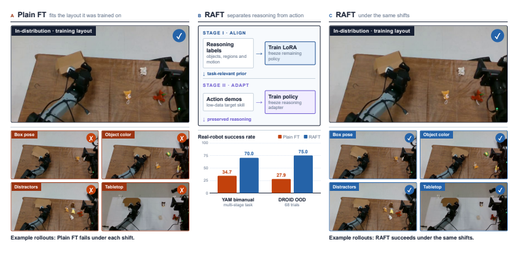
Figure 1 | Reasoning-aligned fine-tuning for robust VLA adaptation.(a) Plain FT, fine-tuned only on actions, succeeds in the training layout but fails under small scene changes. (b)RAFTfirst learns task-relevant reasoning through LoRA adapters, then freezes them while fine-tuning the policy on action demonstrations. (c) With the same demonstrations,RAFTsucceeds under these shifts. On physical robots,RAFTraises success over Plain FT from34.7%to70.0%on YAM and from27.9%to75.0%on out-of-distribution DROID trials.
Original paper · CC BY 4.0 · Shresth Grover, Andrey Kolobov, Dhruv Shah · RAFT: Reasoning-Aligned Fine-Tuning Improves Robustness of VLA Post-Training · Original paper figure · Extracted the figure area from page 2 of the original PDF.Existing fixes act on the weights after the fact. The authors take a different route: they prepare the policy with task-relevant reasoning supervision before adapting it to the target actions. They don't merge weights or constrain drift during action training, so their change happens earlier in the schedule.
The paper reports that the robustness gap shows up on physical robots as well as in simulation. These numbers show that narrow fine-tuning hurts most when the target scene moves away from the demonstrations.
Staging reasoning before action in RAFT
RAFT splits adaptation into two stages, and the split decides which parameters can move at each step. During Stage I, the pretrained parameters stay fixed while only the LoRA parameters are trained. A VLM annotator, Gemini 3.1 Pro, produces the reasoning targets from observations and instructions on D_eta, giving D_reason. Each annotation is a target token sequence trained with standard autoregressive cross-entropy, as in Equation (1).
Stage II takes the learned adapter phi-star and freezes its parameters before any action training begins. Because the adapter is frozen, action gradients never update the reasoning adapter directly. The SigLIP vision tower also remains frozen in Stage II, so vision adaptation happens only through the Stage-I LoRA modules. Pretrained SigLIP weights stay frozen in both stages, which means the vision encoder changes only through the reasoning LoRA.
The authors designed this ordering because co-training reasoning and actions performed worse than plain fine-tuning. Reasoning supervision first shapes the representation, then action learning reads from that representation without rewriting it. Deployment uses the resulting policy with the Stage-II weights and the frozen Stage-I adapter together.
The adapter ablation in Sec. C.2 tests whether freezing the adapter during action learning actually matters.
What each stage optimizes
Stage I fits only the LoRA adapter φ, using reasoning annotations as targets for the frozen pretrained model. A VLM annotator (Gemini 3.1 Pro) produces the reasoning targets from observations and instructions on D_η, giving D_reason. Each target is a token sequence r, and the adapter is trained with standard autoregressive cross-entropy over its tokens.
The loss sums the log-probability of each target token r_j given the observation, the instruction and the earlier tokens. Only φ is updated in this stage, so all remaining parameters stay frozen. The supervision encourages task-relevant grounding before action adaptation begins.
The SigLIP vision tower also stays frozen in this stage, so vision adaptation comes only from the Stage I LoRA. Stage II minimizes the standard supervised fine-tuning objective ℓ_SFT on the task demonstrations, giving θ★ = argmin over θ of the expectation over D_η. Because the adapter is frozen, action gradients never reach the reasoning adapter weights.
The action output is a continuous chunk trained with a flow-matching loss, as Figure 2 shows.
At deployment, the policy is the pair θ★ and φ★, so the reasoning adapter is kept in the final model. The adapter ablation in Sec. C.2 tests whether freezing the adapter during action learning matters.
Simulated pick-and-place and open-drawer results under distribution shift
The simulated experiments ask whether the frozen-adapter schedule keeps its advantage under visual, object and instruction shifts. The authors post-train MolmoBot on 106 successful demonstrations from one layout in the MolmoSpaces benchmark. Each split, in-distribution or shifted, contains 106 trials with matched seeds across methods. OOD-prompt paraphrases the instruction without changing its meaning.
That object-shift gap is the clearest sign that the frozen adapter helps when the object itself is new to the policy.
RAFT also leads under lighting and instruction shifts on this task.
Physical DROID and YAM results
On the physical DROID robot, MolmoBot is post-trained on 50 pick-and-place demonstrations and tested under four axes. The four axes are the demonstration setup, novel object colors, added distractors, and a changed tabletop surface.

Figure 6 | Real-robot results under distribution shift.Left: DROID pick and place. Right: YAM box opening and place inside box.RAFThas the highest success on both platforms:75%versus28%for Plain FT on out-of-distribution DROID trials, and70%versus35%on YAM.
Original paper · CC BY 4.0On the dual-arm YAM platform, the authors post-train π0.5 on 100 demonstrations of a long-horizon task. The task opens a hinged box, picks up an object, and places it inside. Placement only makes sense once the box is open, so the task has a first interaction and a second one.
Figure 6 shows the per-axis breakdown for both physical platforms. The gains on the physical robots are therefore largest on the second step of the task, the placement.
Why freezing the adapter matters
Co-training mixes reasoning and action examples in one training run, sampling them in a 50/50 ratio with equal loss weights. That is below Plain FT at 79.62%, so joint training underperforms plain fine-tuning in this setting.
The authors keep the same Stage-I LoRA in each setting and vary only how it is treated in Stage II. Leaving the LoRA trainable in Stage II lowers mean success to 73.96%, while freezing it gives 83.21%. Freezing the adapter works because Stage II updates only the policy, so action gradients never reach the reasoning weights.
Plain FT with a frozen vision encoder also stays at 79.62%, so freezing the vision weights alone doesn't explain the gain.
What the representation analysis shows
The formula is PR = (sum of lambda_i)^2 divided by the sum of lambda_i^2, so PR grows when variance spreads over many directions. Across six Stage-I reasoning variants, absolute PR at layer 15 has a mean Spearman correlation of 0.76 with success. Because this correlation comes from only six variants, it shows association rather than causation.
The linear probes ask whether object identity and episode-time quartile can be read from the late layers. In layers 14 to 17, probes on RAFT reach 0.51 to 0.53 balanced accuracy for object identity, against chance at 1/7. Plain FT reaches 0.45 on the same probe, and the base policy reaches 0.40. The layer-wise curves in Figure 9 show object-identity decoding rising sharply between layers 13 and 15 for RAFT, but barely changing for Plain FT or the base policy.
For episode-time quartile, RAFT reaches 0.62 to 0.65, against 0.55 for Plain FT and 0.51 for the base policy.
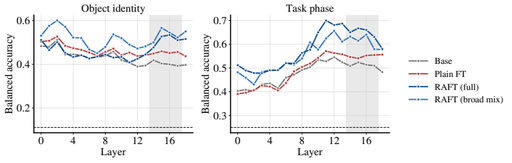
Figure 9 | Layer-wise linear probes.Balanced accuracy for object identity (left; chance1/7) and episode-time quartile (right; chance1/4). Policies use the same 414 frames; episodes are held out from probe fitting, not policy training. Shading marks layers 14–17. In these layers,RAFTreaches 0.51–0.53 object-identity accuracy versus 0.45 for Plain FT, and 0.62–0.65 quartile accuracy versus 0.55.
Original paper · CC BY 4.0The attention enrichment measure compares how much of the policy's visual attention lands on annotated task regions with their share of the image. At layer 11, RAFT gives annotated task regions 3.2 to 3.4 times their uniform attention share, versus 1.9 to 2.1 for Plain FT. Background attention stays near uniform, so the extra attention goes to the annotated regions.
The separation narrows in later layers, and the concentration persists through Stage-II action training.
How much reasoning data is needed
Reasoning-corpus size and composition change both the held-out loss and the downstream success of RAFT. The authors checked this trend in both frame-subsampled and episode-subsampled series.
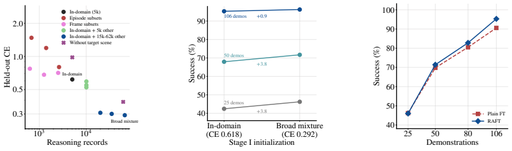
Figure 11 | Effect of reasoning data and demonstration budget.Left: held-out reasoning loss across corpus sizes and constructions. Middle: in-distribution pick-and-place success after 5,000 Stage-II steps from in-domain and broader-mixture Stage-I initializations. Right:RAFTversus Plain FT across demonstration budgets, with 106 evaluation episodes per budget. The broader mixture lowers held-out loss (0.29 versus 0.62) and improves this success by 0.9–3.8 points at every budget.
Original paper · CC BY 4.0That mixture lowers held-out loss to 0.29, compared to 0.62 for the in-domain corpus. Even with target-simulator records removed, the broader mixture still reaches 0.39.
Against Plain FT at matched budgets, the two methods tie with 25 demonstrations at 46.2% success each. So a broader reasoning corpus helps the downstream policy within the budgets the authors tested.
Limitations of the RAFT results
The best Stage-I modality depends on the metric, so no single target format wins on every axis. Full reasoning reaches the highest in-distribution pick-and-place success at 95.28%. Trajectory traces lead on OOD-object success at 45.28%, which shows the trade-off between the two readings. Stage-II training and the evaluation protocol stay fixed across the modality variants, so the gaps trace back to the Stage-I target format.
The simulated splits use 106 trials each, with matched seeds across methods. The YAM evaluation uses 30 trials per OOD axis, so each physical comparison rests on a small number of rollouts.
The simulated study uses one MolmoSpaces layout, with 106 successful demonstrations for each task. The DROID policy is post-trained on 50 pick-and-place demonstrations. The YAM policy is post-trained on 100 demonstrations of a long-horizon task. All Stage-I targets come from one annotator, Gemini 3.1 Pro, so the adapter learns that annotator's view of each scene.
The baselines are Plain FT, RETAIN, DeLock, and the untuned Base policy, so they didn't test other post-training methods. The main runs use a SigLIP vision encoder with an 18-layer Gemma-2B decoder, and they didn't test other VLA backbones.
Paper info
- Authors
- Shresth Grover, Andrey Kolobov, Dhruv Shah
- Venue
- arXiv · Preprint
- First published
- 2026-11-3
- Added
- 2026-11-5
- Updated
- 2026-11-3
- Version
- v1
- arXiv
- 2611.04368
- Category
- cs.RO · cs.CV
- Original paper terms
- CC BY 4.0
- What we show
- Paper info, commentary and permitted figures from the original paper
AI commentary is a separate explanation from the original paper and may contain errors. The original paper and figures follow each source's terms of use and any rights noted separately.
Abstract
Adapting a generalist vision-language-action (VLA) policy to a target task with limited demonstrations can improve nominal task success while reducing robustness to variations in appearance, objects, and instructions. We introduce reasoning-aligned fine-tuning (RAFT), a two-stage post-training procedure: RAFT first trains low-rank adapters on task-relevant reasoning annotations, then freezes them while fine-tuning the policy on action demonstrations. On a physical DROID robot, RAFT achieves $75.0\%$ out-of-distribution success, compared with $27.9\%$ for plain fine-tuning; on a multi-stage bimanual YAM task, it reaches $70.0\%$ mean success, compared with $36.0\%$ for the strongest baseline. RAFT also improves success under visual, object, and instruction shifts in simulated pick-and-place and open-drawer tasks. Compared with plain fine-tuning, RAFT policies place more attention on annotated task regions and yield higher linear-probe accuracy for object identity in later layers. A broader reasoning-data mixture further improves downstream success across demonstration budgets.
Quote from the paper
Shresth Grover, Andrey Kolobov, Dhruv Shah (2026). RAFT: Reasoning-Aligned Fine-Tuning Improves Robustness of VLA Post-Training. arXiv:2611.04368v1. https://arxiv.org/abs/2611.04368v1
BibTeX
@misc{grover2026raft,
  title = {{RAFT: Reasoning-Aligned Fine-Tuning Improves Robustness of VLA Post-Training}},
  author = {Shresth Grover and Andrey Kolobov and Dhruv Shah},
  year = {2026},
  eprint = {2611.04368},
  archivePrefix = {arXiv},
  url = {https://arxiv.org/abs/2611.04368v1}
}