Paper commentary
How Should Planning Agents ReSHAPE Their Search Space?
Showing plans, not asking, recovers the plans a request excludes
- Problem Planners only search plans the user's request admits. Requests rarely state the trade-offs users would accept, so good plans get excluded.
- Method ReSHAPE Planter builds test instances by planting a trade-off the initial specification excludes. It scores each revised specification's search space by how well it matches the acceptable plans.
- Results Adding one correct trade-off makes the same planner reach an acceptable plan up to 4.6 times as often as the initial request.
Why request-based specifications fall short
A planner can only return plans that its specification admits, so the specification sets a ceiling on what the agent can deliver. Yet users decide what they would accept only when they see concrete options, which makes the request they write a weak guide to that choice. Such trade-offs, where a strength offsets a weakness, seldom appear in a request, so the initial specification excludes plans the user would take.
They ask clarifying questions, elicit preferences the user left unstated, or replan when new constraints arrive, and commercial research agents confirm or propose plans for the user to revise. As a result, nobody could tell whether a revision recovers the plans the request excluded.
Scoring the revision before planning
The revision step produces a revised specification, and its search space can be scored before any planner runs. The agent interacts with the user before planning and returns a revised specification instead of a plan. The planner then searches only the plans that the revised specification admits. Figure 1 shows this on one travel request whose rating condition excludes Plan B, which the user would accept.
Because the user's hidden preferences are simulated, acceptance of every plan can be computed exactly.
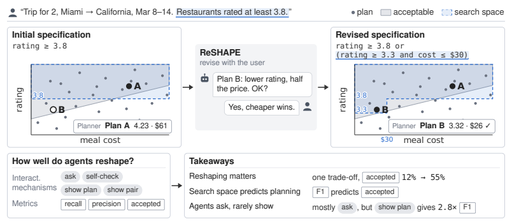
Figure 1 : ReSHAPE scores the revision step before planning.Top left:the request’s specification excludes Plan B, which the user would accept.Top:an agent revises the specification with the user, and the planner, searching the revised space, finds Plan B.Bottom left:the kinds of interaction found in agents’ logs, which we compare under a fixed feedback budget, and the metrics that score a revision: the recall and precision of its search space against the acceptable plans, and whether a fixed planner delivers an accepted plan.Bottom right:our main findings.
Original paper · CC BY 4.0 · Yilin Zhang, Xinran Zhao, Tong Chen, Ziming Yuan, Tongshuang Wu · How Should Planning Agents ReSHAPE Their Search Space? · Original paper figure · Extracted the figure area from page 2 of the original PDF.A revision is scored upstream by how its search space overlaps the acceptable plans. Recall counts how many of the acceptable plans the revision admits. Precision counts how many of the admitted plans are acceptable. F1,w combines the two into one weighted score, and it tracks the planning outcome. Downstream, a fixed planner given the revision either delivers an acceptable plan or doesn't.
Scoring at this level needs instances where revision is both necessary and possible. The authors build ReSHAPE Planter to plant a trade-off that the initial specification excludes and a reference specification adds. Within an instance, F1,w orders 87% of the pairs correctly, against 85% for precision and 71% for recall. On ReSHAPE Shopping, F1,w orders 75% of the pairs correctly with Gemini 3.6 Flash.
Under this score, a search space can stand in for running a planner.
Building instances with a planted trade-off
ReSHAPE Planter turns a planning benchmark into instances where revision is both necessary and possible, because hand-building them does not scale.
The request becomes the initial specification C0, made of a condition ci on the sacrificed attribute, a deal-breaker ck, and the stated budget cb. Writing the trade-off into C0 gives the reference specification Cref = [ci ∨ (c−i ∧ cj)] ∧ ck ∧ cb.
An instance is kept only if the trade-off passes two checks, and the first asks whether it is worth discovering. Some plan that only Cref admits must beat the best plan under C0 by at least δ. The authors kept 88 travel instances out of 102 queries and 87 shopping instances out of 97 requests. No step of this construction uses agent performance.
The simulated user turns this trade-off into a utility over complete plans, which is what makes acceptance computable. Each option is scored against the user's expectation, and each category's scores are averaged over the plan's selected options. Categories are then combined by importance, and the budget penalty π(e) is subtracted, so overspending by a tenth costs almost nothing.
The reference point is the best plan the initial specification admits, and the tolerance sits δ = 0.05 below it. A plan that violates the deal-breaker is rejected whatever its utility.
Checking the simulated user against people
The simulated user's acceptance decisions are checked against 20 human participants before any agent is scored. Each participant judged six ReSHAPE Travel instances for a described traveler. The revision was either the instance's verified trade-off or a decoy.
Under the decoy, most participants kept the plan the request admits. The simulated user matched the majority choice in 11 of the 12 scenarios and faced a tie in the last. Individual participant choices agreed with the simulated user on 76% of choices, with a 95% bootstrap interval of 66 to 85. No fixed answer can exceed 76% here, because participants disagree among themselves.
Under verified revisions and decoys, the mean difference is .52, with p=.0001. The authors fixed this analysis before collecting data, so the test was not tuned after the results came in. Agreement with the simulated user was 70% for verified revisions and 82% for decoys.
The simulated user is still a limit, because it holds a fixed utility over plans. The study checks the simulated user on a fixed set of travel scenarios, not on live interaction. Users who revise their own requests would be needed to test that case.
Does revising the specification help the planner?
The planner's outcome depends on what it is given, and the empty specification shows the failure on the other side. The two baselines fail for opposite reasons: C0 admits almost none of the acceptable plans, while the empty specification admits almost everything else.
Across the study, the reference specification lets the same planner find an acceptable plan up to 4.6 times as often as the initial one. That factor comes from the reference specification, which adds one trade-off that the initial specification leaves out. The authors also check that the planner's result, not just the search space, separates the specifications.
Search space quality tracks the planner's outcome, so a revision can be judged before any planner runs.
On ReSHAPE Shopping, the planner is Gemini 3.6 Flash, and acceptance rises from 26% under C0 to 38% under the reference specification. With GPT-6 Luna as the planner, the same comparison moves from 22% to 57%. The empty specification does worst under both planners on ReSHAPE Shopping. Under both planners, the empty specification falls below C0 on 88 instances.
The planner ranks specifications the same way across the two planners, which supports the orderings the paper relies on. The protocols show how an agent's feedback changes the specification the planner receives. A single judgment lets Exception Probing double the acceptance rate of C0, so early feedback matters most.
What makes a search space useful for the planner
The authors ask whether a measure of search space quality orders specifications correctly by the planner's acceptance within each instance. Within-instance AUC compares only pairs of specifications on the same instance, where the planner accepts exactly one of the two. Over the 14 systems and three baselines, F1,w ordered 87% of such pairs correctly.
Precision reached 85% and recall reached 71% on the same pairs. None of the variants the authors tried did reliably better than F1,w. On ReSHAPE Shopping, F1,w ordered 75% of the pairs correctly with Gemini 3.6 Flash and 84% with GPT-6 Luna.
Table 21 reports these AUCs with 95% confidence intervals under both planners. F1,w beat precision alone and recall alone reliably, but the variants that weigh precision more did not. Recall alone is the weakest signal, which fits the earlier finding that a search space must hold enough acceptable plans to matter. The authors did not find a single measure that clearly beats F1,w, so they use it as the summary of search space quality.
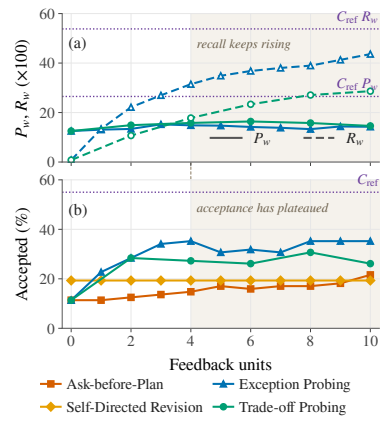
Figure 2 :(a)Precision (solid) and recall (dashed) of the probing protocols’ specifications and(b)the acceptance rate of all four protocols, after each unit of feedback. Unit 0 is C0, and Trade-off Probing spends two units per pair. In the shaded region past the fourth unit, recall keeps rising while acceptance has plateaued. Dotted lines markC ref.
Original paper · CC BY 4.0The feedback curve shows how this changes as the agent spends its budget. Exception Probing ends with a recall close to that of the reference specification but about half its precision. Its acceptance is 20 points lower than the reference specification's. Beyond the first few units, recall keeps rising while precision stays roughly flat and acceptance stops improving.
Table 4 shows the four protocols with Gemini 3.6 Flash on 88 instances. The authors read these numbers as the point where precision, not recall, decides the planner's outcome.
How off-the-shelf agents spend their feedback
Current agents admit too few acceptable plans because they spend their feedback on questions rather than on plans the user can react to. On ReSHAPE Travel, thirteen of the fourteen systems raise F1,w significantly above C0. The best one, mini-SWE-agent with Kimi K3, reaches 14.0, compared to 21.5 for the reference specification Cref. The gap lies in recall, not precision.
Most systems reach a precision of 19 to 27, close to the 26.5 of Cref. Yet they admit at most a third of the acceptable plans, compared to more than half for Cref. Current agents admit at most 32% of the acceptable plans, while the reference specification admits over 52%.
The authors trace this shortfall to where the agents spend their effort. Asking and self-checking together make up three quarters of the systems' actions. Few systems write a trade-off at all. At most 39% of any system's final specifications contain a meaningful trade-off.
The Shopping domain shows the same pattern, so the shortfall doesn't come from one domain. No system admits more than 13% of the acceptable plans on ReSHAPE Shopping. The reference specification admits 53% on the same instances. Showing plans outside the current specification recovers part of the gap. With Claude Sonnet 4.6, the gain is 11.2 points.
Showing plans versus asking
The four fixed protocols run with Gemini 3.6 Flash under the same actions and feedback budget, so differences in results come from strategy. Each agent gets a budget of 10 feedback units, and inspecting, checking, and editing the specification are free. Ask-before-Plan asks preference questions before it revises, while Self-Directed Revision checks candidate plans itself without consulting the user.
Exception Probing and Trade-off Probing are the two probing protocols, because they show the user plans outside the current specification.
Exception Probing reaches an F1 of 15.0, while Ask-before-Plan reaches 5.3 on the same 88 instances. Showing the user plans raises F1 by 9.7 points over asking with Gemini 3.6 Flash. The 95% CI for that gain runs from 5.0 to 15.0 points. With Claude Sonnet 4.6, the same comparison gives a gain of 11.2 points.
Exception Probing ends with a recall close to that of the reference specification, but its precision is about half of it. Self-Directed Revision has more than twice the recall of Ask-before-Plan, but it reaches only half the precision and an F1 of 3.5.
The agents in the logs behave like Ask-before-Plan and Self-Directed Revision, not like the probing protocols. So the recall that matters comes from letting the user react to concrete plans, not from checking plans on the user's behalf.
Limits of the evidence
The limits of these results start with the user model, which holds one fixed utility over plans. That fixed utility makes acceptance exact and lets the authors score a revision over every legal plan. The paper says its setup can't answer how revision should be measured when the target itself moves with the interaction.
Each instance plants only one trade-off, between two attributes of one option category. Whether the admit-first, select-second order holds when trade-offs interact stays open.
Search space quality is measured on the options of each instance, so a condition can score well by fitting those options. Such a condition could score as well as the user's actual trade-off, which the paper's measure doesn't separate. The authors didn't test that transfer to unseen options.
The study also has a narrower scope on presentation: the simulated user judges every plan it is shown exactly. The authors study how an agent discovers which plans the user accepts, not how a real user reasons over presented options. Presentation and its interaction with discovery are left to future work.
Paper info
- Authors
- Yilin Zhang, Xinran Zhao, Tong Chen, Ziming Yuan, Tongshuang Wu
- Venue
- arXiv · Preprint
- First published
- 2026-11-12
- Added
- 2026-11-13
- Updated
- 2026-11-12
- Version
- v1
- arXiv
- 2611.16466
- Category
- cs.AI · cs.CL
- Original paper terms
- CC BY 4.0
- What we show
- Paper info, commentary and permitted figures from the original paper
AI commentary is a separate explanation from the original paper and may contain errors. The original paper and figures follow each source's terms of use and any rights noted separately.
Abstract
Planning agents and benchmarks treat a user's initial specification as fixed. Yet the requests users write exclude plans they would gladly take, since they rarely discover the possible trade-offs they would accept until seeing the options. Agents already revise requests through interaction, but whether this helps planning is unknown. We formalize this step as the ReSHAPE task, which judges a revision by whether its search space matches the acceptable plans and a planner finds one there. Using ReSHAPE Planter, which builds instances from planning benchmarks with a human-validated simulated user, we analyze 5,800 agent-revised specifications in travel and shopping. We find that reshaping matters: one correct trade-off makes the same planner reach an acceptable plan up to 4.6x as often, and search space quality predicts what the planner finds. Current agents, however, admit at most 32% of the acceptable plans, where that trade-off alone admits over 52%, because they ask about preferences instead of showing plans; in travel, showing plans raises F1 by 9.7 points over asking, with two model families. Planning agents should thus treat a request as a hypothesis to test against the user's reactions to concrete plans to recognize user trade-offs.
Quote from the paper
Yilin Zhang, Xinran Zhao, Tong Chen, Ziming Yuan, Tongshuang Wu (2026). How Should Planning Agents ReSHAPE Their Search Space?. arXiv:2611.16466v1. https://arxiv.org/abs/2611.16466v1
BibTeX
@misc{zhang2026should,
  title = {{How Should Planning Agents ReSHAPE Their Search Space?}},
  author = {Yilin Zhang and Xinran Zhao and Tong Chen and Ziming Yuan and Tongshuang Wu},
  year = {2026},
  eprint = {2611.16466},
  archivePrefix = {arXiv},
  url = {https://arxiv.org/abs/2611.16466v1}
}